Chile Process Analytics Market Size & Growth Rate (2026-2032)
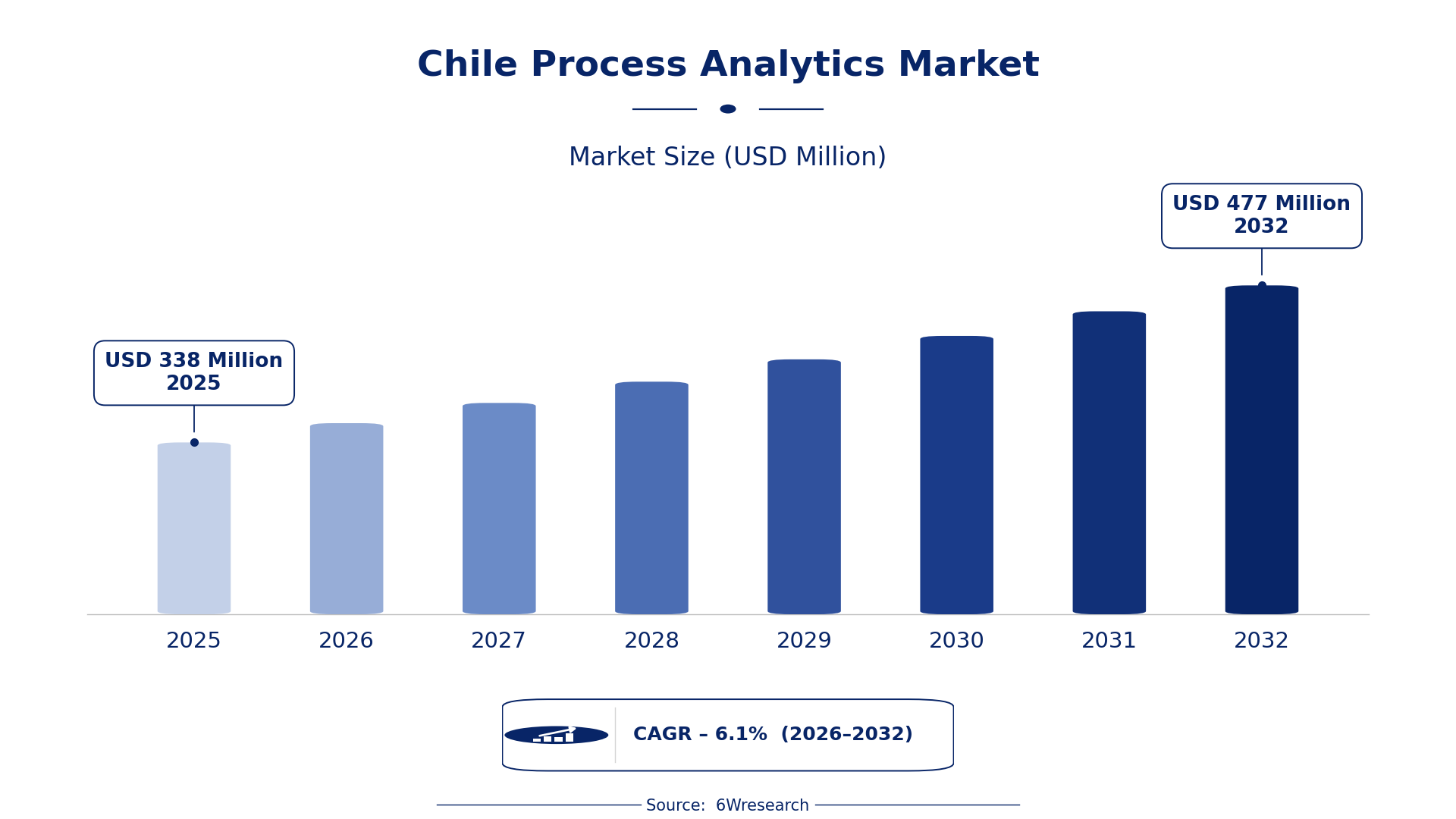
The Chile Process Analytics Market was estimated at USD 338 Million in 2025 and is projected to reach USD 477 Million by 2032, growing at a CAGR of 6.1% from 2026 to 2032.
Chile Process Analytics Market Synopsis
The Chile Process Analytics Market has seen a notable uptick in recent years, fueled by a robust adoption of advanced analytics tools across multiple sectors. Manufacturing, healthcare, and oil & gas industries are increasingly integrating these technologies, realizing their potential to enhance operational efficiency and decision-making.
Looking ahead, the market is set for continued growth as businesses increasingly recognize the necessity of data-driven insights. Government initiatives aimed at digital transformation and Industry 4.0 are expected to further stimulate investment in process analytics solutions, setting the stage for a dynamic future.
Chile Process Analytics Market Year-wise Growth Rate and Key Drivers
This graph illustrates the annual growth rates of the Chile Process Analytics Market from 2021 to 2032, highlighting a steady upward trajectory and projected expansion over the forecast period.
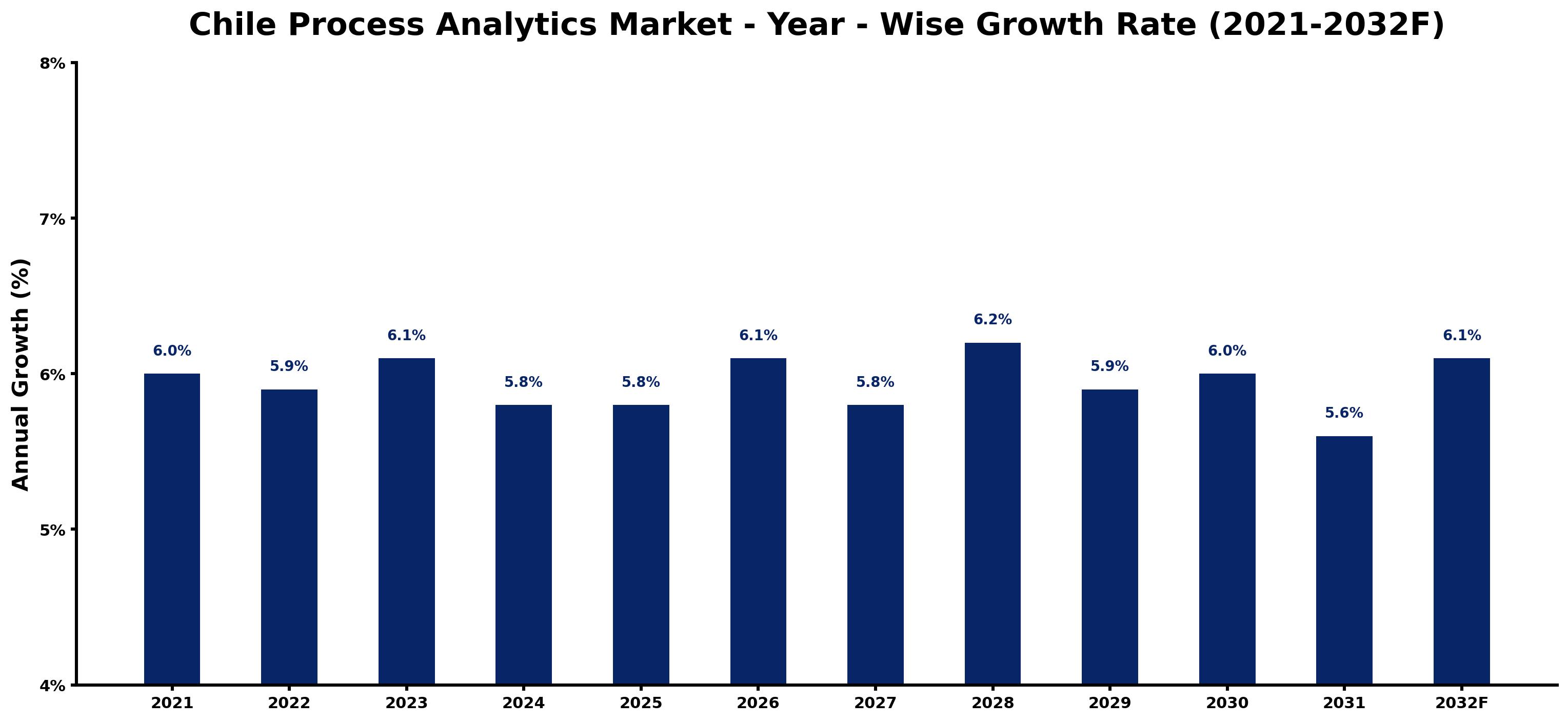
The table below presents the year‑wise growth rates along with the key drivers influencing the market
| Year | Growth Rate | Major Drivers |
| 2021 | 6.0% | Increased demand for mining data analytics solutions. |
| 2022 | 5.9% | Government push for digital transformation in mining sector. |
| 2023 | 6.1% | Growth in renewable energy projects needing process insights. |
| 2024 | 5.8% | Investment in AI technology for operational efficiency. |
| 2025 | 5.8% | Rising focus on sustainability metrics in business processes. |
| 2026 | 6.1% | Emergence of local tech startups specializing in analytics. |
| 2027 | 5.8% | Strategic partnerships enhancing process optimization capabilities. |
| 2028 | 6.2% | Digitalization initiatives within Chilean agricultural analytics. |
| 2029 | 5.9% | Enhanced regulatory frameworks fostering analytics adoption. |
| 2030 | 6.0% | Increased workforce training in data-driven decision making. |
| 2031 | 5.6% | Growth in e-commerce driving process analytics demand. |
| 2032 | 6.1% | Development of local big data infrastructure improving analytics. |
Note: Market size estimations and growth projections presented in this report are based on 6Wresearch's proprietary forecasting methodology, utilizing the latest available industry data, government publications, and primary research inputs.
Chile Process Analytics Market Key Takeaways
Below are some of the specific key takeaways from the market, including:
- The market is driven by the integration of AI and machine learning in analytics tools.
- Cloud-based solutions are becoming increasingly popular for real-time monitoring.
- There is a growing demand for predictive analytics to preempt process failures.
- Customization of analytics solutions for specific industries is a key opportunity.
- High initial costs and data privacy concerns pose challenges to adoption.
Evaluation of Restraints in Chile Process Analytics Market
The Chile Process Analytics Market is held back by several constraints that need to be addressed. A significant barrier is the limited awareness and adoption of advanced analytics technologies among small and medium enterprises. This leads to slower overall market growth, as these organizations often lack the resources to invest in sophisticated solutions. on top of that, there is a notable shortage of skilled professionals capable of implementing and managing these analytics tools, which complicates effective deployment. Integration complexities with existing systems, coupled with concerns over data security, also hinder progress. Finally, the substantial initial investment required for advanced analytics can deter organizations with tighter budgets from pursuing these opportunities.
Chile Process Analytics Market Trends
A number of trends are currently shaping the Chile Process Analytics Market. The integration of artificial intelligence and machine learning capabilities into process analytics solutions is at the forefront, enabling smarter decision-making. There’s also a noticeable shift towards cloud-based analytics, offering scalability and flexibility for real-time data processing. Predictive analytics is gaining traction as companies seek to anticipate issues before they disrupt operations. Additionally, the emphasis on regulatory compliance is driving investments in analytics tools that provide transparency and accountability.
Chile Process Analytics Market Opportunities
The opportunities within the Chile Process Analytics Market are substantial. Companies are increasingly looking for tailored analytics solutions that cater to specific industry needs, which opens the door for vendors to innovate and customize their offerings. Emerging sectors like renewable energy and e-commerce present fertile ground for analytics adoption. on top of that, there’s a strong demand for comprehensive services that encompass data integration, visualization, and predictive modeling, which can drive both business growth and competitive advantages for early adopters.
Government Initiatives in the Chile Process Analytics Market
The Chilean government has recognized the value of process analytics and has implemented various policies to support market growth. Current public-sector priorities focus on fostering innovation, encouraging research and development, and enhancing data privacy frameworks. These initiatives create a favorable environment for the expansion of process analytics technologies across industries.
- A national digital infrastructure upgrade program launched in early 2025 aims to improve connectivity and access to analytics tools.
- Currently ongoing is a government-sponsored funding initiative aimed at small and medium enterprises to encourage technology adoption.
- A regulatory framework introduced in 2025 mandates data transparency in analytics, ensuring user trust and security.
- Upcoming plans include a public-private partnership expected to expand analytics capabilities in the renewable energy sector by 2028.
Future Insights of the Chile Process Analytics Market
The Chile Process Analytics Market is set to evolve significantly between 2026 and 2032. As companies increasingly embrace digital transformation, the demand for advanced analytics will intensify. Major sectors such as manufacturing, healthcare, and energy will drive this growth, especially as regulatory pressures and the need for real-time data analysis become more pronounced. Investments in IoT and big data analytics will further catalyze the market, leading to innovative solutions that enhance efficiency and competitiveness.
Chile Process Analytics Market Latest Developments
In the past 12-14 months, the Chile Process Analytics Market has witnessed several notable developments. Companies are actively launching and refining their analytics solutions to meet growing demand, while collaborations between tech firms and industry leaders are becoming more common. This uptick in activity signals a vibrant market ready for further advancements.
- A major technology vendor unveiled a new cloud-based process analytics platform in Q1 2025, designed to enhance real-time data capabilities.
- An initiative that began in mid-2025 is currently underway, focusing on integrating AI tools into existing analytics frameworks.
- A rollout expected to begin in late 2026 will introduce new predictive analytics features aimed at the healthcare sector.
- In early 2025, a leading regional operator partnered with local universities to develop training programs for data analytics professionals.
Chile Process Analytics Market - Key Attractiveness of the Report
- 10 Years of Market Numbers
- Historical Data Starting from 2022 to 2025
- Base Year: 2025
- Forecast Data until 2032
- Key Performance Indicators Impacting the Market
- Major Upcoming Developments and Projects
Key Highlights of the Report:
- Chile Process Analytics Market Outlook
- Market Size of Chile Process Analytics Market, 2025
- Forecast of Chile Process Analytics Market, 2032
- Historical Data and Forecast of Chile Process Analytics Revenues & Volume for the Period 2022-2032F
- Chile Process Analytics Market Trend Evolution
- Chile Process Analytics Market Drivers and Challenges
- Chile Process Analytics Price Trends
- Chile Process Analytics Porter's Five Forces
- Chile Process Analytics Industry Life Cycle
- Historical Data and Forecast of Chile Process Analytics Market Revenues & Volume By Process Mining Type for the Period 2022-2032F
- Historical Data and Forecast of Chile Process Analytics Market Revenues & Volume By Process discovery for the Period 2022-2032F
- Historical Data and Forecast of Chile Process Analytics Market Revenues & Volume By Process conformance for the Period 2022-2032F
- Historical Data and Forecast of Chile Process Analytics Market Revenues & Volume By Process enhancement for the Period 2022-2032F
- Historical Data and Forecast of Chile Process Analytics Market Revenues & Volume By Deployment Type for the Period 2022-2032F
- Historical Data and Forecast of Chile Process Analytics Market Revenues & Volume By On-premises for the Period 2022-2032F
- Historical Data and Forecast of Chile Process Analytics Market Revenues & Volume By Cloud for the Period 2022-2032F
- Historical Data and Forecast of Chile Process Analytics Market Revenues & Volume By Organization Size for the Period 2022-2032F
- Historical Data and Forecast of Chile Process Analytics Market Revenues & Volume By SMEs for the Period 2022-2032F
- Historical Data and Forecast of Chile Process Analytics Market Revenues & Volume By Large enterprises for the Period 2022-2032F
- Historical Data and Forecast of Chile Process Analytics Market Revenues & Volume By Application for the Period 2022-2032F
- Historical Data and Forecast of Chile Process Analytics Market Revenues & Volume By Business process for the Period 2022-2032F
- Historical Data and Forecast of Chile Process Analytics Market Revenues & Volume By Information technology process for the Period 2022-2032F
- Historical Data and Forecast of Chile Process Analytics Market Revenues & Volume By Customer interaction for the Period 2022-2032F
- Chile Process Analytics Import Export Trade Statistics
- Market Opportunity Assessment By Process Mining Type
- Market Opportunity Assessment By Deployment Type
- Market Opportunity Assessment By Organization Size
- Market Opportunity Assessment By Application
- Chile Process Analytics Top Companies Market Share
- Chile Process Analytics Competitive Benchmarking By Technical and Operational Parameters
- Chile Process Analytics Company Profiles
- Chile Process Analytics Key Strategic Recommendations






































