Chile Refined Petroleum Products Market Size, Share & Growth Rate
The Chile Refined Petroleum Products Market was estimated at USD 570 Million in 2025 and is projected to reach USD 830 Million by 2032, growing at a CAGR of 5.5% from 2026 to 2032. This growth trajectory is primarily fueled by a robust demand for transportation fuels, driven by increased industrial activities and urbanization. Additionally, government policies aimed at sustainability are shaping consumer preferences and investment in cleaner fuel alternatives.
Chile Refined Petroleum Products Market Year-wise Growth Rate and Key Drivers
This graph highlights how the Chile Refined Petroleum Products Market has steadily grown over the years, supported by major growth factors.
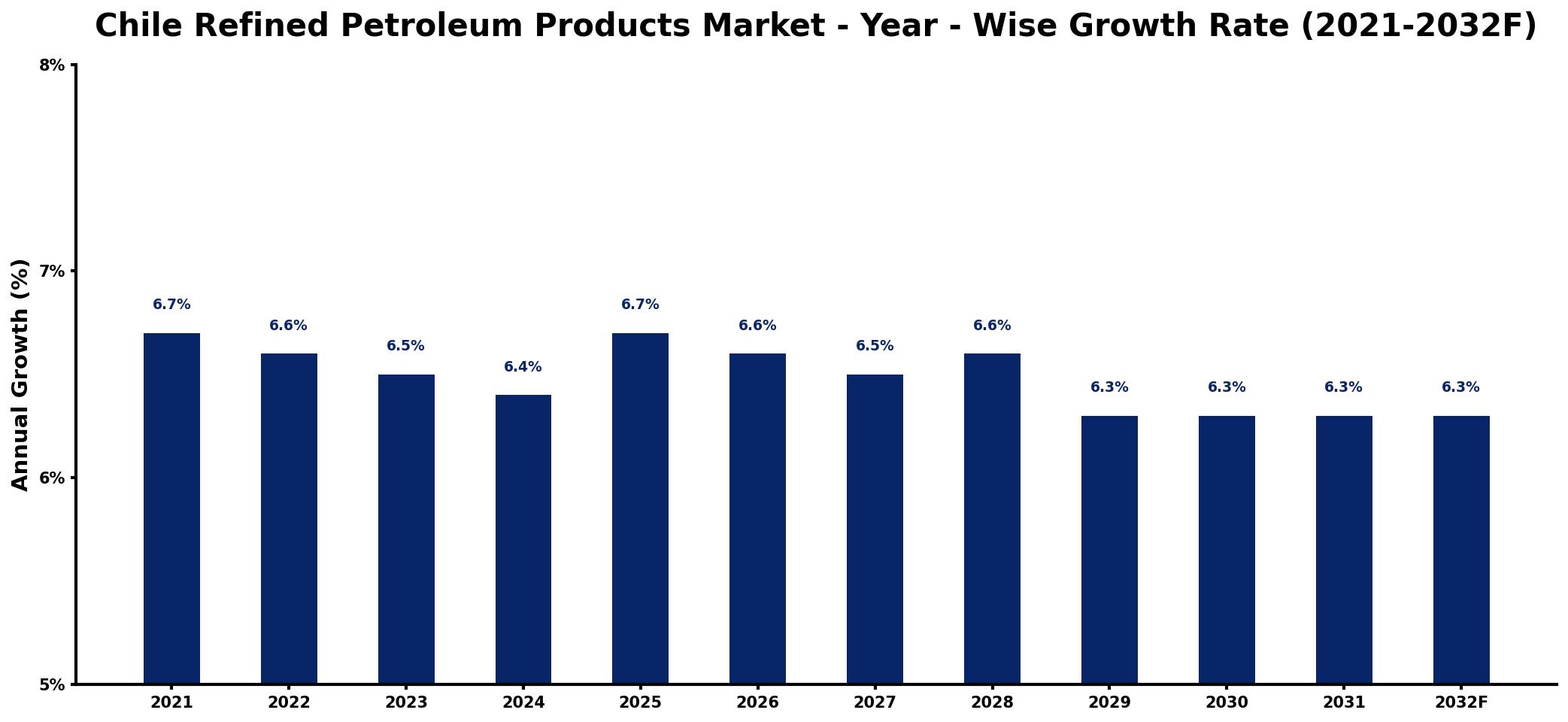
The table below presents the year‑wise growth rates along with the key drivers influencing the market
| Year | Growth Rate | Major Drivers |
| 2021 | 6.7% | Rising transportation sector demand |
| 2022 | 6.6% | Increased industrial energy consumption |
| 2023 | 6.5% | Growth in domestic production activities |
| 2024 | 6.4% | Expansion of renewable energy initiatives |
| 2025 | 6.7% | Higher consumer energy preferences |
| 2026 | 6.6% | Increased infrastructure development projects |
| 2027 | 6.5% | Boost in export market opportunities |
| 2028 | 6.6% | Growing urbanization and population |
| 2029 | 6.3% | Surge in electric vehicle adoption |
| 2030 | 6.3% | Investment in alternative energy sources |
| 2031 | 6.3% | Emerging technologies in logistics |
| 2032 | 6.3% | Enhanced regulatory support frameworks |
Note: Market size estimations and growth projections presented in this report are based on 6Wresearch's proprietary forecasting methodology, utilizing the latest available industry data, government publications, and primary research inputs.
Chile Refined Petroleum Products Market Synopsis
A notable aspect of the Chile Refined Petroleum Products Market is its dependency on imports to satisfy local demand, reflecting the nation's limited domestic oil reserves. As industrial growth accelerates, the pressure for reliable fuel supply becomes even more pronounced, compelling major oil companies to enhance their distribution networks.
As urban areas expand and transportation needs evolve, the market is undergoing transformation. The rise in infrastructure projects not only boosts consumption but also necessitates innovations in refining processes to maintain efficiency and sustainability.
Chile Refined Petroleum Products Market Key Takeaways
- Significant growth projected due to increased demand for transportation fuels and energy production.
- Shifting focus towards cleaner alternatives in response to governmental sustainability mandates.
- Infrastructure development is crucial to meet the rising needs of storage and distribution.
- Major companies dominate the landscape, influencing pricing and supply chain dynamics.
- Investment opportunities lie in the burgeoning biofuels sector and technological advancements.
Evaluation of Restraints in Chile Refined Petroleum Products Market
The primary restraint in the Chile Refined Petroleum Products Market stems from its heavy reliance on imported refined products. This dependency not only exposes the market to global price fluctuations but also geopolitical instability that can disrupt supply chains. Furthermore, regulatory frameworks that impose stringent environmental standards can increase operational costs for local refineries, impacting their competitive edge. The concentration of a few major players further limits market entry for smaller companies, thereby stifling innovation and competitive pricing.
Chile Refined Petroleum Products Market Trends
The current trends within the Chile Refined Petroleum Products Market indicate a pronounced shift towards cleaner and more sustainable fuel sources. As the global community emphasizes environmental responsibility, the demand for biofuels and renewable energy is gaining traction in Chile. Initiatives to blend biofuels in conventional gasoline and diesel underscore a commitment to reducing carbon emissions. Concurrently, advancements in refining technologies aim to improve efficiency and minimize waste, aligning the industry with international sustainability goals.
Chile Refined Petroleum Products Market Opportunities
Investment opportunities abound in the Chile refined petroleum products market, particularly in upgrading infrastructure for storage and distribution. The increasing demand for petroleum products, especially in transportation and energy sectors, presents a ripe environment for modernized facilities. Additionally, the burgeoning interest in biofuels represents a significant area for growth, as regulatory pressures encourage the development of cleaner fuels. Forming partnerships with local entities and leveraging innovative technologies can also optimize operations, driving overall market profitability.
Government Initiatives in the Chile Refined Petroleum Products Market
The Chilean government has enacted various policies aimed at regulating the Refined Petroleum Products Market. These include the Fuel Price Stabilization Fund, designed to mitigate volatility in fuel pricing by adjusting taxes based on international oil price fluctuations. Further, regulations promote the use of cleaner fuels, enforcing the integration of biofuels in conventional petroleum products. Protective import tariffs on refined products bolster local refineries, ensuring a balanced market landscape. Overall, these initiatives strive to stabilize prices, foster environmental sustainability, and support domestic refinery operations.
Future Insights of the Chile Refined Petroleum Products Market
Looking ahead to 2026-2032, the Chile Refined Petroleum Products Market is anticipated to experience robust growth fueled by ongoing economic development and industrialization. The strategic geographical position of Chile as a transport hub in South America will continue to attract investments, particularly in the energy sector. However, global oil price fluctuations and evolving environmental regulations will remain critical factors influencing market dynamics. With a focus on sustainability and technological advancements, the market is likely to transition towards a more resilient and innovative future.
Chile Refined Petroleum Products Market Latest Developments (2025 - 2026)
In recent months, the Chile Refined Petroleum Products Market has seen a surge in infrastructure investments aimed at modernizing storage and distribution capabilities. Companies are increasingly adopting advanced refining technologies to enhance operational efficiency. Additionally, collaborations between public and private sectors are gaining momentum, focusing on the development of cleaner fuel alternatives. Regulatory shifts are also on the horizon, indicating a strengthened commitment to sustainability in the oil sector.
Chile Refined Petroleum Products Market - Key Attractiveness of the Report
- 10 Years of Market Numbers
- Historical Data Starting from 2022 to 2025
- Base Year: 2025
- Forecast Data until 2032
- Key Performance Indicators Impacting the Market
- Major Upcoming Developments and Projects
Key Highlights of the Report:
- Chile Refined Petroleum Products Market Outlook
- Market Size of Chile Refined Petroleum Products Market, 2025
- Forecast of Chile Refined Petroleum Products Market, 2032
- Historical Data and Forecast of Chile Refined Petroleum Products Revenues & Volume for the Period 2022-2032F
- Chile Refined Petroleum Products Market Trend Evolution
- Chile Refined Petroleum Products Market Drivers and Challenges
- Chile Refined Petroleum Products Price Trends
- Chile Refined Petroleum Products Porter's Five Forces
- Chile Refined Petroleum Products Industry Life Cycle
- Historical Data and Forecast of Chile Refined Petroleum Products Market Revenues & Volume By Product Type for the Period 2022-2032F
- Historical Data and Forecast of Chile Refined Petroleum Products Market Revenues & Volume By Diesel for the Period 2022-2032F
- Historical Data and Forecast of Chile Refined Petroleum Products Market Revenues & Volume By Gasoline for the Period 2022-2032F
- Historical Data and Forecast of Chile Refined Petroleum Products Market Revenues & Volume By Fuel Oils for the Period 2022-2032F
- Historical Data and Forecast of Chile Refined Petroleum Products Market Revenues & Volume By Kerosene for the Period 2022-2032F
- Historical Data and Forecast of Chile Refined Petroleum Products Market Revenues & Volume By Others for the Period 2022-2032F
- Historical Data and Forecast of Chile Refined Petroleum Products Market Revenues & Volume By Application for the Period 2022-2032F
- Historical Data and Forecast of Chile Refined Petroleum Products Market Revenues & Volume By Fuel for the Period 2022-2032F
- Historical Data and Forecast of Chile Refined Petroleum Products Market Revenues & Volume By Chemical for the Period 2022-2032F
- Historical Data and Forecast of Chile Refined Petroleum Products Market Revenues & Volume By Others for the Period 2022-2032F
- Historical Data and Forecast of Chile Refined Petroleum Products Market Revenues & Volume By Fraction for the Period 2022-2032F
- Historical Data and Forecast of Chile Refined Petroleum Products Market Revenues & Volume By Light Distillates for the Period 2022-2032F
- Historical Data and Forecast of Chile Refined Petroleum Products Market Revenues & Volume By Middle Distillates for the Period 2022-2032F
- Historical Data and Forecast of Chile Refined Petroleum Products Market Revenues & Volume By Heavy Oils for the Period 2022-2032F
- Chile Refined Petroleum Products Import Export Trade Statistics
- Market Opportunity Assessment By Product Type
- Market Opportunity Assessment By Application
- Market Opportunity Assessment By Fraction
- Chile Refined Petroleum Products Top Companies Market Share
- Chile Refined Petroleum Products Competitive Benchmarking By Technical and Operational Parameters
- Chile Refined Petroleum Products Company Profiles
- Chile Refined Petroleum Products Key Strategic Recommendations






































