Chile Specialty Coffee Market Top 5 Importing Countries and Market Competition (HHI) Analysis
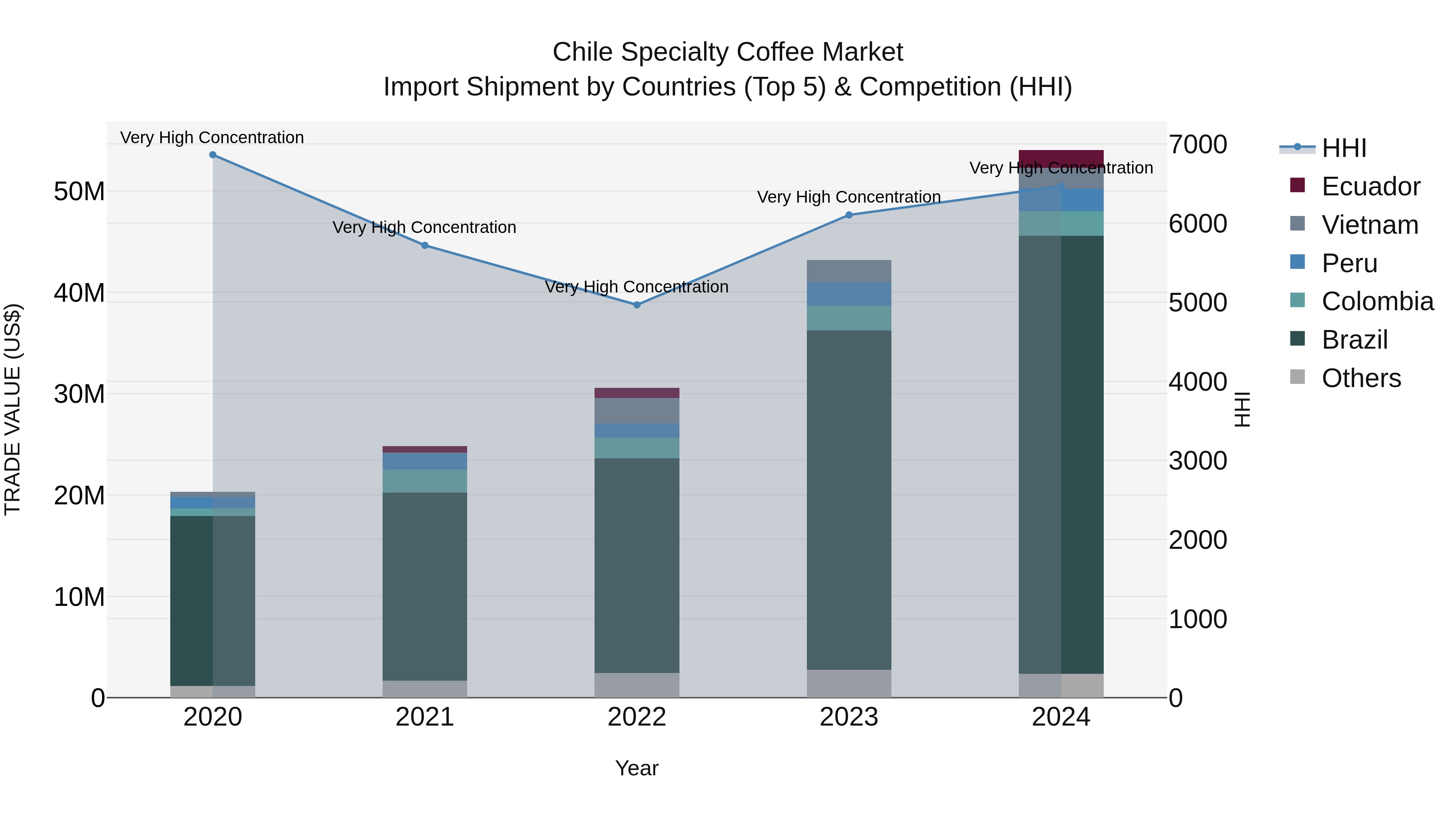
Chile`s specialty coffee import market continued to thrive in 2024, with top exporting countries including Brazil, Colombia, Peru, Vietnam, and Ecuador. The high Herfindahl-Hirschman Index (HHI) indicates a concentrated market, while the impressive compound annual growth rate (CAGR) of 27.69% from 2020 to 2024 demonstrates strong demand. The growth rate of 25.15% from 2023 to 2024 further highlights the momentum in the Chilean specialty coffee sector, positioning it as a key player in the global coffee trade.
Chile Specialty Coffee Market Growth Rate
According to 6Wresearch internal database and industry insights, the Chile Specialty Coffee Market is growing at a compound annual growth rate (CAGR) of 8.2% during the forecast period (2026-2032).
Topics Covered in the Chile Specialty Coffee Market Report
The Chile Specialty Coffee Market report thoroughly covers the market by age group, application, and distribution channels. The report provides an unbiased and detailed analysis of ongoing market trends, opportunities, high-growth areas, and market drivers, helping stakeholders devise and align their market strategies according to the current and future market dynamics.
Chile Specialty Coffee Market Highlights
| Report Name | Chile Specialty Coffee Market |
| Forecast period | 2026-2032 |
| CAGR | 8.2% |
| Growing Sector | e-commerce |
Chile Specialty Coffee Market Synopsis
The Chile Specialty Coffee Market will experience substantial growth as consumers demand high-quality premium coffee products. The market growth in Chile is driven by two factors which include rising awareness of specialty coffee and increasing café culture. The market becomes more accessible to consumers as distribution channels have expanded through online platforms and supermarkets. The demand for single-origin and artisanal coffee continues to grow particularly in urban areas.
Evaluation of Growth Drivers in the Chile Specialty Coffee Market
Below mentioned are some growth drivers and their impact on market dynamics:
| Drivers | Primary Segments Affected | Why It Matters |
| Rise in Coffee Consumption | End-user (Consumers, Retail) | Increased interest in premium, high-quality coffee is driving demand in Chile. |
| Growing Popularity of Specialty Brews | Product Types (Espresso, Cold Brew, etc.) | Increasing coffee culture in Chile has fueled demand for diverse and customized coffee options. |
| Sustainability Focus | Product Types (Organic, Fair Trade Coffee) | More and more consumer demand for ethically sourced and eco-friendly coffee products. |
| Emerging Coffee Subscriptions | Distribution Channel (Online, Retail) | More demand in coffee subscription services is enhancing convenience and accessibility. |
| Technological Innovations | Product Types (Single-origin, Blends) | Upgrades in brewing technology and sourcing methods contribute to higher-quality offerings. |
Chile Specialty Coffee Market is projected to grow significantly at a CAGR of 8.2% during the forecast period of 2026-2032. The Chile Specialty Coffee Market operates as customers increasingly demand high-quality sustainable coffee products which include organic and fair-trade coffee options. The market expansion is driven by new brewing technologies and the increasing popularity of coffee among younger people. The market growth results from two factors which include the rising popularity of online coffee subscription services and the increasing demand for home brewing equipment. The export markets which grow in Europe and the United States market do create important opportunities for the industry to develop.
Evaluation of Restraints in the Chile Specialty Coffee Market
Below mentioned are some major restraints and their influence on market dynamics:
| Restraints | Primary Segments Affected | What This Means |
| Fluctuating Coffee Bean Prices | Product Types (All Types) | Volatile prices affect profit margins and impact pricing stability for producers. |
| Limited Land for Coffee Farming | End-user (Farmers, Producers) | Reduced available land in key coffee regions limits production capacity. |
| Competition from Non-Specialty Coffee | End-user (Consumers, Retail) | The presence of lower-priced, non-specialty coffee could divert demand. |
| Weather Dependency | End-user (Farmers, Producers) | Unpredictable weather patterns affect crop yields and quality. |
| Market Saturation | Distribution Channels (Retail, Online) | Increasing competition in specialty coffee retail channels may limit growth. |
Chile Specialty Coffee Market Challenges
The Chile Specialty Coffee Market faces challenges which arise from its high production costs that result from its restricted local coffee-growing capacity. The supply chain faces challenges as of two factors which include restricted access to quality raw beans and the need to depend on imported beans. The market expansion faces obstacles from two sources which include international coffee brand competition and the increasing popularity of coffee alternatives. The specialty coffee market segment remains unaddressed as consumer understanding about specialty coffee value continues to develop.
Chile Specialty Coffee Market Trends
Some major trends contributing to the development of the Chile Specialty Coffee Market Growth include:
- Increased Focus on Single-Origin Coffee: The consumers are increasingly preferring for single-origin coffee with distinct flavor profiles due to increased demand for unique flavor profile.
- Rise of Home Brewing: The home brewing segment is expected to have consistent growth due to growing culture for specialty coffee for home brewing.
- Premiumization: The consumer of Chile are willing to pay for high quality and artisanal coffee blends due to growing spending power and demand for enhanced flavour coffee.
Investment Opportunities in the Chile Specialty Coffee Market
Here are some investment opportunities in the Chile Specialty Coffee Industry:
- Sustainable Coffee Sourcing: There is a growing demand among consumers for sustainably sourced coffee having certifications and proper labelling due to increased health awareness.
- E-commerce Platforms: The online retail platforms are expected to increase the industry growth by providing ease of accessibility and wide variety of product offerings.
- Expansion Specialty Coffee Shops: More investments can be made in the making of premium cafés offering high quality blends with aesthetically appealing ambience.
Top 5 Leading Players in the Chile Specialty Coffee Market
Here are some top companies contributing to the Chile Specialty Coffee Market Share:
1. Café Cultura
| Company Name | Café Cultura |
| Headquarters | Santiago, Chile |
| Established | 2011 |
| Website | Click Here |
Café Cultura is a pioneer in Chile’s specialty coffee movement, serving as both a high-end roastery and a training academy. The company is recognized for its direct relationships with producers across Latin America and its commitment to educating the Chilean market on coffee origins and preparation.
2. Roasters & Brewers
| Company Name | Roasters & Brewers |
| Headquarters | Santiago, Chile |
| Established | 2015 |
| Website | Click Here |
Roasters & Brewers has established itself as a major specialty player by bridging the gap between artisanal roasting and large-scale distribution. The company focuses on "micro-lots" and provides specialized equipment alongside its roasted beans.
3. 3841 Coffee Roasters
| Company Name | 3841 Coffee Roasters |
| Headquarters | Santiago, Chile |
| Established | 2016 |
| Website | Click Here |
3841 Coffee Roasters is known for its rigorous scientific approach to roasting and its award-winning baristas. The company has gained significant traction for its "experimental" series, featuring unique fermentation processes and rare bean varieties.
4. Café Triciclo
| Company Name | Café Triciclo |
| Headquarters | Santiago, Chile |
| Established | 2013 |
| Website | Click Here |
Starting as a mobile coffee cart, Café Triciclo evolved into a prominent roastery and cafe brand under its roasting arm, 3 Ciclos. It is widely credited with bringing specialty coffee culture to popular neighborhoods like Barrio Italia.
5. We Are Four Coffee Roasters (WR4)
| Company Name | We Are Four Coffee Roasters (WR4) |
| Headquarters | Santiago, Chile |
| Established | 2016 |
| Website | Click Here |
We Are Four (WR4) is a highly influential specialty roastery known for its minimalist branding and exceptional consistency. They focus heavily on transparency and traceability, providing detailed information about the altitude, variety, and farmer for every bag sold.
Government Initiatives in the Chile Specialty Coffee Market
According to the Chilean government data, the organization supports the coffee industry by implementing the Chile Exporta program, which helps local coffee producers access international markets. The organization supports sustainable coffee production through its Fair Trade and Organic certification programs, which meet the international market demand for ethically produced goods. The government provides support to small-scale coffee farmers through subsidies and technical assistance programs, which help them produce higher quality products.
Future Insights of the Chile Specialty Coffee Market
The Chile Specialty Coffee Market will grow at a constant rate as more people want to drink high-quality sustainable and premium coffee. The market will keep growing as coffee production methods have improved, café culture has developed and more people want to drink specialty coffee at home. Established brands and new companies will find new growth opportunities through e-commerce platforms and new coffee-related product developments. The market will be shaped by the ongoing demand for coffee that is both ethically sourced and environmentally sustainable.
Market Segmentation Analysis
The report offers a comprehensive study of the subsequent market segments and their leading categories.
18-24 to Dominate the Market – By Age Group
According to Guneet Kaur, Senior Research Analyst at 6Wresearch, the 18-24 age group dominates the Chile Specialty Coffee Market as younger consumers are increasingly adopting specialty coffee due to rising disposable incomes and a growing coffee culture. This demographic actively seeks premium coffee experiences and diverse brewing options.
Home Brewing to Dominate the Market – By Application Outlook
Home brewing is leading the market by application segment. As consumers wants convenience and personalized coffee experiences from the comfort of their homes. Also, the demand for home-brewing coffee equipment and specialty beans is growing rapidly. This trend is fueled by the growing interest in coffee culture and the need for higher-quality coffee at home.
Online to Dominate the Market – By Distribution Channel
Online sales is leading the market by distribution channel. This is due to the increasing numbers of consumers preferring the convenience and variety of online coffee shopping. E-commerce platforms provide easy access to specialty coffee brands driving this fast-growing segment.
Key Attractiveness of the Report
- 10 Years Market Numbers
- Historical Data Starting from 2022 to 2025
- Base Year: 2025
- Forecast Data until 2032
- Key Performance Indicators Impacting the Market
- Major Upcoming Developments and Projects
Key Highlights of the Report:
- Chile Specialty Coffee Market Outlook
- Market Size of Chile Specialty Coffee Market, 2025
- Forecast of Chile Specialty Coffee Market, 2032
- Historical Data and Forecast of Chile Specialty Coffee Revenues & Volume for the Period 2022 - 2032
- Chile Specialty Coffee Market Trend Evolution
- Chile Specialty Coffee Market Drivers and Challenges
- Chile Specialty Coffee Price Trends
- Chile Specialty Coffee Porter's Five Forces
- Chile Specialty Coffee Industry Life Cycle
- Historical Data and Forecast of Chile Specialty Coffee Market Revenues & Volume By Age Group for the Period 2022 - 2032
- Historical Data and Forecast of Chile Specialty Coffee Market Revenues & Volume By 18-24 for the Period 2022 - 2032
- Historical Data and Forecast of Chile Specialty Coffee Market Revenues & Volume By 25-39 for the Period 2022 - 2032
- Historical Data and Forecast of Chile Specialty Coffee Market Revenues & Volume By 40-59 for the Period 2022 - 2032
- Historical Data and Forecast of Chile Specialty Coffee Market Revenues & Volume By Above 60 for the Period 2022 - 2032
- Historical Data and Forecast of Chile Specialty Coffee Market Revenues & Volume By Application Outlook for the Period 2022 - 2032
- Historical Data and Forecast of Chile Specialty Coffee Market Revenues & Volume By Home for the Period 2022 - 2032
- Historical Data and Forecast of Chile Specialty Coffee Market Revenues & Volume By Commercial for the Period 2022 - 2032
- Historical Data and Forecast of Chile Specialty Coffee Market Revenues & Volume By Distribution Channel for the Period 2022 - 2032
- Historical Data and Forecast of Chile Specialty Coffee Market Revenues & Volume By Supermarkets/Hypermarkets for the Period 2022 - 2032
- Historical Data and Forecast of Chile Specialty Coffee Market Revenues & Volume By Convenience stores for the Period 2022 - 2032
- Historical Data and Forecast of Chile Specialty Coffee Market Revenues & Volume By Online for the Period 2022 - 2032
- Chile Specialty Coffee Import Export Trade Statistics
- Market Opportunity Assessment By Age Group
- Market Opportunity Assessment By Application Outlook
- Market Opportunity Assessment By Distribution Channel
- Chile Specialty Coffee Top Companies Market Share
- Chile Specialty Coffee Competitive Benchmarking By Technical and Operational Parameters
- Chile Specialty Coffee Company Profiles
- Chile Specialty Coffee Key Strategic Recommendations






































