Chile Toys and Games Market Size, Share & Growth Rate
The Chile Toys and Games Market was estimated at USD 477 Million in 2025 and is projected to reach USD 634 Million by 2032, growing at a CAGR of 4.1% from 2026 to 2032. This upward trajectory is fueled by rising disposable incomes and an increasing inclination among parents towards educational and interactive toys. The shift in consumer preferences towards sustainability and eco-friendly options further underscores the market's potential, driving innovation and expansion.
Chile Toys and Games Market Year-wise Growth Rate and Key Drivers
This graph highlights how the Chile Toys and Games Market has steadily grown over the years, supported by major growth factors.
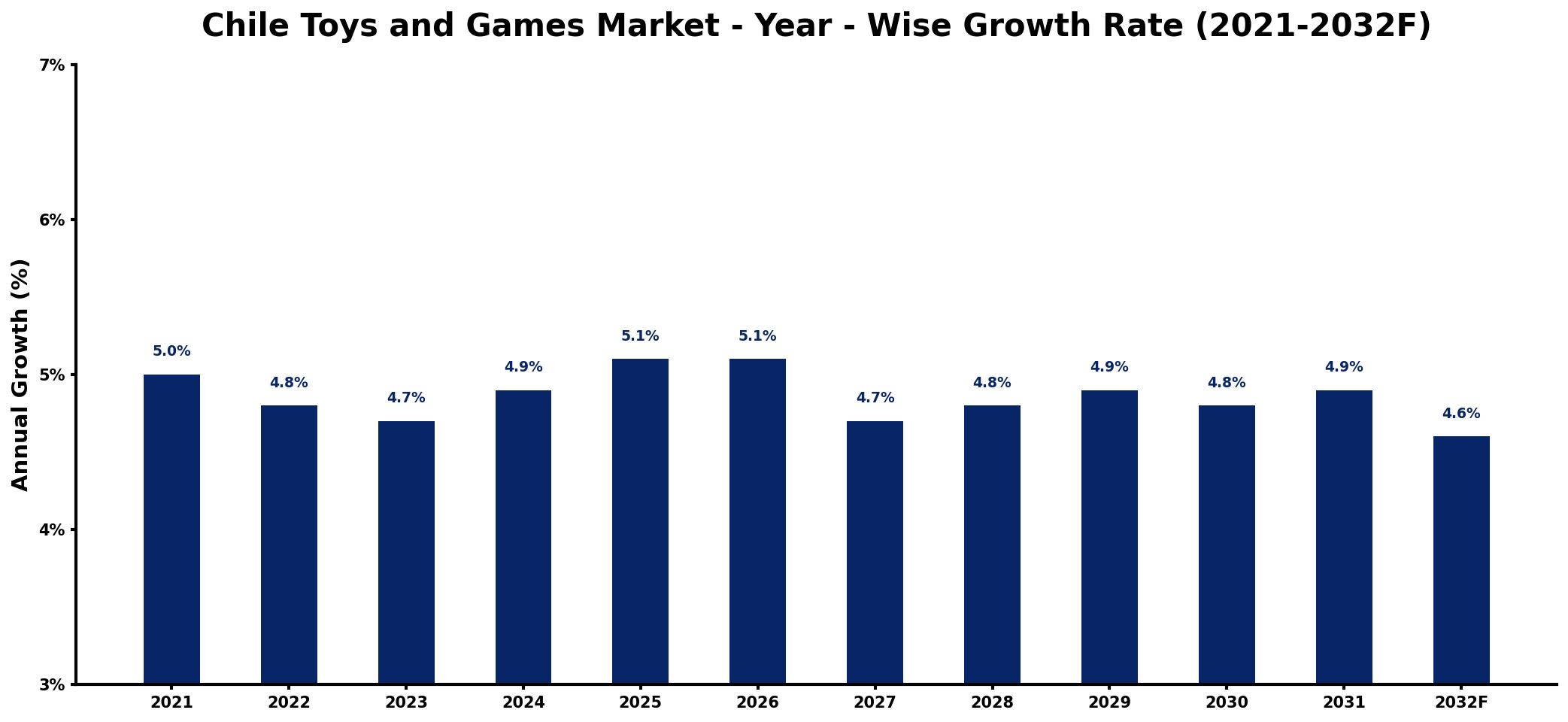
The table below presents the year‑wise growth rates along with the key drivers influencing the market
| Year | Growth Rate | Major Drivers |
| 2021 | 5.0% | Increased consumer spending on leisure |
| 2022 | 4.8% | Growing popularity of educational products |
| 2023 | 4.7% | Rise in online retail platforms |
| 2024 | 4.9% | Expansion of local manufacturing capabilities |
| 2025 | 5.1% | Higher disposable income among families |
| 2026 | 5.1% | Investment in innovative product designs |
| 2027 | 4.7% | Strengthening of marketing strategies |
| 2028 | 4.8% | Emergence of eco-friendly alternatives |
| 2029 | 4.9% | Adoption of digital engagement tools |
| 2030 | 4.8% | Collaboration with entertainment franchises |
| 2031 | 4.9% | Diversification of distribution channels |
| 2032 | 4.6% | Increased focus on experiential offerings |
Note: Market size estimations and growth projections presented in this report are based on 6Wresearch's proprietary forecasting methodology, utilizing the latest available industry data, government publications, and primary research inputs.
Chile Toys and Games Market Synopsis
The Chilean Toys and Games Market has seen robust momentum recently, largely due to the growing middle class and enhanced spending capacity of families. However, as we look ahead, the landscape is evolving with more emphasis on educational value and eco-sustainability, reflecting broader global trends.
Moving forward, the market is poised for transformation, with increased competition from both domestic and international brands. Key players are adapting their offerings to meet the nuanced preferences of Chilean consumers, particularly in the realm of technology-enhanced toys and sustainable products.
Chile Toys and Games Market Key Takeaways
- The market is projected to grow steadily, driven by rising disposable incomes and shifting consumer preferences.
- There is a notable demand for educational and STEM-focused toys, reflecting parental priorities on cognitive development.
- Sustainability trends are influencing purchasing decisions, with eco-friendly toys gaining traction.
- E-commerce platforms are becoming increasingly significant as consumers seek convenience and variety.
- Licensing agreements with popular franchises continue to provide momentum for toy sales.
Evaluation of Restraints in Chile Toys and Games Market
Despite its growth prospects, the Chile Toys and Games Market faces several significant restraints. Intense competition from international brands creates pressure on pricing and market share for local companies. Fluctuations in the exchange rate can further complicate profit margins, particularly for imports. Regulatory requirements for safety standards, while essential for consumer protection, can impose additional costs and complexity for manufacturers. As the market becomes more dynamic, continuous innovation and adaptation are necessary to meet the evolving expectations of consumers.
Chile Toys and Games Market Trends
Key trends shaping the Chile Toys and Games Market include a surge in demand for educational toys that promote STEM learning and cognitive development. Simultaneously, there is a growing inclination towards eco-friendly toys as consumers become increasingly aware of environmental issues. Furthermore, the rise of digital gaming and online platforms is reshaping how children interact with toys, pushing traditional retailers to innovate and adapt their strategies to stay relevant.
Chile Toys and Games Market Opportunities
Investment opportunities in the Chilean Toys and Games Market are particularly promising in the educational toys segment. The ongoing focus on children's development opens doors for innovative educational products that blend fun with learning. Additionally, the burgeoning digital gaming sector presents a significant growth avenue, with potential collaborations with local game developers poised to capitalize on the increasing popularity of mobile and video games.
Government Initiatives in the Chile Toys and Games Market
The Chilean government plays a vital role in regulating the toys and games market to ensure consumer safety and promote fair competition. Regulatory bodies such as the National Consumer Service (SERNAC) oversee product safety standards and labeling requirements, providing a framework that protects children and their families. Moreover, initiatives from the Ministry of Economy, Development, and Tourism aim to enhance innovation and competitiveness within the industry, supporting local enterprises and fostering a thriving market environment.
Future Insights of the Chile Toys and Games Market
The Chile Toys and Games Market is set for sustained growth through 2032, driven by increasing disposable incomes and a burgeoning interest in educational and technology-driven toys. As the market expands, it is likely to witness a shift towards more innovative and interactive offerings, particularly in digital gaming. The rising consumer focus on sustainability and child safety will also play a critical role in shaping product development and market strategies, making this an exciting time for stakeholders in the industry.
Chile Toys and Games Market Latest Developments (2025 - 2026)
In the recent months, the Chile Toys and Games Market has shown notable shifts towards enhanced digital engagement and e-commerce solutions. Companies are increasingly investing in online sales platforms to meet consumer demand for convenience and a broader selection of products. Additionally, there's a marked increase in collaborations focused on sustainable toy production, responding to consumer calls for more eco-conscious options. These developments point to a market that is actively evolving to meet the changing landscape of consumer preferences.
Chile Toys and Games Market - Key Attractiveness of the Report
- 10 Years of Market Numbers
- Historical Data Starting from 2022 to 2025
- Base Year: 2025
- Forecast Data until 2032
- Key Performance Indicators Impacting the Market
- Major Upcoming Developments and Projects
Key Highlights of the Report:
- Chile ToysandGames Market Outlook
- Market Size of Chile ToysandGames Market, 2025
- Forecast of Chile ToysandGames Market, 2032
- Historical Data and Forecast of Chile ToysandGames Revenues & Volume for the Period 2022-2032F
- Chile ToysandGames Market Trend Evolution
- Chile ToysandGames Market Drivers and Challenges
- Chile ToysandGames Price Trends
- Chile ToysandGames Porter's Five Forces
- Chile ToysandGames Industry Life Cycle
- Historical Data and Forecast of Chile ToysandGames Market Revenues & Volume By Product Type for the Period 2022-2032F
- Historical Data and Forecast of Chile ToysandGames Market Revenues & Volume By Games and Puzzles for the Period 2022-2032F
- Historical Data and Forecast of Chile ToysandGames Market Revenues & Volume By Video Games for the Period 2022-2032F
- Historical Data and Forecast of Chile ToysandGames Market Revenues & Volume By Construction Toys for the Period 2022-2032F
- Historical Data and Forecast of Chile ToysandGames Market Revenues & Volume By Dolls and Accessories for the Period 2022-2032F
- Historical Data and Forecast of Chile ToysandGames Market Revenues & Volume By Outdoor and Sports Toys for the Period 2022-2032F
- Historical Data and Forecast of Chile ToysandGames Market Revenues & Volume By Other for the Period 2022-2032F
- Historical Data and Forecast of Chile ToysandGames Market Revenues & Volume By Distribution Channel for the Period 2022-2032F
- Historical Data and Forecast of Chile ToysandGames Market Revenues & Volume By Online Channel for the Period 2022-2032F
- Historical Data and Forecast of Chile ToysandGames Market Revenues & Volume By Offline Channel for the Period 2022-2032F
- Chile ToysandGames Import Export Trade Statistics
- Market Opportunity Assessment By Product Type
- Market Opportunity Assessment By Distribution Channel
- Chile ToysandGames Top Companies Market Share
- Chile ToysandGames Competitive Benchmarking By Technical and Operational Parameters
- Chile ToysandGames Company Profiles
- Chile ToysandGames Key Strategic Recommendations






































