China Aerosol Market Size, Share & Growth Rate
The China Aerosol Market was estimated at USD 136 Million in 2025 and is projected to reach USD 156 Million by 2032, growing at a CAGR of 2.0% from 2026 to 2032. This growth trajectory is significantly fueled by the increasing consumer preference for convenient and easy-to-use products across diverse sectors such as personal care and household cleaning. Urbanization and rising disposable incomes further enhance the market's potential, as more consumers seek innovative aerosol solutions in their daily lives.
China Aerosol Market Year-wise Growth Rate and Key Drivers
This graph highlights how the China Aerosol Market has steadily grown over the years, supported by major growth factors.
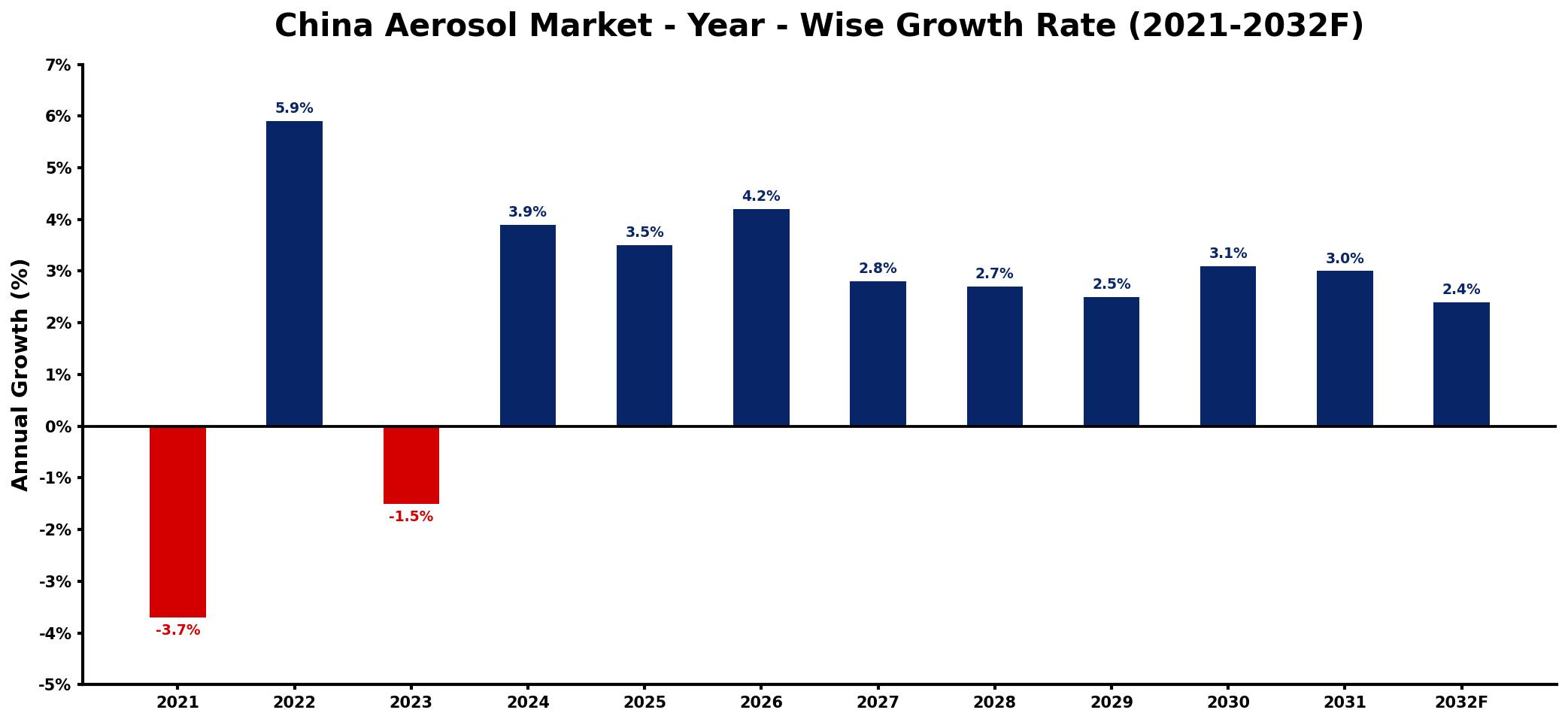
The table below presents the year‑wise growth rates along with the key drivers influencing the market
| Year | Growth Rate | Major Drivers |
| 2021 | -3.7% | decrease in consumer spending |
| 2022 | 5.9% | increased environmental regulations compliance |
| 2023 | -1.5% | decline in manufacturing output |
| 2024 | 3.9% | growth in home care applications |
| 2025 | 3.5% | rise in personal care sector |
| 2026 | 4.2% | expansion of industrial applications |
| 2027 | 2.8% | increased demand for packaging solutions |
| 2028 | 2.7% | enhanced product quality standards |
| 2029 | 2.5% | rising end-use demand growth |
| 2030 | 3.1% | expansion in e-commerce channels |
| 2031 | 3.0% | rising infrastructure development spending |
| 2032 | 2.4% | increase in retail distribution networks |
Note: Market size estimations and growth projections presented in this report are based on 6Wresearch's proprietary forecasting methodology, utilizing the latest available industry data, government publications, and primary research inputs.
China Aerosol Market Synopsis
The strongest force currently shaping the China Aerosol Market is the shifting consumer mindset towards convenience and sustainability. As lifestyles evolve, aerosol products offer the ease of use that modern consumers crave, with categories ranging from personal care items to household cleaners witnessing significant demand.
Additionally, growing environmental awareness is influencing product development. Manufacturers are increasingly focusing on eco-friendly aerosols, tapping into the rising consumer preference for sustainable options that minimize environmental impact.
China Aerosol Market Key Takeaways
- The market is poised for growth driven by urbanization, changing consumer lifestyles, and rising disposable incomes.
- Eco-friendly and sustainable aerosol products are emerging as a key trend, aligning with consumer preferences for environmentally conscious options.
- The personal care and household products segments are particularly thriving due to the increasing demand for convenience.
- Regulatory challenges regarding environmental standards are prompting innovation in eco-friendly aerosol technologies.
- The Chinese government's support for sustainable practices in manufacturing is influencing market dynamics positively.
Evaluation of Restraints in China Aerosol Market
Despite promising growth, the China Aerosol Market faces notable restraints. Regulatory frameworks concerning volatile organic compounds (VOCs) in aerosol products impose restrictions that can limit product formulation and innovation. Furthermore, competition from alternative packaging formats, such as pump sprays and refillable containers, presents significant challenges for aerosol products. Companies must navigate these complexities while striving to maintain compliance with evolving safety and environmental regulations, ensuring they can meet consumer demand without compromising on sustainability.
China Aerosol Market Trends
Current trends indicate a robust shift towards sustainable packaging and product formulations within the aerosol sector. As consumers become increasingly aware of their environmental footprint, the demand for products featuring recyclable packaging and eco-friendly propellants continues to rise. Additionally, personal care items, such as deodorants and hair sprays, are seeing heightened popularity due to their convenience and effectiveness. The growing urban population further amplifies the demand for innovative aerosol solutions that align with fast-paced lifestyles.
China Aerosol Market Opportunities
Significant investment opportunities exist in the China Aerosol Market, particularly in personal care and household cleaning segments. As the middle class continues to expand, there is an increasing emphasis on grooming and hygiene, driving the consumption of aerosol products. Moreover, businesses can capitalize on the demand for innovative, sustainable technologies that cater to environmentally conscious consumers, ensuring they remain competitive as market dynamics evolve.
Government Initiatives in the China Aerosol Market
The Chinese government has implemented a variety of policies to enhance environmental protection and safety within the aerosol market. These initiatives include regulations aimed at controlling the use of VOCs to reduce air pollution, guidelines for safe aerosol can handling and disposal, and product labeling standards that promote transparency regarding ingredients. Additionally, the government encourages manufacturers to invest in research and development of sustainable aerosol technologies, fostering a more environmentally conscious market landscape.
Future Insights of the China Aerosol Market
Looking ahead to 2026-2032, the China Aerosol Market is expected to continue its upward trajectory. Factors such as increasing consumer awareness around hygiene and convenience will sustain demand for aerosol products. Innovations in formulation and packaging will likely result in more effective and sustainable solutions. While challenges related to regulatory compliance and competition from alternative formats exist, the overall market outlook remains promising as companies adapt to evolving consumer preferences and environmental considerations.
China Aerosol Market Latest Developments (2025 - 2026)
Recent developments in the China Aerosol Market highlight a growing emphasis on sustainability and innovation. Companies are increasingly launching eco-friendly product lines, responding to consumer demand for greener options. Collaborations among manufacturers and research institutions are also on the rise, focusing on developing advanced aerosol technologies that align with the latest environmental standards. The landscape continues to evolve rapidly, reflecting the dynamic nature of consumer preferences and regulatory frameworks.
China Aerosol Market - Key Attractiveness of the Report
- 10 Years of Market Numbers
- Historical Data Starting from 2022 to 2025
- Base Year: 2025
- Forecast Data until 2032
- Key Performance Indicators Impacting the Market
- Major Upcoming Developments and Projects
Key Highlights of the Report:
- China Aerosol Market Outlook
- Market Size of China Aerosol Market, 2025
- Forecast of China Aerosol Market, 2032
- Historical Data and Forecast of China Aerosol Revenues & Volume for the Period 2022-2032F
- China Aerosol Market Trend Evolution
- China Aerosol Market Drivers and Challenges
- China Aerosol Price Trends
- China Aerosol Porter's Five Forces
- China Aerosol Industry Life Cycle
- Historical Data and Forecast of China Aerosol Market Revenues & Volume By Material for the Period 2022-2032F
- Historical Data and Forecast of China Aerosol Market Revenues & Volume By Steel for the Period 2022-2032F
- Historical Data and Forecast of China Aerosol Market Revenues & Volume By Aluminum for the Period 2022-2032F
- Historical Data and Forecast of China Aerosol Market Revenues & Volume By Others for the Period 2022-2032F
- Historical Data and Forecast of China Aerosol Market Revenues & Volume By Type for the Period 2022-2032F
- Historical Data and Forecast of China Aerosol Market Revenues & Volume By Bag-In-Valve for the Period 2022-2032F
- Historical Data and Forecast of China Aerosol Market Revenues & Volume By Standard for the Period 2022-2032F
- Historical Data and Forecast of China Aerosol Market Revenues & Volume By Application for the Period 2022-2032F
- Historical Data and Forecast of China Aerosol Market Revenues & Volume By Personal Care for the Period 2022-2032F
- Historical Data and Forecast of China Aerosol Market Revenues & Volume By Household for the Period 2022-2032F
- Historical Data and Forecast of China Aerosol Market Revenues & Volume By Automotive & Industrial for the Period 2022-2032F
- Historical Data and Forecast of China Aerosol Market Revenues & Volume By Food for the Period 2022-2032F
- Historical Data and Forecast of China Aerosol Market Revenues & Volume By Paints for the Period 2022-2032F
- Historical Data and Forecast of China Aerosol Market Revenues & Volume By Medical for the Period 2022-2032F
- Historical Data and Forecast of China Aerosol Market Revenues & Volume By Others for the Period 2022-2032F
- China Aerosol Import Export Trade Statistics
- Market Opportunity Assessment By Material
- Market Opportunity Assessment By Type
- Market Opportunity Assessment By Application
- China Aerosol Top Companies Market Share
- China Aerosol Competitive Benchmarking By Technical and Operational Parameters
- China Aerosol Company Profiles
- China Aerosol Key Strategic Recommendations






































