China Application Modernization Services Market Size & Growth Rate (2026-2032)
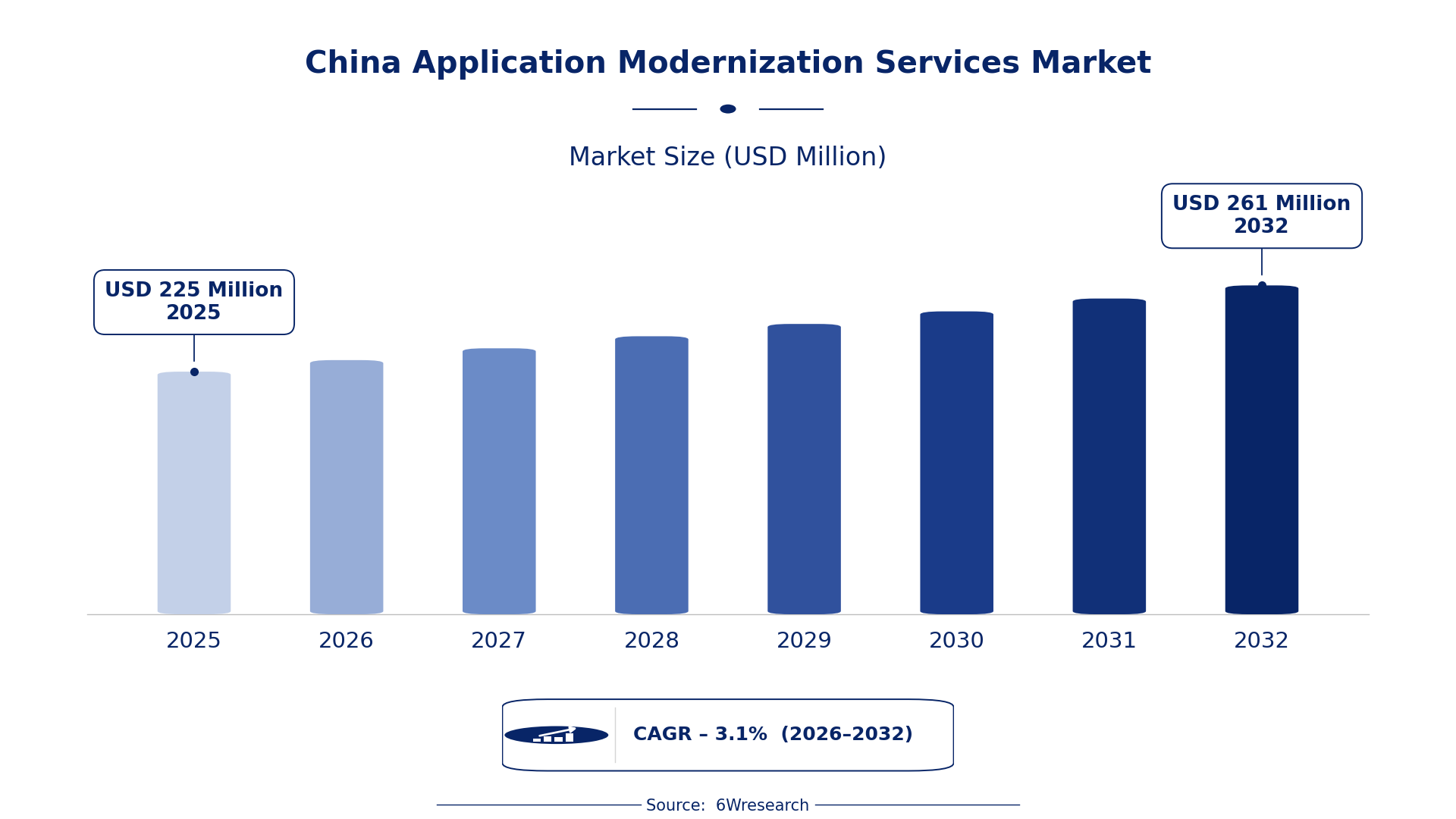
The China Application Modernization Services Market was estimated at USD 225 Million in 2025 and is projected to reach USD 261 Million by 2032, growing at a CAGR of 3.1% from 2026 to 2032.
China Application Modernization Services Market Synopsis
The growing demand for digital transformation in China is propelling enterprises to rethink their legacy systems. With competition intensifying across sectors, businesses are increasingly prioritizing modernization strategies that enhance operational efficiency and customer engagement.
Firms are now adopting a variety of modernization approaches, such as re-platforming and re-engineering, to address the shortcomings of outdated applications. This shift not only fosters innovation but also helps organizations remain agile in a rapidly changing market environment.
China Application Modernization Services Market Year-wise Growth Rate and Key Drivers
This graph illustrates the annual growth rates of the China Application Modernization Services Market from 2021 to 2032, highlighting a steady upward trajectory and projected expansion over the forecast period.
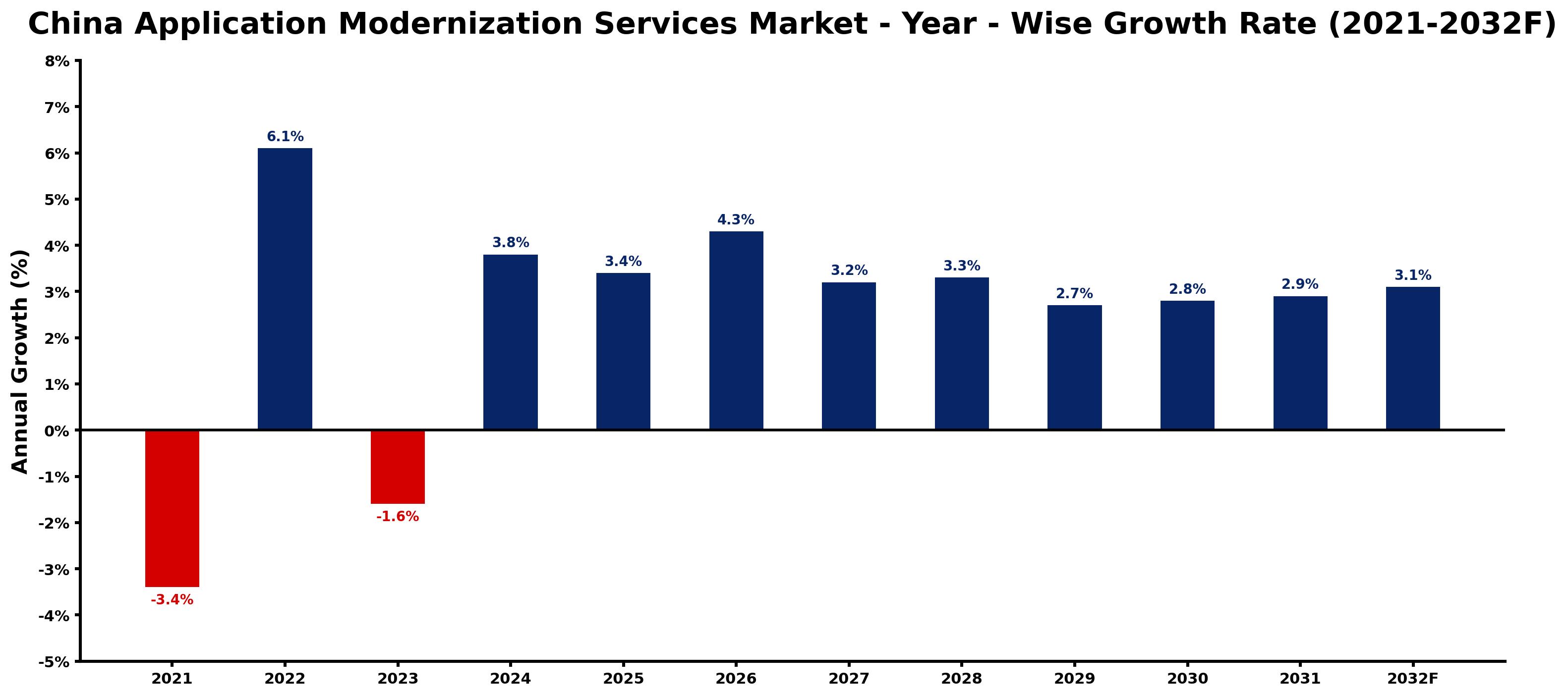
The table below presents the year‑wise growth rates along with the key drivers influencing the market
| Year | Growth Rate | Major Drivers |
| 2021 | -3.4% | Zero Covid policy limited IT investment growth. |
| 2022 | 6.1% | China's digital economy growth spurs demand for modernization. |
| 2023 | -1.6% | Stagnant demand from state-owned enterprise modernization initiatives. |
| 2024 | 3.8% | Government's 'Cloud Computing Development Three-Year Action Plan'. |
| 2025 | 3.4% | Rise in local businesses embracing agile application practices. |
| 2026 | 4.3% | Increased investments in AI-driven software solutions. |
| 2027 | 3.2% | Growing cybersecurity regulations boost application upgrade needs. |
| 2028 | 3.3% | E-commerce expansion necessitates enhanced application frameworks. |
| 2029 | 2.7% | Shift towards hybrid cloud models increases modernization efforts. |
| 2030 | 2.8% | Local tech firms prioritize legacy system transformations. |
| 2031 | 2.9% | Increased competition drives app efficiency and innovation demands. |
| 2032 | 3.1% | Rising remote working trends require adaptable application services. |
Note: Market size estimations and growth projections presented in this report are based on 6Wresearch's proprietary forecasting methodology, utilizing the latest available industry data, government publications, and primary research inputs.
China Application Modernization Services Market Key Takeaways
Below are some of the specific key takeaways from the market, including:
- Enterprises are increasingly investing in cloud-based platforms to enhance scalability and flexibility.
- The adoption of agile methodologies is on the rise, facilitating quicker deployment cycles.
- AI and IoT integrations are becoming critical for intelligent automation in modernization efforts.
- Competition is heating up, with numerous domestic and international players aiming for market share.
- Data security and regulatory compliance remain top concerns as businesses navigate modernization projects.
Evaluation of Restraints in China Application Modernization Services Market
Despite the promising growth potential, several restraints are impacting the China Application Modernization Services Market. The rapid pace of technological change necessitates that service providers continually update their skills and offerings to remain competitive. on top of that, clients increasingly demand tailored solutions to meet their specific business needs, which adds complexity to implementation processes. The market's competitive nature, coupled with data security concerns and stringent regulatory compliance, further complicates the landscape for modernization services.
China Application Modernization Services Market Trends
A noticeable trend in the China Application Modernization Services Market is the shift towards cloud-native applications. This transition allows businesses to leverage the advantages of cloud computing, such as enhanced accessibility and reduced costs. Additionally, the rise of DevOps practices is accelerating deployment cycles, enabling companies to respond swiftly to market demands. The integration of machine learning for intelligent automation is also gaining traction, helping organizations optimize processes and enhance decision-making.
China Application Modernization Services Market Opportunities
The market is ripe with opportunities for service providers specializing in legacy system transformation. As more organizations embark on digitalization journeys, the demand for modernization solutions is expected to skyrocket. Companies focusing on cloud migration, re-platforming, and software reengineering are particularly well-positioned to capitalize on this growing need. By aligning their offerings with the evolving requirements of Chinese businesses, investors can tap into the lucrative potential of this market.
Government Initiatives in the China Application Modernization Services Market
Government policy plays a significant role in shaping the dynamics of the China Application Modernization Services Market. With initiatives aimed at bolstering digital transformation across sectors, the government is creating a conducive environment for modernization services. Policies promoting the adoption of advanced technologies emphasize enhancing operational efficiencies, making it essential for businesses to align with these objectives.
- A recently completed initiative included a national digital infrastructure upgrade program focused on modernizing IT systems across various industries.
- Currently ongoing is the "Internet Plus" strategy, promoting the integration of internet technologies in traditional sectors to drive efficiency.
- A planned public-private partnership aims to enhance cloud computing capabilities nationwide, expected to roll out in the coming years.
- The "Made in China 2025" strategy is emphasizing the importance of technological innovation, guiding enterprises towards modernization.
- Incentives and subsidies for companies investing in upgrading IT infrastructure are currently being offered to accelerate digital adoption.
Future Insights of the China Application Modernization Services Market
Looking ahead to 2026-2032, the China Application Modernization Services Market is set for considerable expansion. The demand for modernization services will be driven by the increasing prevalence of cloud technologies and the ongoing need for businesses to update legacy systems. on top of that, as digital transformation becomes a priority for enterprises, service providers will likely diversify their offerings to include comprehensive modernization solutions. The combination of government support and market demand will create a fertile ground for growth in this sector.
China Application Modernization Services Market Latest Developments
In recent months, the China Application Modernization Services Market has witnessed notable activity, signaling a vibrant environment for innovation and investment. Companies are increasingly focusing on partnerships and technology advancements to meet the growing demand for modernization solutions.
- A major technology vendor launched a new cloud migration service in Q1 2025, aimed at assisting enterprises in transitioning to cloud-native architectures.
- An ongoing initiative started in mid-2025 focuses on implementing AI-driven analytics tools to enhance application performance and user experience.
- In late 2025, a leading regional operator announced a partnership with a software development firm to enhance their modernization offerings.
- A rollout of an integrated modernization framework is expected to begin in the second half of 2026, aimed at streamlining legacy system upgrades.
- A new suite of re-engineering tools was introduced in early 2025, designed to assist businesses in optimizing their application portfolios.
China Application Modernization Services Market - Key Attractiveness of the Report
- 10 Years of Market Numbers
- Historical Data Starting from 2022 to 2025
- Base Year: 2025
- Forecast Data until 2032
- Key Performance Indicators Impacting the Market
- Major Upcoming Developments and Projects
Key Highlights of the Report:
- China Application Modernization Services Market Outlook
- Market Size of China Application Modernization Services Market, 2025
- Forecast of China Application Modernization Services Market, 2032
- Historical Data and Forecast of China Application Modernization Services Revenues & Volume for the Period 2022-2032F
- China Application Modernization Services Market Trend Evolution
- China Application Modernization Services Market Drivers and Challenges
- China Application Modernization Services Price Trends
- China Application Modernization Services Porter's Five Forces
- China Application Modernization Services Industry Life Cycle
- Historical Data and Forecast of China Application Modernization Services Market Revenues & Volume By Service Type for the Period 2022-2032F
- Historical Data and Forecast of China Application Modernization Services Market Revenues & Volume By Application Portfolio Assessment for the Period 2022-2032F
- Historical Data and Forecast of China Application Modernization Services Market Revenues & Volume By Cloud Application Migration for the Period 2022-2032F
- Historical Data and Forecast of China Application Modernization Services Market Revenues & Volume By Application Re-Platforming for the Period 2022-2032F
- Historical Data and Forecast of China Application Modernization Services Market Revenues & Volume By Application Integration for the Period 2022-2032F
- Historical Data and Forecast of China Application Modernization Services Market Revenues & Volume By UI Modernization for the Period 2022-2032F
- Historical Data and Forecast of China Application Modernization Services Market Revenues & Volume By Post-Modernization for the Period 2022-2032F
- Historical Data and Forecast of China Application Modernization Services Market Revenues & Volume By Deployment Mode for the Period 2022-2032F
- Historical Data and Forecast of China Application Modernization Services Market Revenues & Volume By Public Cloud for the Period 2022-2032F
- Historical Data and Forecast of China Application Modernization Services Market Revenues & Volume By Private Cloud for the Period 2022-2032F
- Historical Data and Forecast of China Application Modernization Services Market Revenues & Volume By Organization Size for the Period 2022-2032F
- Historical Data and Forecast of China Application Modernization Services Market Revenues & Volume By Large enterprises for the Period 2022-2032F
- Historical Data and Forecast of China Application Modernization Services Market Revenues & Volume By Small and Medium Enterprises (SMEs) for the Period 2022-2032F
- Historical Data and Forecast of China Application Modernization Services Market Revenues & Volume By Verticals for the Period 2022-2032F
- Historical Data and Forecast of China Application Modernization Services Market Revenues & Volume By BFSI for the Period 2022-2032F
- Historical Data and Forecast of China Application Modernization Services Market Revenues & Volume By Healthcare and Life Sciences for the Period 2022-2032F
- Historical Data and Forecast of China Application Modernization Services Market Revenues & Volume By Telecommunication for the Period 2022-2032F
- Historical Data and Forecast of China Application Modernization Services Market Revenues & Volume By IT and ITeS for the Period 2022-2032F
- Historical Data and Forecast of China Application Modernization Services Market Revenues & Volume By Retail and Consumer Goods for the Period 2022-2032F
- Historical Data and Forecast of China Application Modernization Services Market Revenues & Volume By Government and Public Sector for the Period 2022-2032F
- Historical Data and Forecast of China Application Modernization Services Market Revenues & Volume By Energy and Utilities for the Period 2022-2032F
- Historical Data and Forecast of China Application Modernization Services Market Revenues & Volume By Manufacturing for the Period 2022-2032F
- China Application Modernization Services Import Export Trade Statistics
- Market Opportunity Assessment By Service Type
- Market Opportunity Assessment By Deployment Mode
- Market Opportunity Assessment By Organization Size
- Market Opportunity Assessment By Verticals
- China Application Modernization Services Top Companies Market Share
- China Application Modernization Services Competitive Benchmarking By Technical and Operational Parameters
- China Application Modernization Services Company Profiles
- China Application Modernization Services Key Strategic Recommendations






































