China Application Release Automation Market Size & Growth Rate (2026-2032)
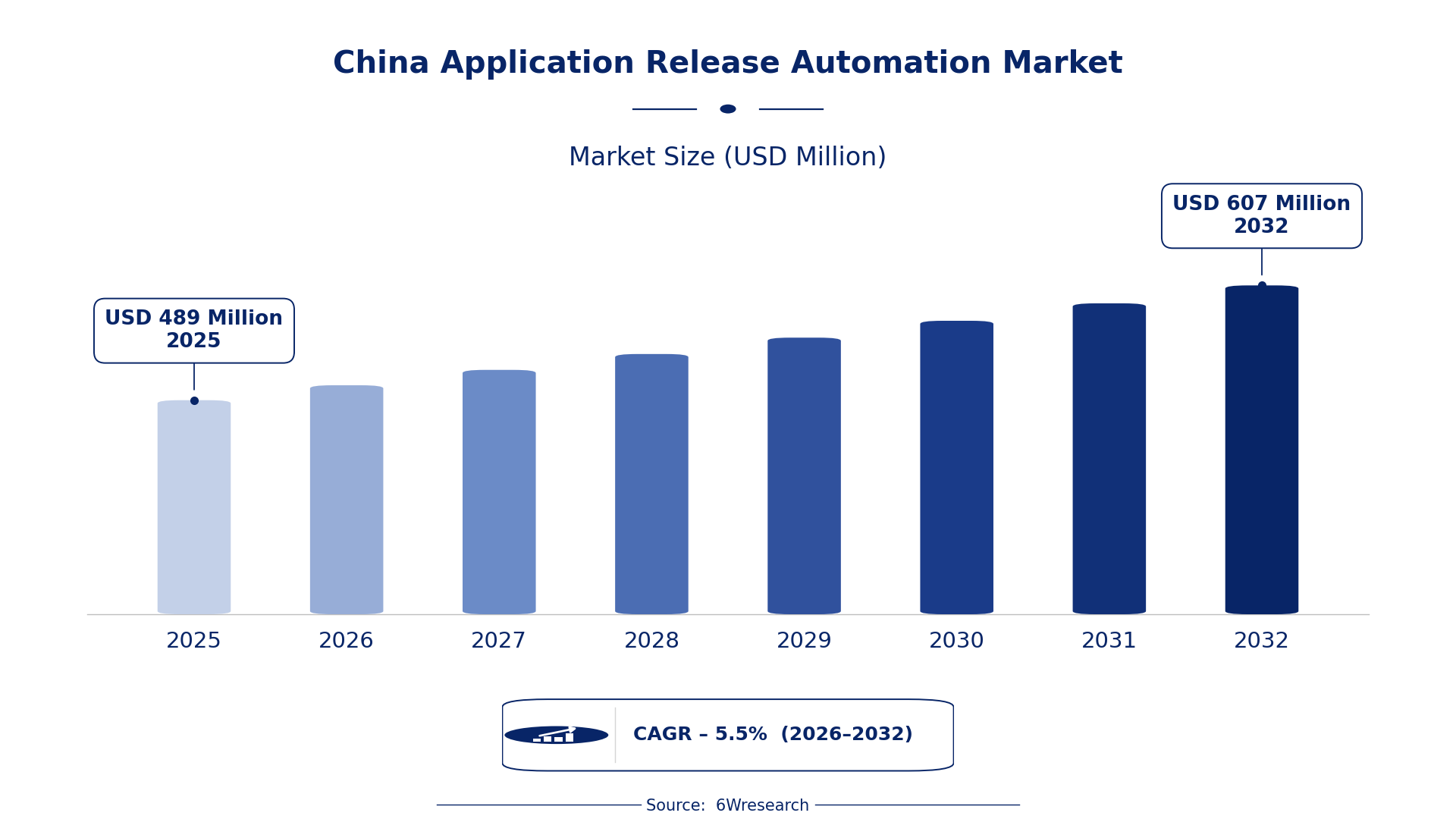
The China Application Release Automation Market was estimated at USD 489 Million in 2025 and is projected to reach USD 607 Million by 2032, growing at a CAGR of 5.5% from 2026 to 2032.
China Application Release Automation Market Synopsis
The demand for application release automation tools in China is surging as enterprises shift towards DevOps methodologies. This shift is driven by the need to enhance software delivery speeds and improve overall quality, prompting organizations to invest heavily in automation solutions that address these critical needs.
As businesses undergo digital transformation, the complexity of their software applications increases, necessitating sophisticated release automation tools. The market is adapting quickly, with vendors offering tailored solutions that align with local compliance requirements and integrate seamlessly into existing IT ecosystems.
China Application Release Automation Market Year-wise Growth Rate and Key Drivers
This graph illustrates the annual growth rates of the China Application Release Automation Market from 2021 to 2032, highlighting a steady upward trajectory and projected expansion over the forecast period.
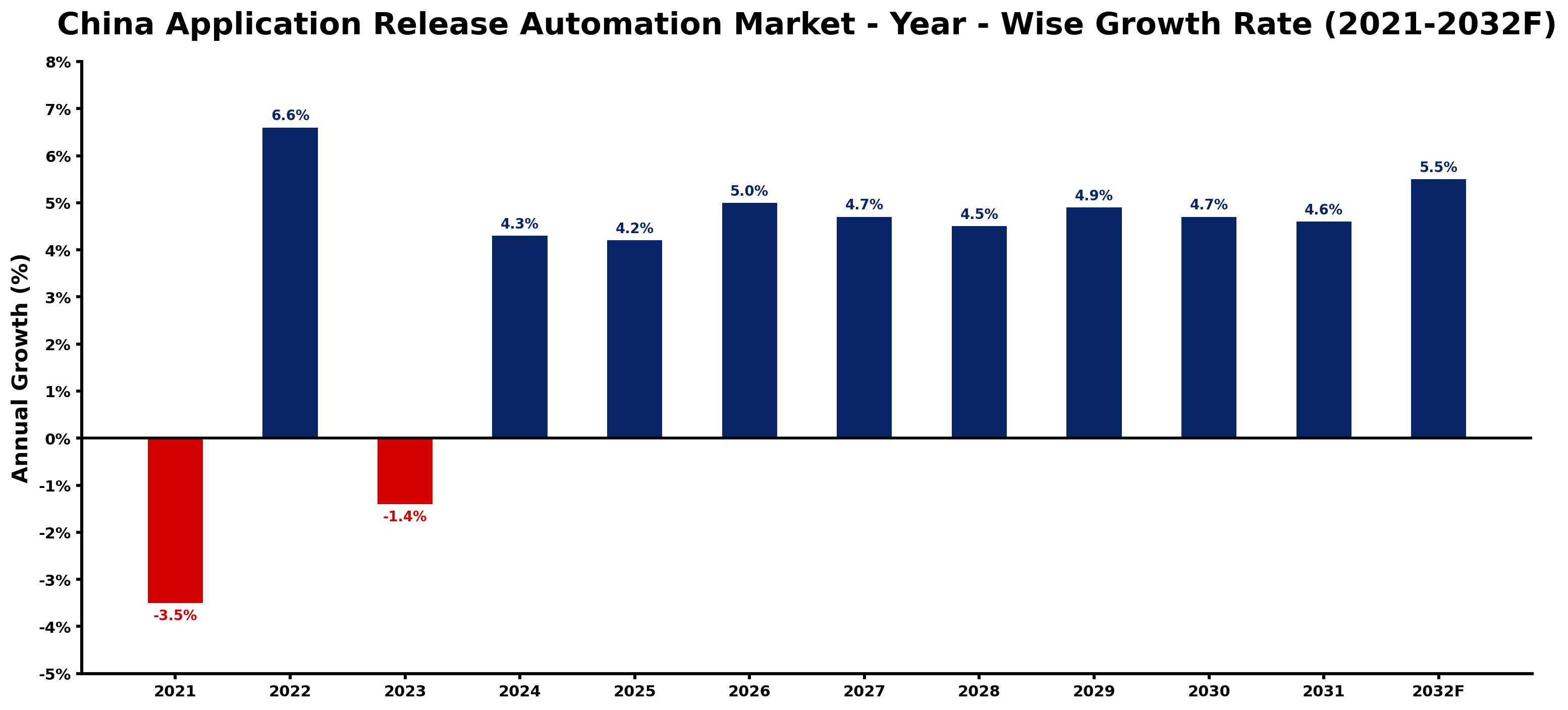
The table below presents the year‑wise growth rates along with the key drivers influencing the market
| Year | Growth Rate | Major Drivers |
| 2021 | -3.5% | New cyber regulations impacted software deployment speed. |
| 2022 | 6.6% | Increased investment in AI for software development productivity |
| 2023 | -1.4% | Local tech giants shifted focus away from automation tools. |
| 2024 | 4.3% | China's push for DevOps culture in tech enterprises |
| 2025 | 4.2% | Rising adoption of low-code platforms among developers |
| 2026 | 5.0% | Government policies promoting agile software development frameworks |
| 2027 | 4.7% | Surge in mobile application development across industries |
| 2028 | 4.5% | Focus on compliance with local cybersecurity regulations |
| 2029 | 4.9% | Growing interest in automation among fintech startups |
| 2030 | 4.7% | Increased use of containerization for application scalability |
| 2031 | 4.6% | Demand for quick software deployment in consumer tech |
| 2032 | 5.5% | Accelerated digital adoption post-pandemic in enterprises |
Note: Market size estimations and growth projections presented in this report are based on 6Wresearch's proprietary forecasting methodology, utilizing the latest available industry data, government publications, and primary research inputs.
China Application Release Automation Market Key Takeaways
Below are some of the specific key takeaways from the market, including:
- Adoption of cloud-based automation solutions is rapidly increasing among Chinese businesses.
- Integration of AI and machine learning in automation tools is becoming a key differentiator.
- Organizations are prioritizing security and compliance throughout their software release processes.
- Investment in continuous integration and continuous delivery (CI/CD) tools is on the rise.
- Flexibility and scalability are critical attributes sought by businesses across various sectors.
Evaluation of Restraints in China Application Release Automation Market
The application release automation market in China faces notable restraints that can hinder growth. Many organizations grapple with integrating automation tools into existing workflows due to the diversity of their IT environments. Resistance to change, stemming from cultural factors and a strong preference for manual processes, poses additional challenges. on top of that, stringent data security regulations necessitate that companies ensure their automated solutions comply with local laws, complicating the implementation of these technologies. The rapid pace of technological change also requires businesses to stay updated, adding to the operational complexities.
China Application Release Automation Market Trends
Key trends in the China Application Release Automation Market include a significant shift towards cloud-based solutions, driven by the need for agility and cost-effectiveness. The incorporation of AI and machine learning capabilities for predictive analytics is becoming increasingly common, enabling organizations to optimize release processes proactively. Additionally, there is a heightened focus on security and compliance, reflecting the necessity for organizations to safeguard sensitive data throughout the software development lifecycle. Continuous integration and delivery (CI/CD) practices are also gaining traction, streamlining development and deployment while enhancing overall efficiency.
China Application Release Automation Market Opportunities
With the escalating demand for efficient software delivery, the China Application Release Automation Market presents ample investment opportunities. Companies can capitalize on the burgeoning technology sector by developing innovative automation solutions tailored to local business needs. Partnerships with regional tech firms can further enhance market penetration and growth potential. The focus on providing user-friendly and adaptable tools will be essential as businesses seek to optimize their application release processes.
Government Initiatives in the China Application Release Automation Market
The Chinese government is actively shaping the Application Release Automation Market through various initiatives aimed at promoting technological innovation and improving software development efficiency. These policies not only encourage the adoption of automation tools but also ensure compliance with stringent data security regulations. The government's commitment to fostering a conducive environment for technological advancement is crucial for the market's future growth.
- A regulatory framework for the standardization and certification of application release automation tools was introduced recently to enhance industry reliability.
- A national initiative promoting research and development in automation technologies is currently underway, aiming to boost local innovation.
- Financial incentives for companies investing in application release automation solutions are part of the ongoing government support strategy.
- Plans for a comprehensive digital infrastructure upgrade expected to commence in 2027 aim to enhance the technological backbone for automation tools.
Future Insights of the China Application Release Automation Market
Looking ahead, the China Application Release Automation Market is set to grow substantially from 2026 to 2032. As digital transformation accelerates, organizations will increasingly seek automation solutions to meet the complexities of software development. The continuous evolution of technologies like AI and machine learning will further enhance automation capabilities, leading to smarter, faster release processes. Companies prioritizing agility, speed, and quality in their software development will drive demand, ensuring a vibrant market ahead.
China Application Release Automation Market Latest Developments
Over the past year, the China Application Release Automation Market has seen several noteworthy developments. These activities reflect the industry's adaptation to changing demands and technological advancements, with companies striving to enhance their offerings and capabilities.
- A major technology vendor launched a new cloud-based automation platform in early 2025, designed to streamline application release processes.
- An ongoing initiative aims to integrate AI-driven analytics into existing automation tools, enhancing predictive capabilities for organizations.
- A collaboration between several tech firms to develop a standardized automation framework is currently underway, expected to improve interoperability.
- Plans for a comprehensive training program targeting software developers to enhance skills in automation tools are anticipated to roll out by mid-2026.
China Application Release Automation Market - Key Attractiveness of the Report
- 10 Years of Market Numbers
- Historical Data Starting from 2022 to 2025
- Base Year: 2025
- Forecast Data until 2032
- Key Performance Indicators Impacting the Market
- Major Upcoming Developments and Projects
Government policies in China focus on promoting the development of the ARA industry through standardization, R&D incentives, and ensuring compliance with data protection regulations, which are vital for market growth.
Key Highlights of the Report:
- China Application Release Automation Market Outlook
- Market Size of China Application Release Automation Market, 2025
- Forecast of China Application Release Automation Market, 2032
- Historical Data and Forecast of China Application Release Automation Revenues & Volume for the Period 2022-2032F
- China Application Release Automation Market Trend Evolution
- China Application Release Automation Market Drivers and Challenges
- China Application Release Automation Price Trends
- China Application Release Automation Porter's Five Forces
- China Application Release Automation Industry Life Cycle
- Historical Data and Forecast of China Application Release Automation Market Revenues & Volume By Component for the Period 2022-2032F
- Historical Data and Forecast of China Application Release Automation Market Revenues & Volume By Tool for the Period 2022-2032F
- Historical Data and Forecast of China Application Release Automation Market Revenues & Volume By Services for the Period 2022-2032F
- Historical Data and Forecast of China Application Release Automation Market Revenues & Volume By Vertical for the Period 2022-2032F
- Historical Data and Forecast of China Application Release Automation Market Revenues & Volume By BFSI for the Period 2022-2032F
- Historical Data and Forecast of China Application Release Automation Market Revenues & Volume By ITEs for the Period 2022-2032F
- Historical Data and Forecast of China Application Release Automation Market Revenues & Volume By Telecommunications for the Period 2022-2032F
- Historical Data and Forecast of China Application Release Automation Market Revenues & Volume By Manufacturing for the Period 2022-2032F
- Historical Data and Forecast of China Application Release Automation Market Revenues & Volume By Deployment Type for the Period 2022-2032F
- Historical Data and Forecast of China Application Release Automation Market Revenues & Volume By On-Premises for the Period 2022-2032F
- Historical Data and Forecast of China Application Release Automation Market Revenues & Volume By Cloud for the Period 2022-2032F
- Historical Data and Forecast of China Application Release Automation Market Revenues & Volume By Organization Size for the Period 2022-2032F
- China Application Release Automation Import Export Trade Statistics
- Market Opportunity Assessment By Component
- Market Opportunity Assessment By Vertical
- Market Opportunity Assessment By Deployment Type
- Market Opportunity Assessment By Organization Size
- China Application Release Automation Top Companies Market Share
- China Application Release Automation Competitive Benchmarking By Technical and Operational Parameters
- China Application Release Automation Company Profiles
- China Application Release Automation Key Strategic Recommendations






































