China Auto Parts And Accessories Market Size, Share & Growth Rate
The China Auto Parts And Accessories Market was estimated at USD 125 Million in 2025 and is projected to reach USD 145 Million by 2032, growing at a CAGR of 2.1% from 2026 to 2032. This growth trajectory is primarily fueled by the continuous increase in vehicle ownership across China, driven by rising disposable incomes and urbanization. Furthermore, the shift towards electric vehicles (EVs) is significantly influencing the market, with demand for specialized components and accessories on the rise.
China Auto Parts And Accessories Market Year-wise Growth Rate and Key Drivers
This graph highlights how the China Auto Parts And Accessories Market has steadily grown over the years, supported by major growth factors.
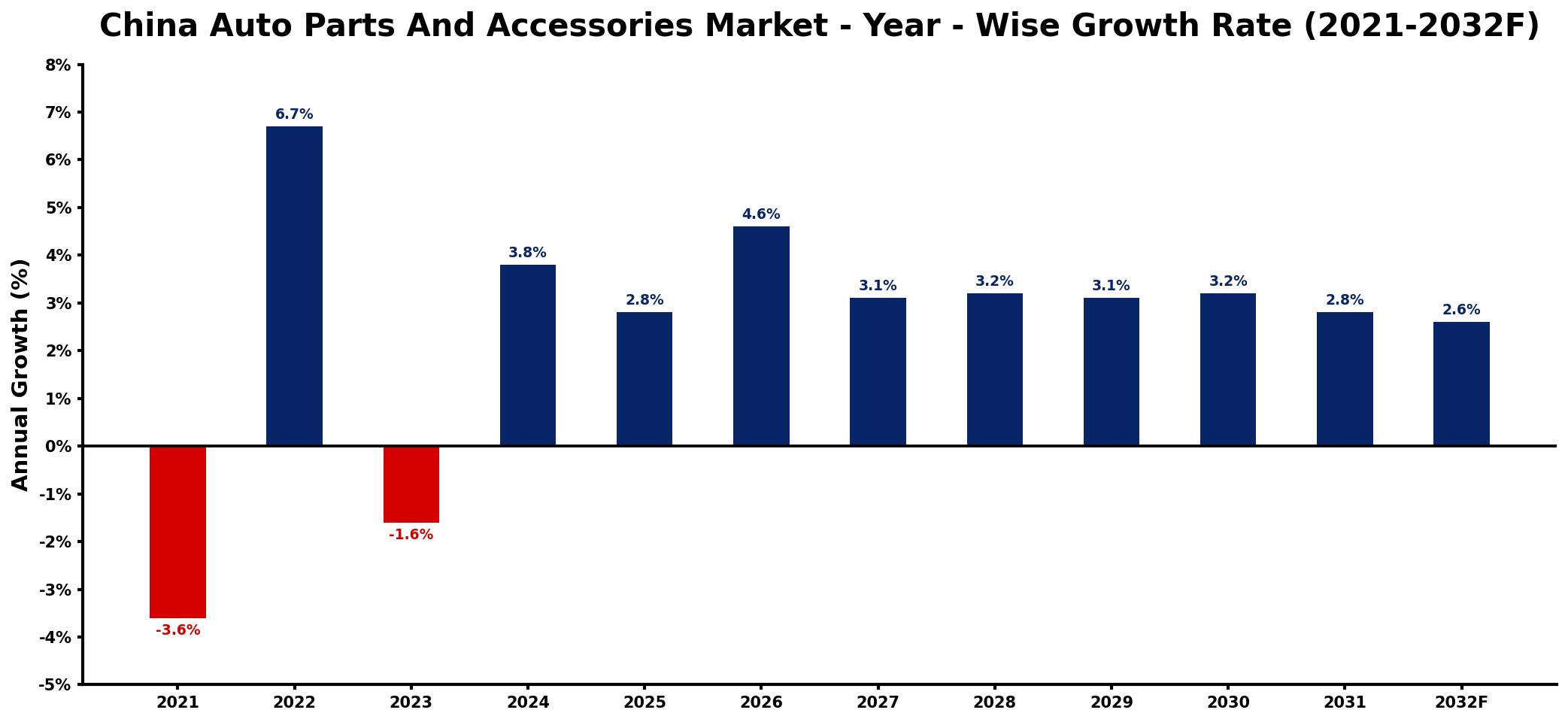
The table below presents the year‑wise growth rates along with the key drivers influencing the market
| Year | Growth Rate | Major Drivers |
| 2021 | -3.6% | Decreased consumer confidence levels |
| 2022 | 6.7% | Rising investment in technology |
| 2023 | -1.6% | Falling production capacity utilization |
| 2024 | 3.8% | Growing electric vehicle adoption |
| 2025 | 2.8% | Increased focus on sustainability |
| 2026 | 4.6% | Expansion of online retail channels |
| 2027 | 3.1% | Rising demand for innovation |
| 2028 | 3.2% | Strengthening supply chain networks |
| 2029 | 3.1% | Growing aftermarket service opportunities |
| 2030 | 3.2% | Increased global trade agreements |
| 2031 | 2.8% | Rising consumer disposable income |
| 2032 | 2.6% | Strengthened regulatory compliance measures |
Note: Market size estimations and growth projections presented in this report are based on 6Wresearch's proprietary forecasting methodology, utilizing the latest available industry data, government publications, and primary research inputs.
China Auto Parts And Accessories Market Synopsis
As the number of vehicles on the road in China surges, the need for high-quality auto parts and accessories has become more pronounced. This burgeoning demand is complemented by a growing middle class that is increasingly investing in vehicle upgrades and maintenance. The robust growth of e-commerce platforms has also transformed how consumers purchase auto parts, providing access to a broader array of products at competitive prices.
The market landscape is characterized by a blend of domestic and international manufacturers vying for dominance. Innovations in technology, particularly in electric vehicles and smart automotive solutions, are reshaping consumer preferences and creating a fertile ground for new entrants. This dynamic environment underscores the importance of agility and responsiveness in meeting market demands.
China Auto Parts And Accessories Market Key Takeaways
- The market is witnessing a significant shift towards electric vehicles and associated components.
- E-commerce channels are revolutionizing the distribution of auto parts and accessories in China.
- Government initiatives are fostering innovation, sustainability, and domestic production.
- There is a growing need for high-quality components amidst increasing vehicle ownership.
- Investment opportunities abound for companies focusing on EV technologies and smart automotive solutions.
Evaluation of Restraints in China Auto Parts And Accessories Market
Despite the growth potential, several restraints are hindering the market's progress. Intense competition among both local and international players is driving prices down, which can undermine profit margins. Additionally, quality control remains a pressing issue, as counterfeit products infiltrate the market, compromising consumer trust. Regulatory hurdles concerning environmental standards and intellectual property rights further complicate the landscape, necessitating a careful navigation of compliance protocols to succeed.
China Auto Parts And Accessories Market Trends
The current trends shaping the China Auto Parts And Accessories Market are heavily influenced by the rapid adoption of electric vehicles and smart automotive technologies. With governmental policies supporting green initiatives, the demand for EV components, including batteries and charging systems, is expected to escalate. Furthermore, consumers are increasingly prioritizing features such as connectivity and enhanced safety systems, pushing manufacturers to innovate continuously. E-commerce remains a critical channel for distribution, granting consumers convenient access to a variety of products.
China Auto Parts And Accessories Market Opportunities
The China Auto Parts And Accessories Market presents lucrative investment opportunities, particularly in the burgeoning EV sector. Companies producing EV-related components, such as batteries and electronic systems, are well-positioned for growth. Moreover, partnerships between foreign investors and local manufacturers can enhance market entry strategies and leverage established distribution networks. The increasing emphasis on technological advancements, coupled with rising vehicle ownership, creates a landscape ripe for innovation and expansion.
Government Initiatives in the China Auto Parts And Accessories Market
The Chinese government has rolled out several initiatives aimed at bolstering the auto parts and accessories market. These include setting stringent emission standards to promote eco-friendly product development and providing financial incentives for companies investing in R&D. Import tariffs are also strategically employed to protect local manufacturers while enhancing product quality and safety standards. Additionally, initiatives focusing on recycling and material reuse in the industry align with broader sustainability goals.
Future Insights of the China Auto Parts And Accessories Market
Looking ahead to 2026-2032, the China Auto Parts And Accessories Market is poised for substantial growth fueled by evolving consumer preferences and regulatory support. The push for more sustainable and technologically advanced vehicles will drive demand for innovative components and accessories. Companies are expected to prioritize innovation and sustainability, capitalizing on digital solutions to enhance customer engagement and operational efficiency. As the automotive landscape transforms, market participants will need to adapt to these changes to remain competitive and capture emerging opportunities.
China Auto Parts And Accessories Market Latest Developments (2025 - 2026)
In recent months, the China auto parts and accessories market has seen various strategic developments aimed at harnessing growth potential. Manufacturers are increasingly investing in research and development to innovate new products that align with consumer demands for smarter, more efficient technologies. Additionally, e-commerce platforms continue to expand their offerings, facilitating a broader selection of auto parts. The market is also witnessing a rise in collaborations between technology firms and traditional manufacturers to enhance product quality and sustainability practices.
China Auto Parts And Accessories Market - Key Attractiveness of the Report
- 10 Years of Market Numbers
- Historical Data Starting from 2022 to 2025
- Base Year: 2025
- Forecast Data until 2032
- Key Performance Indicators Impacting the Market
- Major Upcoming Developments and Projects
Key Highlights of the Report:
- China Auto Parts And Accessories Market Outlook
- Market Size of China Auto Parts And Accessories Market, 2025
- Forecast of China Auto Parts And Accessories Market, 2032
- Historical Data and Forecast of China Auto Parts And Accessories Revenues & Volume for the Period 2022-2032F
- China Auto Parts And Accessories Market Trend Evolution
- China Auto Parts And Accessories Market Drivers and Challenges
- China Auto Parts And Accessories Price Trends
- China Auto Parts And Accessories Porter's Five Forces
- China Auto Parts And Accessories Industry Life Cycle
- Historical Data and Forecast of China Auto Parts And Accessories Market Revenues & Volume By Product for the Period 2022-2032F
- Historical Data and Forecast of China Auto Parts And Accessories Market Revenues & Volume By Driveline & Powertrain for the Period 2022-2032F
- Historical Data and Forecast of China Auto Parts And Accessories Market Revenues & Volume By Interiors & Exteriors for the Period 2022-2032F
- Historical Data and Forecast of China Auto Parts And Accessories Market Revenues & Volume By Electronics for the Period 2022-2032F
- Historical Data and Forecast of China Auto Parts And Accessories Market Revenues & Volume By Bodies & Chassis for the Period 2022-2032F
- Historical Data and Forecast of China Auto Parts And Accessories Market Revenues & Volume By Wheel & Tires for the Period 2022-2032F
- Historical Data and Forecast of China Auto Parts And Accessories Market Revenues & Volume By Others for the Period 2022-2032F
- Historical Data and Forecast of China Auto Parts And Accessories Market Revenues & Volume By Application for the Period 2022-2032F
- Historical Data and Forecast of China Auto Parts And Accessories Market Revenues & Volume By OEMs for the Period 2022-2032F
- Historical Data and Forecast of China Auto Parts And Accessories Market Revenues & Volume By Aftermarket for the Period 2022-2032F
- China Auto Parts And Accessories Import Export Trade Statistics
- Market Opportunity Assessment By Product
- Market Opportunity Assessment By Application
- China Auto Parts And Accessories Top Companies Market Share
- China Auto Parts And Accessories Competitive Benchmarking By Technical and Operational Parameters
- China Auto Parts And Accessories Company Profiles
- China Auto Parts And Accessories Key Strategic Recommendations






































