China Automotive Diecast Scale Model Market Size, Share & Growth Rate
The China Automotive Diecast Scale Model Market was estimated at USD 163 Million in 2025 and is projected to reach USD 188 Million by 2032, growing at a CAGR of 2.1% from 2026 to 2032. This growth trajectory is largely fueled by the rising disposable income among consumers, which has enhanced their capacity to indulge in hobbies like collecting. Moreover, the increasing availability of online retail platforms has made it easier for enthusiasts to access an extensive array of diecast models, further propelling market expansion.
China Automotive Diecast Scale Model Market Year-wise Growth Rate and Key Drivers
This graph highlights how the China Automotive Diecast Scale Model Market has steadily grown over the years, supported by major growth factors.
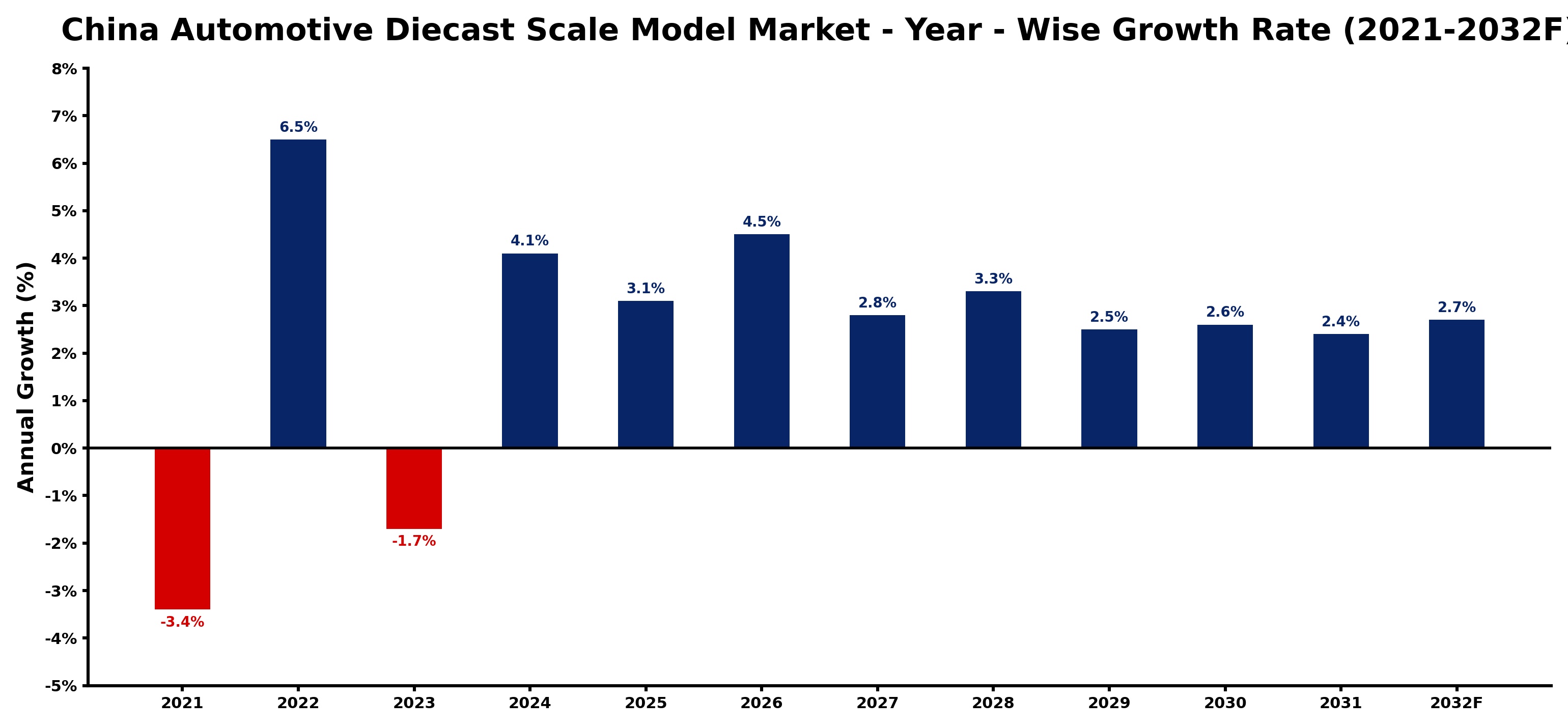
The table below presents the year‑wise growth rates along with the key drivers influencing the market
| Year | Growth Rate | Major Drivers |
| 2021 | -3.4% | Growing renewable energy integration projects |
| 2022 | 6.5% | Growing urbanization and commercial development |
| 2023 | -1.7% | Increasing smart city development projects |
| 2024 | 4.1% | Increasing industrial automation investments |
| 2025 | 3.1% | Expansion of manufacturing activities |
| 2026 | 4.5% | Growing renewable energy integration projects |
| 2027 | 2.8% | Expansion of commercial construction activities |
| 2028 | 3.3% | Growing renewable energy integration projects |
| 2029 | 2.5% | Expansion of commercial construction activities |
| 2030 | 2.6% | Growing renewable energy integration projects |
| 2031 | 2.4% | Increasing adoption of advanced technologies |
| 2032 | 2.7% | Rapid growth in telecom and data center sectors |
Note - Market size estimations and growth projections presented in this report are based on 6Wresearch’s advanced forecasting approach, validated with industry datasets as of June 2026.
China Automotive Diecast Scale Model Market Synopsis
The China Automotive Diecast Scale Model Market is rapidly evolving, bolstered by a cultural shift towards automotive collectibles. With both seasoned collectors and newcomers eager to acquire precise replicas, the market has witnessed a significant surge in interest.
Distinctive features, including limited editions and customizable options, have captivated consumers. As manufacturers enhance the realism and craftsmanship of their models, the appeal of diecast vehicles becomes even more pronounced, aligning with the broader trends in the automotive and collectibles markets.
China Automotive Diecast Scale Model Market Key Takeaways
- The market is driven by increasing consumer disposable income and a growing interest in car collecting.
- Online retail platforms are expanding access to a diverse range of diecast models, enhancing market reach.
- Customization options are gaining traction, appealing to consumers seeking personalized products.
- Collaborations between diecast manufacturers and automotive brands are leading to exclusive offerings.
- The market is under pressure from competitive pricing and quality concerns due to counterfeiting.
Evaluation of Restraints in China Automotive Diecast Scale Model Market
While the China Automotive Diecast Scale Model Market shows promise, it is not without its challenges. Intense competition, both from domestic manufacturers and international brands, has led to pricing pressures that can squeeze profit margins. Additionally, the market grapples with issues of intellectual property infringement, which not only affects the reputation of brands but can also lead to consumer mistrust regarding product quality. Furthermore, the fluctuating costs of raw materials add another layer of complexity to the operational landscape, impacting manufacturers' ability to maintain profitability while staying competitive.
China Automotive Diecast Scale Model Market Trends
Emerging trends are defining the landscape of the China Automotive Diecast Scale Model Market. There is a noticeable shift towards highly detailed and accurate models, with collectors showing a preference for both modern vehicles and classic cars. Furthermore, as technology advances, manufacturers are investing in higher craftsmanship, allowing for more realistic models. The growing popularity of e-commerce has transformed how enthusiasts purchase diecast models, facilitating easier access to both local and international offerings. Such trends underscore the market's dynamism and the importance of innovation in meeting consumer expectations.
China Automotive Diecast Scale Model Market Opportunities
There are abundant opportunities for investment in the China Automotive Diecast Scale Model Market. The increasing passion for collecting among consumers presents avenues for companies to introduce new and unique models. Collaborations with automotive manufacturers for licensing agreements can generate exclusive products that appeal directly to target audiences. Additionally, leveraging the burgeoning e-commerce sector can enhance distribution capabilities, allowing businesses to reach a broader customer base effectively. These strategies can significantly contribute to market expansion and profitability.
Government Initiatives in the China Automotive Diecast Scale Model Market
The Chinese government has implemented various policies aimed at improving the Automotive Diecast Scale Model Market. These include stringent regulations on product quality and safety standards, as well as initiatives to protect intellectual property rights. Environmental sustainability is also a focus, with guidelines to promote responsible manufacturing practices. Such regulations not only enhance market competitiveness but also ensure the safety and satisfaction of consumers. Furthermore, the government encourages innovation and technological advancements within the sector through funding opportunities and support for collaborative projects among industry players.
Future Insights of the China Automotive Diecast Scale Model Market
The future of the China Automotive Diecast Scale Model Market is promising, with expectations for steady growth driven by rising disposable incomes and a burgeoning interest in automotive culture. As consumer engagement in collecting continues to deepen, manufacturers will need to adapt by enhancing model quality and diversifying offerings. The ongoing expansion of e-commerce will also play a pivotal role, providing easier access for consumers and allowing for innovative marketing strategies. Overall, as the market evolves, there will be opportunities for both established players and new entrants to thrive.
China Automotive Diecast Scale Model Market Latest Developments (May 2025 - June 2026)
Recent developments in the China Automotive Diecast Scale Model Market indicate a strong push towards innovation and quality enhancement. Manufacturers are increasingly focusing on technology-driven solutions to improve the craftsmanship of their models. The rise of social media and online communities dedicated to diecast collecting has further stimulated consumer interest, leading to more niche markets. Additionally, there are growing partnerships between model manufacturers and automotive companies, resulting in exclusive releases that attract collectors and enthusiasts alike.
China Automotive Diecast Scale Model Market - Key Attractiveness of the Report
- 10 Years of Market Numbers
- Historical Data Starting from 2022 to 2025
- Base Year: 2025
- Forecast Data until 2032
- Key Performance Indicators Impacting the Market
- Major Upcoming Developments and Projects
Key Highlights of the Report:
- China Automotive Diecast Scale Model Market Outlook
- Market Size of China Automotive Diecast Scale Model Market, 2025
- Forecast of China Automotive Diecast Scale Model Market, 2032
- Historical Data and Forecast of China Automotive Diecast Scale Model Revenues & Volume for the Period 2022-2032F
- China Automotive Diecast Scale Model Market Trend Evolution
- China Automotive Diecast Scale Model Market Drivers and Challenges
- China Automotive Diecast Scale Model Price Trends
- China Automotive Diecast Scale Model Porter's Five Forces
- China Automotive Diecast Scale Model Industry Life Cycle
- Historical Data and Forecast of China Automotive Diecast Scale Model Market Revenues & Volume By Type for the Period 2022-2032F
- Historical Data and Forecast of China Automotive Diecast Scale Model Market Revenues & Volume By Plastic Model for the Period 2022-2032F
- Historical Data and Forecast of China Automotive Diecast Scale Model Market Revenues & Volume By Metal Model for the Period 2022-2032F
- Historical Data and Forecast of China Automotive Diecast Scale Model Market Revenues & Volume By End-users for the Period 2022-2032F
- Historical Data and Forecast of China Automotive Diecast Scale Model Market Revenues & Volume By Collectors for the Period 2022-2032F
- Historical Data and Forecast of China Automotive Diecast Scale Model Market Revenues & Volume By Non-collectors for the Period 2022-2032F
- China Automotive Diecast Scale Model Import Export Trade Statistics
- Market Opportunity Assessment By Type
- Market Opportunity Assessment By End-users
- China Automotive Diecast Scale Model Top Companies Market Share
- China Automotive Diecast Scale Model Competitive Benchmarking By Technical and Operational Parameters
- China Automotive Diecast Scale Model Company Profiles
- China Automotive Diecast Scale Model Key Strategic Recommendations






































