China Automotive Reversing Radar Market Size, Share & Growth Rate
The China Automotive Reversing Radar Market was estimated at USD 189 Million in 2025 and is projected to reach USD 248 Million by 2032, growing at a CAGR of 4.0% from 2026 to 2032. This growth trajectory is fueled by an increasing consumer focus on vehicle safety and an uptick in the adoption of advanced parking assistance systems. As urbanization accelerates, the sheer volume of vehicles on the roads enhances the necessity for technologies that help reduce parking-related accidents, positioning reversing radar systems as indispensable safety tools.
China Automotive Reversing Radar Market Year-wise Growth Rate and Key Drivers
This graph highlights how the China Automotive Reversing Radar Market has steadily grown over the years, supported by major growth factors.
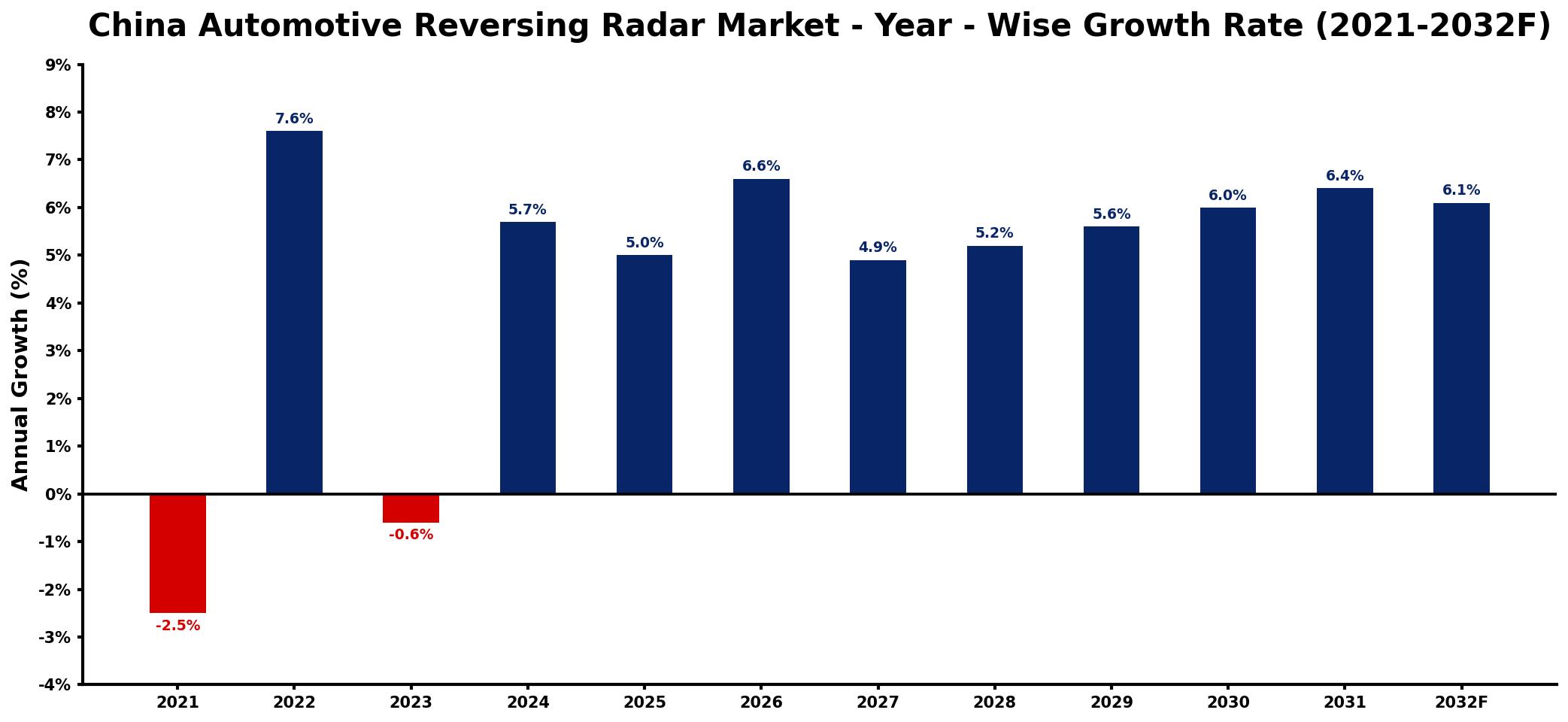
The table below presents the year‑wise growth rates along with the key drivers influencing the market
| Year | Growth Rate | Major Drivers |
| 2021 | -2.5% | decrease in consumer spending habits |
| 2022 | 7.6% | rise in vehicle safety regulations |
| 2023 | -0.6% | drop in manufacturing investments |
| 2024 | 5.7% | expansion of smart vehicle technologies |
| 2025 | 5.0% | improved processing technologies adoption |
| 2026 | 6.6% | growing demand for safety features |
| 2027 | 4.9% | increased domestic production output |
| 2028 | 5.2% | increase in urban mobility solutions |
| 2029 | 5.6% | growing interest in autonomous driving |
| 2030 | 6.0% | stronger distribution network expansion |
| 2031 | 6.4% | rising end-use demand growth |
| 2032 | 6.1% | rising demand from electronics |
Note: Market size estimations and growth projections presented in this report are based on 6Wresearch's proprietary forecasting methodology, utilizing the latest available industry data, government publications, and primary research inputs.
China Automotive Reversing Radar Market Synopsis
Despite a solid foundation and recent momentum in the adoption of reversing radar technology, the market is poised for further expansion. The convergence of safety regulations and technological advancements is setting the stage for more widespread integration of reversing radar systems across various vehicle models in the upcoming years.
The current market landscape reflects a robust demand driven by rising safety concerns among consumers. Looking ahead, the sector is likely to evolve with innovations that enhance the reliability and accuracy of radar systems, ensuring that the market remains competitive against alternative driver assistance technologies.
China Automotive Reversing Radar Market Key Takeaways
- The market is projected to grow steadily, reflecting the increasing importance of vehicle safety.
- Consumer demand for parking assistance solutions is significantly driving market expansion.
- Technological advancements are essential to ensure the reliability and efficacy of radar systems.
- Government policies are fostering innovation and regulatory compliance in the sector.
- Challenges such as integration with existing vehicle systems pose ongoing hurdles for manufacturers.
Evaluation of Restraints in China Automotive Reversing Radar Market
The market faces notable restraints that could hinder its full potential. One of the primary challenges is the integration of advanced radar technologies with existing automotive systems, which can require significant investment and engineering effort. Additionally, the need to comply with increasingly stringent safety regulations complicates the development process, potentially leading to delays in bringing new products to market. Finally, the competitive landscape, featuring a variety of advanced driver assistance systems, creates pressure on manufacturers to continually innovate while managing costs.
China Automotive Reversing Radar Market Trends
Several key trends are shaping the demand for reversing radar systems in China. Firstly, a growing integration of artificial intelligence and machine learning into radar technology is enhancing functionality, allowing for improved obstacle detection and real-time alerts. Secondly, the rise of smart vehicle technology is encouraging manufacturers to incorporate reversing radar as standard equipment, rather than optional features. Lastly, the increasing emphasis on eco-friendly vehicles is influencing manufacturers to design radar systems that are both energy-efficient and compact, aligning with the overall trend toward sustainability in automotive engineering.
China Automotive Reversing Radar Market Opportunities
The market presents genuine growth opportunities, particularly in urban areas where dense traffic conditions amplify the need for enhanced parking solutions. Additionally, with the expansion of electric and autonomous vehicles, there is potential for integrating more sophisticated reversing radar systems that not only assist in parking but also enhance overall vehicle functionality. Investment in research and development, particularly in improving radar accuracy and reducing costs, will also be crucial for capturing the evolving needs of consumers.
Government Initiatives in the China Automotive Reversing Radar Market
Chinese government initiatives are playing a pivotal role in shaping the automotive reversing radar market. Policies aimed at enhancing vehicle safety standards encourage manufacturers to innovate and upgrade their radar systems. Additionally, the government provides funding and incentives for research and development, fostering a climate of technological advancement. Regulations ensure that these systems meet safety requirements and reliable performance expectations, promoting public trust in these essential safety technologies.
Future Insights of the China Automotive Reversing Radar Market
Looking toward the future, the China Automotive Reversing Radar Market is expected to evolve significantly between 2026 and 2032. The integration of more sophisticated technologies such as machine learning will likely enhance system capabilities, contributing to reduced accident rates. As consumers become more aware of safety technologies, the demand for reliable reversing radar systems is anticipated to grow. Ultimately, the convergence of technological advancement and governmental support will be instrumental in driving the market forward.
China Automotive Reversing Radar Market Latest Developments (2025 - 2026)
Recent developments in the automotive reversing radar sector reflect a dynamic shift toward enhanced technologies and features. Manufacturers are increasingly focusing on R&D to produce more efficient and accurate radar systems that meet consumer demands. Furthermore, partnerships and collaborations aimed at integrating advanced safety features into new vehicle models have gained traction, indicating a collective industry effort to bolster safety measures. Enhanced regulatory frameworks are also being adopted to ensure that emerging technologies meet stringent safety standards.
China Automotive Reversing Radar Market - Key Attractiveness of the Report
- 10 Years of Market Numbers
- Historical Data Starting from 2022 to 2025
- Base Year: 2025
- Forecast Data until 2032
- Key Performance Indicators Impacting the Market
- Major Upcoming Developments and Projects
Key Highlights of the Report:
- China Automotive Reversing Radar Market Outlook
- Market Size of China Automotive Reversing Radar Market, 2025
- Forecast of China Automotive Reversing Radar Market, 2032
- Historical Data and Forecast of China Automotive Reversing Radar Revenues & Volume for the Period 2022-2032F
- China Automotive Reversing Radar Market Trend Evolution
- China Automotive Reversing Radar Market Drivers and Challenges
- China Automotive Reversing Radar Price Trends
- China Automotive Reversing Radar Porter's Five Forces
- China Automotive Reversing Radar Industry Life Cycle
- Historical Data and Forecast of China Automotive Reversing Radar Market Revenues & Volume By Type for the Period 2022-2032F
- Historical Data and Forecast of China Automotive Reversing Radar Market Revenues & Volume By Ultrasonic for the Period 2022-2032F
- Historical Data and Forecast of China Automotive Reversing Radar Market Revenues & Volume By Electromagnetic for the Period 2022-2032F
- Historical Data and Forecast of China Automotive Reversing Radar Market Revenues & Volume By Application for the Period 2022-2032F
- Historical Data and Forecast of China Automotive Reversing Radar Market Revenues & Volume By Passenger Vehicle for the Period 2022-2032F
- Historical Data and Forecast of China Automotive Reversing Radar Market Revenues & Volume By Commercial Vehicle for the Period 2022-2032F
- China Automotive Reversing Radar Import Export Trade Statistics
- Market Opportunity Assessment By Type
- Market Opportunity Assessment By Application
- China Automotive Reversing Radar Top Companies Market Share
- China Automotive Reversing Radar Competitive Benchmarking By Technical and Operational Parameters
- China Automotive Reversing Radar Company Profiles
- China Automotive Reversing Radar Key Strategic Recommendations






































