China Ballast Water Treatment Market Size, Share & Growth Rate
The China Ballast Water Treatment Market was estimated at USD 119 Million in 2025 and is projected to reach USD 137 Million by 2032, growing at a CAGR of 2.0% from 2026 to 2032. This growth trajectory is propelled by an increasingly stringent regulatory landscape aimed at curbing the proliferation of invasive aquatic species through ballast water. Furthermore, the rising shipping activities and heightened environmental awareness among stakeholders further catalyze the demand for advanced treatment systems.
China Ballast Water Treatment Market Year-wise Growth Rate and Key Drivers
This graph highlights how the China Ballast Water Treatment Market has steadily grown over the years, supported by major growth factors.
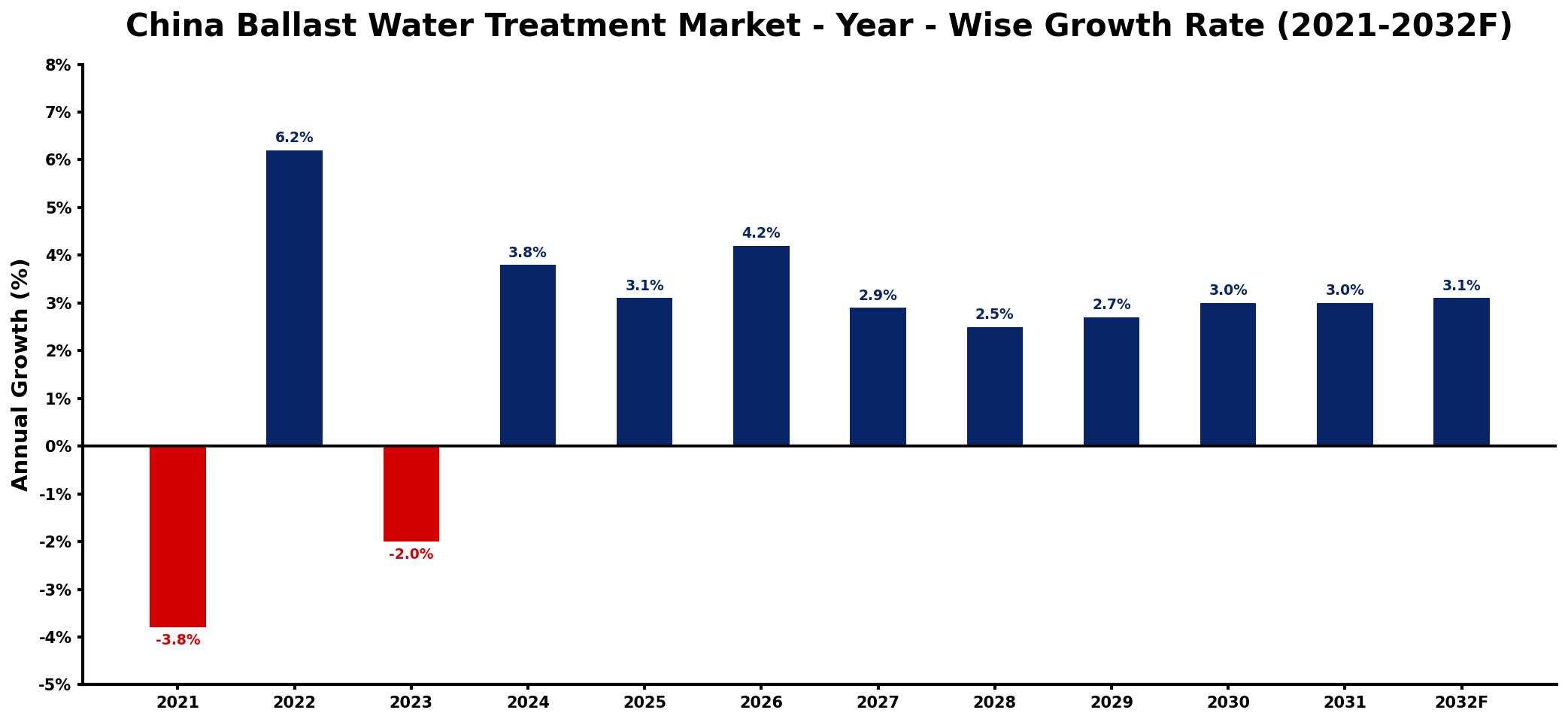
The table below presents the year‑wise growth rates along with the key drivers influencing the market
| Year | Growth Rate | Major Drivers |
| 2021 | -3.8% | Decreased maritime regulatory enforcement |
| 2022 | 6.2% | Rising shipping industry investments |
| 2023 | -2.0% | Falling maritime vessel deliveries |
| 2024 | 3.8% | Growing environmental compliance requirements |
| 2025 | 3.1% | Increased focus on sustainability initiatives |
| 2026 | 4.2% | Expansion of global shipping routes |
| 2027 | 2.9% | Higher demand for shipping efficiency |
| 2028 | 2.5% | Technological advancements in marine sectors |
| 2029 | 2.7% | More stringent international regulations |
| 2030 | 3.0% | Investment in green technologies |
| 2031 | 3.0% | Emerging markets driving demand |
| 2032 | 3.1% | Ongoing innovation in maritime solutions |
Note: Market size estimations and growth projections presented in this report are based on 6Wresearch's proprietary forecasting methodology, utilizing the latest available industry data, government publications, and primary research inputs.
China Ballast Water Treatment Market Synopsis
Recently, the China ballast water treatment market has witnessed a notable surge in activity, driven by growing compliance with international maritime regulations. However, as the market matures, it faces challenges in sustaining growth amidst technological advancements and the high costs associated with compliance.
Looking ahead, the market is set to evolve as innovative solutions emerge to tackle existing barriers. The interplay between regulatory pressures and technological innovations is expected to shape the future landscape of the ballast water treatment sector in China.
China Ballast Water Treatment Market Key Takeaways
- Growth is fueled by stringent regulations aimed at safeguarding marine environments.
- Increased shipping activities are spurring demand for effective treatment solutions.
- Continuous technological innovation is essential for meeting evolving standards.
- Cost factors remain a significant barrier to widespread adoption of treatment technologies.
- Government policies are increasingly supportive of advanced treatment systems.
Evaluation of Restraints in China Ballast Water Treatment Market
Despite its growth potential, the China ballast water treatment market is hindered by several restraints. The high costs associated with advanced treatment technologies represent a significant financial challenge for many maritime operators, limiting their ability to invest in necessary solutions. Furthermore, the complexity of regulatory compliance creates additional burdens, often resulting in delays and increased operational costs. International competitors, offering more economical solutions, further complicate the landscape, demanding a continual push for innovation from local providers to remain relevant.
China Ballast Water Treatment Market Trends
The market is currently witnessing trends towards the adoption of more energy-efficient and automated treatment systems. Innovations in biofouling prevention and real-time monitoring are becoming increasingly important, as ship operators seek to enhance compliance while reducing operational costs. Additionally, the integration of digital technologies such as IoT and AI into ballast water management is set to reshape the competitive landscape, offering smarter and more effective treatment options.
China Ballast Water Treatment Market Opportunities
Significant growth opportunities lie in the development of cost-effective and efficient treatment systems that can cater to the unique needs of the Chinese maritime sector. Investment in R&D to innovate and enhance existing technologies can position companies favorably against international competition. Moreover, collaborations with governmental and environmental bodies can lead to better-funded initiatives aimed at expanding the adoption of advanced treatment systems.
Government Initiatives in the China Ballast Water Treatment Market
The Chinese government has implemented stringent regulations regarding ballast water treatment, with a clear focus on preventing the spread of invasive species and protecting marine ecosystems. To foster compliance, there are various support mechanisms in place, including research grants and incentives to encourage the development of advanced treatment technologies. This commitment to environmental protection is set to drive investment into the ballast water treatment sector.
Future Insights of the China Ballast Water Treatment Market
As the China ballast water treatment market evolves from 2026 to 2032, it is anticipated to be characterized by significant technological advancements and enhanced regulatory frameworks. Companies that invest in innovative solutions and adapt swiftly to regulatory changes are likely to emerge as market leaders. The ongoing commitment to marine protection will further enhance investment in effective treatment technologies, driving sustainable growth in the sector.
China Ballast Water Treatment Market Latest Developments (2025 - 2026)
The ballast water treatment industry in China is currently experiencing a shift as companies begin to roll out next-generation treatment systems. There have been increasing partnerships between technology firms and maritime operators, aimed at optimizing ballast water management. Efforts to align with international standards have led to the emergence of advanced solutions, setting the stage for a more integrated approach to environmental compliance.
China Ballast Water Treatment Market - Key Attractiveness of the Report
- 10 Years of Market Numbers
- Historical Data Starting from 2022 to 2025
- Base Year: 2025
- Forecast Data until 2032
- Key Performance Indicators Impacting the Market
- Major Upcoming Developments and Projects
Key Highlights of the Report:
- China Ballast Water Treatment Market Outlook
- Market Size of China Ballast Water Treatment Market, 2025
- Forecast of China Ballast Water Treatment Market, 2032
- Historical Data and Forecast of China Ballast Water Treatment Revenues & Volume for the Period 2022-2032F
- China Ballast Water Treatment Market Trend Evolution
- China Ballast Water Treatment Market Drivers and Challenges
- China Ballast Water Treatment Price Trends
- China Ballast Water Treatment Porter's Five Forces
- China Ballast Water Treatment Industry Life Cycle
- Historical Data and Forecast of China Ballast Water Treatment Market Revenues & Volume By Technology for the Period 2022-2032F
- Historical Data and Forecast of China Ballast Water Treatment Market Revenues & Volume By Physical Disinfection for the Period 2022-2032F
- Historical Data and Forecast of China Ballast Water Treatment Market Revenues & Volume By Mechanical Method for the Period 2022-2032F
- Historical Data and Forecast of China Ballast Water Treatment Market Revenues & Volume By Chemical Method for the Period 2022-2032F
- Historical Data and Forecast of China Ballast Water Treatment Market Revenues & Volume By Service for the Period 2022-2032F
- Historical Data and Forecast of China Ballast Water Treatment Market Revenues & Volume By Installation & Calibration for the Period 2022-2032F
- Historical Data and Forecast of China Ballast Water Treatment Market Revenues & Volume By Performance Measurement for the Period 2022-2032F
- Historical Data and Forecast of China Ballast Water Treatment Market Revenues & Volume By Recommissioning for the Period 2022-2032F
- China Ballast Water Treatment Import Export Trade Statistics
- Market Opportunity Assessment By Technology
- Market Opportunity Assessment By Service
- China Ballast Water Treatment Top Companies Market Share
- China Ballast Water Treatment Competitive Benchmarking By Technical and Operational Parameters
- China Ballast Water Treatment Company Profiles
- China Ballast Water Treatment Key Strategic Recommendations






































