China Billiards and Snooker Equipment Market Size, Share & Growth Rate
The China Billiards and Snooker Equipment Market was estimated at USD 165 Million in 2025 and is projected to reach USD 190 Million by 2032, growing at a CAGR of 2.0% from 2026 to 2032. This steady growth trajectory is being fueled by increasing disposable incomes, which empower a larger segment of the population to engage in recreational activities such as billiards and snooker. Furthermore, the proliferation of billiards and snooker clubs across urban areas is enhancing accessibility, thus broadening the consumer base.
China Billiards and Snooker Equipment Market Year-wise Growth Rate and Key Drivers
This graph highlights how the China Billiards and Snooker Equipment Market has steadily grown over the years, supported by major growth factors.
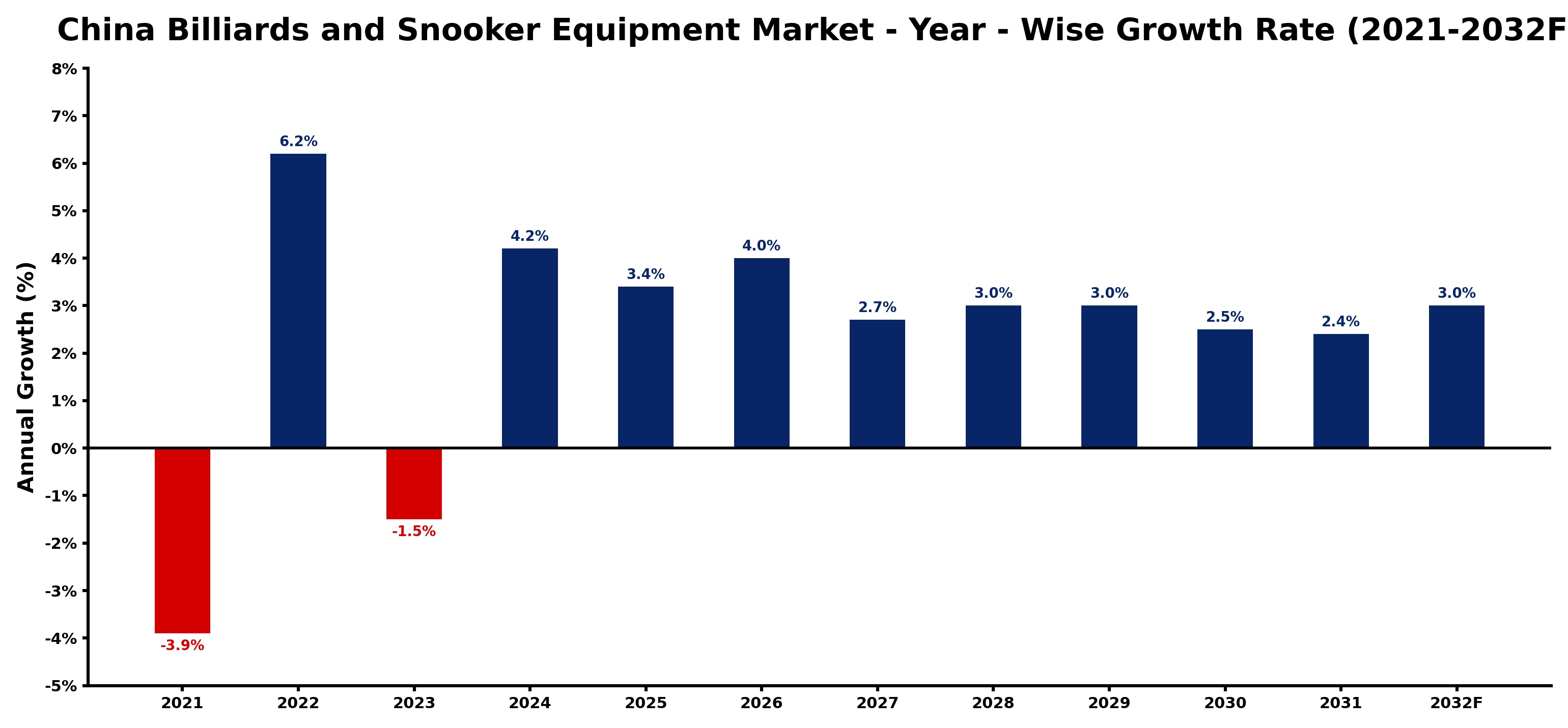
The table below presents the year‑wise growth rates along with the key drivers influencing the market
| Year | Growth Rate | Major Drivers |
| 2021 | -3.9% | Increasing smart city development projects |
| 2022 | 6.2% | Expansion of manufacturing activities |
| 2023 | -1.5% | Increasing industrial infrastructure investments |
| 2024 | 4.2% | Expansion of manufacturing activities |
| 2025 | 3.4% | Increasing industrial infrastructure investments |
| 2026 | 4.0% | Increasing adoption of advanced technologies |
| 2027 | 2.7% | Growing renewable energy integration projects |
| 2028 | 3.0% | Increasing adoption of advanced technologies |
| 2029 | 3.0% | Increasing industrial automation investments |
| 2030 | 2.5% | Growing renewable energy integration projects |
| 2031 | 2.4% | Expansion of transportation and logistics networks |
| 2032 | 3.0% | Growing renewable energy integration projects |
Note - Market size estimations and growth projections presented in this report are based on 6Wresearch’s advanced forecasting approach, validated with industry datasets as of June 2026.
China Billiards and Snooker Equipment Market Synopsis
The demand for high-quality billiards and snooker equipment is surging, driven by a younger generation that seeks not just recreational outlets but also competitive play. The emergence of professional circuits and international tournaments hosted in China is generating a heightened interest in premium-grade equipment, which is seen as essential for serious players.
Moreover, innovations in equipment technology, such as smart cue sticks equipped with performance-tracking sensors, are capturing the interest of tech-savvy enthusiasts. This trend towards high-performance and durable products is reshaping consumer expectations, creating a rich landscape for growth and expansion.
China Billiards and Snooker Equipment Market Key Takeaways
- The market is benefiting from rising disposable incomes and a growing middle-class demographic.
- Technological innovations are reshaping the landscape of product offerings.
- Customization and personalization of billiards equipment are becoming essential competitive advantages.
- Government policies support the industry through regulations that ensure quality and safety.
- Strategic partnerships and collaborations are enhancing market presence among manufacturers.
Evaluation of Restraints in China Billiards and Snooker Equipment Market
Despite its promising growth trajectory, the China Billiards and Snooker Equipment Market faces notable restraints. Increasing competition from both domestic and international manufacturers has created price wars, which compress profit margins. Additionally, the presence of counterfeit products and low-quality alternatives undermines brand trust and market share for established companies. Furthermore, regulatory hurdles related to licensing for clubs can deter new entrants and slow down market expansion.
China Billiards and Snooker Equipment Market Trends
Current trends in the market point towards an increasing emphasis on high-quality, performance-enhancing products. Consumers are increasingly gravitating towards innovative designs and materials, which offer better playability and longevity. Moreover, the interest in professional-grade equipment is growing, driven in part by televised tournaments and celebrity endorsements, further fueling the demand for superior equipment.
Additionally, there is a noticeable shift towards online retail platforms, which provide consumers with greater convenience and access to a broader range of products, including specialized items. This transition towards digital commerce is expected to continue playing a significant role in shaping purchasing behaviors.
China Billiards and Snooker Equipment Market Opportunities
The investment landscape within the China Billiards and Snooker Equipment Market is ripe with opportunities. As more young people take up the sport, the demand for both high-quality equipment and unique, customized products is expected to rise. Retailers and manufacturers can tap into this trend by developing specialized lines that cater to niche markets, such as luxury or personalized billiards gear. Moreover, the growth of online platforms presents a robust avenue for expanding reach and enhancing sales.
Government Initiatives in the China Billiards and Snooker Equipment Market
The Chinese government has been actively promoting sports and recreational activities, which includes billiards and snooker. Policies aimed at encouraging participation and ensuring safety in manufacturing are vital for the industry's development. Tax incentives have also been put in place to bolster domestic production and attract investment, creating a favorable environment for both new and existing players in the market.
Future Insights of the China Billiards and Snooker Equipment Market
Looking ahead to 2026-2032, the China Billiards and Snooker Equipment Market is set for continued growth, driven by urbanization and rising interest in recreational sports. The expanding number of clubs and improved infrastructure for billiards and snooker facilities are likely to facilitate greater participation. As consumer spending grows, the market will see an uptick in demand for innovative, high-quality products that enhance the playing experience.
China Billiards and Snooker Equipment Market Latest Developments (May 2025 - June 2026)
Recent industry developments indicate a stronger focus on technological integration within equipment offerings. Manufacturers are exploring advanced materials and intelligent features in cue sticks and tables. Meanwhile, partnerships among industry stakeholders are fostering collaborative efforts to enhance product accessibility and consumer education, further propelling market growth.
China Billiards and Snooker Equipment Market - Key Attractiveness of the Report
- 10 Years of Market Numbers
- Historical Data Starting from 2022 to 2025
- Base Year: 2025
- Forecast Data until 2032
- Key Performance Indicators Impacting the Market
- Major Upcoming Developments and Projects
Key Highlights of the Report:
- China Billiards and Snooker Equipment Market Outlook
- Market Size of China Billiards and Snooker Equipment Market, 2025
- Forecast of China Billiards and Snooker Equipment Market, 2032
- Historical Data and Forecast of China Billiards and Snooker Equipment Revenues & Volume for the Period 2022-2032F
- China Billiards and Snooker Equipment Market Trend Evolution
- China Billiards and Snooker Equipment Market Drivers and Challenges
- China Billiards and Snooker Equipment Price Trends
- China Billiards and Snooker Equipment Porter's Five Forces
- China Billiards and Snooker Equipment Industry Life Cycle
- Historical Data and Forecast of China Billiards and Snooker Equipment Market Revenues & Volume By Type for the Period 2022-2032F
- Historical Data and Forecast of China Billiards and Snooker Equipment Market Revenues & Volume By Carom for the Period 2022-2032F
- Historical Data and Forecast of China Billiards and Snooker Equipment Market Revenues & Volume By Pool for the Period 2022-2032F
- Historical Data and Forecast of China Billiards and Snooker Equipment Market Revenues & Volume By Snooker for the Period 2022-2032F
- Historical Data and Forecast of China Billiards and Snooker Equipment Market Revenues & Volume By Equipment for the Period 2022-2032F
- Historical Data and Forecast of China Billiards and Snooker Equipment Market Revenues & Volume By Table for the Period 2022-2032F
- Historical Data and Forecast of China Billiards and Snooker Equipment Market Revenues & Volume By Ball for the Period 2022-2032F
- Historical Data and Forecast of China Billiards and Snooker Equipment Market Revenues & Volume By Cue for the Period 2022-2032F
- Historical Data and Forecast of China Billiards and Snooker Equipment Market Revenues & Volume By Other equipment for the Period 2022-2032F
- Historical Data and Forecast of China Billiards and Snooker Equipment Market Revenues & Volume By Distribution Channel for the Period 2022-2032F
- Historical Data and Forecast of China Billiards and Snooker Equipment Market Revenues & Volume By Offline channel for the Period 2022-2032F
- Historical Data and Forecast of China Billiards and Snooker Equipment Market Revenues & Volume By Online channel for the Period 2022-2032F
- China Billiards and Snooker Equipment Import Export Trade Statistics
- Market Opportunity Assessment By Type
- Market Opportunity Assessment By Equipment
- Market Opportunity Assessment By Distribution Channel
- China Billiards and Snooker Equipment Top Companies Market Share
- China Billiards and Snooker Equipment Competitive Benchmarking By Technical and Operational Parameters
- China Billiards and Snooker Equipment Company Profiles
- China Billiards and Snooker Equipment Key Strategic Recommendations






































