China Biomimetic Materials Market Size, Share & Growth Rate
The China Biomimetic Materials Market was estimated at USD 134 Million in 2025 and is projected to reach USD 153 Million by 2032, growing at a CAGR of 1.9% from 2026 to 2032. This growth trajectory is largely attributed to heightened demand for sustainable materials that mimic natural processes, particularly in sectors such as healthcare, construction, and automotive. As industries increasingly seek innovative solutions to reduce environmental impact while enhancing product performance, the biomimetic materials segment is uniquely positioned for expansion.
China Biomimetic Materials Market Year-wise Growth Rate and Key Drivers
This graph highlights how the China Biomimetic Materials Market has steadily grown over the years, supported by major growth factors.
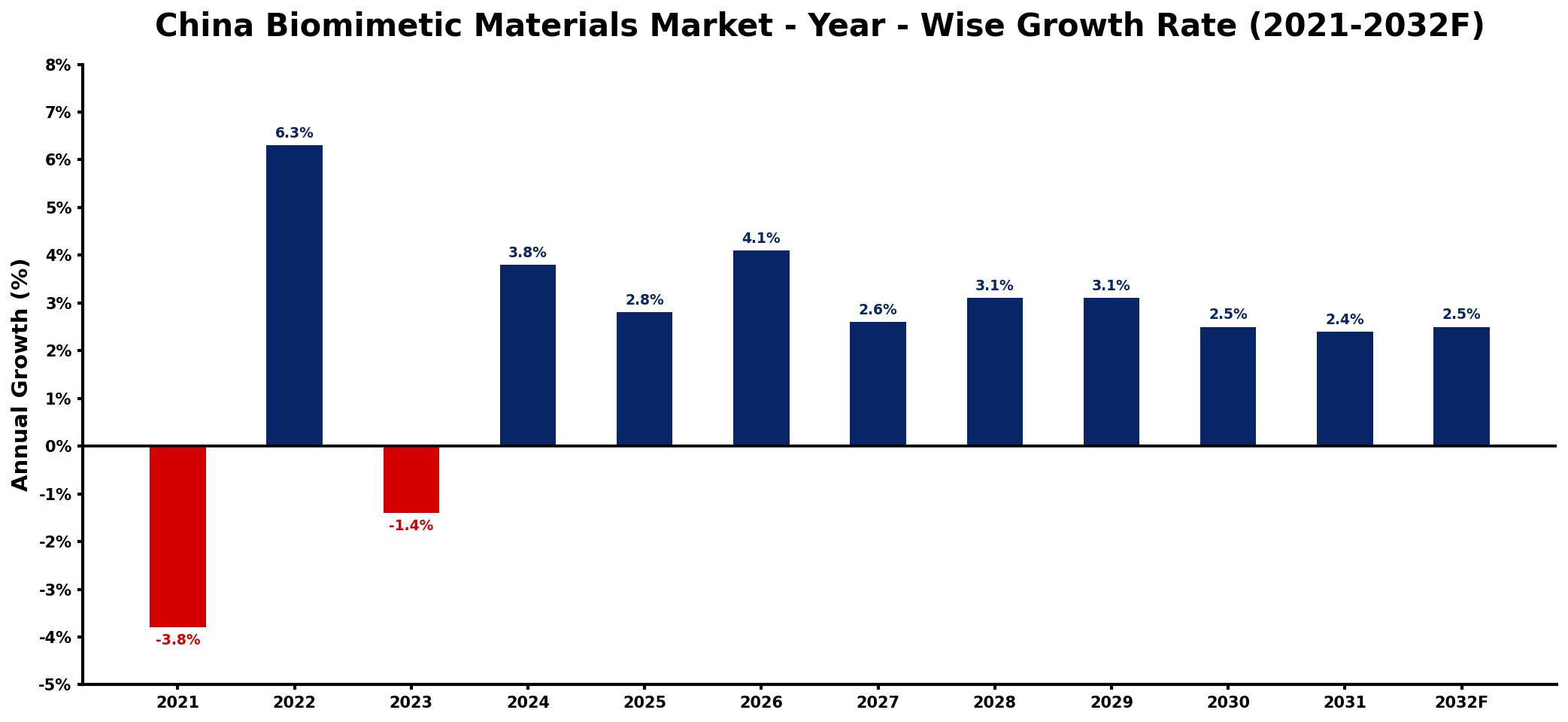
The table below presents the year‑wise growth rates along with the key drivers influencing the market
| Year | Growth Rate | Major Drivers |
| 2021 | -3.8% | Decreased investment in research funding |
| 2022 | 6.3% | Rise in sustainable building practices |
| 2023 | -1.4% | Lower consumer demand for innovation |
| 2024 | 3.8% | Expansion of green technology sectors |
| 2025 | 2.8% | Increased interest in eco-friendly solutions |
| 2026 | 4.1% | Growth in healthcare application demands |
| 2027 | 2.6% | Surge in renewable energy projects |
| 2028 | 3.1% | Boost in government sustainability initiatives |
| 2029 | 3.1% | Emergence of new industrial applications |
| 2030 | 2.5% | Rising awareness of environmental impact |
| 2031 | 2.4% | Development of advanced manufacturing techniques |
| 2032 | 2.5% | Strengthening international trade partnerships |
Note: Market size estimations and growth projections presented in this report are based on 6Wresearch's proprietary forecasting methodology, utilizing the latest available industry data, government publications, and primary research inputs.
China Biomimetic Materials Market Synopsis
In China, the rising focus on sustainability has propelled the adoption of biomimetic materials, with applications ranging from advanced medical implants to eco-friendly construction materials. This demand is further fueled by ongoing research and development initiatives aimed at optimizing the characteristics of these materials, such as self-healing and biocompatibility.
Moreover, China's government is actively supporting the biomimetic materials sector through policy frameworks and funding initiatives. These efforts aim to bolster innovation and encourage collaborations between academic institutions and industry stakeholders, ensuring the rapid commercialization of cutting-edge biomimetic technologies.
China Biomimetic Materials Market Key Takeaways
- The market is projected to experience steady growth, reaching USD 153 Million by 2032.
- Strong government backing is fostering innovation and collaboration in the biomimetic materials sector.
- Key applications in healthcare, construction, and textiles highlight diverse growth opportunities.
- Increased R&D investment is essential for optimizing the performance and scalability of biomimetic materials.
- Technological advancements, particularly in nanotechnology, are paving the way for innovative product developments.
Evaluation of Restraints in China Biomimetic Materials Market
Despite its growth potential, the China Biomimetic Materials Market faces several restraints. Regulatory hurdles related to material approval and certification can slow down market entry and innovation. Additionally, a general lack of awareness and understanding among end-users about biomimetic technologies may hinder widespread adoption. The competition from traditional materials also poses a challenge, as industries may be reluctant to switch to newer solutions without clear proven advantages. Furthermore, the intellectual property landscape surrounding biomimetic designs raises concerns about ethical sourcing and sustainability, which need to be addressed collaboratively for the sector to thrive.
China Biomimetic Materials Market Trends
Several key trends are shaping the China Biomimetic Materials Market. The focus on developing bio-inspired materials with self-healing, self-cleaning, and enhanced biocompatibility is becoming more pronounced. Additionally, advancements in nanotechnology are enabling the creation of materials that offer superior performance characteristics, further driving innovation in the sector. Collaborations among research institutions, universities, and industry players are fostering an ecosystem that emphasizes technology transfer and commercialization of new biomimetic solutions. With sustainability at the forefront, industries are increasingly seeking eco-friendly alternatives, solidifying the demand for biomimetic materials across various applications.
China Biomimetic Materials Market Opportunities
The China Biomimetic Materials Market is ripe with investment opportunities, particularly in healthcare, construction, and textile industries. In healthcare, innovations such as tissue engineering and drug delivery systems present significant growth avenues. Meanwhile, the construction sector is turning towards sustainable building materials that harness biomimetic principles to improve energy efficiency and structural integrity. Moreover, the textile industry is witnessing rising interest in biomimetic fabrics that enhance performance and comfort. Investors looking to capitalize on the growing demand for innovative and eco-friendly materials should focus on companies that are at the forefront of research, development, and commercialization of biomimetic solutions.
Government Initiatives in the China Biomimetic Materials Market
The Chinese government is playing a pivotal role in the advancement of the biomimetic materials market through various supportive initiatives. These include investments in R&D projects aimed at innovation, funding for businesses engaged in the development of sustainable materials, and regulatory frameworks that ensure safety and quality. Furthermore, government policies emphasize the importance of sustainability and environmental protection, actively promoting the adoption of biomimetic materials as viable eco-friendly alternatives across multiple sectors.
Future Insights of the China Biomimetic Materials Market
Looking ahead, the China Biomimetic Materials Market is expected to flourish between 2026 and 2032. Continued investment in research and development will lead to further advancements in material properties and functionalities. As industries increasingly prioritize sustainability and seek innovative solutions, the demand for biomimetic materials will likely escalate. Government initiatives to promote technological advancements and collaborations will further enhance the market's growth potential. With a focus on environmentally friendly materials that align with natural design principles, the future appears promising for the biomimetic materials sector in China.
China Biomimetic Materials Market Latest Developments (2025 - 2026)
Recent developments in the China Biomimetic Materials Market indicate a strong push toward innovative applications of biomimetic technologies. Collaborative research projects between leading universities and private sector companies have accelerated advancements in material functionalities. Additionally, there is a growing emphasis on educational programs that raise awareness and understanding of biomimetic materials among potential end-users. Efforts are being made to establish standardized guidelines for the approval and commercialization of these materials, aiming to facilitate smoother market entry and wider adoption.
China Biomimetic Materials Market - Key Attractiveness of the Report
- 10 Years of Market Numbers
- Historical Data Starting from 2022 to 2025
- Base Year: 2025
- Forecast Data until 2032
- Key Performance Indicators Impacting the Market
- Major Upcoming Developments and Projects
Key Highlights of the Report:
- China Biomimetic Materials Market Outlook
- Market Size of China Biomimetic Materials Market, 2025
- Forecast of China Biomimetic Materials Market, 2032
- Historical Data and Forecast of China Biomimetic Materials Revenues & Volume for the Period 2022-2032F
- China Biomimetic Materials Market Trend Evolution
- China Biomimetic Materials Market Drivers and Challenges
- China Biomimetic Materials Price Trends
- China Biomimetic Materials Porter's Five Forces
- China Biomimetic Materials Industry Life Cycle
- Historical Data and Forecast of China Biomimetic Materials Market Revenues & Volume By Material for the Period 2022-2032F
- Historical Data and Forecast of China Biomimetic Materials Market Revenues & Volume By Biomimetic Polymers for the Period 2022-2032F
- Historical Data and Forecast of China Biomimetic Materials Market Revenues & Volume By Biomimetic Ceramics & Glass for the Period 2022-2032F
- Historical Data and Forecast of China Biomimetic Materials Market Revenues & Volume By Biomimetic Metals & Alloys for the Period 2022-2032F
- Historical Data and Forecast of China Biomimetic Materials Market Revenues & Volume By Others for the Period 2022-2032F
- Historical Data and Forecast of China Biomimetic Materials Market Revenues & Volume By Application for the Period 2022-2032F
- Historical Data and Forecast of China Biomimetic Materials Market Revenues & Volume By Medical for the Period 2022-2032F
- Historical Data and Forecast of China Biomimetic Materials Market Revenues & Volume By Automotive for the Period 2022-2032F
- Historical Data and Forecast of China Biomimetic Materials Market Revenues & Volume By Defense for the Period 2022-2032F
- Historical Data and Forecast of China Biomimetic Materials Market Revenues & Volume By Electronics for the Period 2022-2032F
- Historical Data and Forecast of China Biomimetic Materials Market Revenues & Volume By Others for the Period 2022-2032F
- China Biomimetic Materials Import Export Trade Statistics
- Market Opportunity Assessment By Material
- Market Opportunity Assessment By Application
- China Biomimetic Materials Top Companies Market Share
- China Biomimetic Materials Competitive Benchmarking By Technical and Operational Parameters
- China Biomimetic Materials Company Profiles
- China Biomimetic Materials Key Strategic Recommendations






































