China Business Intelligence Market Size & Growth Rate (2026-2032)
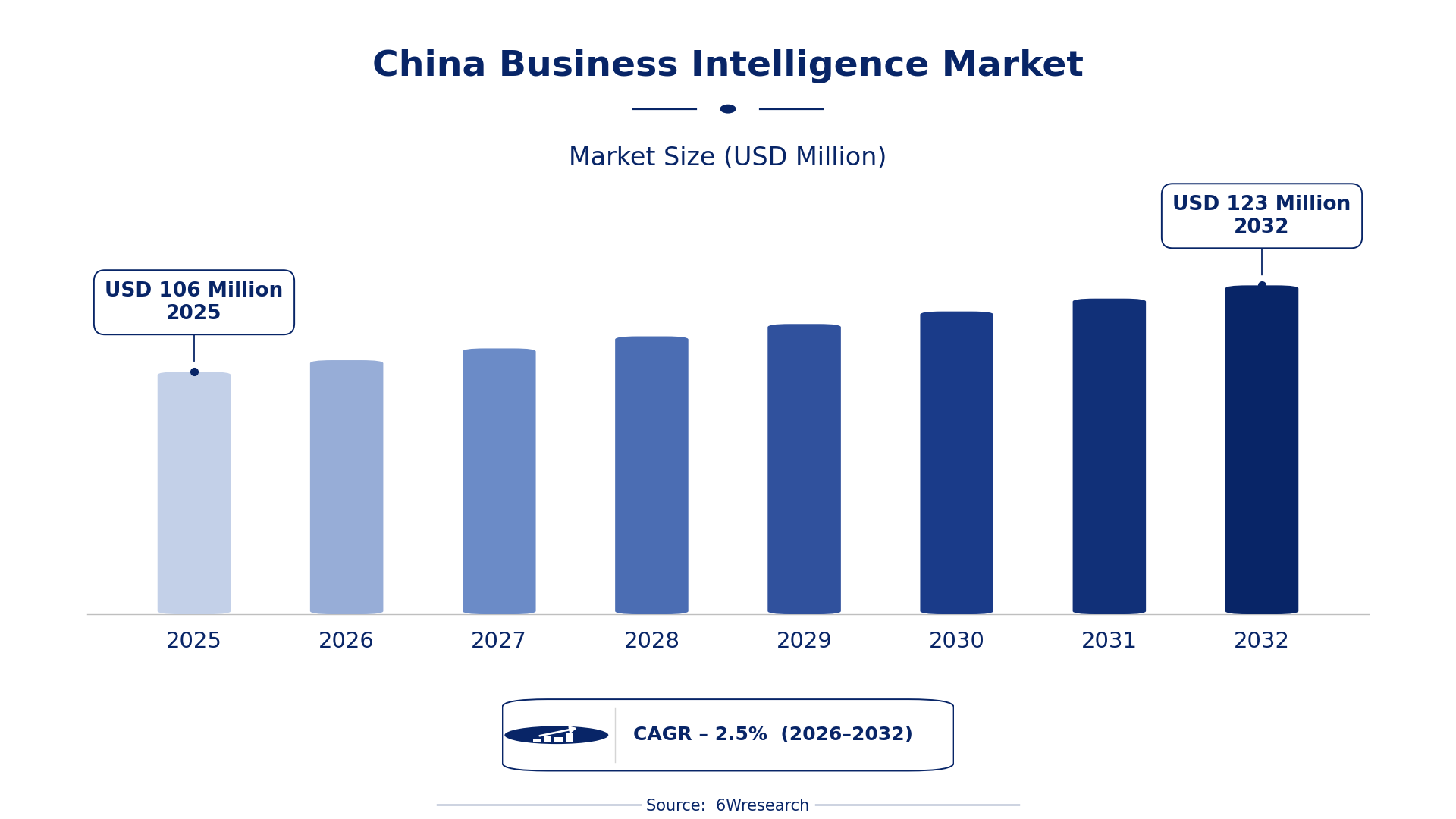
The China Business Intelligence Market was estimated at USD 106 Million in 2025 and is projected to reach USD 123 Million by 2032, growing at a CAGR of 2.5% from 2026 to 2032.
China Business Intelligence Market Synopsis
The China Business Intelligence Market has recently gained momentum due to the increasing integration of advanced analytics tools across various industries. As businesses prioritize data-driven decision-making, the demand for sophisticated BI solutions is expected to accelerate, transforming the market dynamics in the coming years.
Looking ahead, the market is set to evolve significantly as organizations embrace cloud-based analytics and AI technologies. This shift indicates a growing recognition of the value of actionable insights, setting the stage for continued innovation and investment in business intelligence tools within the Chinese market.
China Business Intelligence Market Year-wise Growth Rate and Key Drivers
This graph illustrates the annual growth rates of the China Business Intelligence Market from 2021 to 2032, highlighting a steady upward trajectory and projected expansion over the forecast period.
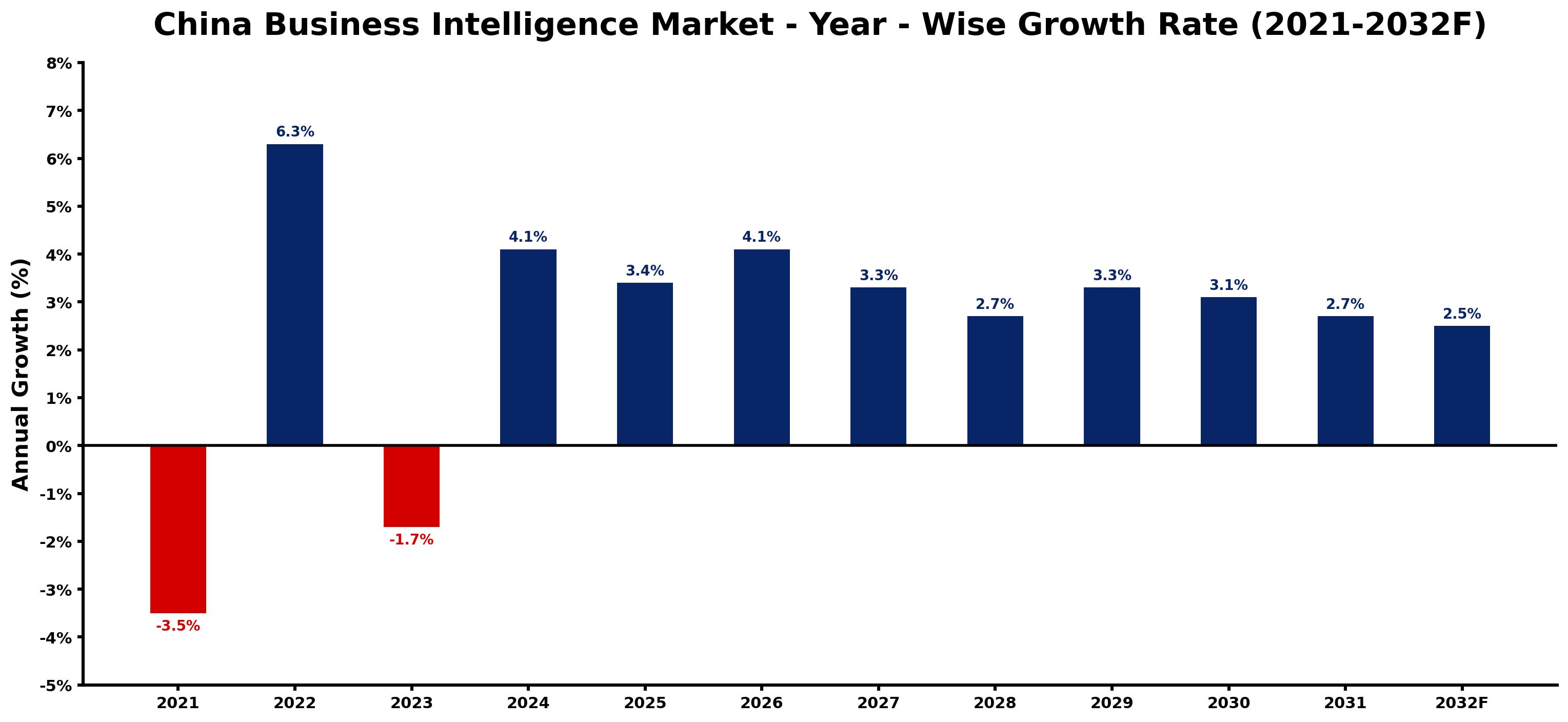
The table below presents the year‑wise growth rates along with the key drivers influencing the market
| Year | Growth Rate | Major Drivers |
| 2021 | -3.5% | Increased scrutiny from China's Ministry of Industry and Information Technology. |
| 2022 | 6.3% | Rising adoption of AI-driven analytics tools in businesses. |
| 2023 | -1.7% | Declining adoption of AI-driven analytics solutions in China. |
| 2024 | 4.1% | Increased demand for data visualization in financial services. |
| 2025 | 3.4% | Growing e-commerce sector boosting consumer insights needs. |
| 2026 | 4.1% | Regulatory push for enhanced data governance and compliance. |
| 2027 | 3.3% | Expanding urbanization driving localized market research requirements. |
| 2028 | 2.7% | Emergence of cloud-based solutions in SMEs enhancing accessibility. |
| 2029 | 3.3% | Collaboration with tech firms for real-time data processing. |
| 2030 | 3.1% | Focus on leveraging data for sustainability initiatives. |
| 2031 | 2.7% | Demand for predictive analytics in manufacturing optimization. |
| 2032 | 2.5% | Growing emphasis on consumer behavior analysis in retail. |
Note: Market size estimations and growth projections presented in this report are based on 6Wresearch's proprietary forecasting methodology, utilizing the latest available industry data, government publications, and primary research inputs.
China Business Intelligence Market Key Takeaways
Below are some of the specific key takeaways from the market, including:
- The increasing adoption of big data analytics is reshaping business strategies.
- Cloud-based BI solutions are gaining traction among enterprises looking for scalability.
- AI-powered tools are becoming essential for real-time data analysis and predictive insights.
- Investment opportunities are emerging in industry-specific BI applications tailored for local needs.
- Government policies are both supporting innovation and imposing data privacy regulations.
Evaluation of Restraints in China Business Intelligence Market
Despite the promising growth trajectory, several factors constrain the expansion of the China Business Intelligence Market. Chief among these are stringent data security regulations that create compliance challenges for businesses. Additionally, the competitive environment, filled with both domestic and international players, intensifies the pressure on companies to differentiate their offerings. The shortage of skilled professionals in business intelligence further exacerbates these issues, making it difficult for organizations to effectively implement and utilize BI solutions. Cultural nuances and language barriers also complicate market entry and engagement strategies for foreign firms, necessitating a nuanced approach to local operations.
China Business Intelligence Market Trends
The demand for real-time analytics is a prominent trend in the China Business Intelligence Market, as businesses seek immediate insights to drive decision-making. Predictive modeling and data visualization tools are also gaining traction, enabling organizations to forecast trends and present data in more accessible formats. on top of that, the integration of BI solutions with mobile platforms is enhancing accessibility, allowing decision-makers to leverage insights anytime, anywhere. A significant emphasis on self-service analytics is emerging, empowering employees across various levels to engage with data independently and foster a culture of data-driven decision-making.
China Business Intelligence Market Opportunities
Investment opportunities in the China Business Intelligence Market are plentiful, particularly in advanced analytics and AI technologies. The growing focus on digital transformation is driving demand for BI tools that help businesses optimize operations and understand consumer behavior. The e-commerce sector, which continues to expand rapidly, presents unique opportunities for BI solutions to enhance marketing strategies and improve customer engagement. Investors can explore partnerships with established BI vendors or consider emerging startups that offer innovative solutions tailored to the Chinese market.
Government Initiatives in the China Business Intelligence Market
Government policies play a crucial role in shaping the China Business Intelligence Market, balancing innovation with regulation. The administration has instituted various initiatives to promote the adoption of business intelligence technologies while ensuring data security and privacy compliance. This regulatory posture is vital for fostering a sustainable environment for BI growth.
- A regulatory framework introduced in 2025 mandates strict compliance with data protection laws for companies handling sensitive information.
- Current initiatives are focusing on enhancing the capabilities of AI and big data technologies through public-private partnerships.
- A planned public sector program is expected to boost investment in digital infrastructure, improving access to advanced analytics tools by 2027.
- Recently, the government launched a campaign to promote data literacy among businesses, aiming to create a more informed workforce by 2026.
- Ongoing efforts are in place to streamline foreign investment processes in tech sectors, expected to evolve by 2028.
Future Insights of the China Business Intelligence Market
The future of the China Business Intelligence Market looks promising as businesses increasingly recognize the importance of data in driving strategic decisions. The continued emphasis on digital transformation will likely fuel further adoption of BI solutions, with a focus on real-time analytics and AI-driven insights. As government initiatives support the development of advanced technologies, the market is expected to witness significant innovation, leading to a more competitive environment. With the anticipated growth of e-commerce and other sectors, opportunities for BI solutions will expand, ensuring a robust market presence in the years ahead.
China Business Intelligence Market Latest Developments
Recent months have seen a flurry of activity within the China Business Intelligence Market, reflecting a dynamic shift towards advanced analytics and AI integration. Companies are increasingly launching initiatives aimed at enhancing their BI capabilities, driven by the urgent need for data-driven decision-making amidst evolving market conditions.
- A major technology vendor completed a rollout of an AI-enhanced analytics platform in early 2025, significantly improving user experience and data insights.
- Currently ongoing is a collaboration between industry players to develop industry-specific BI tools tailored for the manufacturing sector.
- A new public initiative aimed at increasing data literacy among businesses is in its early implementation phase, expected to yield results by late 2025.
- Planned for the second half of 2026 is a comprehensive upgrade of cloud-based BI solutions, enhancing their scalability and performance.
- A recently launched partnership initiative is focused on integrating mobile analytics capabilities into existing BI platforms, currently underway.
China Business Intelligence Market - Key Attractiveness of the Report
- 10 Years of Market Numbers
- Historical Data Starting from 2022 to 2025
- Base Year: 2025
- Forecast Data until 2032
- Key Performance Indicators Impacting the Market
- Major Upcoming Developments and Projects
Key Highlights of the Report:
- China Business Intelligence Market Outlook
- Market Size of China Business Intelligence Market, 2025
- Forecast of China Business Intelligence Market, 2032
- Historical Data and Forecast of China Business Intelligence Revenues & Volume for the Period 2022-2032F
- China Business Intelligence Market Trend Evolution
- China Business Intelligence Market Drivers and Challenges
- China Business Intelligence Price Trends
- China Business Intelligence Porter's Five Forces
- China Business Intelligence Industry Life Cycle
- Historical Data and Forecast of China Business Intelligence Market Revenues & Volume By Component for the Period 2022-2032F
- Historical Data and Forecast of China Business Intelligence Market Revenues & Volume By Solutions for the Period 2022-2032F
- Historical Data and Forecast of China Business Intelligence Market Revenues & Volume By Services for the Period 2022-2032F
- Historical Data and Forecast of China Business Intelligence Market Revenues & Volume By Business Function for the Period 2022-2032F
- Historical Data and Forecast of China Business Intelligence Market Revenues & Volume By Human Resource for the Period 2022-2032F
- Historical Data and Forecast of China Business Intelligence Market Revenues & Volume By Finance for the Period 2022-2032F
- Historical Data and Forecast of China Business Intelligence Market Revenues & Volume By Operations for the Period 2022-2032F
- Historical Data and Forecast of China Business Intelligence Market Revenues & Volume By Sales and Marketing for the Period 2022-2032F
- Historical Data and Forecast of China Business Intelligence Market Revenues & Volume By Deployment Mode for the Period 2022-2032F
- Historical Data and Forecast of China Business Intelligence Market Revenues & Volume By On-premises for the Period 2022-2032F
- Historical Data and Forecast of China Business Intelligence Market Revenues & Volume By Cloud for the Period 2022-2032F
- Historical Data and Forecast of China Business Intelligence Market Revenues & Volume By Organization Size for the Period 2022-2032F
- Historical Data and Forecast of China Business Intelligence Market Revenues & Volume By SMEs for the Period 2022-2032F
- Historical Data and Forecast of China Business Intelligence Market Revenues & Volume By Large Enterprises for the Period 2022-2032F
- Historical Data and Forecast of China Business Intelligence Market Revenues & Volume By Vertical for the Period 2022-2032F
- Historical Data and Forecast of China Business Intelligence Market Revenues & Volume By Retail for the Period 2022-2032F
- Historical Data and Forecast of China Business Intelligence Market Revenues & Volume By Manufacturing for the Period 2022-2032F
- Historical Data and Forecast of China Business Intelligence Market Revenues & Volume By Government and Public Services for the Period 2022-2032F
- Historical Data and Forecast of China Business Intelligence Market Revenues & Volume By Media and Entertainment for the Period 2022-2032F
- Historical Data and Forecast of China Business Intelligence Market Revenues & Volume By Transportation and Logistics for the Period 2022-2032F
- Historical Data and Forecast of China Business Intelligence Market Revenues & Volume By BFSI for the Period 2022-2032F
- Historical Data and Forecast of China Business Intelligence Market Revenues & Volume By Telecom and IT for the Period 2022-2032F
- Historical Data and Forecast of China Business Intelligence Market Revenues & Volume By Healthcare and Life Sciences for the Period 2022-2032F
- China Business Intelligence Import Export Trade Statistics
- Market Opportunity Assessment By Component
- Market Opportunity Assessment By Business Function
- Market Opportunity Assessment By Deployment Mode
- Market Opportunity Assessment By Organization Size
- Market Opportunity Assessment By Vertical
- China Business Intelligence Top Companies Market Share
- China Business Intelligence Competitive Benchmarking By Technical and Operational Parameters
- China Business Intelligence Company Profiles
- China Business Intelligence Key Strategic Recommendations






































