China Camera Tripods Market Size, Share & Growth Rate
The China Camera Tripods Market was estimated at USD 159 Million in 2025 and is projected to reach USD 183 Million by 2032, growing at a CAGR of 2.0% from 2026 to 2032. This upward trajectory is primarily driven by the surge in photography and videography interest among the populace, supported by an increasing number of content creators and influencers leveraging social media platforms. As consumers prioritize quality visuals for personal and professional projects, the need for high-quality tripod solutions continues to intensify.
China Camera Tripods Market Year-wise Growth Rate and Key Drivers
This graph highlights how the China Camera Tripods Market has steadily grown over the years, supported by major growth factors.
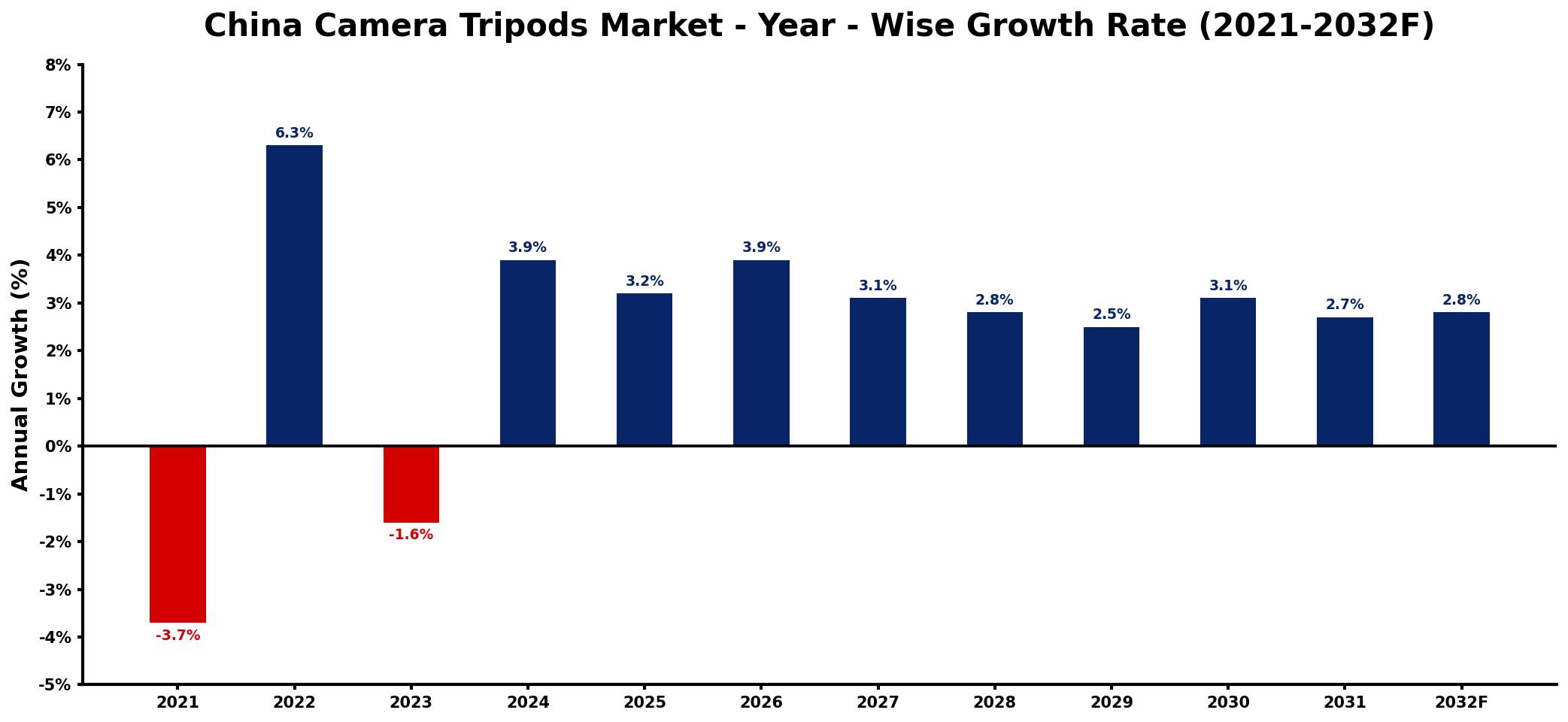
The table below presents the year‑wise growth rates along with the key drivers influencing the market
| Year | Growth Rate | Major Drivers |
| 2021 | -3.7% | decrease in consumer spending habits |
| 2022 | 6.3% | rise in photography hobbyists community |
| 2023 | -1.6% | reduction in outdoor events popularity |
| 2024 | 3.9% | growth in influencer marketing strategies |
| 2025 | 3.2% | increase in content creation platforms |
| 2026 | 3.9% | expansion of adventure tourism sector |
| 2027 | 3.1% | surge in social media engagement |
| 2028 | 2.8% | development of new photography technologies |
| 2029 | 2.5% | growing commercial sector adoption |
| 2030 | 3.1% | increased pharmaceutical industry usage |
| 2031 | 2.7% | rising procurement volume requirements |
| 2032 | 2.8% | growing downstream application demand |
Note: Market size estimations and growth projections presented in this report are based on 6Wresearch's proprietary forecasting methodology, utilizing the latest available industry data, government publications, and primary research inputs.
China Camera Tripods Market Synopsis
The most powerful force currently shaping the China Camera Tripods Market is the expansion of the social media landscape and the accompanying rise in content creation. With platforms like Douyin and Xiaohongshu gaining prominence, users require reliable camera accessories to enhance their visual storytelling capabilities, directly influencing tripod sales.
Additionally, a growing segment of tech-savvy consumers is showing preference for innovative products that integrate advanced features. This has led manufacturers to develop versatile tripods equipped for a range of devices—from DSLRs to smartphones—catering to an expanding customer base looking for multifunctional equipment.
China Camera Tripods Market Key Takeaways
- The increasing popularity of vlogging and content creation is driving significant demand for versatile camera tripods.
- Innovative designs and features, such as lightweight materials and enhanced stability, are becoming essential for capturing quality visuals.
- Domestic and international competition is fierce, leading to ongoing technological advancements in tripod offerings.
- Chinese consumers are increasingly seeking eco-friendly and high-quality products, aligning with global sustainability trends.
- Investment opportunities abound, particularly in specialized tripod designs catering to diverse photographic needs.
Evaluation of Restraints in China Camera Tripods Market
Despite promising growth, the China Camera Tripods Market faces certain restraints. Intense competition, both from local and international manufacturers, often leads to aggressive pricing strategies that can squeeze profit margins. Moreover, rapid technological advancements demand continuous innovation; companies that fail to adapt may quickly lose market relevance. Intellectual property issues, including counterfeiting, also pose significant challenges, potentially undermining trust in brand quality and impacting established manufacturers. Adapting to shifting consumer preferences toward compact and lightweight options can further strain traditional tripod producers who may be slow to respond to these trends.
China Camera Tripods Market Trends
Several compelling trends are shaping the China Camera Tripods Market. Foremost among these is the rising demand for lightweight and portable tripods that cater to on-the-go photographers. As more consumers engage in outdoor photography or travel, the preference for easily transportable equipment grows. Furthermore, versatile tripods that accommodate various devices—such as smartphones and action cameras—are becoming increasingly popular. There is also a noticeable trend toward designs featuring adjustable legs and quick-release mechanisms, enhancing functionality and user experience, which is vital for capturing dynamic content.
China Camera Tripods Market Opportunities
With the burgeoning interest in high-quality visual content, the China Camera Tripods Market presents numerous investment opportunities. Innovators can explore the design of specialized tripods tailored for different photography needs, appealing to both amateurs and professionals alike. Additionally, enhancing marketing and distribution strategies can help manufacturers reach a broader demographic across China's diverse consumer landscape. Engaging with social media influencers for product endorsements could also amplify brand visibility and drive sales in a rapidly growing segment.
Government Initiatives in the China Camera Tripods Market
The Chinese government has rolled out several supportive initiatives aimed at fostering innovation within the camera tripods market. These include tax incentives for companies investing in R&D to advance tripod technology, as well as subsidies to promote sustainable manufacturing practices. Policies ensuring stringent quality and safety standards also bolster consumer confidence in local products. By encouraging international partnerships and trade agreements, the government is enhancing market accessibility for Chinese manufacturers, ultimately boosting competitiveness on a global scale.
Future Insights of the China Camera Tripods Market
Looking ahead to 2026-2032, the future of the China Camera Tripods Market appears bright, driven by a sustained interest in photography and videography. As social media trends continue to evolve, the need for innovative and high-quality accessories is likely to increase. The market will benefit from ongoing advancements in materials and design that promote portability and versatility. With a growing focus on user-friendly features that enhance the content creation experience, we can anticipate a dynamic and rapidly evolving landscape in camera support equipment.
China Camera Tripods Market Latest Developments (2025 - 2026)
In recent months, the China Camera Tripods Market has witnessed several notable industry shifts. Manufacturers are increasingly prioritizing the integration of smart technology into tripod designs, allowing for remote control features that enhance user convenience. Additionally, collaborations with social media platforms to develop customized products tailored to content creators have emerged as a strategic focus. The push for sustainability has also gained momentum, with more brands adopting eco-friendly production practices in response to consumer demand for greener products.
China Camera Tripods Market - Key Attractiveness of the Report
- 10 Years of Market Numbers
- Historical Data Starting from 2022 to 2025
- Base Year: 2025
- Forecast Data until 2032
- Key Performance Indicators Impacting the Market
- Major Upcoming Developments and Projects
Key Highlights of the Report:
- China Camera Tripods Market Outlook
- Market Size of China Camera Tripods Market, 2025
- Forecast of China Camera Tripods Market, 2032
- Historical Data and Forecast of China Camera Tripods Revenues & Volume for the Period 2022-2032F
- China Camera Tripods Market Trend Evolution
- China Camera Tripods Market Drivers and Challenges
- China Camera Tripods Price Trends
- China Camera Tripods Porter's Five Forces
- China Camera Tripods Industry Life Cycle
- Historical Data and Forecast of China Camera Tripods Market Revenues & Volume By Product Type for the Period 2022-2032F
- Historical Data and Forecast of China Camera Tripods Market Revenues & Volume By Travel for the Period 2022-2032F
- Historical Data and Forecast of China Camera Tripods Market Revenues & Volume By Studio for the Period 2022-2032F
- Historical Data and Forecast of China Camera Tripods Market Revenues & Volume By Pocket for the Period 2022-2032F
- Historical Data and Forecast of China Camera Tripods Market Revenues & Volume By Others for the Period 2022-2032F
- Historical Data and Forecast of China Camera Tripods Market Revenues & Volume By Distribution Channel for the Period 2022-2032F
- Historical Data and Forecast of China Camera Tripods Market Revenues & Volume By Store Based for the Period 2022-2032F
- Historical Data and Forecast of China Camera Tripods Market Revenues & Volume By Non Store Based for the Period 2022-2032F
- China Camera Tripods Import Export Trade Statistics
- Market Opportunity Assessment By Product Type
- Market Opportunity Assessment By Distribution Channel
- China Camera Tripods Top Companies Market Share
- China Camera Tripods Competitive Benchmarking By Technical and Operational Parameters
- China Camera Tripods Company Profiles
- China Camera Tripods Key Strategic Recommendations






































