China Canned Fruits Market Summary
The china canned fruits market was estimated at USD 190 Million in 2025 and is projected to reach USD 217 Million by 2032, growing at a CAGR of 4.0% from 2026 to 2032.
China Canned Fruits Market Year-wise Growth Rate and Key Drivers
This graph highlights how the China Canned Fruits Market has steadily grown over the past five years, supported by major growth factors.
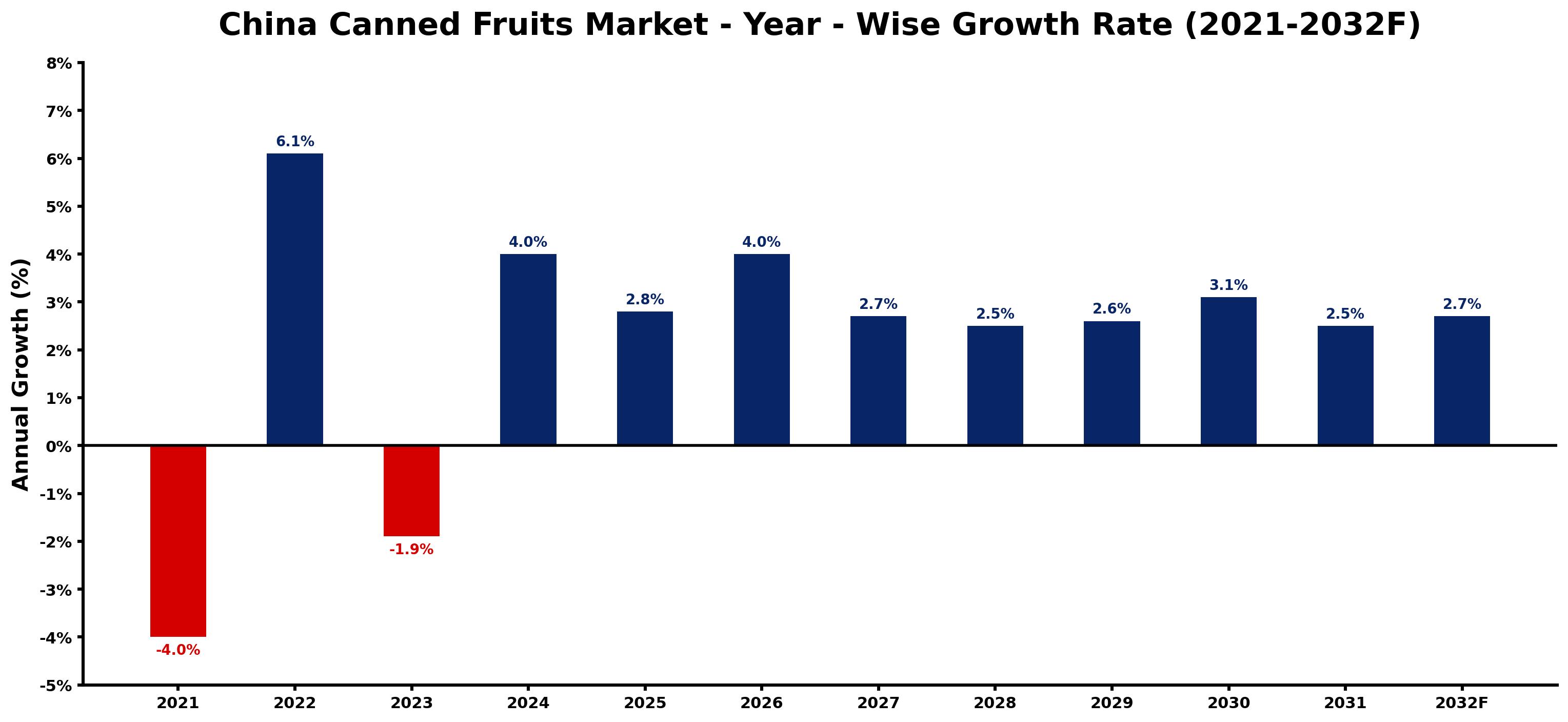
The table below presents the year wise growth rates along with the key drivers influencing the market
| Year | Growth Rate | Major Drivers |
| 2021 | -4.0% | Increased competition from fresh fruit alternatives diminished the appeal of canned products among healthconscious consumers. |
| 2022 | 6.1% | Health-conscious trends drive demand for naturally preserved fruits without additives. |
| 2023 | -1.9% | Heightened competition from fresh fruit alternatives diminished consumer interest in canned fruit products this year. |
| 2024 | 4.0% | Local brands focus on sustainable practices to appeal to eco-aware consumers. |
| 2025 | 2.8% | Product diversification introduces exotic flavors catering to adventurous palates. |
| 2026 | 4.0% | Supply chain improvements enhance distribution efficiency across major metropolitan areas. |
| 2027 | 2.7% | Food safety concerns elevate consumer expectations for quality and transparency. |
| 2028 | 2.5% | Collaborations with health influencers amplify awareness of fruit-based diets. |
| 2029 | 2.6% | Investment in packaging innovation supports extended shelf life and freshness. |
| 2030 | 3.1% | Regional economic stability encourages disposable income growth for premium products. |
| 2031 | 2.5% | School feeding programs increasingly incorporate canned fruits for nutritious meals. |
| 2032 | 2.7% | Cultural shifts embrace canned fruits in traditional recipes, expanding culinary uses. |
Note - Market size estimations and growth projections presented in this report are based on 6Wresearch's advanced forecasting approach, validated with industry datasets as of June 2026.
China Canned Fruits Market Synopsis
The China Canned Fruits Market is projected to reach 4.0% and witness significant growth during the forecast period (2026-2032). This growth is primarily driven by the increasing urbanization and evolving consumer lifestyles that favor convenience food options. Consumers are turning to canned fruits not only for their accessibility but also for the extended shelf life and diversity they offer compared to fresh produce.
China Canned Fruits Market Growth Drivers
The growth of the China canned fruits market can be attributed to several key drivers:
- The rapid pace of urbanization in China has shifted consumer behavior, making convenient food options, such as canned fruits, more appealing.
- Changing lifestyles are leading to an increase in demand for ready-to-eat and easy-to-store food items, particularly among busy professionals and young families.
- Health consciousness among consumers is rising, resulting in a preference for canned fruits that are organic and free from artificial additives.
- The growth of disposable income allows consumers to explore premium options, with a noticeable trend towards exotic canned fruit varieties.
- The widespread adoption of e-commerce platforms has expanded market reach, enabling consumers to access a wide range of canned fruit products from the comfort of their homes.
China Canned Fruits Market Trends and Opportunities
Current trends within the China canned fruits market illustrate a shifting landscape driven by consumer preferences:
- There is a significant uptick in demand for healthier snacks, with canned fruits being favored as a nutritious on-the-go option.
- Consumers are increasingly willing to pay a premium for products that emphasize quality, taste, and nutritional value, resulting in higher sales for top-tier canned fruit brands.
- The introduction of organic and natural canned fruit products is responding well to the health-conscious segment of the market.
- E-commerce plays an essential role in the distribution of canned fruits, as more consumers turn to online shopping for convenience and variety.
- Innovative packaging solutions, which preserve taste and extend shelf life, are becoming a focal point in attracting a discerning customer base.
China Canned Fruits Market Challenges and Restraints
Despite its growth potential, the China canned fruits market encounters various challenges that could impact its trajectory:
- Intense competition from fresh fruit options poses a challenge, as consumers often perceive fresh produce to be healthier.
- Concerns regarding the nutritional value and quality of canned fruits can deter consumers who prioritize their health.
- Fluctuating prices of raw materials can affect profit margins and pricing strategies for manufacturers in the market.
- Logistical hurdles, including transportation and storage issues, can complicate operations for companies involved in the canned fruits sector.
- Stringent food safety regulations require companies to ensure compliance, which can increase operational costs and influence product development timelines.
China Canned Fruits Market Investment Opportunities
The evolving landscape of the China canned fruits market presents attractive investment opportunities:
- The growing demand for convenience foods indicates a robust market potential for innovation in canned fruit products.
- Investing in advanced packaging technologies can enhance product appeal and improve shelf stability, capturing a larger market share.
- Companies that focus on product diversification, including organic options, are likely to resonate with the health-conscious consumer segment.
- Leveraging e-commerce platforms offers a strategic route for market penetration and consumer engagement, facilitating growth.
- Emphasizing sustainability practices in sourcing and production can attract environmentally conscious consumers and enhance brand loyalty.
China Canned Fruits Market Government Investment and Initiatives
The Chinese government has implemented several initiatives to bolster the canned fruits market while promoting food safety:
- Regulatory frameworks regarding labeling, quality standards, and safety inspections have been established to safeguard consumer interests.
- Support for domestic producers through financial incentives and subsidies aims to enhance production capabilities and improve product quality.
- Import tariffs and restrictions are enforced to strengthen local manufacturers' competitive edge against foreign imports.
- Government-backed public health campaigns often emphasize the consumption of canned fruits as part of a balanced diet, encouraging demand.
- Investment in infrastructure developments, including cold chain logistics, is crucial to facilitate distribution and enhance product availability.
China Canned Fruits Market Latest Developments (May 2025 - June 2026)
Recent developments in the China canned fruits market indicate a robust trajectory for growth:
- There has been a noticeable shift towards healthier canned fruit options, with increased production of organic varieties.
- Innovations in packaging have gained traction, with companies exploring eco-friendly materials that appeal to environmentally conscious consumers.
- A surge in e-commerce sales for canned fruits has been observed, reflecting a broader trend of online shopping across various consumer goods.
- Collaborations between manufacturers and retailers have emerged to enhance product visibility and availability in the market.
- Consumer education efforts regarding the benefits of canned fruits have resulted in a gradual increase in acceptance and preference for these products.
China Canned Fruits Market - Key Attractiveness of the Report
- 10 Years of Market Numbers
- Historical Data Starting from 2022 to 2025
- Base Year: 2025
- Forecast Data until 2032
- Key Performance Indicators Impacting the Market
- Major Upcoming Developments and Projects
Key Highlights of the Report:
- China Canned Fruits Market Outlook
- Market Size of China Canned Fruits Market, 2025
- Forecast of China Canned Fruits Market, 2032F
- Historical Data and Forecast of China Canned Fruits Revenues & Volume for the Period 2022-2032F
- China Canned Fruits Market Trend Evolution
- China Canned Fruits Market Drivers and Challenges
- China Canned Fruits Price Trends
- China Canned Fruits Porter's Five Forces
- China Canned Fruits Industry Life Cycle
- Historical Data and Forecast of China Canned Fruits Market Revenues & Volume By Fruit Type for the Period 2022-2032F
- Historical Data and Forecast of China Canned Fruits Market Revenues & Volume By Peaches for the Period 2022-2032F
- Historical Data and Forecast of China Canned Fruits Market Revenues & Volume By Pineapple for the Period 2022-2032F
- Historical Data and Forecast of China Canned Fruits Market Revenues & Volume By Mandarin oranges for the Period 2022-2032F
- Historical Data and Forecast of China Canned Fruits Market Revenues & Volume By Pears for the Period 2022-2032F
- Historical Data and Forecast of China Canned Fruits Market Revenues & Volume By Others for the Period 2022-2032F
- Historical Data and Forecast of China Canned Fruits Market Revenues & Volume By Form for the Period 2022-2032F
- Historical Data and Forecast of China Canned Fruits Market Revenues & Volume By Whole fruits for the Period 2022-2032F
- Historical Data and Forecast of China Canned Fruits Market Revenues & Volume By Cut fruits for the Period 2022-2032F
- Historical Data and Forecast of China Canned Fruits Market Revenues & Volume By Distribution Channel for the Period 2022-2032F
- Historical Data and Forecast of China Canned Fruits Market Revenues & Volume By Supermarkets/Hypermarkets for the Period 2022-2032F
- Historical Data and Forecast of China Canned Fruits Market Revenues & Volume By Convenience Stores for the Period 2022-2032F
- Historical Data and Forecast of China Canned Fruits Market Revenues & Volume By Online Retail for the Period 2022-2032F
- Historical Data and Forecast of China Canned Fruits Market Revenues & Volume By Other for the Period 2022-2032F
- China Canned Fruits Import Export Trade Statistics
- Market Opportunity Assessment By Fruit Type
- Market Opportunity Assessment By Form
- Market Opportunity Assessment By Distribution Channel
- China Canned Fruits Top Companies Market Share
- China Canned Fruits Competitive Benchmarking By Technical and Operational Parameters
- China Canned Fruits Company Profiles
- China Canned Fruits Key Strategic Recommendations






































