China Carnauba Wax Market Size Growth Rate
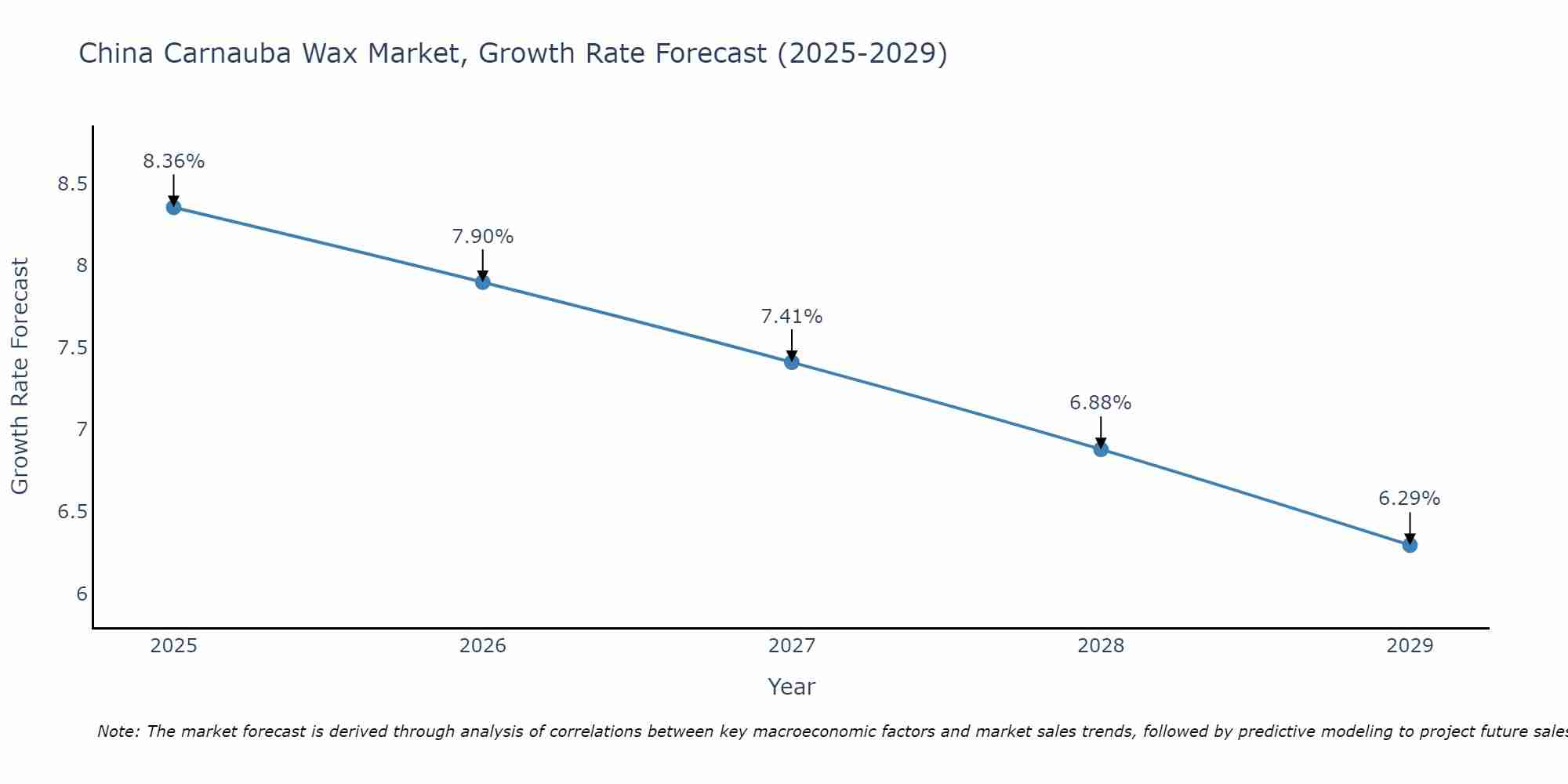
The China Carnauba Wax Market may undergo a gradual slowdown in growth rates between 2025 and 2029. Although the growth rate starts strong at 8.36% in 2025, it steadily loses momentum, ending at 6.29% by 2029.
China Carnauba Wax Market Overview
The Carnauba Wax market in China is expanding due to the demand for natural waxes in various applications, including cosmetics, pharmaceuticals, and food industries. Carnauba wax is prized for its high melting point and glossy finish, making it suitable for use in coatings and formulations. The market is driven by the increasing preference for natural and sustainable ingredients, as well as the growth of the cosmetic and personal care industries. Innovations in wax processing and applications contribute to the markets positive outlook.
Drivers of the market
The China Carnauba Wax Market is driven by the growing demand for natural and sustainable ingredients in cosmetics, food, and pharmaceuticals. Carnauba wax is widely used as a coating agent, thickener, and emulsifier, making it a versatile ingredient in various applications. The increasing consumer awareness about the benefits of natural products and the rising demand for organic and vegan products also contribute to market growth.
Challenges of the market
The China Carnauba Wax market faces challenges from fluctuating raw material supply and high production costs. Carnauba wax is derived from a specific palm tree native to Brazil, and its supply is highly dependent on climatic conditions, leading to price volatility. Additionally, there is strong competition from synthetic waxes and other natural waxes, which can limit market growth.
Government Policy of the market
The Chinese government regulates the carnauba wax market to ensure the quality and safety of imported wax products. Policies include tariffs and import restrictions to protect domestic producers, as well as standards for the use of carnauba wax in food, cosmetics, and industrial applications. The government also encourages the development of alternative waxes to diversify market offerings.
Key Highlights of the Report:
- China Carnauba Wax Market Outlook
- Market Size of China Carnauba Wax Market, 2024
- Forecast of China Carnauba Wax Market, 2031
- Historical Data and Forecast of China Carnauba Wax Revenues & Volume for the Period 2018 - 2031
- China Carnauba Wax Market Trend Evolution
- China Carnauba Wax Market Drivers and Challenges
- China Carnauba Wax Price Trends
- China Carnauba Wax Porter's Five Forces
- China Carnauba Wax Industry Life Cycle
- Historical Data and Forecast of China Carnauba Wax Market Revenues & Volume By Product for the Period 2018 - 2031
- Historical Data and Forecast of China Carnauba Wax Market Revenues & Volume By Type1 for the Period 2018 - 2031
- Historical Data and Forecast of China Carnauba Wax Market Revenues & Volume By Type3 for the Period 2018 - 2031
- Historical Data and Forecast of China Carnauba Wax Market Revenues & Volume By Type4 for the Period 2018 - 2031
- Historical Data and Forecast of China Carnauba Wax Market Revenues & Volume By Application for the Period 2018 - 2031
- Historical Data and Forecast of China Carnauba Wax Market Revenues & Volume By Cosmetics for the Period 2018 - 2031
- Historical Data and Forecast of China Carnauba Wax Market Revenues & Volume By Food for the Period 2018 - 2031
- Historical Data and Forecast of China Carnauba Wax Market Revenues & Volume By Automotive for the Period 2018 - 2031
- Historical Data and Forecast of China Carnauba Wax Market Revenues & Volume By Pharmaceutical for the Period 2018 - 2031
- Historical Data and Forecast of China Carnauba Wax Market Revenues & Volume By Others for the Period 2018 - 2031
- China Carnauba Wax Import Export Trade Statistics
- Market Opportunity Assessment By Product
- Market Opportunity Assessment By Application
- China Carnauba Wax Top Companies Market Share
- China Carnauba Wax Competitive Benchmarking By Technical and Operational Parameters
- China Carnauba Wax Company Profiles
- China Carnauba Wax Key Strategic Recommendations






































