China Cattle Feeds and Feed Concentrates Market Top 5 Importing Countries and Market Competition (HHI) Analysis
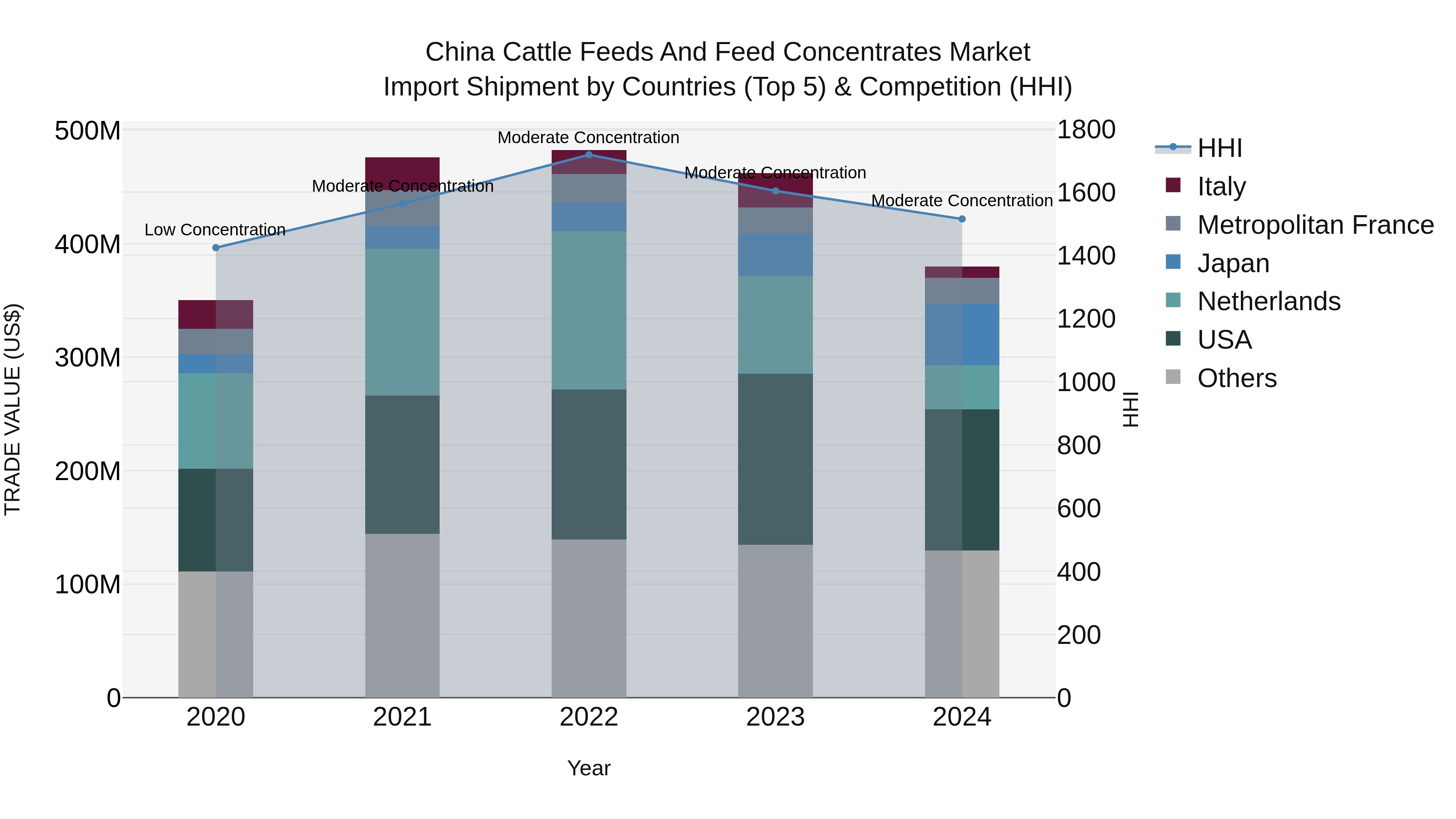
In 2024, China cattle feeds and feed concentrates import market continued to show steady growth with a CAGR of 2.04% from 2020 to 2024. Despite a slight decline in growth rate from 2023 to 2024 at -17.81%, the top exporting countries to China such as USA, Japan, Netherlands, Bulgaria, and Metropolitan France maintained their positions. The market concentration, as measured by the HHI, remained at a moderate level in 2024. This data suggests a stable and competitive landscape in the China cattle feeds and feed concentrates import market, with key players from various countries contributing to its growth.
Key Highlights of the Report:
- China Cattle feeds and Feed Concentrates Market Outlook
- Market Size of China Cattle feeds and Feed Concentrates Market, 2025
- Forecast of China Cattle feeds and Feed Concentrates Market, 2032
- Historical Data and Forecast of China Cattle feeds and Feed Concentrates Revenues & Volume for the Period 2022 - 2032F
- China Cattle feeds and Feed Concentrates Market Trend Evolution
- China Cattle feeds and Feed Concentrates Market Drivers and Challenges
- China Cattle feeds and Feed Concentrates Price Trends
- China Cattle feeds and Feed Concentrates Porter's Five Forces
- China Cattle feeds and Feed Concentrates Industry Life Cycle
- Historical Data and Forecast of China Cattle feeds and Feed Concentrates Market Revenues & Volume By Product Type for the Period 2022 - 2032F
- Historical Data and Forecast of China Cattle feeds and Feed Concentrates Market Revenues & Volume By Straights for the Period 2022 - 2032F
- Historical Data and Forecast of China Cattle feeds and Feed Concentrates Market Revenues & Volume By Blends for the Period 2022 - 2032F
- Historical Data and Forecast of China Cattle feeds and Feed Concentrates Market Revenues & Volume By Compounds for the Period 2022 - 2032F
- Historical Data and Forecast of China Cattle feeds and Feed Concentrates Market Revenues & Volume By Distribution Channel for the Period 2022 - 2032F
- Historical Data and Forecast of China Cattle feeds and Feed Concentrates Market Revenues & Volume By Hypermarkets/Supermarkets for the Period 2022 - 2032F
- Historical Data and Forecast of China Cattle feeds and Feed Concentrates Market Revenues & Volume By Specialty Stores for the Period 2022 - 2032F
- Historical Data and Forecast of China Cattle feeds and Feed Concentrates Market Revenues & Volume By Retail Stores for the Period 2022 - 2032F
- Historical Data and Forecast of China Cattle feeds and Feed Concentrates Market Revenues & Volume By Online Stores for the Period 2022 - 2032F
- Historical Data and Forecast of China Cattle feeds and Feed Concentrates Market Revenues & Volume By End-Use for the Period 2022 - 2032F
- Historical Data and Forecast of China Cattle feeds and Feed Concentrates Market Revenues & Volume By Household (Retail) for the Period 2022 - 2032F
- Historical Data and Forecast of China Cattle feeds and Feed Concentrates Market Revenues & Volume By Commercial for the Period 2022 - 2032F
- China Cattle feeds and Feed Concentrates Import Export Trade Statistics
- Market Opportunity Assessment By Product Type
- Market Opportunity Assessment By Distribution Channel
- Market Opportunity Assessment By End-Use
- China Cattle feeds and Feed Concentrates Top Companies Market Share
- China Cattle feeds and Feed Concentrates Competitive Benchmarking By Technical and Operational Parameters
- China Cattle feeds and Feed Concentrates Company Profiles
- China Cattle feeds and Feed Concentrates Key Strategic Recommendations






































