China Cement and Concrete Market Growth Rate Analysis (2025 - 2031)
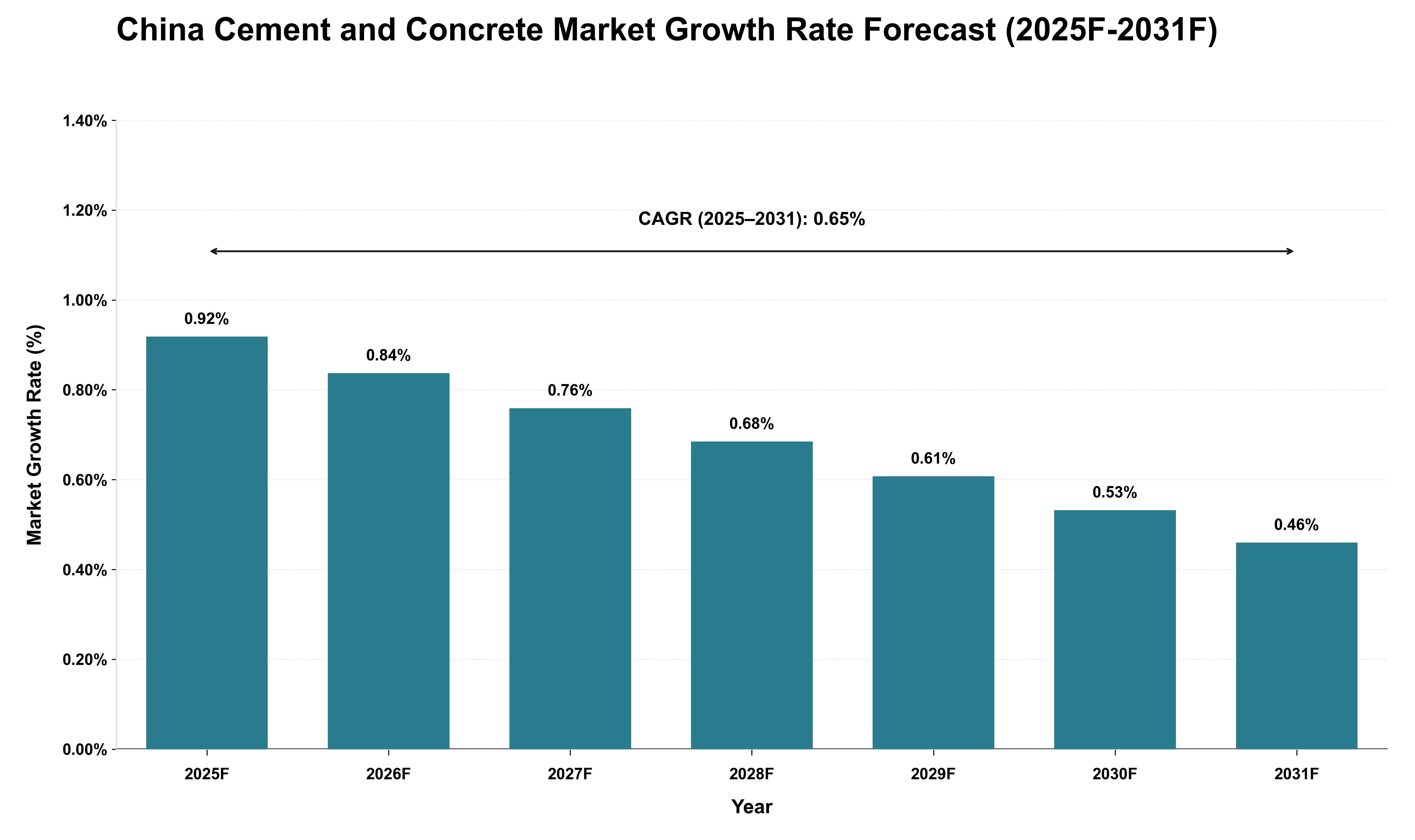
The projected deceleration in the China cement and concrete market, indicated by a decline from 0.92% growth in 2025 to 0.46% by 2031, reflects underlying shifts in the competitive landscape and capacity dynamics. As domestic demand stabilizes amid urbanization trends, the market will likely experience increased pressure from both domestic producers and potential import dependencies, particularly as global supply chains adapt to changing economic conditions. The gradual reduction in growth rates suggests that firms may face challenges in maintaining profitability while managing excess capacity and operational efficiencies. Additionally, cyclical trends tied to infrastructure spending will influence demand fluctuations; however, the overall trend indicates a cautious outlook for new investments in capacity expansion. This scenario will compel industry players to innovate and optimize existing resources rather than pursue aggressive growth strategies during this forecast period.
Key Highlights of the Report:
- China Cement and Concrete Market Outlook
- Market Size of China Cement and Concrete Market, 2024
- Forecast of China Cement and Concrete Market, 2026
- Historical Data and Forecast of China Cement and Concrete Revenues & Volume for the Period 2021 - 2031
- China Cement and Concrete Market Trend Evolution
- China Cement and Concrete Market Drivers and Challenges
- China Cement and Concrete Price Trends
- China Cement and Concrete Porter's Five Forces
- China Cement and Concrete Industry Life Cycle
- Historical Data and Forecast of China Cement and Concrete Market Revenues & Volume By Type for the Period 2021 - 2031
- Historical Data and Forecast of China Cement and Concrete Market Revenues & Volume By Cement for the Period 2021 - 2031
- Historical Data and Forecast of China Cement and Concrete Market Revenues & Volume By Ready-Mix Concrete for the Period 2021 - 2031
- Historical Data and Forecast of China Cement and Concrete Market Revenues & Volume By Concrete PipeBrickand Block for the Period 2021 - 2031
- Historical Data and Forecast of China Cement and Concrete Market Revenues & Volume By Others for the Period 2021 - 2031
- Historical Data and Forecast of China Cement and Concrete Market Revenues & Volume By Applications for the Period 2021 - 2031
- Historical Data and Forecast of China Cement and Concrete Market Revenues & Volume By Residential for the Period 2021 - 2031
- Historical Data and Forecast of China Cement and Concrete Market Revenues & Volume By Nonresidential for the Period 2021 - 2031
- China Cement and Concrete Import Export Trade Statistics
- Market Opportunity Assessment By Type
- Market Opportunity Assessment By Applications
- China Cement and Concrete Top Companies Market Share
- China Cement and Concrete Competitive Benchmarking By Technical and Operational Parameters
- China Cement and Concrete Company Profiles
- China Cement and Concrete Key Strategic Recommendations






































