China Certificate Authority Market Size & Growth Rate (2026-2032)
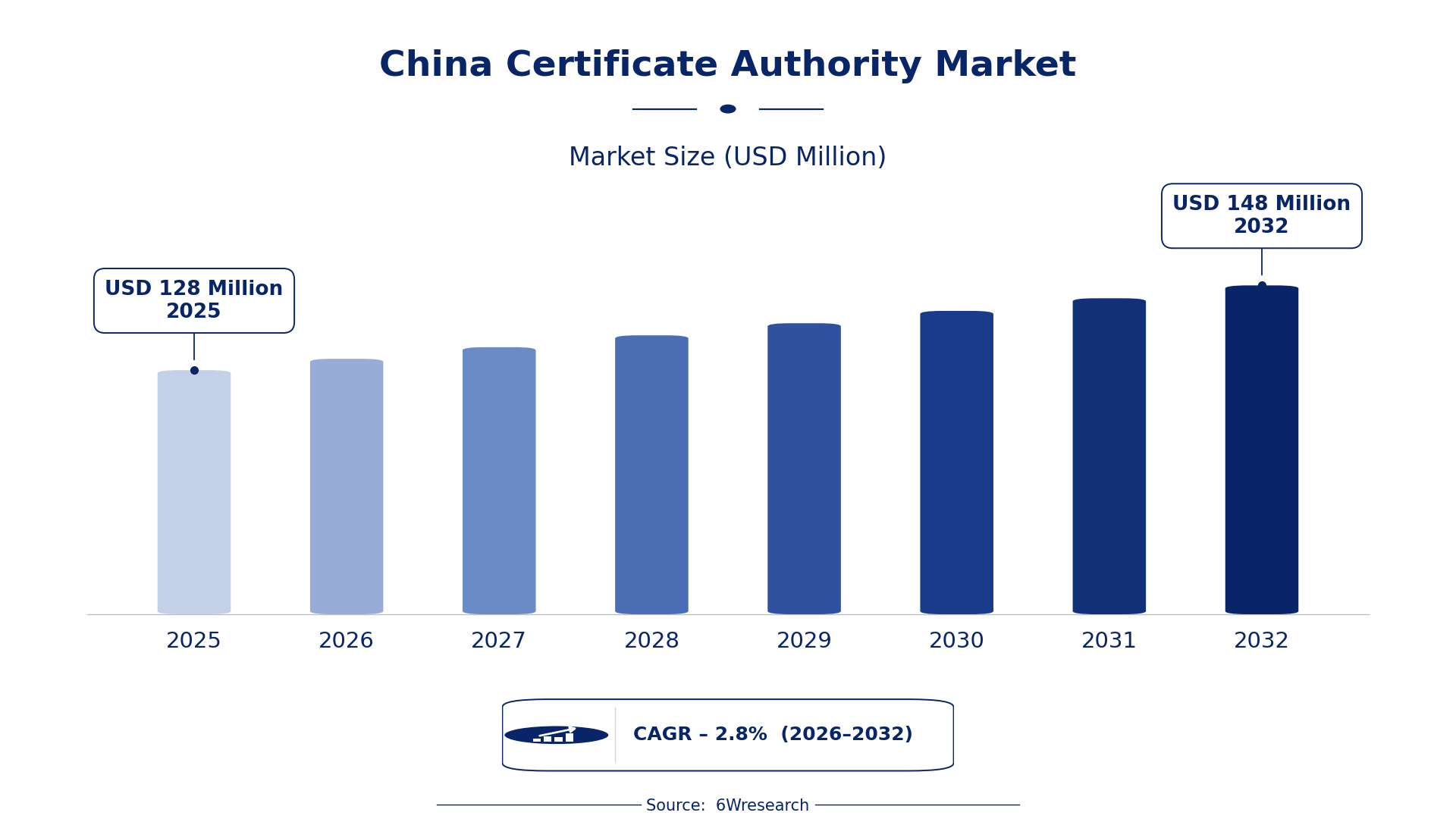
The China Certificate Authority Market was estimated at USD 128 Million in 2025 and is projected to reach USD 148 Million by 2032, growing at a CAGR of 2.8% from 2026 to 2032.
China Certificate Authority Market Synopsis
The China Certificate Authority market has gained substantial momentum recently, driven by the increasing reliance on digital certificates across various sectors. As businesses and consumers seek greater security in online transactions, the demand for digital certificates such as SSL/TLS and code signing has surged.
Looking ahead, this market is set to grow further, spurred by ongoing technological advancements and regulatory initiatives aimed at bolstering cybersecurity. The increasing sophistication of cyber threats necessitates an environment where secure communication and data integrity are prioritized, which is likely to propel market expansion in the coming years.
China Certificate Authority Market Year-wise Growth Rate and Key Drivers
This graph illustrates the annual growth rates of the China Certificate Authority Market from 2021 to 2032, highlighting a steady upward trajectory and projected expansion over the forecast period.
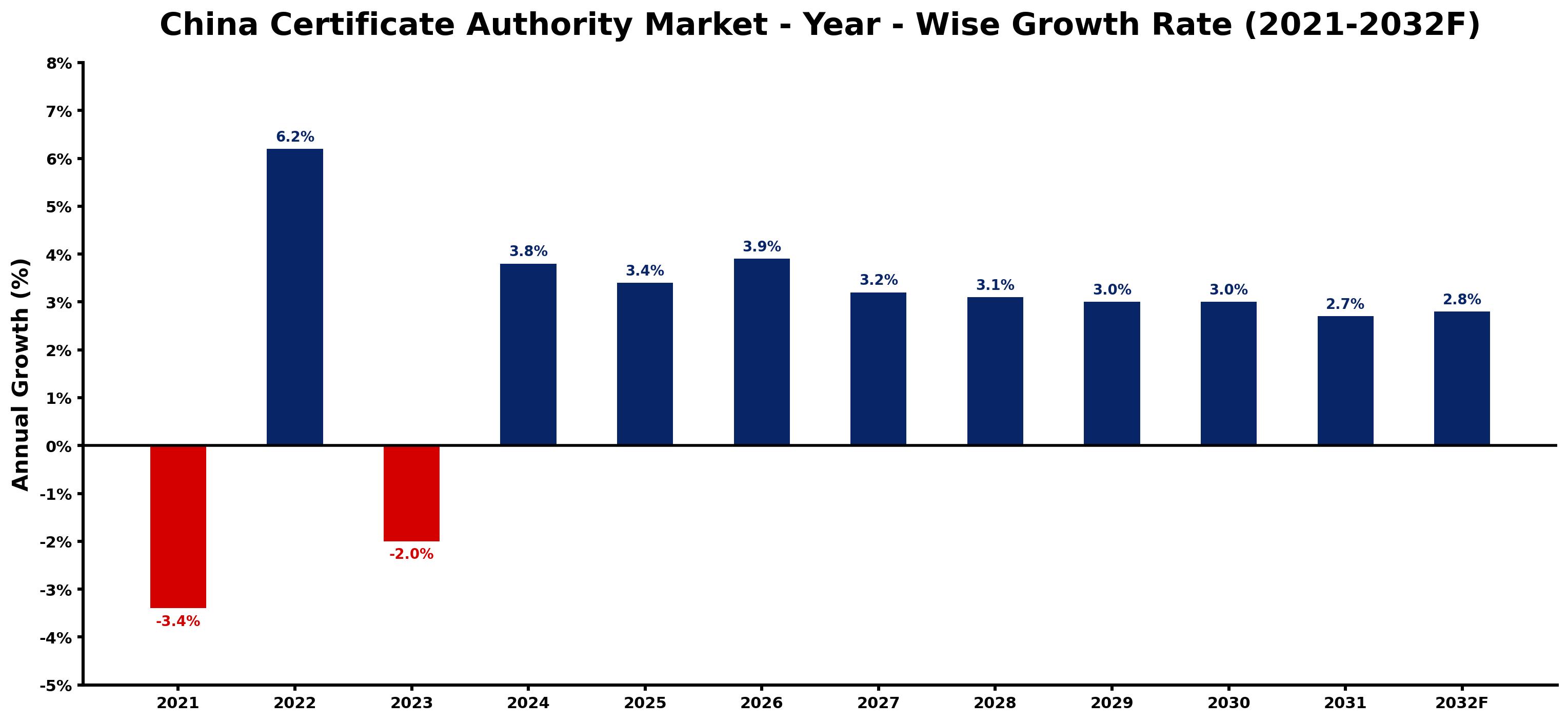
The table below presents the year‑wise growth rates along with the key drivers influencing the market
| Year | Growth Rate | Major Drivers |
| 2021 | -3.4% | Local cybersecurity regulations tightening under the Ministry of Industry. |
| 2022 | 6.2% | Implementation of China's E-signature Law bolstering digital security. |
| 2023 | -2.0% | Declining demand due to adoption of alternative authentication methods. |
| 2024 | 3.8% | Increased demand for biometric verification solutions across platforms. |
| 2025 | 3.4% | Growing emphasis on cybersecurity across financial institutions. |
| 2026 | 3.9% | Boost in online commerce requiring robust digital identity solutions. |
| 2027 | 3.2% | Widespread adoption of blockchain enhancing trust in transactions. |
| 2028 | 3.1% | Stricter regulations on data privacy driving certificate services. |
| 2029 | 3.0% | Rise in remote work increasing reliance on secure communications. |
| 2030 | 3.0% | National strategies promoting digital transformation in services sector. |
| 2031 | 2.7% | Emergence of smart cities necessitating trusted digital identification. |
| 2032 | 2.8% | Growing awareness of cybersecurity risks among small businesses. |
Note: Market size estimations and growth projections presented in this report are based on 6Wresearch's proprietary forecasting methodology, utilizing the latest available industry data, government publications, and primary research inputs.
China Certificate Authority Market Key Takeaways
Below are some of the specific key takeaways from the market, including:
- Growing demand for digital certificates fueled by heightened cybersecurity concerns.
- The emergence of cloud-based certificate management solutions enhancing operational efficiency.
- Increased utilization of certificates for IoT device authentication.
- Ongoing investments in advanced encryption technologies by certificate authorities.
- Government regulations are shaping the framework for compliance and security in digital transactions.
Evaluation of Restraints in China Certificate Authority Market
Several factors are constraining the growth of the China Certificate Authority market. The intense competition among domestic and international players is leading to price wars, which can adversely impact profit margins. Regulatory hurdles imposed by the Chinese government also complicate operations for Certificate Authorities, as they must comply with stringent data protection laws and local storage mandates. on top of that, as cybersecurity threats become increasingly sophisticated, the pressure on these organizations to innovate constantly remains high, adding to operational costs and complexity.
China Certificate Authority Market Trends
Current trends indicate a shift towards cloud-based certificate management systems that offer scalability and flexibility for businesses. Organizations are increasingly recognizing the critical role of IoT security, leading to a higher demand for digital certificates that authenticate connected devices. Additionally, there’s a notable movement toward blockchain technologies for certificate verification, providing enhanced transparency and security. Lastly, as compliance with data protection regulations becomes more stringent, organizations are prioritizing Certificate Authorities that can meet these requirements effectively.
China Certificate Authority Market Opportunities
Investment opportunities abound within the China Certificate Authority Market, primarily due to rising demand for secure digital transactions and an increasing focus on data protection. The push for a more secure online environment aligns well with established Certificate Authorities that can provide the necessary solutions. Additionally, innovative startups in the digital security space are ripe for investment, particularly those focused on unique offerings like automated certificate management and advanced encryption solutions. Companies providing SSL/TLS and other digital identity services are especially well-positioned to capitalize on market growth.
Government Initiatives in the China Certificate Authority Market
The Chinese government plays an integral role in shaping the Certificate Authority market through rigorous regulatory policies focused on data security and compliance with cybersecurity standards. As digital transformation accelerates, governmental oversight aims to bolster consumer trust in online transactions, making it essential for Certificate Authorities to align with these evolving guidelines.
- A regulatory framework introduced in 2023 mandating the use of domestic Certificate Authorities for certain types of digital transactions.
- A national initiative launched in late 2024 focused on enhancing cybersecurity infrastructure across major industries.
- A current push for compliance with the China Cybersecurity Law, requiring ongoing audits of Certificate Authorities.
- A planned 2026 program aimed at fostering collaboration between government agencies and tech firms to innovate security technologies.
- An ongoing review of data protection laws expected to conclude in 2025, which may lead to tighter regulations on Certificate Authority operations.
Future Insights of the China Certificate Authority Market
From 2026 to 2032, the China Certificate Authority market is set for notable growth. The acceleration of e-commerce and digital banking will push demand for reliable digital certificates even further. As cyber threats increase in complexity, businesses and consumers will prioritize security solutions that ensure data integrity and secure communication. The influence of government regulations, particularly in data privacy, will further solidify the need for trusted Certificate Authorities capable of adapting to a dynamic regulatory environment.
China Certificate Authority Market Latest Developments
In the past year, the China Certificate Authority market has seen dynamic developments reflective of growing security needs and regulatory adaptations. With rising cyber threats and the expansion of digital services, companies are enhancing their certificate offerings to meet both consumer and regulatory demands.
- A new suite of automated certificate management tools was launched in early 2025, aimed at simplifying security for small to medium enterprises.
- An initiative that began in mid-2025 to integrate IoT device authentication with existing certificate solutions is currently underway.
- A major technology vendor plans to introduce a blockchain-based certificate verification service expected to debut in late 2026.
- A partnership formed in early 2025 between a Certificate Authority and a cybersecurity firm, aimed at developing next-gen encryption algorithms.
- Ongoing enhancements to existing SSL/TLS offerings designed to comply with upcoming regulatory changes anticipated in 2026.
China Certificate Authority Market - Key Attractiveness of the Report
- 10 Years of Market Numbers
- Historical Data Starting from 2022 to 2025
- Base Year: 2025
- Forecast Data until 2032
- Key Performance Indicators Impacting the Market
- Major Upcoming Developments and Projects
There’s a significant shift towards cloud-based management systems and increasing focus on IoT device authentication, along with a growing interest in blockchain technologies for certificate verification.
Key Highlights of the Report:
- China Certificate Authority Market Outlook
- Market Size of China Certificate Authority Market, 2025
- Forecast of China Certificate Authority Market, 2032
- Historical Data and Forecast of China Certificate Authority Revenues & Volume for the Period 2022-2032F
- China Certificate Authority Market Trend Evolution
- China Certificate Authority Market Drivers and Challenges
- China Certificate Authority Price Trends
- China Certificate Authority Porter's Five Forces
- China Certificate Authority Industry Life Cycle
- Historical Data and Forecast of China Certificate Authority Market Revenues & Volume By Component for the Period 2022-2032F
- Historical Data and Forecast of China Certificate Authority Market Revenues & Volume By Certificate Types for the Period 2022-2032F
- Historical Data and Forecast of China Certificate Authority Market Revenues & Volume By Services for the Period 2022-2032F
- Historical Data and Forecast of China Certificate Authority Market Revenues & Volume By SSL Certification Validation Type for the Period 2022-2032F
- Historical Data and Forecast of China Certificate Authority Market Revenues & Volume By Domain Validation for the Period 2022-2032F
- Historical Data and Forecast of China Certificate Authority Market Revenues & Volume By Organization Validation for the Period 2022-2032F
- Historical Data and Forecast of China Certificate Authority Market Revenues & Volume By Extended Validation for the Period 2022-2032F
- Historical Data and Forecast of China Certificate Authority Market Revenues & Volume By Organization Size for the Period 2022-2032F
- Historical Data and Forecast of China Certificate Authority Market Revenues & Volume By Large Enterprises for the Period 2022-2032F
- Historical Data and Forecast of China Certificate Authority Market Revenues & Volume By SMEs for the Period 2022-2032F
- Historical Data and Forecast of China Certificate Authority Market Revenues & Volume By Vertical for the Period 2022-2032F
- Historical Data and Forecast of China Certificate Authority Market Revenues & Volume By BFSI for the Period 2022-2032F
- Historical Data and Forecast of China Certificate Authority Market Revenues & Volume By Retail and eCommerce for the Period 2022-2032F
- Historical Data and Forecast of China Certificate Authority Market Revenues & Volume By Government and Defense for the Period 2022-2032F
- Historical Data and Forecast of China Certificate Authority Market Revenues & Volume By Healthcare and Life Sciences for the Period 2022-2032F
- Historical Data and Forecast of China Certificate Authority Market Revenues & Volume By IT and Telecom for the Period 2022-2032F
- Historical Data and Forecast of China Certificate Authority Market Revenues & Volume By Travel and Hospitality for the Period 2022-2032F
- Historical Data and Forecast of China Certificate Authority Market Revenues & Volume By Education for the Period 2022-2032F
- Historical Data and Forecast of China Certificate Authority Market Revenues & Volume By Other verticals (transportation and logistics, media and entertainment, and manufacturing) for the Period 2022-2032F
- China Certificate Authority Import Export Trade Statistics
- Market Opportunity Assessment By Component
- Market Opportunity Assessment By SSL Certification Validation Type
- Market Opportunity Assessment By Organization Size
- Market Opportunity Assessment By Vertical
- China Certificate Authority Top Companies Market Share
- China Certificate Authority Competitive Benchmarking By Technical and Operational Parameters
- China Certificate Authority Company Profiles
- China Certificate Authority Key Strategic Recommendations






































