China Chamotte Market Size, Share & Growth Rate
The China Chamotte Market was estimated at USD 191 Million in 2025 and is projected to reach USD 220 Million by 2032, growing at a CAGR of 2.0% from 2026 to 2032. This growth trajectory is primarily driven by escalating demand from the construction sector and the ceramics industry, both of which require high-quality raw materials for sustainable production practices. Additionally, increased investment in infrastructure projects further fuels the adoption of chamotte, solidifying its role in key industrial applications.
China Chamotte Market Year-wise Growth Rate and Key Drivers
This graph highlights how the China Chamotte Market has steadily grown over the years, supported by major growth factors.
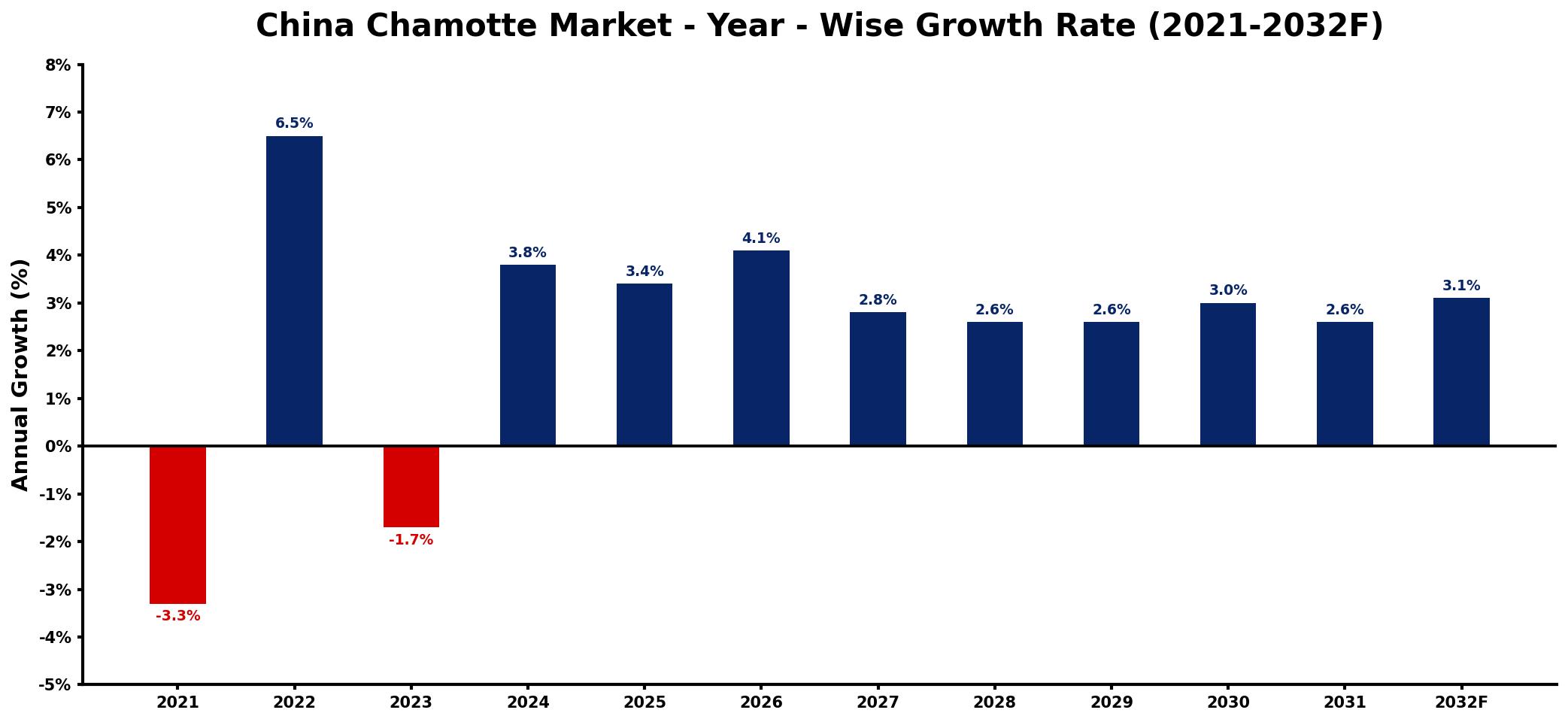
The table below presents the year‑wise growth rates along with the key drivers influencing the market
| Year | Growth Rate | Major Drivers |
| 2021 | -3.3% | Construction activity seeing downturn |
| 2022 | 6.5% | Manufacturing sector experiencing revival |
| 2023 | -1.7% | Investment in infrastructure projects slowing |
| 2024 | 3.8% | Energy sector driving demand growth |
| 2025 | 3.4% | Technological advancements boosting applications |
| 2026 | 4.1% | Exports increasing to global markets |
| 2027 | 2.8% | New construction projects launching nationwide |
| 2028 | 2.6% | Rising industrial production levels reported |
| 2029 | 2.6% | Sustainable practices gaining traction |
| 2030 | 3.0% | Innovative uses in emerging industries |
| 2031 | 2.6% | Regulatory support for industry expansion |
| 2032 | 3.1% | Market diversification opportunities increasing |
Note: Market size estimations and growth projections presented in this report are based on 6Wresearch's proprietary forecasting methodology, utilizing the latest available industry data, government publications, and primary research inputs.
China Chamotte Market Synopsis
The most significant force shaping the China Chamotte Market is the booming construction industry, which demands high-performance materials for various applications. This upward momentum is complemented by the rising need for efficient refractory products, particularly within sectors such as steel, cement, and glass manufacturing.
As the market evolves, there is a marked shift towards sustainable production methods, prompting manufacturers to innovate and improve product quality. The ongoing technological advancements in chamotte processing not only enhance performance but also meet stringent regulatory standards, further embedding chamotte into the fabric of modern industrial practices.
China Chamotte Market Key Takeaways
- The China Chamotte Market is poised for steady growth driven by the construction and ceramics sectors.
- Sustainability and product innovation are increasingly prioritized by manufacturers to meet market demands.
- Technological advancements are improving the efficiency and quality of chamotte production processes.
- Government policies are creating a favorable environment for chamotte manufacturers through support and incentives.
- Strategic partnerships among industry players are reshaping the competitive landscape of the market.
Evaluation of Restraints in China Chamotte Market
Despite the optimistic outlook, the China Chamotte Market faces a number of restraints. Competition from substitute materials, such as magnesia and zirconia, presents a significant challenge to market players striving to maintain their market share. Furthermore, fluctuating raw material prices complicate production cost management, while environmental regulations increasingly dictate operational methodologies. Overcapacity in certain segments has led to pricing pressures, potentially undermining profit margins for many manufacturers. Adapting to these dynamics requires a laser-focused approach on innovation and sustainable practices.
China Chamotte Market Trends
The current landscape of the China Chamotte Market is characterized by several key trends. Notably, there is a shift towards sustainable production practices, encouraging the development of environmentally friendly chamotte products. Technological advancements are also enhancing the manufacturing processes, improving product quality and performance characteristics. Additionally, as industries increasingly adopt high-performance refractories, the demand for specialized chamotte products continues to rise, prompting market players to refine their offerings.
China Chamotte Market Opportunities
The China Chamotte Market presents several lucrative investment opportunities. With the construction sector expanding rapidly and the need for high-quality refractory materials intensifying, there is ample room for growth. Investing in production facilities that emphasize efficiency and sustainability can yield significant returns. Additionally, the government's commitment to infrastructure development and industrial expansion further bolsters the attractiveness of the chamotte market for potential investors seeking long-term benefits.
Government Initiatives in the China Chamotte Market
The Chinese government has implemented a range of policies aimed at supporting the chamotte market. These include strict environmental regulations that mandate cleaner production processes, ensuring minimal pollution during manufacturing. Moreover, safety standards have been established to protect workers involved in chamotte production. Financial incentives and funding for research and development initiatives are also provided, further fostering innovation and competitiveness within the industry.
Future Insights of the China Chamotte Market
Looking ahead to 2026-2032, the China Chamotte Market is expected to maintain a positive growth trajectory. The continuing expansion of the construction and ceramics sectors will significantly bolster demand for chamotte. Additionally, the push towards energy-efficient and sustainable building materials aligns with governmental initiatives aimed at infrastructure development. While challenges such as fluctuating raw material prices and environmental concerns will need to be addressed, the overall outlook remains bright, with opportunities for innovation and market expansion abound.
China Chamotte Market Latest Developments (2025 - 2026)
In recent months, the China Chamotte Market has seen a notable shift towards environmentally sustainable production practices. Manufacturers are increasingly investing in advanced technologies that improve both the quality of chamotte and the efficiency of production processes. Concurrently, several strategic collaborations have emerged within the industry, aimed at expanding product offerings and enhancing market presence. As companies adjust to evolving regulatory landscapes and consumer preferences, the market remains dynamic and responsive to new opportunities.
China Chamotte Market - Key Attractiveness of the Report
- 10 Years of Market Numbers
- Historical Data Starting from 2022 to 2025
- Base Year: 2025
- Forecast Data until 2032
- Key Performance Indicators Impacting the Market
- Major Upcoming Developments and Projects
Key Highlights of the Report:
- China Chamotte Market Outlook
- Market Size of China Chamotte Market, 2025
- Forecast of China Chamotte Market, 2032
- Historical Data and Forecast of China Chamotte Revenues & Volume for the Period 2022-2032F
- China Chamotte Market Trend Evolution
- China Chamotte Market Drivers and Challenges
- China Chamotte Price Trends
- China Chamotte Porter's Five Forces
- China Chamotte Industry Life Cycle
- Historical Data and Forecast of China Chamotte Market Revenues & Volume By Type for the Period 2022-2032F
- Historical Data and Forecast of China Chamotte Market Revenues & Volume By Clinker for the Period 2022-2032F
- Historical Data and Forecast of China Chamotte Market Revenues & Volume By Cement Clinker for the Period 2022-2032F
- Historical Data and Forecast of China Chamotte Market Revenues & Volume By Application for the Period 2022-2032F
- Historical Data and Forecast of China Chamotte Market Revenues & Volume By Cement for the Period 2022-2032F
- Historical Data and Forecast of China Chamotte Market Revenues & Volume By Silicate Material for the Period 2022-2032F
- Historical Data and Forecast of China Chamotte Market Revenues & Volume By Others for the Period 2022-2032F
- China Chamotte Import Export Trade Statistics
- Market Opportunity Assessment By Type
- Market Opportunity Assessment By Application
- China Chamotte Top Companies Market Share
- China Chamotte Competitive Benchmarking By Technical and Operational Parameters
- China Chamotte Company Profiles
- China Chamotte Key Strategic Recommendations






































