China Chatbot Market Size & Growth Rate (2026-2032)
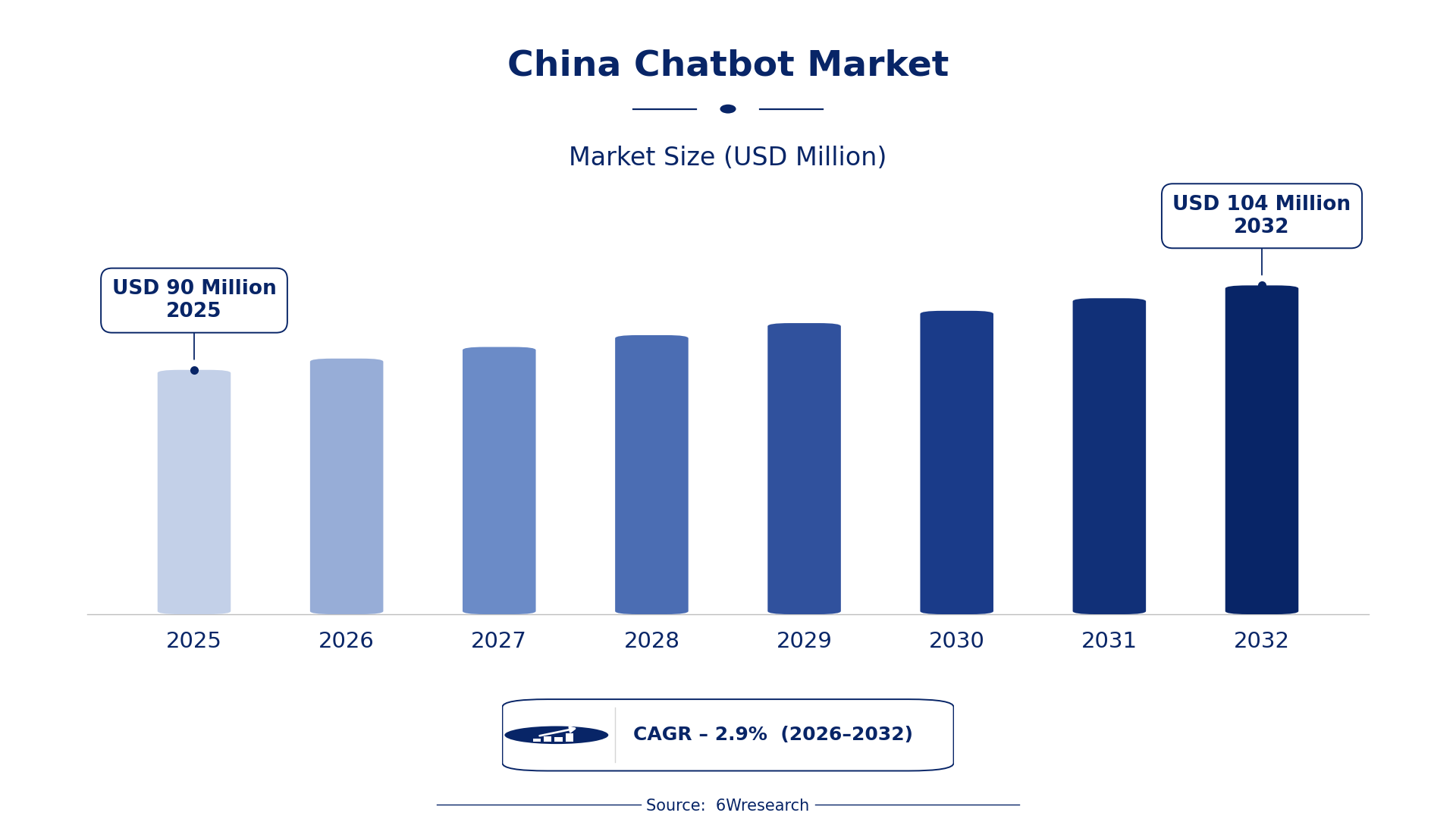
The China Chatbot Market was estimated at USD 90 Million in 2025 and is projected to reach USD 104 Million by 2032, growing at a CAGR of 2.9% from 2026 to 2032.
China Chatbot Market Synopsis
The China Chatbot Market is rapidly transforming, fueled by the increasing integration of artificial intelligence in various sectors. With businesses striving to enhance customer engagement and streamline operations, chatbots are becoming essential tools for effective communication in e-commerce, finance, and healthcare.
As consumers in China grow more accustomed to digital interactions, companies are investing significantly in sophisticated chatbot solutions. This trend underscores the market's competitive nature, where both domestic and international entities are eager to capture market share and meet evolving customer expectations.
China Chatbot Market Year-wise Growth Rate and Key Drivers
This graph illustrates the annual growth rates of the China Chatbot Market from 2021 to 2032, highlighting a steady upward trajectory and projected expansion over the forecast period.
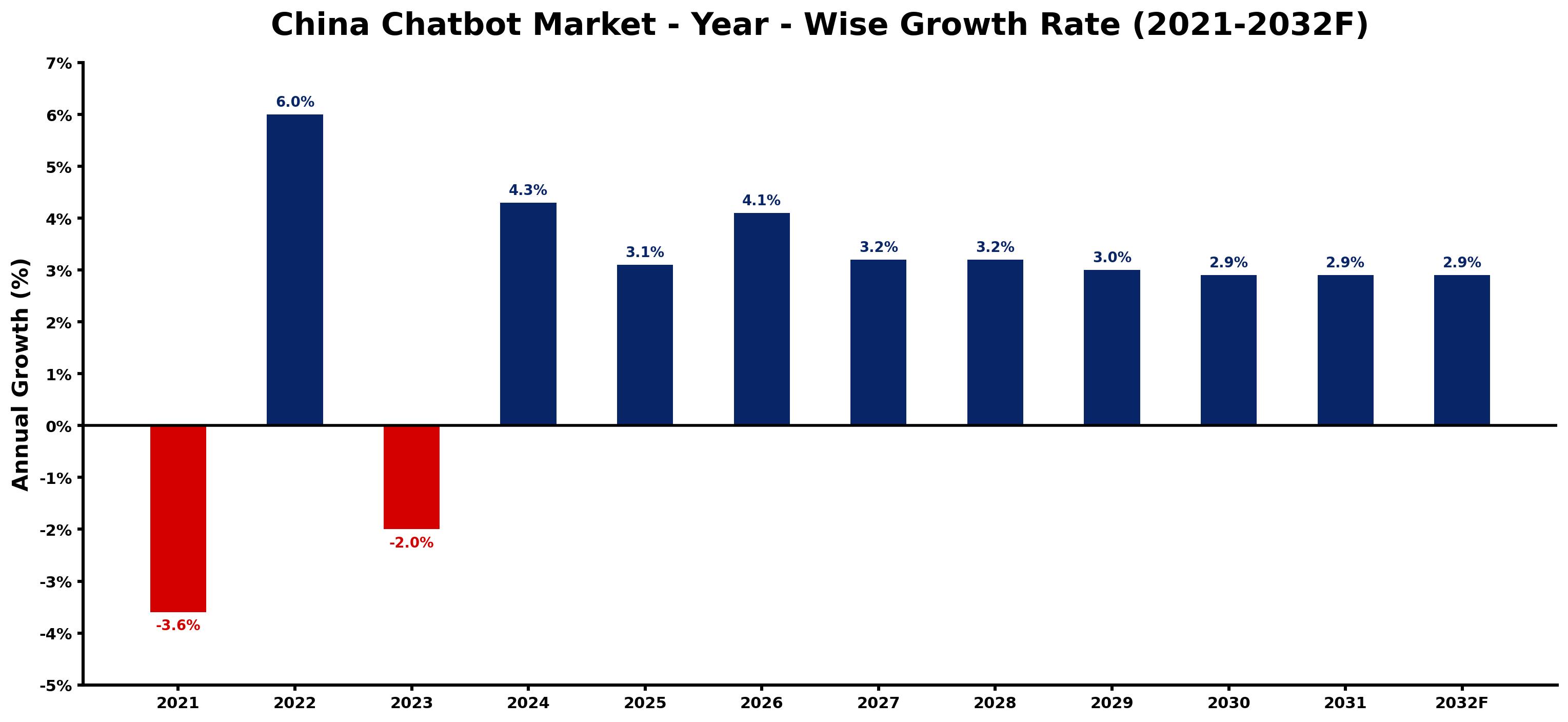
The table below presents the year‑wise growth rates along with the key drivers influencing the market
| Year | Growth Rate | Major Drivers |
| 2021 | -3.6% | Strict regulations imposed by Chinese state cybersecurity laws. |
| 2022 | 6.0% | Increased adoption of WeChat mini-programs for commerce. |
| 2023 | -2.0% | Weak demand following ChatGPT's dominance in Chinese tech. |
| 2024 | 4.3% | Government AI policy incentivizing chatbot development initiatives. |
| 2025 | 3.1% | Rise in online education requiring interactive learning tools. |
| 2026 | 4.1% | Rapid growth in fintech driving customer support automation. |
| 2027 | 3.2% | Gaining traction in healthcare chatbots for patient engagement. |
| 2028 | 3.2% | Surge in gaming industry fostering chatbot interactions. |
| 2029 | 3.0% | Retail sector leveraging chatbots for personalized shopping experiences. |
| 2030 | 2.9% | Local businesses adopting chatbots for cost-effective service. |
| 2031 | 2.9% | Growing smartphone penetration enhancing chatbot accessibility. |
| 2032 | 2.9% | Smart city initiatives promoting AI-driven public service chatbots. |
Note: Market size estimations and growth projections presented in this report are based on 6Wresearch's proprietary forecasting methodology, utilizing the latest available industry data, government publications, and primary research inputs.
China Chatbot Market Key Takeaways
Below are some of the specific key takeaways from the market, including:
- The market is driven by rising demand for automation in customer service across various industries.
- Integration of advanced natural language processing capabilities is enhancing chatbot efficiency.
- Personalized interactions are becoming a key focus, improving user experience.
- Regulatory challenges and data privacy concerns present significant hurdles for market players.
- Opportunities abound in sectors such as e-commerce, healthcare, and finance.
Evaluation of Restraints in China Chatbot Market
The China Chatbot Market faces several constraints that may hinder its growth trajectory. Stringent regulations imposed by the government on data collection and privacy practices create a complex environment for chatbot deployment. Companies must navigate these challenges carefully to avoid compliance issues.
Cultural nuances also present difficulties in designing chatbots that resonate with local users. Failure to account for these intricacies can lead to ineffective customer interactions, limiting the potential of chatbot technology. Additionally, the fierce competition among providers necessitates continuous innovation to stay relevant.
China Chatbot Market Trends
Several trends are shaping the China Chatbot Market. The adoption of multi-channel deployment options is becoming increasingly popular, allowing businesses to engage customers through various platforms. This flexibility is essential as consumers prefer interacting via their favorite messaging apps.
on top of that, the integration of machine learning algorithms is enabling chatbots to learn from interactions, making them smarter and more efficient. As businesses seek to enhance customer satisfaction, personalized chatbot experiences are gaining traction, driving demand for innovative solutions.
China Chatbot Market Opportunities
Opportunities within the China Chatbot Market are abundant, particularly in sectors like e-commerce and banking where 24/7 customer support is crucial. Businesses are increasingly recognizing the cost-saving potential of chatbots, leading to heightened investment in automated solutions.
As technology continues to advance, there is room for developers to create tailored solutions that address the unique demands of Chinese consumers. Companies willing to innovate and adapt their offerings will find significant growth potential in this dynamic market.
Government Initiatives in the China Chatbot Market
Government policies play a crucial role in shaping the China Chatbot Market. With a focus on regulating the industry while fostering innovation, authorities aim to balance the needs of consumers and businesses. Compliance with data protection regulations is a top priority, ensuring user information remains secure.
- A recent regulatory framework was introduced to enhance data privacy protections for chatbot users.
- Currently ongoing initiatives include public sector programs that promote AI technology development, including chatbots.
- The "New Generation Artificial Intelligence Development Plan" aims to support innovation in AI, including chatbot technologies.
- Upcoming policies are expected to address the ethical use of AI in sensitive sectors like finance and healthcare.
- The government is also launching awareness campaigns to educate businesses on compliance with chatbot regulations.
Future Insights of the China Chatbot Market
Looking ahead to 2026-2032, the China Chatbot Market is set for continued growth. The increasing reliance on AI technologies and the demand for personalized customer interactions will drive the evolution of chatbot solutions. Businesses will increasingly adopt AI-powered chatbots to enhance service delivery and operational efficiency.
As digital transformation accelerates, we can expect more integrations of chatbots into social media platforms and the emergence of voice-enabled chatbots. Companies that prioritize these innovations will be well-positioned to capture the evolving needs of the market.
China Chatbot Market Latest Developments
In the past year, the China Chatbot Market has seen a flurry of activity, characterized by technological advancements and strategic partnerships. Industry players are focusing on enhancing their offerings to stay competitive in a crowded field.
- A major technology vendor launched a new AI-driven chatbot platform in early 2025, enhancing its service capabilities.
- Ongoing collaborations between chatbot developers and e-commerce firms aim to improve customer service experiences.
- In mid-2025, a leading regional operator announced plans to integrate chatbot solutions into its customer service framework.
- A rollout of a voice-enabled chatbot feature is expected to begin in late 2026, catering to evolving consumer preferences.
- By early 2026, several firms are expected to adopt advanced natural language processing tools to enhance chatbot interactions.
China Chatbot Market - Key Attractiveness of the Report
- 10 Years of Market Numbers
- Historical Data Starting from 2022 to 2025
- Base Year: 2025
- Forecast Data until 2032
- Key Performance Indicators Impacting the Market
- Major Upcoming Developments and Projects
Key Highlights of the Report:
- China Chatbot Market Outlook
- Market Size of China Chatbot Market, 2025
- Forecast of China Chatbot Market, 2032
- Historical Data and Forecast of China Chatbot Revenues & Volume for the Period 2022-2032F
- China Chatbot Market Trend Evolution
- China Chatbot Market Drivers and Challenges
- China Chatbot Price Trends
- China Chatbot Porter's Five Forces
- China Chatbot Industry Life Cycle
- Historical Data and Forecast of China Chatbot Market Revenues & Volume By Component for the Period 2022-2032F
- Historical Data and Forecast of China Chatbot Market Revenues & Volume By Solutions for the Period 2022-2032F
- Historical Data and Forecast of China Chatbot Market Revenues & Volume By Services for the Period 2022-2032F
- Historical Data and Forecast of China Chatbot Market Revenues & Volume By Type for the Period 2022-2032F
- Historical Data and Forecast of China Chatbot Market Revenues & Volume By Rule Based for the Period 2022-2032F
- Historical Data and Forecast of China Chatbot Market Revenues & Volume By AI Based for the Period 2022-2032F
- Historical Data and Forecast of China Chatbot Market Revenues & Volume By Deployment Mode for the Period 2022-2032F
- Historical Data and Forecast of China Chatbot Market Revenues & Volume By On-premises for the Period 2022-2032F
- Historical Data and Forecast of China Chatbot Market Revenues & Volume By Cloud for the Period 2022-2032F
- Historical Data and Forecast of China Chatbot Market Revenues & Volume By Channel Integration for the Period 2022-2032F
- Historical Data and Forecast of China Chatbot Market Revenues & Volume By Websites for the Period 2022-2032F
- Historical Data and Forecast of China Chatbot Market Revenues & Volume By Contact Centers for the Period 2022-2032F
- Historical Data and Forecast of China Chatbot Market Revenues & Volume By Social Media for the Period 2022-2032F
- Historical Data and Forecast of China Chatbot Market Revenues & Volume By Mobile Applications for the Period 2022-2032F
- Historical Data and Forecast of China Chatbot Market Revenues & Volume By Organization Size for the Period 2022-2032F
- Historical Data and Forecast of China Chatbot Market Revenues & Volume By Large Enterprises for the Period 2022-2032F
- Historical Data and Forecast of China Chatbot Market Revenues & Volume By SMEs for the Period 2022-2032F
- Historical Data and Forecast of China Chatbot Market Revenues & Volume By Business Function for the Period 2022-2032F
- Historical Data and Forecast of China Chatbot Market Revenues & Volume By Information Technology Service Management for the Period 2022-2032F
- Historical Data and Forecast of China Chatbot Market Revenues & Volume By Human Resources for the Period 2022-2032F
- Historical Data and Forecast of China Chatbot Market Revenues & Volume By Sales and Marketing for the Period 2022-2032F
- Historical Data and Forecast of China Chatbot Market Revenues & Volume By Finance for the Period 2022-2032F
- Historical Data and Forecast of China Chatbot Market Revenues & Volume By Application for the Period 2022-2032F
- Historical Data and Forecast of China Chatbot Market Revenues & Volume By Customer Service for the Period 2022-2032F
- Historical Data and Forecast of China Chatbot Market Revenues & Volume By Personal Assistant for the Period 2022-2032F
- Historical Data and Forecast of China Chatbot Market Revenues & Volume By Branding and Advertisement for the Period 2022-2032F
- Historical Data and Forecast of China Chatbot Market Revenues & Volume By Customer Engagement and Retention for the Period 2022-2032F
- Historical Data and Forecast of China Chatbot Market Revenues & Volume By Data Privacy and Compliance for the Period 2022-2032F
- Historical Data and Forecast of China Chatbot Market Revenues & Volume By Employee Engagement and On Boarding for the Period 2022-2032F
- Historical Data and Forecast of China Chatbot Market Revenues & Volume By Payment Processing for the Period 2022-2032F
- Historical Data and Forecast of China Chatbot Market Revenues & Volume By Others for the Period 2022-2032F
- Historical Data and Forecast of China Chatbot Market Revenues & Volume By Vertical for the Period 2022-2032F
- Historical Data and Forecast of China Chatbot Market Revenues & Volume By BFSI for the Period 2022-2032F
- Historical Data and Forecast of China Chatbot Market Revenues & Volume By IT and Telecom for the Period 2022-2032F
- Historical Data and Forecast of China Chatbot Market Revenues & Volume By Retail and Ecommerce for the Period 2022-2032F
- Historical Data and Forecast of China Chatbot Market Revenues & Volume By Healthcare and Life Sciences for the Period 2022-2032F
- Historical Data and Forecast of China Chatbot Market Revenues & Volume By Transportation and Logistics for the Period 2022-2032F
- Historical Data and Forecast of China Chatbot Market Revenues & Volume By Government for the Period 2022-2032F
- Historical Data and Forecast of China Chatbot Market Revenues & Volume By Travel and Hospitality for the Period 2022-2032F
- Historical Data and Forecast of China Chatbot Market Revenues & Volume By Media and Entertainment for the Period 2022-2032F
- China Chatbot Import Export Trade Statistics
- Market Opportunity Assessment By Component
- Market Opportunity Assessment By Type
- Market Opportunity Assessment By Deployment Mode
- Market Opportunity Assessment By Channel Integration
- Market Opportunity Assessment By Organization Size
- Market Opportunity Assessment By Business Function
- Market Opportunity Assessment By Application
- Market Opportunity Assessment By Vertical
- China Chatbot Top Companies Market Share
- China Chatbot Competitive Benchmarking By Technical and Operational Parameters
- China Chatbot Company Profiles
- China Chatbot Key Strategic Recommendations






































