China Chillers Market Top 5 Importing Countries and Market Competition (HHI) Analysis
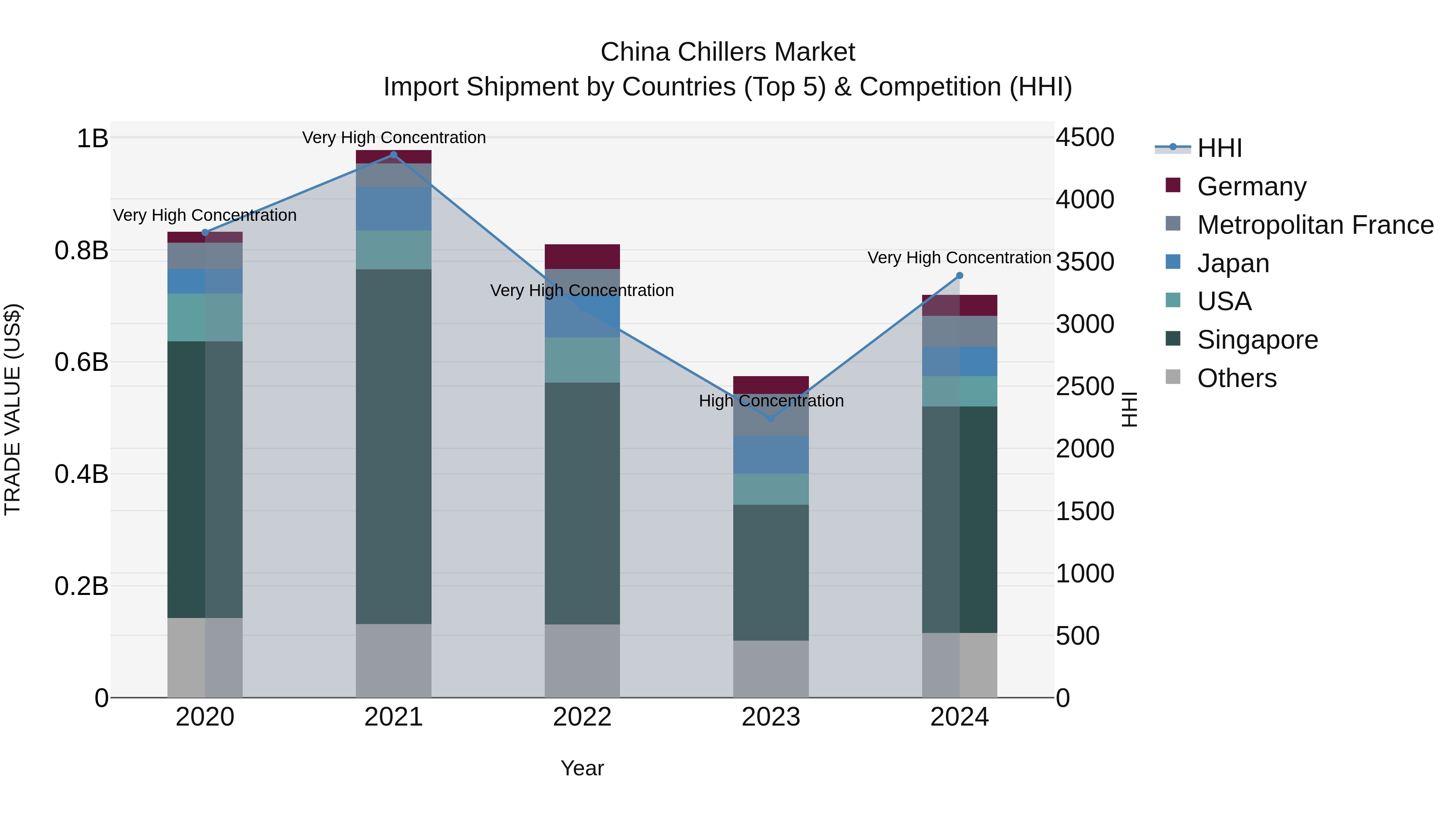
China chiller import market in 2024 saw a significant increase in concentration, with top exporting countries being Singapore, Metropolitan France, USA, Japan, and Germany. The market displayed a negative CAGR of -3.57% from 2020 to 2024, but experienced a notable growth rate of 25.26% from 2023 to 2024. This data suggests a shifting landscape in China chiller import industry, with a heightened focus on key players and potential opportunities for market expansion.
China Chillers Market Overview
The chillers market in China is experiencing robust growth due to the rapid industrialization and urbanization across the country. Chillers are essential for various applications, including air conditioning, refrigeration, and industrial processes. The demand for energy-efficient and environmentally friendly cooling solutions has spurred innovation in chiller technologies. With increasing emphasis on reducing carbon footprints and improving energy efficiency, the market is seeing a shift towards advanced chillers with enhanced performance and reduced environmental impact.
Drivers of the market
The China Chillers Market is influenced by the expansion of the industrial and commercial sectors, which require advanced cooling solutions for efficient operation. Increasing investments in infrastructure, data centers, and manufacturing facilities drive the demand for high-performance chillers. Moreover, rising awareness of energy efficiency and environmental regulations also fuel market growth.
Challenges of the market
The China Chillers Market encounters challenges related to energy efficiency and environmental regulations. Increasing demands for energy-efficient and environmentally friendly cooling solutions require significant investment in research and development. The market also faces competition from alternative cooling technologies and the need to adapt to changing regulatory standards concerning refrigerants and emissions.
Government Policy of the market
The China chillers market is governed by policies aimed at improving energy efficiency and reducing environmental impact. The government enforces standards related to energy consumption, refrigerant use, and emissions for chillers. Incentives and subsidies are provided for the adoption of energy-efficient technologies and systems. Compliance with international standards, such as those set by the American Society of Heating, Refrigerating and Air-Conditioning Engineers (ASHRAE), is also required to promote sustainability and technological advancement in the market.
Key Highlights of the Report:
- China Chillers Market Outlook
- Market Size of China Chillers Market, 2024
- Forecast of China Chillers Market, 2031
- Historical Data and Forecast of China Chillers Revenues & Volume for the Period 2021-2031
- China Chillers Market Trend Evolution
- China Chillers Market Drivers and Challenges
- China Chillers Price Trends
- China Chillers Porter's Five Forces
- China Chillers Industry Life Cycle
- Historical Data and Forecast of China Chillers Market Revenues & Volume By Type for the Period 2021-2031
- Historical Data and Forecast of China Chillers Market Revenues & Volume By Scroll for the Period 2021-2031
- Historical Data and Forecast of China Chillers Market Revenues & Volume By Screw for the Period 2021-2031
- Historical Data and Forecast of China Chillers Market Revenues & Volume By Centrifugal for the Period 2021-2031
- Historical Data and Forecast of China Chillers Market Revenues & Volume By Reciprocating for the Period 2021-2031
- Historical Data and Forecast of China Chillers Market Revenues & Volume By Absorption for the Period 2021-2031
- Historical Data and Forecast of China Chillers Market Revenues & Volume By End Use Industry for the Period 2021-2031
- Historical Data and Forecast of China Chillers Market Revenues & Volume By Plastic for the Period 2021-2031
- Historical Data and Forecast of China Chillers Market Revenues & Volume By Chemical & Petrochemical for the Period 2021-2031
- Historical Data and Forecast of China Chillers Market Revenues & Volume By Rubber for the Period 2021-2031
- Historical Data and Forecast of China Chillers Market Revenues & Volume By Food & Beverage for the Period 2021-2031
- Historical Data and Forecast of China Chillers Market Revenues & Volume By Medical & Pharmaceutical for the Period 2021-2031
- Historical Data and Forecast of China Chillers Market Revenues & Volume By Capacity for the Period 2021-2031
- Historical Data and Forecast of China Chillers Market Revenues & Volume By >17.5 kW for the Period 2021-2031
- Historical Data and Forecast of China Chillers Market Revenues & Volume By 17.6-50 kW for the Period 2021-2031
- Historical Data and Forecast of China Chillers Market Revenues & Volume By 51-100 kW for the Period 2021-2031
- Historical Data and Forecast of China Chillers Market Revenues & Volume By 101-200 kW for the Period 2021-2031
- Historical Data and Forecast of China Chillers Market Revenues & Volume By 201-350 kW for the Period 2021-2031
- Historical Data and Forecast of China Chillers Market Revenues & Volume By 351-500 kW for the Period 2021-2031
- Historical Data and Forecast of China Chillers Market Revenues & Volume By 501-700 kW for the Period 2021-2031
- Historical Data and Forecast of China Chillers Market Revenues & Volume By 701-900 kW for the Period 2021-2031
- China Chillers Import Export Trade Statistics
- Market Opportunity Assessment By Type
- Market Opportunity Assessment By End Use Industry
- Market Opportunity Assessment By Capacity
- China Chillers Top Companies Market Share
- China Chillers Competitive Benchmarking By Technical and Operational Parameters
- China Chillers Company Profiles
- China Chillers Key Strategic Recommendations






































