China Circuit Breakers Market Size, Share & Growth Rate
The China Circuit Breakers Market was estimated at USD 238 Million in 2025 and is projected to reach USD 274 Million by 2032, growing at a CAGR of 2.0% from 2026 to 2032. This growth trajectory is largely fueled by rapid industrialization and urbanization across the country, which in turn drives the demand for stable and reliable electricity supply. Additionally, government initiatives focused on renewable energy sources and infrastructural upgrades are bolstering the market, creating a robust environment for circuit breaker innovations.
China Circuit Breakers Market Year-wise Growth Rate and Key Drivers
This graph highlights how the China Circuit Breakers Market has steadily grown over the years, supported by major growth factors.
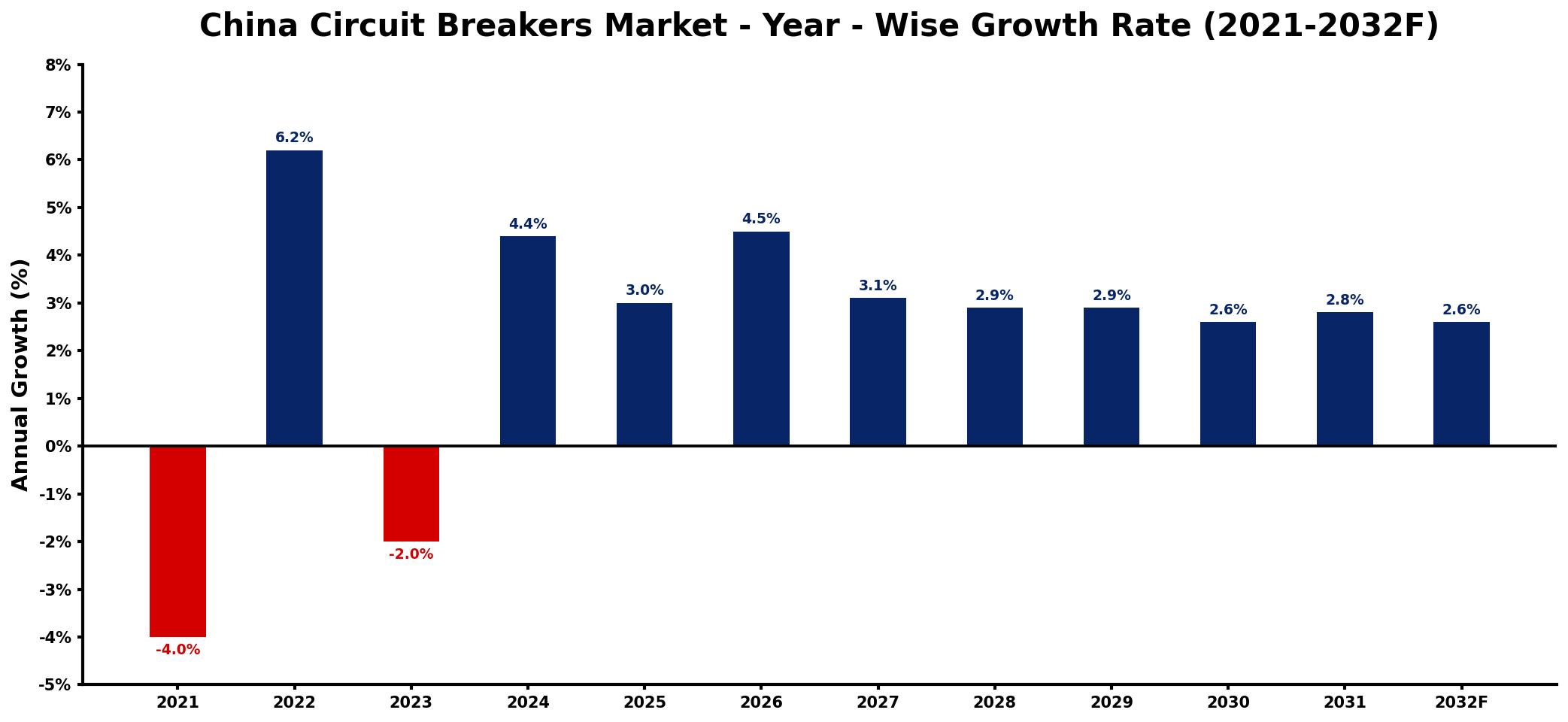
The table below presents the year‑wise growth rates along with the key drivers influencing the market
| Year | Growth Rate | Major Drivers |
| 2021 | -4.0% | decrease in industrial investments |
| 2022 | 6.2% | growth in renewable energy projects |
| 2023 | -2.0% | slower demand from construction sector |
| 2024 | 4.4% | increase in urban infrastructure projects |
| 2025 | 3.0% | expansion of electric vehicle market |
| 2026 | 4.5% | rise in smart grid initiatives |
| 2027 | 3.1% | increased domestic production output |
| 2028 | 2.9% | stronger distribution network expansion |
| 2029 | 2.9% | improved raw material availability |
| 2030 | 2.6% | improved processing technologies adoption |
| 2031 | 2.8% | strengthening international trade flows |
| 2032 | 2.6% | increased focus on sustainability practices |
Note: Market size estimations and growth projections presented in this report are based on 6Wresearch's proprietary forecasting methodology, utilizing the latest available industry data, government publications, and primary research inputs.
China Circuit Breakers Market Synopsis
Recent momentum in the China Circuit Breakers Market has been marked by an increased focus on smart technology and energy-efficient solutions. As industries evolve, the market is expected to transition towards a more sustainable and digitally integrated future, with investments in advanced circuit breaker technologies at the forefront of this change.
The adoption of smart and intelligent circuit breakers is becoming a significant trend, driven by the need for real-time monitoring and remote operations. As consumer awareness of safety and sustainability rises, manufacturers are responding with eco-friendly circuit breakers, setting the stage for continued market expansion.
China Circuit Breakers Market Key Takeaways
- The market is projected to grow steadily, driven by increasing demand for electricity and infrastructure development.
- Technological advancements in smart circuit breakers are revolutionizing safety and efficiency in power distribution.
- Government policies favoring renewable energy are promoting investment in advanced circuit protection solutions.
- Domestic and international competition is intensifying, necessitating innovative approaches from market players.
- The shift towards digitalization and automation is creating new opportunities for growth in various sectors.
Evaluation of Restraints in China Circuit Breakers Market
Despite the promising outlook, the China Circuit Breakers Market faces notable restraints. Intense competition among domestic and international entities can lead to price wars, impacting profit margins. Additionally, navigating complex regulatory frameworks poses a significant challenge for companies seeking to establish a foothold in this dynamic market. Maintaining high standards of product quality and reliability is crucial, as is adapting to rapid technological changes and shifting consumer preferences. Companies must remain agile and innovative to mitigate these challenges and capitalize on emerging opportunities.
China Circuit Breakers Market Trends
The demand for smart circuit breakers is at an all-time high, fueled by advancements in IoT and AI technologies. These intelligent systems are favored for their ability to enhance safety, streamline operations, and facilitate predictive maintenance. Furthermore, there is a growing emphasis on energy efficiency, with eco-friendly circuit breakers gaining traction due to their high breaking capacities and reduced environmental footprint. Digitalization across sectors is also propelling demand for innovative circuit breaker solutions that align with contemporary industrial practices.
China Circuit Breakers Market Opportunities
Investment prospects in the China Circuit Breakers Market are particularly promising, as the push for electrical infrastructure modernization continues. The rise of the renewable energy sector is expected to further accelerate demand for advanced circuit protection solutions. Opportunities also abound in collaborating with local manufacturers or investing in R&D to meet evolving market needs. Emphasizing innovative technologies, such as remote monitoring and enhanced safety features, will provide a competitive edge and yield significant returns in this growing market.
Government Initiatives in the China Circuit Breakers Market
The Chinese government is actively promoting initiatives aimed at enhancing electrical safety and reliability, thereby bolstering the circuit breakers market. Investments in smart grid technologies and infrastructure upgrades, along with favorable policies for renewable energy adoption, are shaping the landscape. Public spending directed towards energy efficiency projects is expected to further stimulate market growth. Such government support provides a conducive environment for innovation and development in circuit breaker technologies.
Future Insights of the China Circuit Breakers Market
Looking ahead to 2026-2032, the China Circuit Breakers Market is set to witness robust growth as urbanization and industrialization continue to expand. The increasing focus on smart technologies and renewable energy integration will shape market dynamics. Stringent regulations emphasizing electrical safety and grid reliability will further drive the demand for advanced circuit breakers. As industries increasingly embrace digital transformation, opportunities for innovative product development will proliferate, ensuring a bright outlook for this sector.
China Circuit Breakers Market Latest Developments (2025 - 2026)
Recent developments in the China Circuit Breakers Market have highlighted a shift towards intelligent and automated solutions. Companies are increasingly investing in R&D to develop circuit breakers that offer enhanced connectivity features. There's also a noticeable trend towards collaborations between technology firms and manufacturers, aimed at integrating AI and IoT capabilities into circuit protection systems. As these advancements unfold, the market is expected to adapt, aligning with contemporary industrial needs.
China Circuit Breakers Market - Key Attractiveness of the Report
- 10 Years of Market Numbers
- Historical Data Starting from 2022 to 2025
- Base Year: 2025
- Forecast Data until 2032
- Key Performance Indicators Impacting the Market
- Major Upcoming Developments and Projects
Key Highlights of the Report:
- China Circuit Breakers Market Outlook
- Market Size of China Circuit Breakers Market, 2025
- Forecast of China Circuit Breakers Market, 2032
- Historical Data and Forecast of China Circuit Breakers Revenues & Volume for the Period 2022-2032F
- China Circuit Breakers Market Trend Evolution
- China Circuit Breakers Market Drivers and Challenges
- China Circuit Breakers Price Trends
- China Circuit Breakers Porter's Five Forces
- China Circuit Breakers Industry Life Cycle
- Historical Data and Forecast of China Circuit Breakers Market Revenues & Volume By Type for the Period 2022-2032F
- Historical Data and Forecast of China Circuit Breakers Market Revenues & Volume By Type B MCB for the Period 2022-2032F
- Historical Data and Forecast of China Circuit Breakers Market Revenues & Volume By Type C MCB for the Period 2022-2032F
- Historical Data and Forecast of China Circuit Breakers Market Revenues & Volume By Type D MCB for the Period 2022-2032F
- Historical Data and Forecast of China Circuit Breakers Market Revenues & Volume By Application for the Period 2022-2032F
- Historical Data and Forecast of China Circuit Breakers Market Revenues & Volume By Residential for the Period 2022-2032F
- Historical Data and Forecast of China Circuit Breakers Market Revenues & Volume By Commercial for the Period 2022-2032F
- Historical Data and Forecast of China Circuit Breakers Market Revenues & Volume By Industrial for the Period 2022-2032F
- China Circuit Breakers Import Export Trade Statistics
- Market Opportunity Assessment By Type
- Market Opportunity Assessment By Application
- China Circuit Breakers Top Companies Market Share
- China Circuit Breakers Competitive Benchmarking By Technical and Operational Parameters
- China Circuit Breakers Company Profiles
- China Circuit Breakers Key Strategic Recommendations






































