China Cloud Compliance Market Size & Growth Rate (2026-2032)
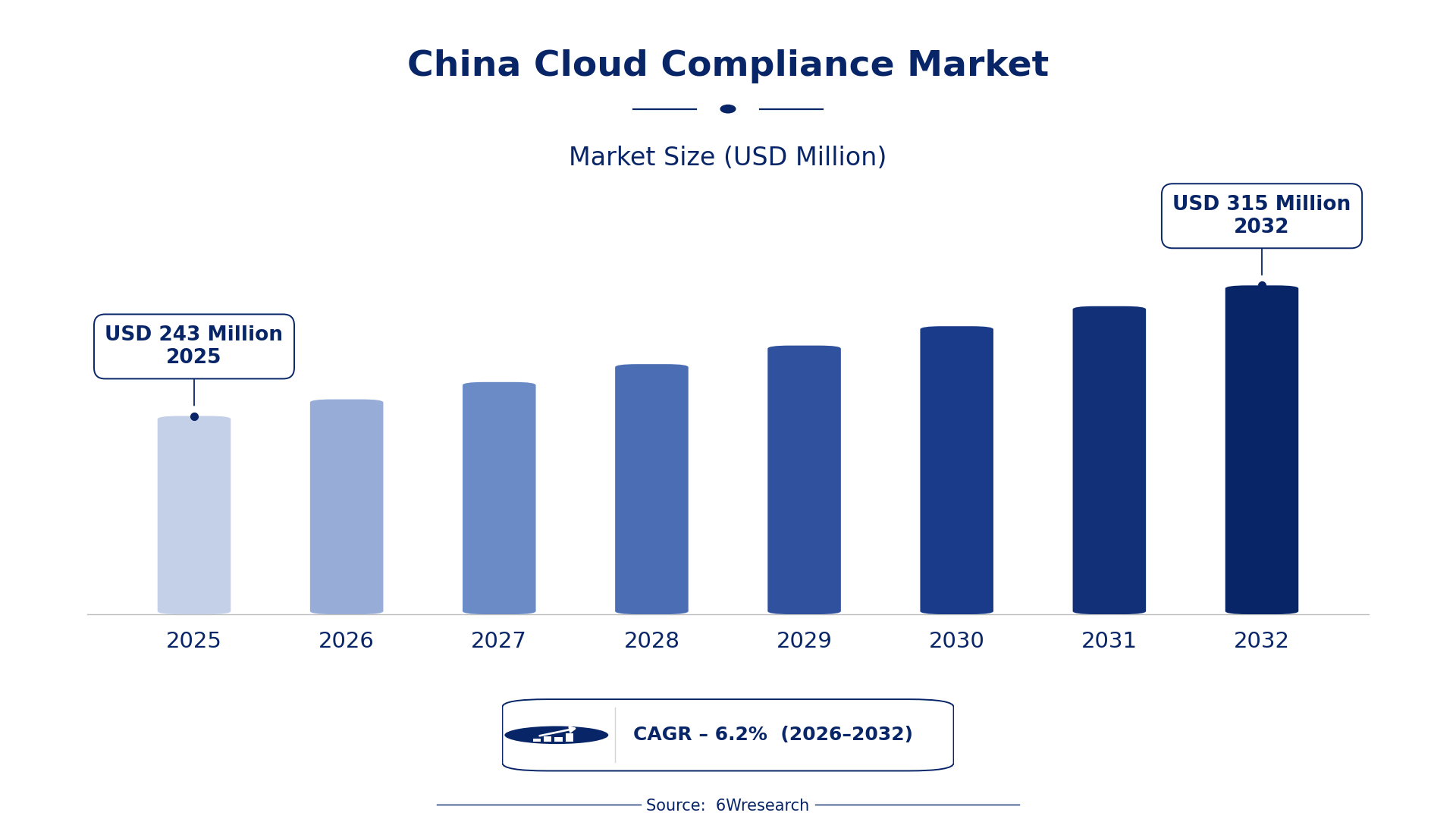
The China Cloud Compliance Market was estimated at USD 243 Million in 2025 and is projected to reach USD 315 Million by 2032, growing at a CAGR of 6.2% from 2026 to 2032.
China Cloud Compliance Market Synopsis
As regulatory scrutiny intensifies, organizations in China are under pressure to align with evolving compliance standards. The implementation of the Cybersecurity Law and the Personal Information Protection Law has made adherence to data protection protocols non-negotiable for cloud service providers.
In this climate, companies are increasingly investing in cloud compliance solutions that offer critical functionalities such as data encryption, access controls, and detailed monitoring capabilities. The result is a rapidly expanding market, with both local and international players adapting their offerings to meet the specific demands of Chinese regulations.
China Cloud Compliance Market Year-wise Growth Rate and Key Drivers
This graph illustrates the annual growth rates of the China Cloud Compliance Market from 2021 to 2032, highlighting a steady upward trajectory and projected expansion over the forecast period.
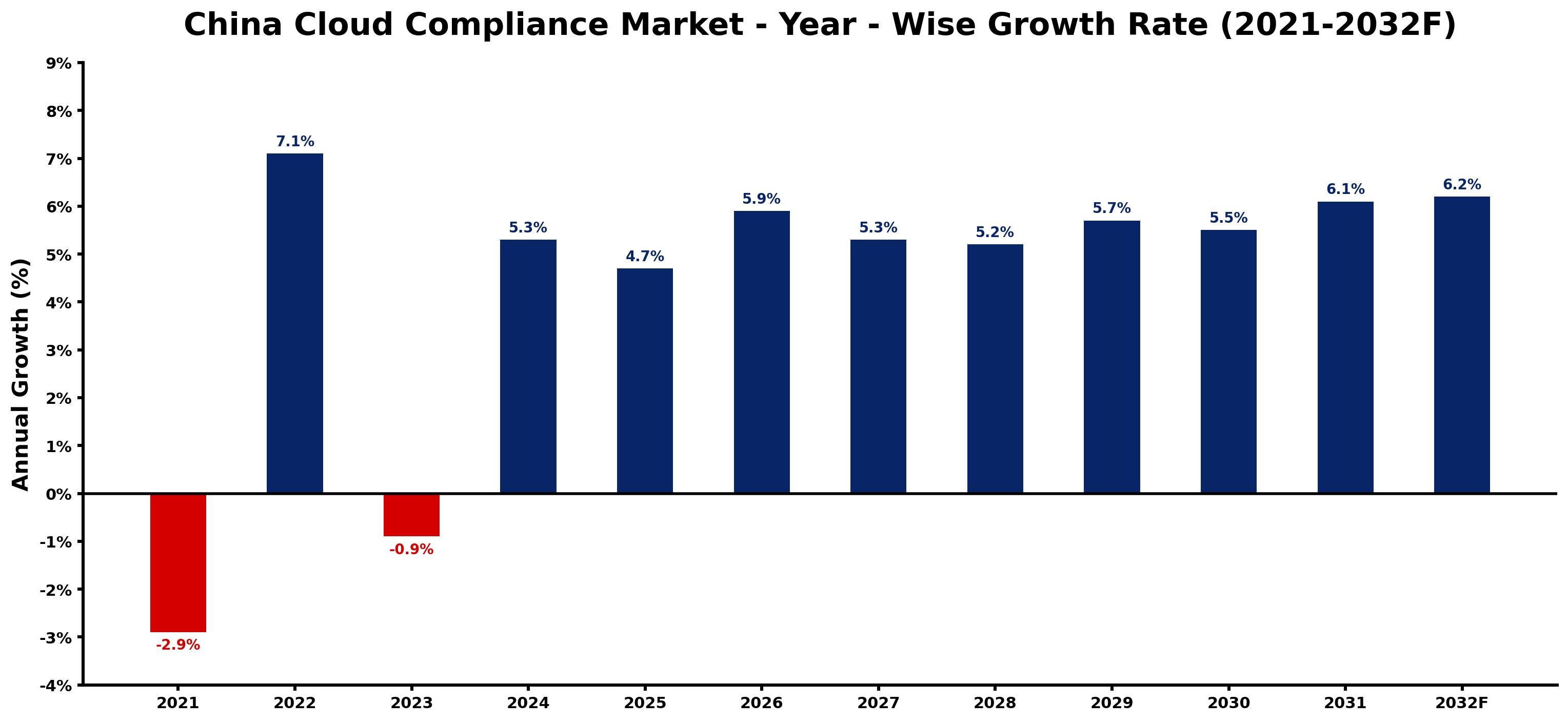
The table below presents the year‑wise growth rates along with the key drivers influencing the market
| Year | Growth Rate | Major Drivers |
| 2021 | -2.9% | Tightened regulations from Cyberspace Administration of China |
| 2022 | 7.1% | Implementation of China’s Cybersecurity Law enforcement guidelines. |
| 2023 | -0.9% | Increased scrutiny from Ministry of Industry and Information Technology |
| 2024 | 5.3% | Growing local data sovereignty regulations for cloud services. |
| 2025 | 4.7% | Rising adoption of national cloud solutions among enterprises. |
| 2026 | 5.9% | Enhanced focus on personal data protection compliance mandates. |
| 2027 | 5.3% | Increased collaboration with government on cloud security frameworks. |
| 2028 | 5.2% | Support for state-sponsored cloud infrastructure certification programs. |
| 2029 | 5.7% | Demand for cross-border data transfer compliance protocols rising. |
| 2030 | 5.5% | Strengthened local compliance requirements for multinational companies. |
| 2031 | 6.1% | Emergence of new privacy regulations influencing cloud adoption. |
| 2032 | 6.2% | Expansive growth of local cloud certification and standards initiatives. |
Note: Market size estimations and growth projections presented in this report are based on 6Wresearch's proprietary forecasting methodology, utilizing the latest available industry data, government publications, and primary research inputs.
China Cloud Compliance Market Key Takeaways
Below are some of the specific key takeaways from the market, including:
- Growing regulatory requirements are driving demand for cloud compliance solutions.
- Data protection and privacy concerns are at the forefront of compliance strategies.
- Investment in compliance tools is essential for businesses to avoid legal penalties.
- Key market players are focused on developing comprehensive compliance features.
- Emerging technologies are becoming integral to meeting compliance challenges.
Evaluation of Restraints in China Cloud Compliance Market
Navigating the regulatory maze poses a serious challenge for organizations operating in the cloud compliance space. The complexity of China’s data localization requirements and the stringent regulations surrounding data processing can impede service providers. on top of that, the absence of clear guidelines often results in uncertainty, making compliance an uphill battle. These hurdles can stifle innovation and slow market growth, as companies struggle to align their services with the ever-changing regulatory framework.
China Cloud Compliance Market Trends
A pronounced trend in the China Cloud Compliance Market is the increased focus on data security, propelled by new legislative measures. Companies are actively seeking cloud compliance services that can effectively address the unique challenges posed by domestic regulations. Concurrently, as digital transformation accelerates, there is a growing need for compliance solutions that can adapt to the rapid pace of technological change.
Additionally, businesses are prioritizing solutions that integrate advanced capabilities such as artificial intelligence for real-time monitoring and compliance analytics. The convergence of compliance technology and data management practices is becoming a critical factor for organizations aiming to maintain competitiveness while ensuring regulatory adherence.
China Cloud Compliance Market Opportunities
The shifting regulatory environment in China opens up substantial investment opportunities within the cloud compliance sector. Companies offering specialized compliance software and cybersecurity solutions are well-positioned to benefit from the demand surge. on top of that, as businesses digitize operations, the need for consulting services to navigate compliance issues is on the rise. Investors should also consider opportunities in data encryption technologies that are tailored to meet the stringent requirements of Chinese law, which are likely to see heightened interest.
Government Initiatives in the China Cloud Compliance Market
Government policy plays a crucial role in shaping the China Cloud Compliance Market, with a focus on stringent data security and privacy regulations. Recent legislative efforts have established a framework that mandates compliance, affecting how businesses manage their cloud operations. These initiatives not only ensure protection for consumers but also dictate the operational parameters for service providers in the cloud space.
- A regulatory framework introduced in 2021 mandates strict compliance with the Personal Information Protection Law, focusing on data processing and transfer regulations.
- Current initiatives under the Cybersecurity Law require cloud service providers to undergo regular security assessments and store data domestically.
- A national digital infrastructure upgrade programme is underway, aimed at enhancing compliance capabilities across various sectors.
- The Multi-Level Protection Scheme (MLPS), which categorizes data by sensitivity, is being implemented to enforce corresponding security measures.
- Planned updates to compliance regulations are expected to roll out by 2026, further tightening data management standards across industries.
Future Insights of the China Cloud Compliance Market
Looking ahead to 2026-2032, the China Cloud Compliance Market is expected to thrive as businesses continue to embrace cloud technology. The regulatory landscape will likely evolve, becoming even more complex, which in turn will drive the demand for sophisticated compliance solutions. As industries such as finance, healthcare, and e-commerce ramp up their cloud adoption, the need for tailored compliance services will become increasingly urgent. Companies that can adapt to regulatory changes while offering innovative compliance solutions will find themselves at the forefront of this expanding market.
China Cloud Compliance Market Latest Developments
Recent activity in the China Cloud Compliance Market has been marked by a flurry of initiatives aimed at enhancing compliance standards. Organizations are actively rolling out new compliance tools to meet regulatory demands while also investing in data security enhancements. This is indicative of a sector that is rapidly evolving in response to governmental regulations and market needs.
- A major technology vendor launched a comprehensive compliance management platform in Q1 2025, aimed at streamlining adherence to new regulatory standards.
- An initiative that began in early 2025 is currently ongoing, focusing on integrating AI-driven compliance analytics into cloud services.
- A partnership between regional cloud providers and cybersecurity firms was announced in mid-2025, aimed at bolstering data protection measures.
- A rollout expected to begin in late 2025 will introduce enhanced encryption protocols across cloud services to meet evolving compliance requirements.
- By mid-2026, a new training programme for compliance professionals is set to launch, addressing the skills gap in the market.
China Cloud Compliance Market - Key Attractiveness of the Report
- 10 Years of Market Numbers
- Historical Data Starting from 2022 to 2025
- Base Year: 2025
- Forecast Data until 2032
- Key Performance Indicators Impacting the Market
- Major Upcoming Developments and Projects
Key Highlights of the Report:
- China Cloud Compliance Market Outlook
- Market Size of China Cloud Compliance Market, 2025
- Forecast of China Cloud Compliance Market, 2032
- Historical Data and Forecast of China Cloud Compliance Revenues & Volume for the Period 2022-2032F
- China Cloud Compliance Market Trend Evolution
- China Cloud Compliance Market Drivers and Challenges
- China Cloud Compliance Price Trends
- China Cloud Compliance Porter's Five Forces
- China Cloud Compliance Industry Life Cycle
- Historical Data and Forecast of China Cloud Compliance Market Revenues & Volume By Component for the Period 2022-2032F
- Historical Data and Forecast of China Cloud Compliance Market Revenues & Volume By Software for the Period 2022-2032F
- Historical Data and Forecast of China Cloud Compliance Market Revenues & Volume By Services for the Period 2022-2032F
- Historical Data and Forecast of China Cloud Compliance Market Revenues & Volume By Cloud Model for the Period 2022-2032F
- Historical Data and Forecast of China Cloud Compliance Market Revenues & Volume By Infrastructure-as-a-Service (IaaS) for the Period 2022-2032F
- Historical Data and Forecast of China Cloud Compliance Market Revenues & Volume By Platform-as-a-Service (PaaS) for the Period 2022-2032F
- Historical Data and Forecast of China Cloud Compliance Market Revenues & Volume By Software-as-a-Service (SaaS) for the Period 2022-2032F
- Historical Data and Forecast of China Cloud Compliance Market Revenues & Volume By Application for the Period 2022-2032F
- Historical Data and Forecast of China Cloud Compliance Market Revenues & Volume By Audit and Compliance Management for the Period 2022-2032F
- Historical Data and Forecast of China Cloud Compliance Market Revenues & Volume By Threat Detection and Remediation for the Period 2022-2032F
- Historical Data and Forecast of China Cloud Compliance Market Revenues & Volume By Activity Monitoring and Analytics for the Period 2022-2032F
- Historical Data and Forecast of China Cloud Compliance Market Revenues & Volume By Visibility and Risk Assessment for the Period 2022-2032F
- Historical Data and Forecast of China Cloud Compliance Market Revenues & Volume By Other Applications for the Period 2022-2032F
- Historical Data and Forecast of China Cloud Compliance Market Revenues & Volume By Organization Size for the Period 2022-2032F
- Historical Data and Forecast of China Cloud Compliance Market Revenues & Volume By Large Enterprises for the Period 2022-2032F
- Historical Data and Forecast of China Cloud Compliance Market Revenues & Volume By Small and Medium-sized Enterprises (SMEs) for the Period 2022-2032F
- Historical Data and Forecast of China Cloud Compliance Market Revenues & Volume By Vertical for the Period 2022-2032F
- Historical Data and Forecast of China Cloud Compliance Market Revenues & Volume By Banking, Financial Services, and Insurance (BFSI) for the Period 2022-2032F
- Historical Data and Forecast of China Cloud Compliance Market Revenues & Volume By Government for the Period 2022-2032F
- Historical Data and Forecast of China Cloud Compliance Market Revenues & Volume By Healthcare for the Period 2022-2032F
- Historical Data and Forecast of China Cloud Compliance Market Revenues & Volume By IT and ITeS for the Period 2022-2032F
- Historical Data and Forecast of China Cloud Compliance Market Revenues & Volume By Retail and eCommerce for the Period 2022-2032F
- Historical Data and Forecast of China Cloud Compliance Market Revenues & Volume By Manufacturing for the Period 2022-2032F
- China Cloud Compliance Import Export Trade Statistics
- Market Opportunity Assessment By Component
- Market Opportunity Assessment By Cloud Model
- Market Opportunity Assessment By Application
- Market Opportunity Assessment By Organization Size
- Market Opportunity Assessment By Vertical
- China Cloud Compliance Top Companies Market Share
- China Cloud Compliance Competitive Benchmarking By Technical and Operational Parameters
- China Cloud Compliance Company Profiles
- China Cloud Compliance Key Strategic Recommendations






































