China Cloud ERP Market Size & Growth Rate (2026-2032)
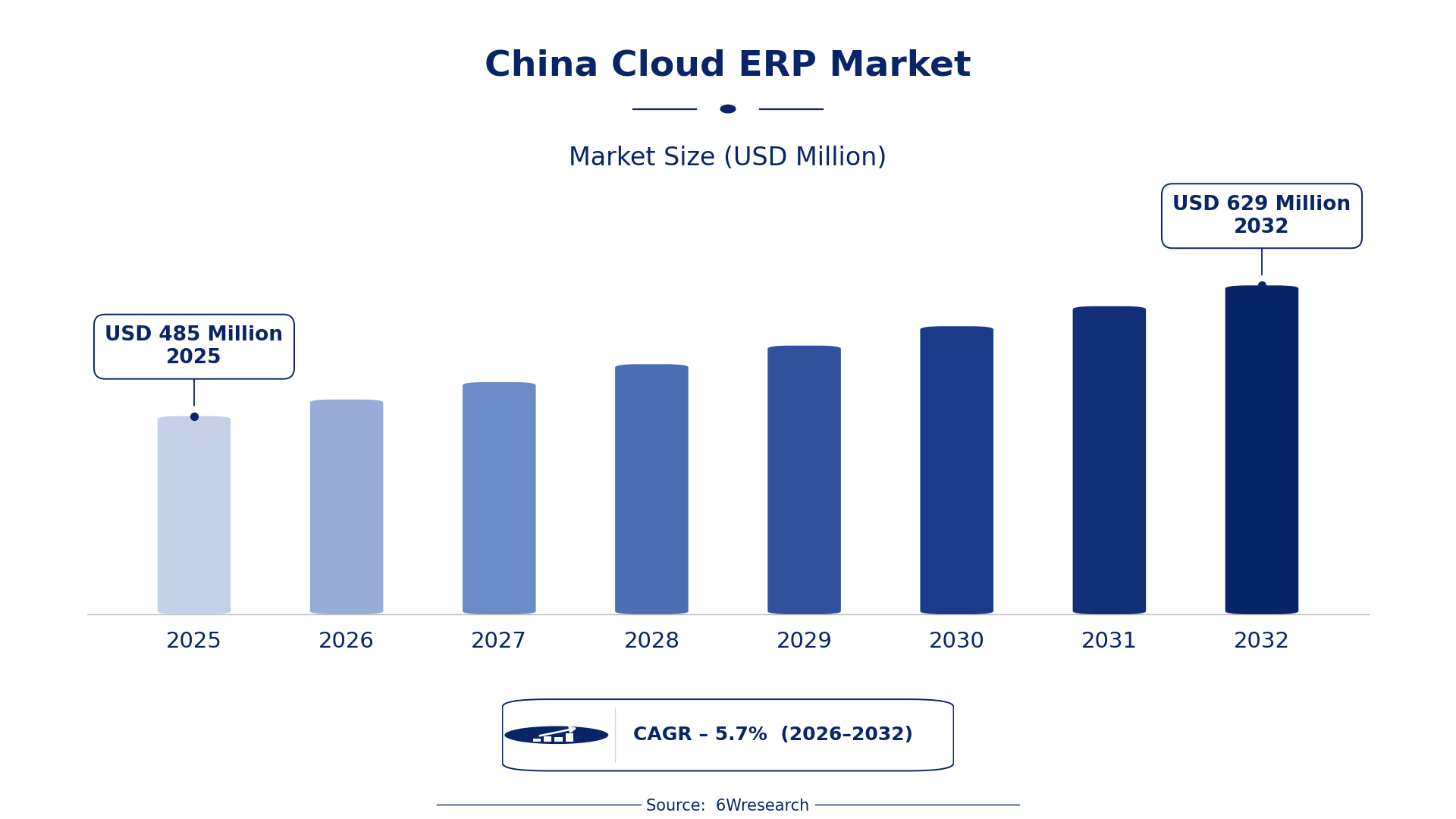
The China Cloud ERP Market was estimated at USD 485 Million in 2025 and is projected to reach USD 629 Million by 2032, growing at a CAGR of 5.7% from 2026 to 2032.
China Cloud ERP Market Synopsis
The recent momentum in the China Cloud ERP Market reflects a substantial shift as enterprises abandon traditional on-premise systems in favor of cloud solutions. This transition is not merely a trend; it embodies a strategic pivot towards agility and efficiency, aligning with the demands of modern business operations.
Looking ahead, the market is expected to continue this upward trajectory, driven by the increasing necessity for integrated business processes and real-time data accessibility. As companies prioritize operational efficiency and cost-effectiveness, cloud ERP solutions are becoming indispensable tools for achieving these goals.
China Cloud ERP Market Year-wise Growth Rate and Key Drivers
This graph illustrates the annual growth rates of the China Cloud ERP Market from 2021 to 2032, highlighting a steady upward trajectory and projected expansion over the forecast period.
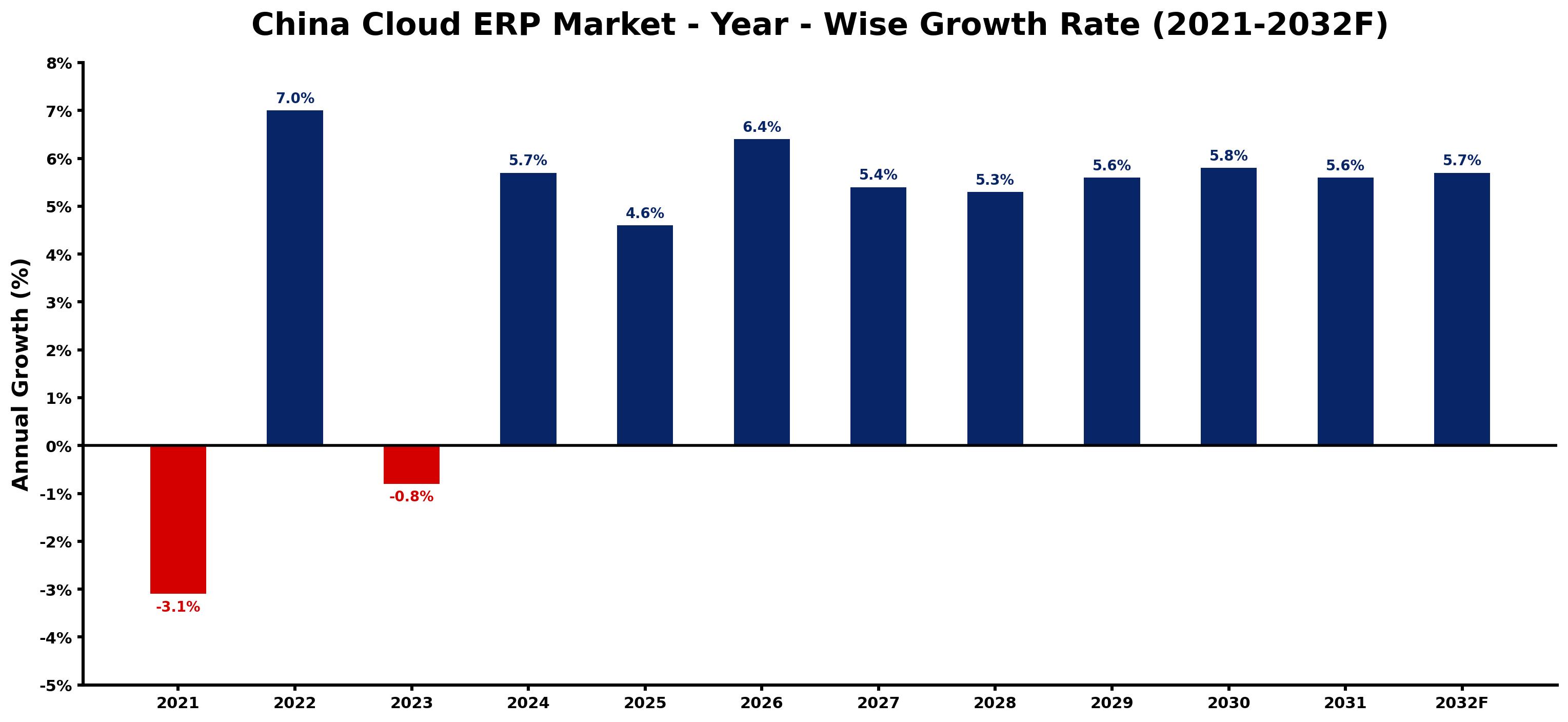
The table below presents the year‑wise growth rates along with the key drivers influencing the market
| Year | Growth Rate | Major Drivers |
| 2021 | -3.1% | New data privacy laws restricted cloud ERP access |
| 2022 | 7.0% | Government's digital transformation initiative boosting cloud adoption |
| 2023 | -0.8% | Increased reliance on local on-premise solutions dampened adoption |
| 2024 | 5.7% | Increased demand for SaaS solutions in manufacturing sector |
| 2025 | 4.6% | Growing adoption of AI for supply chain management |
| 2026 | 6.4% | Rising need for compliance with domestic ERP regulations |
| 2027 | 5.4% | Economic recovery post-pandemic driving enterprise tech investments |
| 2028 | 5.3% | Expanding e-commerce sector necessitating advanced ERP systems |
| 2029 | 5.6% | Integration of big data analytics in business operations |
| 2030 | 5.8% | Push for smart manufacturing enhances cloud ERP demand |
| 2031 | 5.6% | Local SMEs upgrading systems through governmental subsidies |
| 2032 | 5.7% | Emergence of industry-specific cloud solutions attracting clients |
Note: Market size estimations and growth projections presented in this report are based on 6Wresearch's proprietary forecasting methodology, utilizing the latest available industry data, government publications, and primary research inputs.
China Cloud ERP Market Key Takeaways
Below are some of the specific key takeaways from the market, including:
- The market is witnessing a shift from traditional ERP systems to cloud-based solutions, enhancing operational agility.
- Integration capabilities with other cloud applications are essential for driving adoption among enterprises.
- Cost savings remain a primary motivator for businesses transitioning to cloud ERP.
- Government policies are increasingly supportive of digital transformation initiatives within businesses.
- Concerns about data security and control continue to challenge full-scale adoption of cloud ERP solutions.
Evaluation of Restraints in China Cloud ERP Market
Despite the growth prospects, several restraints hinder market progression. Resistance from enterprises that have long relied on on-premise systems remains a notable barrier, primarily due to concerns surrounding data control and security. Integration challenges with existing IT infrastructure also complicate the transition process. Additionally, the costs associated with migrating to cloud solutions can deter businesses from making the leap, particularly when potential disruptions to operations are considered.
China Cloud ERP Market Trends
A few key trends are shaping the China Cloud ERP Market. Firstly, the integration of artificial intelligence and machine learning within cloud ERP systems is gaining traction, allowing businesses to harness data analytics for improved decision-making. Secondly, the rise of remote work has accelerated the demand for cloud-based solutions that facilitate seamless collaboration. Lastly, customizable ERP solutions are becoming increasingly popular, as companies seek tailored applications that meet their unique operational needs.
China Cloud ERP Market Opportunities
The market presents numerous growth opportunities, particularly for vendors focusing on enhancing security features and integration capabilities. Additionally, as small and medium enterprises recognize the benefits of cloud ERP, there’s a substantial market segment ripe for engagement. Companies that can provide scalable and cost-effective solutions are well-positioned to capitalize on this growing demand.
Government Initiatives in the China Cloud ERP Market
The Chinese government actively fosters the adoption of cloud ERP systems through various policy measures aimed at promoting digital transformation. Public-sector priorities include enhancing the efficiency and competitiveness of businesses, which is critical for economic growth. These supportive measures are crucial as they help mitigate some of the resistance enterprises face when transitioning to cloud-based solutions.
- A regulatory framework introduced in 2025 mandates that businesses adopt cloud-based systems as part of digital upgrade plans.
- Currently underway is a national digital infrastructure upgrade program aimed at improving access to cloud services across urban and rural areas.
- A financial incentive program launched in early 2026 encourages small and medium enterprises to transition to cloud ERP systems.
- A planned public-private initiative expected to expand digital literacy among workers by 2027, facilitating smoother ERP adoption.
Future Insights of the China Cloud ERP Market
From 2026 to 2032, the China Cloud ERP Market is anticipated to evolve significantly, propelled by continuous advancements in technology and increasing corporate investment in digital solutions. As integration with AI and data analytics deepens, businesses will likely experience enhanced efficiency and productivity. on top of that, the ongoing push for regulatory compliance and digital transformation will further cement cloud ERP as a cornerstone of organizational strategy.
China Cloud ERP Market Latest Developments
Recent activity in the China Cloud ERP Market indicates a shift towards more sophisticated solutions as companies seek to enhance operational efficiency. Over the past year, there has been a notable uptick in partnerships between technology firms and traditional businesses aiming to leverage cloud capabilities.
- A major technology vendor launched an innovative cloud ERP solution in Q1 2025, aimed at small and medium-sized enterprises.
- An ongoing collaboration between regional operators is focused on integrating cloud ERP systems with local supply chains, enhancing operational connectivity.
- A leading software provider is currently upgrading its cloud ERP platform to include advanced analytics features, with a rollout expected by mid-2026.
- A new initiative to provide training resources for cloud ERP implementation is set to begin in late 2025, targeting businesses across various sectors.
China Cloud ERP Market - Key Attractiveness of the Report
- 10 Years of Market Numbers
- Historical Data Starting from 2022 to 2025
- Base Year: 2025
- Forecast Data until 2032
- Key Performance Indicators Impacting the Market
- Major Upcoming Developments and Projects
Key Highlights of the Report:
- China Cloud ERP Market Outlook
- Market Size of China Cloud ERP Market, 2025
- Forecast of China Cloud ERP Market, 2032
- Historical Data and Forecast of China Cloud ERP Revenues & Volume for the Period 2022-2032F
- China Cloud ERP Market Trend Evolution
- China Cloud ERP Market Drivers and Challenges
- China Cloud ERP Price Trends
- China Cloud ERP Porter's Five Forces
- China Cloud ERP Industry Life Cycle
- Historical Data and Forecast of China Cloud ERP Market Revenues & Volume By Component for the Period 2022-2032F
- Historical Data and Forecast of China Cloud ERP Market Revenues & Volume By Solution for the Period 2022-2032F
- Historical Data and Forecast of China Cloud ERP Market Revenues & Volume By Services for the Period 2022-2032F
- Historical Data and Forecast of China Cloud ERP Market Revenues & Volume By Vertical for the Period 2022-2032F
- Historical Data and Forecast of China Cloud ERP Market Revenues & Volume By BFSI for the Period 2022-2032F
- Historical Data and Forecast of China Cloud ERP Market Revenues & Volume By Manufacturing for the Period 2022-2032F
- Historical Data and Forecast of China Cloud ERP Market Revenues & Volume By IT and Telecom for the Period 2022-2032F
- Historical Data and Forecast of China Cloud ERP Market Revenues & Volume By Business Function for the Period 2022-2032F
- Historical Data and Forecast of China Cloud ERP Market Revenues & Volume By Accounting and Finance for the Period 2022-2032F
- Historical Data and Forecast of China Cloud ERP Market Revenues & Volume By Sales and Marketing for the Period 2022-2032F
- Historical Data and Forecast of China Cloud ERP Market Revenues & Volume By Inventory and Order Management for the Period 2022-2032F
- Historical Data and Forecast of China Cloud ERP Market Revenues & Volume By Organization Size for the Period 2022-2032F
- Historical Data and Forecast of China Cloud ERP Market Revenues & Volume By SMEs for the Period 2022-2032F
- Historical Data and Forecast of China Cloud ERP Market Revenues & Volume By Large Enterprises for the Period 2022-2032F
- China Cloud ERP Import Export Trade Statistics
- Market Opportunity Assessment By Component
- Market Opportunity Assessment By Vertical
- Market Opportunity Assessment By Business Function
- Market Opportunity Assessment By Organization Size
- China Cloud ERP Top Companies Market Share
- China Cloud ERP Competitive Benchmarking By Technical and Operational Parameters
- China Cloud ERP Company Profiles
- China Cloud ERP Key Strategic Recommendations






































