China Coffee Beans Market Top 5 Importing Countries and Market Competition (HHI) Analysis
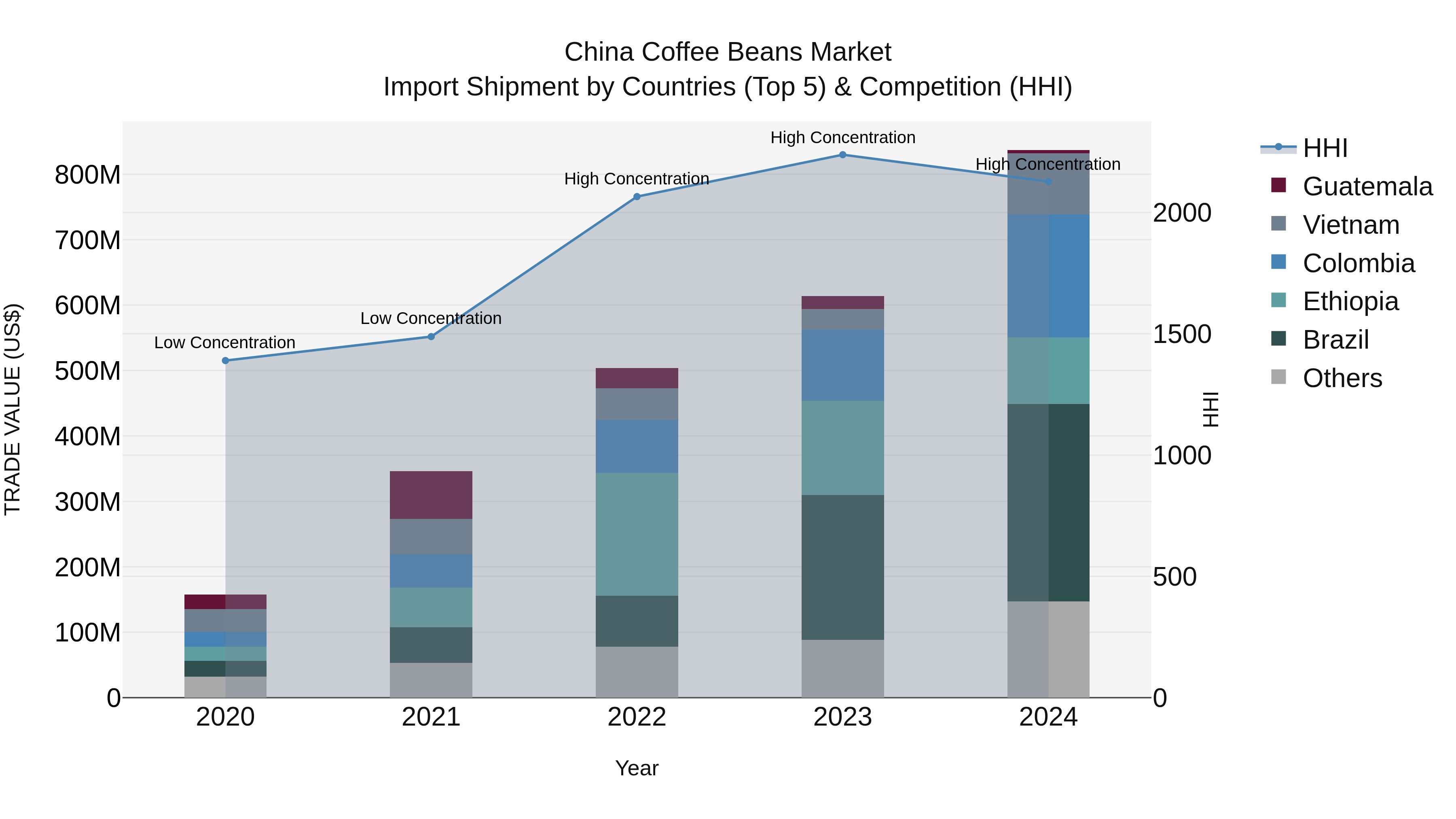
China coffee beans import market continued to showcase strong growth in 2024, with top exporting countries being Brazil, Colombia, Ethiopia, Vietnam, and Indonesia. The Herfindahl-Hirschman Index (HHI) indicates a high concentration of imports, reflecting market dominance by key suppliers. The impressive Compound Annual Growth Rate (CAGR) of 51.79% from 2020 to 2024 underscores the increasing demand for coffee beans in China. Moreover, the notable growth rate of 36.28% from 2023 to 2024 signals a thriving market and lucrative opportunities for exporters looking to tap into China coffee industry.
China Coffee Beans Market Overview
The coffee beans market in China is growing, driven by increasing coffee consumption and a rising coffee culture among Chinese consumers. Specialty coffee shops and premium coffee brands are gaining popularity, contributing to higher demand for high-quality coffee beans. Urbanization and changes in lifestyle, along with a growing middle class with disposable income, are further supporting market growth. However, challenges such as fluctuating global coffee prices and supply chain disruptions due to climatic changes and geopolitical factors could impact market stability.
Drivers of the market
The demand for coffee beans in China is driven by the expanding coffee culture and growing consumer preference for specialty coffee. As urbanization and disposable incomes increase, more consumers are seeking high-quality coffee experiences, fueling the demand for premium coffee beans. The proliferation of coffee shops and cafes, along with the rising trend of home brewing, further supports market growth. Additionally, Chinas coffee industry is benefiting from improved supply chain logistics and increasing investments in coffee cultivation and production, which enhance the availability and quality of coffee beans.
Challenges of the market
The China coffee beans market encounters several challenges, such as supply chain disruptions and fluctuating coffee bean prices. Climate change and unpredictable weather patterns can affect coffee bean production, leading to supply shortages and price volatility. Additionally, the market faces competition from other beverage options and the need to cater to changing consumer preferences for specialty coffee and sustainable sourcing practices.
Government Policy of the market
The Chinese government regulates the coffee beans market through agricultural policies and import/export regulations. The Ministry of Agriculture and Rural Affairs oversees domestic coffee production, supporting initiatives to improve quality and yield. Additionally, the General Administration of Customs enforces standards for imported coffee beans, ensuring they meet safety and quality requirements to protect consumers and support local industry growth.
Key Highlights of the Report:
- China Coffee Beans Market Outlook
- Market Size of China Coffee Beans Market, 2024
- Forecast of China Coffee Beans Market, 2031
- Historical Data and Forecast of China Coffee Beans Revenues & Volume for the Period 2021-2031
- China Coffee Beans Market Trend Evolution
- China Coffee Beans Market Drivers and Challenges
- China Coffee Beans Price Trends
- China Coffee Beans Porter's Five Forces
- China Coffee Beans Industry Life Cycle
- Historical Data and Forecast of China Coffee Beans Market Revenues & Volume By Product Type for the Period 2021-2031
- Historical Data and Forecast of China Coffee Beans Market Revenues & Volume By Arabica for the Period 2021-2031
- Historical Data and Forecast of China Coffee Beans Market Revenues & Volume By Robusta for the Period 2021-2031
- Historical Data and Forecast of China Coffee Beans Market Revenues & Volume By Others for the Period 2021-2031
- Historical Data and Forecast of China Coffee Beans Market Revenues & Volume By Applications for the Period 2021-2031
- Historical Data and Forecast of China Coffee Beans Market Revenues & Volume By Personal Care for the Period 2021-2031
- Historical Data and Forecast of China Coffee Beans Market Revenues & Volume By Food for the Period 2021-2031
- Historical Data and Forecast of China Coffee Beans Market Revenues & Volume By Pharmaceutical for the Period 2021-2031
- China Coffee Beans Import Export Trade Statistics
- Market Opportunity Assessment By Product Type
- Market Opportunity Assessment By Applications
- China Coffee Beans Top Companies Market Share
- China Coffee Beans Competitive Benchmarking By Technical and Operational Parameters
- China Coffee Beans Company Profiles
- China Coffee Beans Key Strategic Recommendations






































