China Commercial Boiler Market Size, Share & Growth Rate
The China Commercial Boiler Market was estimated at USD 237 Million in 2025 and is projected to reach USD 273 Million by 2032, growing at a CAGR of 2.0% from 2026 to 2032. This growth trajectory is primarily fueled by the increasing demand for efficient heating solutions across a broad spectrum of commercial settings. Urbanization and the expansion of commercial real estate are particularly pivotal, as they necessitate reliable heating and hot water systems. Moreover, stringent government regulations aimed at enhancing energy efficiency and reducing emissions are further driving advancements in boiler technology.
China Commercial Boiler Market Year-wise Growth Rate and Key Drivers
This graph highlights how the China Commercial Boiler Market has steadily grown over the years, supported by major growth factors.
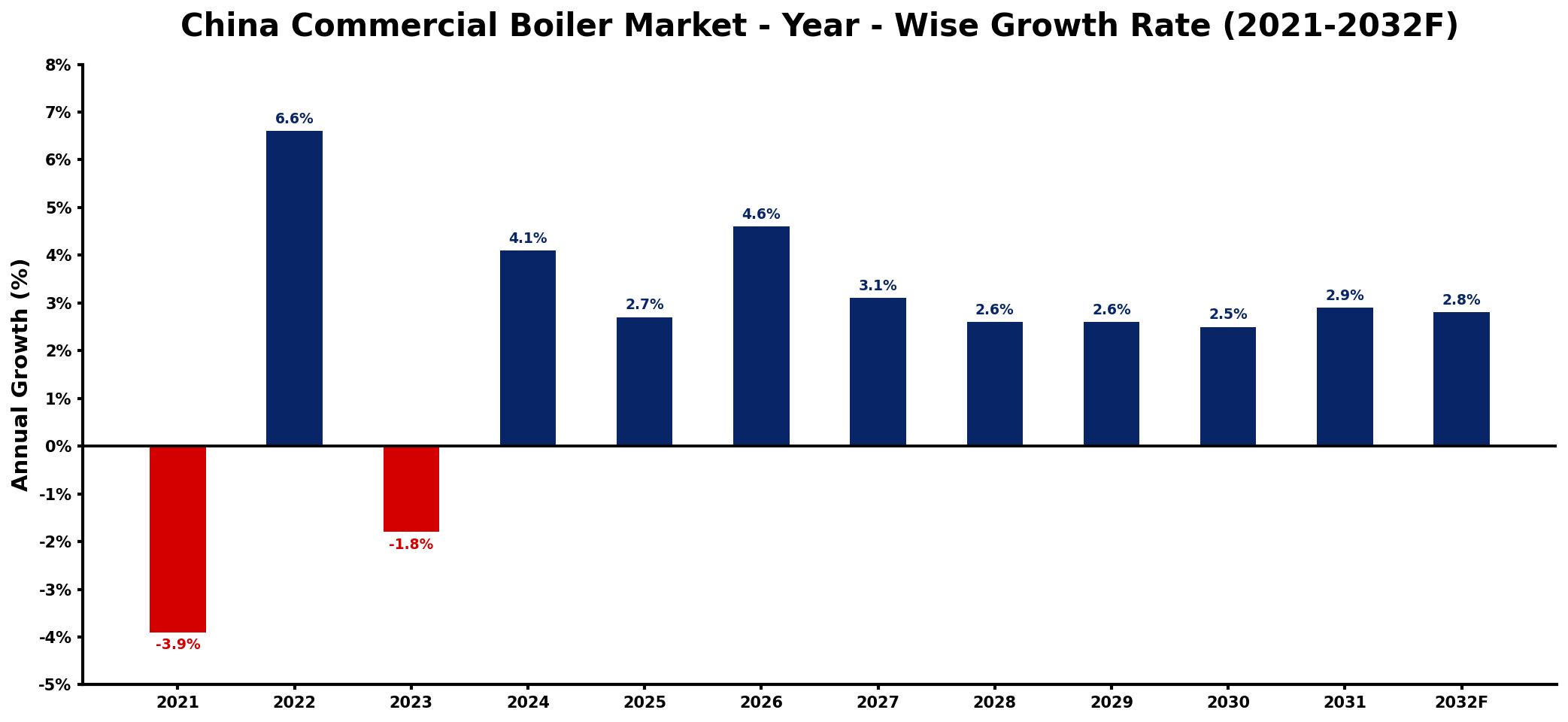
The table below presents the year‑wise growth rates along with the key drivers influencing the market
| Year | Growth Rate | Major Drivers |
| 2021 | -3.9% | decreased industrial energy consumption |
| 2022 | 6.6% | rising demand for energy efficiency |
| 2023 | -1.8% | lowered construction sector activity |
| 2024 | 4.1% | increased government infrastructure spending |
| 2025 | 2.7% | growing focus on sustainability initiatives |
| 2026 | 4.6% | expansion of renewable energy projects |
| 2027 | 3.1% | enhanced industrial automation trends |
| 2028 | 2.6% | increased investment in manufacturing |
| 2029 | 2.6% | growing urbanization and infrastructure |
| 2030 | 2.5% | rising energy sector investments |
| 2031 | 2.9% | increased technological advancements adoption |
| 2032 | 2.8% | growing demand for clean energy |
Note: Market size estimations and growth projections presented in this report are based on 6Wresearch's proprietary forecasting methodology, utilizing the latest available industry data, government publications, and primary research inputs.
China Commercial Boiler Market Synopsis
The most significant force shaping the China Commercial Boiler Market is the push for improved energy efficiency amidst rapid industrial growth. As urban areas expand and industrial activities intensify, the demand for robust heating systems becomes critical, particularly in sectors like hospitality and manufacturing.
Additionally, the transition towards cleaner energy sources is revolutionizing the market landscape. This shift not only aligns with global sustainability goals but also encourages the adoption of innovative technologies that meet new environmental standards, thereby influencing purchasing decisions across the industry.
China Commercial Boiler Market Key Takeaways
- The market is experiencing steady growth driven by urbanization and industrial expansion.
- Technological advancements are critical for meeting stringent environmental regulations.
- Government policies are incentivizing energy-efficient practices in commercial boiler applications.
- The demand for sustainable and cleaner heating solutions is shaping market dynamics.
- Competitive market landscape requires continuous innovation to retain market share.
Evaluation of Restraints in China Commercial Boiler Market
Despite promising growth prospects, the China Commercial Boiler Market faces significant constraints primarily related to regulatory compliance and the need for ongoing technological upgrades. Manufacturers are under increasing pressure to meet stringent environmental standards, which often necessitates substantial investment in new technologies. Additionally, the intense competition among numerous market players may lead to price wars, impacting profitability and market positioning. Companies must also navigate the complexities of rapidly evolving customer expectations while ensuring adherence to emerging regulatory frameworks.
China Commercial Boiler Market Trends
Key trends influencing the China Commercial Boiler Market include the integration of smart technologies into boiler systems. These innovations enhance energy management and operational efficiency, providing users with real-time data to optimize performance. Furthermore, the emphasis on alternative fuel sources is gaining traction as businesses increasingly seek to minimize their carbon footprints and comply with government mandates.
Another trend is the growing preference for modular and scalable boiler systems, enabling flexibility and adaptability in various commercial applications. This approach not only streamlines installation but also caters to diverse heating demands, thereby driving market growth.
China Commercial Boiler Market Opportunities
The China Commercial Boiler Market presents numerous growth and investment opportunities, particularly for companies focusing on energy-efficient and environmentally friendly solutions. As businesses strive to reduce operational costs while adhering to stricter regulations, there is a clear market for advanced, sustainable boiler technologies. Furthermore, the expansion of e-commerce and online platforms offers new channels for distribution, enhancing market reach for manufacturers. With ongoing investments in infrastructure and commercial facilities, companies can capitalize on the burgeoning demand for reliable heating systems.
Government Initiatives in the China Commercial Boiler Market
The regulatory framework governing the China Commercial Boiler Market is primarily dictated by the Ministry of Housing and Urban-Rural Development and the Ministry of Ecology and Environment. Government initiatives focus on improving energy efficiency and reducing emissions from commercial boilers. Incentives are being provided to promote the adoption of energy-efficient technologies, and strict compliance with safety and environmental standards is enforced. There are also comprehensive guidelines for the maintenance and operation of commercial boilers to ensure that they meet established regulatory benchmarks.
Future Insights of the China Commercial Boiler Market
Looking ahead to the period from 2026 to 2032, the China Commercial Boiler Market is poised for steady evolution. With the continued emphasis on sustainability, we can expect to see significant advancements in boiler technology that prioritize efficiency and reduced emissions. Additionally, the expanding middle class and urbanization will likely drive up demand for commercial infrastructure, subsequently increasing the need for dependable heating solutions. Companies that leverage innovative technologies and align with government regulations are likely to gain a competitive edge in this dynamic market.
China Commercial Boiler Market Latest Developments (2025 - 2026)
In the recent months, the China Commercial Boiler Market has witnessed a surge in innovations aimed at enhancing energy efficiency and operational performance. Many manufacturers are investing in research and development to create smarter, more adaptive systems. The emphasis on modular boiler solutions has also gained momentum, with companies focusing on scalability to meet the varying demands of commercial enterprises. Regulatory updates are pushing firms to accelerate their compliance efforts, further underscoring the importance of aligning technological advancements with governmental guidelines.
China Commercial Boiler Market - Key Attractiveness of the Report
- 10 Years of Market Numbers
- Historical Data Starting from 2022 to 2025
- Base Year: 2025
- Forecast Data until 2032
- Key Performance Indicators Impacting the Market
- Major Upcoming Developments and Projects
Key Highlights of the Report:
- China Commercial Boiler Market Outlook
- Market Size of China Commercial Boiler Market, 2025
- Forecast of China Commercial Boiler Market, 2032
- Historical Data and Forecast of China Commercial Boiler Revenues & Volume for the Period 2022-2032F
- China Commercial Boiler Market Trend Evolution
- China Commercial Boiler Market Drivers and Challenges
- China Commercial Boiler Price Trends
- China Commercial Boiler Porter's Five Forces
- China Commercial Boiler Industry Life Cycle
- Historical Data and Forecast of China Commercial Boiler Market Revenues & Volume By Fuel Type for the Period 2022-2032F
- Historical Data and Forecast of China Commercial Boiler Market Revenues & Volume By Natural Gas for the Period 2022-2032F
- Historical Data and Forecast of China Commercial Boiler Market Revenues & Volume By Oil for the Period 2022-2032F
- Historical Data and Forecast of China Commercial Boiler Market Revenues & Volume By Coal for the Period 2022-2032F
- Historical Data and Forecast of China Commercial Boiler Market Revenues & Volume By Others for the Period 2022-2032F
- Historical Data and Forecast of China Commercial Boiler Market Revenues & Volume By Technology for the Period 2022-2032F
- Historical Data and Forecast of China Commercial Boiler Market Revenues & Volume By Condensing for the Period 2022-2032F
- Historical Data and Forecast of China Commercial Boiler Market Revenues & Volume By Non-Condensing for the Period 2022-2032F
- Historical Data and Forecast of China Commercial Boiler Market Revenues & Volume By Capacity for the Period 2022-2032F
- Historical Data and Forecast of China Commercial Boiler Market Revenues & Volume By Less than 10 MMBtu/hr for the Period 2022-2032F
- Historical Data and Forecast of China Commercial Boiler Market Revenues & Volume By 10-50 MMBtu/hr for the Period 2022-2032F
- Historical Data and Forecast of China Commercial Boiler Market Revenues & Volume By Others for the Period 2022-2032F
- Historical Data and Forecast of China Commercial Boiler Market Revenues & Volume By End User for the Period 2022-2032F
- Historical Data and Forecast of China Commercial Boiler Market Revenues & Volume By Offices for the Period 2022-2032F
- Historical Data and Forecast of China Commercial Boiler Market Revenues & Volume By Hospitals for the Period 2022-2032F
- Historical Data and Forecast of China Commercial Boiler Market Revenues & Volume By Educational Institutions for the Period 2022-2032F
- Historical Data and Forecast of China Commercial Boiler Market Revenues & Volume By Lodging for the Period 2022-2032F
- Historical Data and Forecast of China Commercial Boiler Market Revenues & Volume By Others for the Period 2022-2032F
- China Commercial Boiler Import Export Trade Statistics
- Market Opportunity Assessment By Fuel Type
- Market Opportunity Assessment By Technology
- Market Opportunity Assessment By Capacity
- Market Opportunity Assessment By End User
- China Commercial Boiler Top Companies Market Share
- China Commercial Boiler Competitive Benchmarking By Technical and Operational Parameters
- China Commercial Boiler Company Profiles
- China Commercial Boiler Key Strategic Recommendations






































