China Consumer Battery Market Size, Share & Growth Rate
The China Consumer Battery Market was estimated at USD 162 Million in 2025 and is projected to reach USD 212 Million by 2032, growing at a CAGR of 3.9% from 2026 to 2032. This upward trajectory is driven primarily by the rising adoption of portable electronic devices, such as smartphones and laptops, coupled with the growing interest in electric vehicles (EVs). Furthermore, advancements in battery technology, including improved energy density and lifespan, are significantly contributing to market expansion.
China Consumer Battery Market Year-wise Growth Rate and Key Drivers
This graph highlights how the China Consumer Battery Market has steadily grown over the years, supported by major growth factors.
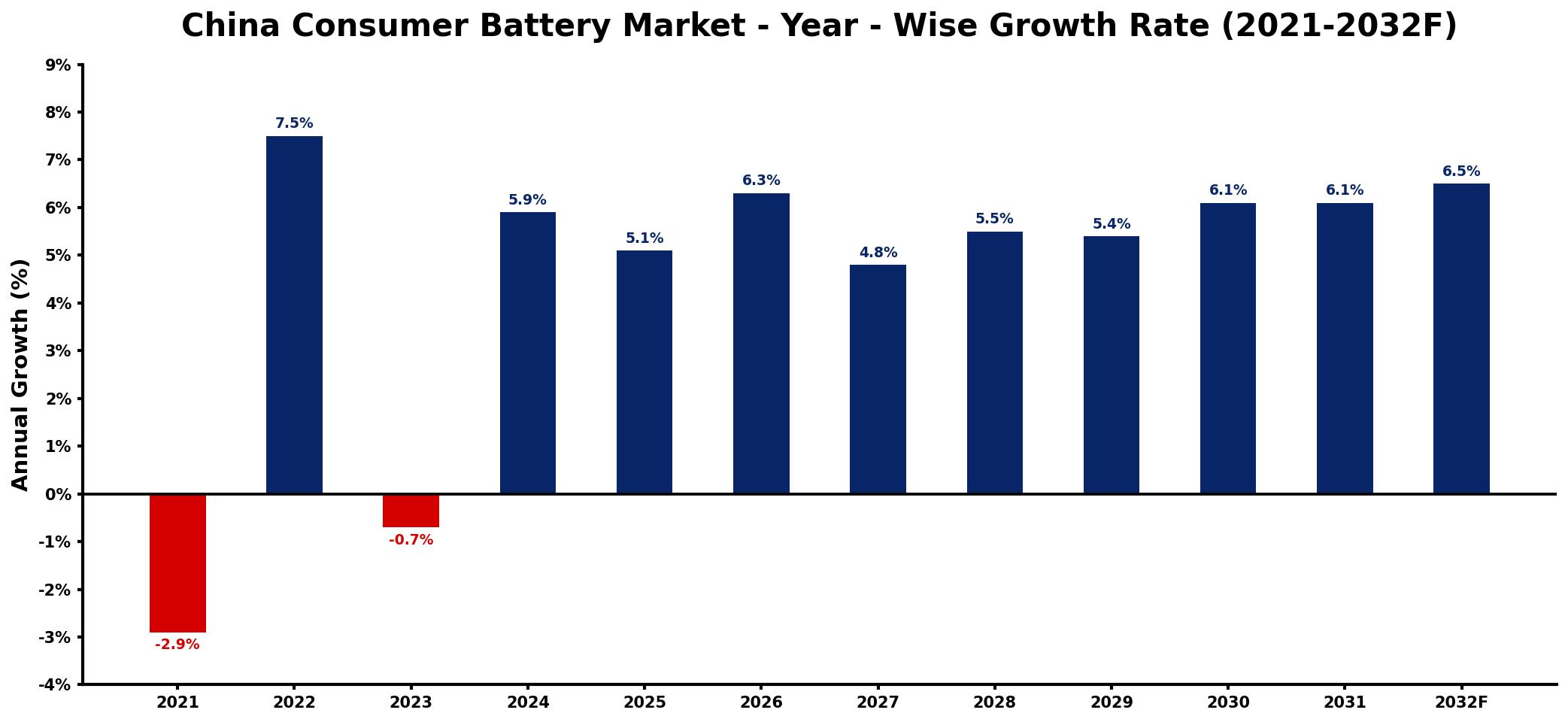
The table below presents the year‑wise growth rates along with the key drivers influencing the market
| Year | Growth Rate | Major Drivers |
| 2021 | -2.9% | Manufacturing output slowed significantly |
| 2022 | 7.5% | Electric vehicle adoption accelerated rapidly |
| 2023 | -0.7% | Raw material prices fluctuated unpredictably |
| 2024 | 5.9% | Renewable energy projects expanded significantly |
| 2025 | 5.1% | Technological advancements enhanced performance |
| 2026 | 6.3% | increased capital investment inflows |
| 2027 | 4.8% | Sustainable energy initiatives gained momentum |
| 2028 | 5.5% | Infrastructure investments grew significantly |
| 2029 | 5.4% | Research funding boosted innovation efforts |
| 2030 | 6.1% | Global market expansion created opportunities |
| 2031 | 6.1% | Government policies favored clean energy |
| 2032 | 6.5% | New applications emerged in industries |
Note: Market size estimations and growth projections presented in this report are based on 6Wresearch's proprietary forecasting methodology, utilizing the latest available industry data, government publications, and primary research inputs.
China Consumer Battery Market Synopsis
The landscape of the China consumer battery market is rapidly evolving, characterized by a blend of increasing consumer demand and significant technological advancements. As consumers seek more efficient and sustainable energy solutions, the demand for high-performance batteries continues to surge.
This surge is not only evident in the personal electronics sector but also in the burgeoning electric vehicle market, where the push for sustainability is reshaping consumer preferences. Moreover, innovations in battery technology are facilitating longer-lasting and more eco-friendly products, further solidifying the market's growth potential.
China Consumer Battery Market Key Takeaways
- The market is driven by the increasing demand for portable electronic devices and electric vehicles.
- Technological innovations are enhancing battery performance and sustainability.
- Government policies are promoting the adoption of cleaner energy solutions.
- The competitive landscape is marked by intense rivalry among manufacturers.
- Consumer preference is shifting towards rechargeable batteries due to environmental concerns.
Evaluation of Restraints in China Consumer Battery Market
Despite robust growth prospects, the China consumer battery market encounters significant restraints. Chief among these are intense competition, leading to aggressive pricing strategies that squeeze profit margins. Regulatory pressures surrounding battery disposal and recycling impose additional challenges, as companies must ensure compliance while managing costs. Furthermore, fluctuations in raw material prices, particularly for lithium and other rare metals, introduce uncertainty, impacting overall market stability.
China Consumer Battery Market Trends
Several key trends are shaping the China consumer battery market. The increasing focus on sustainability has fueled a shift toward rechargeable battery technologies, particularly lithium-ion, which are favored for their efficiency and reduced environmental impact. Additionally, innovations in solid-state battery technology are gaining traction, promising enhanced safety and performance. The adoption of smart devices is also spurring demand for batteries with higher energy densities, positioning manufacturers to explore new materials and designs.
China Consumer Battery Market Opportunities
The consumer battery market in China presents a wealth of opportunities, particularly in the electric vehicle sector. As the government continues to advocate for the transition to EVs, there is substantial room for growth in battery production and technology development. Additionally, the expansion of renewable energy storage solutions is another avenue for investment, as consumers increasingly seek efficient ways to harness solar and wind energy. Companies that innovate in battery recycling technologies also stand to benefit significantly, aligning with the growing emphasis on environmental sustainability.
Government Initiatives in the China Consumer Battery Market
The Chinese government is actively supporting the consumer battery market through a range of policies aimed at ensuring quality, safety, and environmental protection. Regulations have been established to enforce strict safety standards in battery production and disposal processes, minimizing risks to public health and the environment. Moreover, incentives such as funding and tax breaks are being offered for research and development in cutting-edge battery technologies, including solid-state batteries and advanced recycling methods, fostering an innovative market landscape.
Future Insights of the China Consumer Battery Market
Looking ahead to 2026-2032, the China consumer battery market is poised for significant advancements driven by ongoing technological innovations and strong government support. The anticipated rise in electric vehicle adoption and portable electronic devices will continue to fuel demand. Moreover, as manufacturers prioritize sustainable practices, the focus on environmentally friendly battery production and recycling is expected to intensify. Overall, the future landscape will likely be characterized by dynamic growth and evolving consumer preferences.
China Consumer Battery Market Latest Developments (2025 - 2026)
In recent months, the China consumer battery market has seen a shift towards innovative energy storage solutions aimed at enhancing battery efficiency and lifespan. Manufacturers are increasingly investing in research to develop next-generation technologies that align with sustainability goals. Additionally, there has been a notable rise in collaboration between tech companies and battery manufacturers, aimed at integrating smart technologies into consumer batteries, thereby improving overall user experience and functionality.
China Consumer Battery Market - Key Attractiveness of the Report
- 10 Years of Market Numbers
- Historical Data Starting from 2022 to 2025
- Base Year: 2025
- Forecast Data until 2032
- Key Performance Indicators Impacting the Market
- Major Upcoming Developments and Projects
Key Highlights of the Report:
- China Consumer Battery Market Outlook
- Market Size of China Consumer Battery Market, 2025
- Forecast of China Consumer Battery Market, 2032
- Historical Data and Forecast of China Consumer Battery Revenues & Volume for the Period 2022-2032F
- China Consumer Battery Market Trend Evolution
- China Consumer Battery Market Drivers and Challenges
- China Consumer Battery Price Trends
- China Consumer Battery Porter's Five Forces
- China Consumer Battery Industry Life Cycle
- Historical Data and Forecast of China Consumer Battery Market Revenues & Volume By Type for the Period 2022-2032F
- Historical Data and Forecast of China Consumer Battery Market Revenues & Volume By Lithium-ion Batteries for the Period 2022-2032F
- Historical Data and Forecast of China Consumer Battery Market Revenues & Volume By Zinc-Carbon Batteries for the Period 2022-2032F
- Historical Data and Forecast of China Consumer Battery Market Revenues & Volume By Alkaline Batteries for the Period 2022-2032F
- Historical Data and Forecast of China Consumer Battery Market Revenues & Volume By Nickel Metal Hydride for the Period 2022-2032F
- Historical Data and Forecast of China Consumer Battery Market Revenues & Volume By Nickel Cadmium for the Period 2022-2032F
- Historical Data and Forecast of China Consumer Battery Market Revenues & Volume By Others for the Period 2022-2032F
- Historical Data and Forecast of China Consumer Battery Market Revenues & Volume By End-User for the Period 2022-2032F
- Historical Data and Forecast of China Consumer Battery Market Revenues & Volume By Residential for the Period 2022-2032F
- Historical Data and Forecast of China Consumer Battery Market Revenues & Volume By Commercial for the Period 2022-2032F
- China Consumer Battery Import Export Trade Statistics
- Market Opportunity Assessment By Type
- Market Opportunity Assessment By End-User
- China Consumer Battery Top Companies Market Share
- China Consumer Battery Competitive Benchmarking By Technical and Operational Parameters
- China Consumer Battery Company Profiles
- China Consumer Battery Key Strategic Recommendations






































