China Container Security Market Size & Growth Rate (2026-2032)
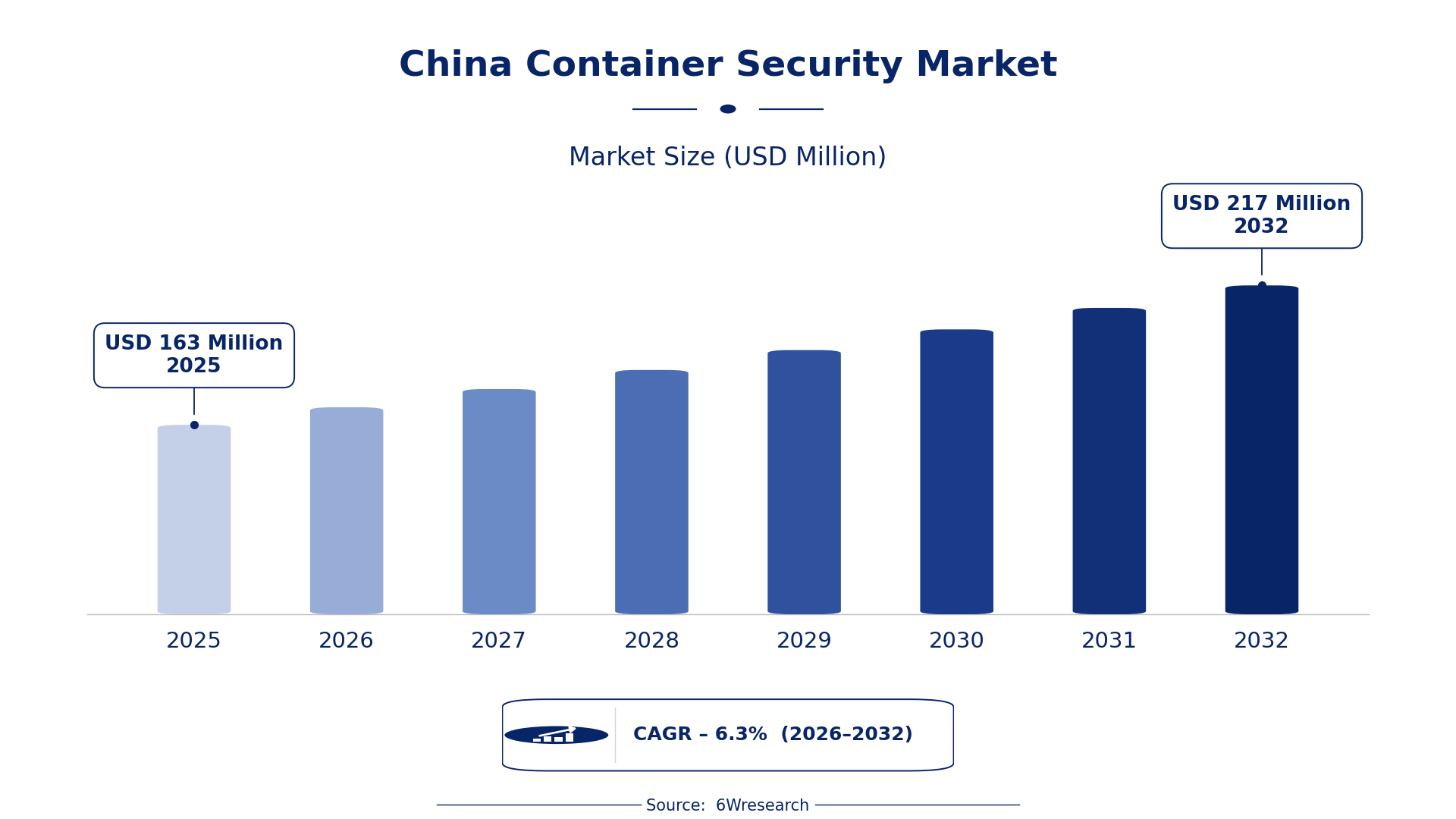
The China Container Security Market was estimated at USD 163 Million in 2025 and is projected to reach USD 217 Million by 2032, growing at a CAGR of 6.3% from 2026 to 2032.
China Container Security Market Synopsis
The increasing reliance on containerization technologies within China is reshaping the security landscape. Organizations are racing to adopt these innovations, driven by the need for heightened protection against cyber threats and data breaches.
As companies transition to cloud-native applications and microservices, the demand for integrated security measures is at an all-time high. This shift not only amplifies vulnerabilities but also necessitates compliance with evolving regulatory standards.
China Container Security Market Year-wise Growth Rate and Key Drivers
This graph illustrates the annual growth rates of the China Container Security Market from 2021 to 2032, highlighting a steady upward trajectory and projected expansion over the forecast period.
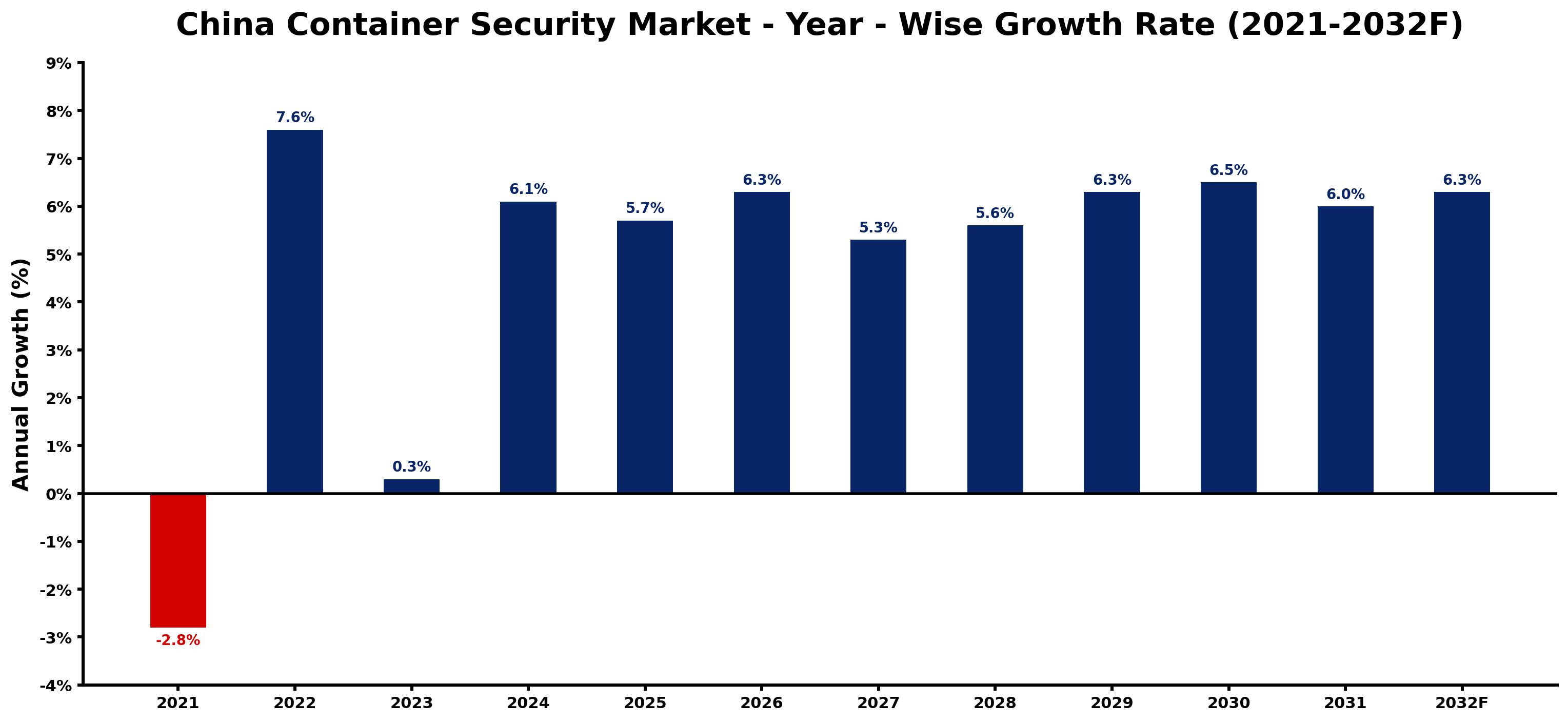
The table below presents the year‑wise growth rates along with the key drivers influencing the market
| Year | Growth Rate | Major Drivers |
| 2021 | -2.8% | China's tightened port security regulations hindered growth. |
| 2022 | 7.6% | China's new Customs Anti-Smuggling Law enforcement enhancements |
| 2023 | 0.3% | Implementation of stricter cybersecurity regulations on logistics firms |
| 2024 | 6.1% | Increased investments in smart container tracking technologies |
| 2025 | 5.7% | Growing focus on supply chain resilience post-pandemic |
| 2026 | 6.3% | Government incentives for automated container security solutions |
| 2027 | 5.3% | Rising global trade demands enhancing container security priorities |
| 2028 | 5.6% | Local manufacturers adopting advanced RFID technology for tracking |
| 2029 | 6.3% | Strengthened port security protocols by China's Ministry of Transport |
| 2030 | 6.5% | Increased maritime insurance requirements driving security investments |
| 2031 | 6.0% | Continuous upgrades to customs inspection technologies in ports |
| 2032 | 6.3% | Emerging AI solutions enhancing container security analytics |
Note: Market size estimations and growth projections presented in this report are based on 6Wresearch's proprietary forecasting methodology, utilizing the latest available industry data, government publications, and primary research inputs.
China Container Security Market Key Takeaways
Below are some of the specific key takeaways from the market, including:
- The market is expected to experience steady growth driven by increasing cyber threats.
- Cloud-native applications are significantly impacting security strategies in container environments.
- Regulatory compliance is a strong motivator for organizations investing in container security solutions.
- Integration challenges remain a key concern for many organizations adopting these technologies.
- Skills shortages in the cybersecurity workforce hinder effective implementation and management.
Evaluation of Restraints in China Container Security Market
Several critical factors are holding back the growth of the China Container Security Market. One of the most pressing issues is the difficulty in integrating new security solutions into pre-existing IT infrastructure. This complexity often leads to hesitancy among organizations, stalling investments. Compounding this issue is the shortage of qualified professionals capable of effectively managing sophisticated security tools. As security technologies advance rapidly, organizations find themselves needing to adapt to new threats quickly, which can be a daunting task for those without the necessary expertise.
China Container Security Market Trends
The market is currently witnessing several key trends that are shaping its trajectory. First, the rise of hybrid cloud environments is prompting businesses to adopt more comprehensive security frameworks. There’s also a growing emphasis on automated security measures to reduce human error and streamline incident response. on top of that, the increasing focus on regulatory compliance is pushing companies to enhance their security postures significantly. This trend reflects a broader industry commitment to safeguarding sensitive data in an age where cyber threats are ubiquitous.
China Container Security Market Opportunities
Emerging opportunities within the China Container Security Market are abundant. Organizations looking to innovate can find a lucrative space in developing tailored security solutions that cater specifically to containerized environments. Additionally, the expansion of Internet of Things (IoT) technologies creates new avenues for securing interconnected devices within container ecosystems. Public-private partnerships are also becoming a more prevalent strategy for addressing skills gaps and enhancing overall security capabilities. Companies that align their services with these growing demands will likely find themselves at the forefront of market evolution.
Government Initiatives in the China Container Security Market
The Chinese government has adopted a proactive stance regarding container security, recognizing its importance in safeguarding trade and commerce. By instituting rigorous regulations and encouraging the use of cutting-edge technologies, authorities aim to elevate security standards across the supply chain. These initiatives are crucial for mitigating risks associated with cyber threats and ensuring compliance with international shipping norms.
- A regulatory framework implemented in 2023 mandates advanced security measures for all container operations at national ports.
- Currently ongoing is a nationwide initiative that integrates AI and IoT technologies to enhance real-time monitoring of container shipments.
- In 2024, the government plans to launch a public-private collaboration aimed at developing a new container security certification program.
- Inspection and certification processes for containers have been tightened, with a focus on ensuring compliance with international security standards.
- As of 2025, a nationwide training program is underway to address the shortage of skilled personnel in container security management.
Future Insights of the China Container Security Market
Looking ahead to 2026-2032, the China Container Security Market is set to evolve in response to ongoing technological advancements and regulatory demands. The continued rise of container adoption will likely necessitate ever more sophisticated security solutions, pushing vendors to innovate. As organizations prioritize data security, investments in advanced threat detection and response systems will surge. on top of that, the increasing complexity of containerized applications will drive the need for improved integration of security measures within IT infrastructures.
China Container Security Market Latest Developments
In recent months, activity within the China Container Security Market has intensified, with several noteworthy developments shaping its future. Vendors are ramping up efforts to align their offerings with the pressing need for enhanced security measures, responding to both regulatory pressures and emerging threats in the cyber landscape.
- A leading regional operator launched a new container security tool aimed at enhancing visibility and control in early 2025.
- An initiative that began in late 2024 is currently underway, focusing on integrating AI technologies into existing container security frameworks.
- Plans for a major technology vendor's product rollout expected to begin in Q3 2026 aim to address compliance with the new government regulations.
- In early 2025, a partnership between public-sector agencies and technology firms was announced, targeting cybersecurity workforce development.
- A major upgrade to security standards for containers is set to be implemented by the government in 2026, enhancing mandatory compliance measures.
China Container Security Market - Key Attractiveness of the Report
- 10 Years of Market Numbers
- Historical Data Starting from 2022 to 2025
- Base Year: 2025
- Forecast Data until 2032
- Key Performance Indicators Impacting the Market
- Major Upcoming Developments and Projects
Key Highlights of the Report:
- China Container Security Market Outlook
- Market Size of China Container Security Market, 2025
- Forecast of China Container Security Market, 2032
- Historical Data and Forecast of China Container Security Revenues & Volume for the Period 2022-2032F
- China Container Security Market Trend Evolution
- China Container Security Market Drivers and Challenges
- China Container Security Price Trends
- China Container Security Porter's Five Forces
- China Container Security Industry Life Cycle
- Historical Data and Forecast of China Container Security Market Revenues & Volume By Component for the Period 2022-2032F
- Historical Data and Forecast of China Container Security Market Revenues & Volume By Container Security Products for the Period 2022-2032F
- Historical Data and Forecast of China Container Security Market Revenues & Volume By Services (Professional, Managed) for the Period 2022-2032F
- Historical Data and Forecast of China Container Security Market Revenues & Volume By Deployment Type for the Period 2022-2032F
- Historical Data and Forecast of China Container Security Market Revenues & Volume By Cloud for the Period 2022-2032F
- Historical Data and Forecast of China Container Security Market Revenues & Volume By On-premises for the Period 2022-2032F
- Historical Data and Forecast of China Container Security Market Revenues & Volume By Vertical for the Period 2022-2032F
- Historical Data and Forecast of China Container Security Market Revenues & Volume By BFSI for the Period 2022-2032F
- Historical Data and Forecast of China Container Security Market Revenues & Volume By Retail for the Period 2022-2032F
- Historical Data and Forecast of China Container Security Market Revenues & Volume By Government for the Period 2022-2032F
- Historical Data and Forecast of China Container Security Market Revenues & Volume By Healthcare for the Period 2022-2032F
- China Container Security Import Export Trade Statistics
- Market Opportunity Assessment By Component
- Market Opportunity Assessment By Deployment Type
- Market Opportunity Assessment By Vertical
- China Container Security Top Companies Market Share
- China Container Security Competitive Benchmarking By Technical and Operational Parameters
- China Container Security Company Profiles
- China Container Security Key Strategic Recommendations






































