China Content Services Platforms Market Size & Growth Rate (2026-2032)
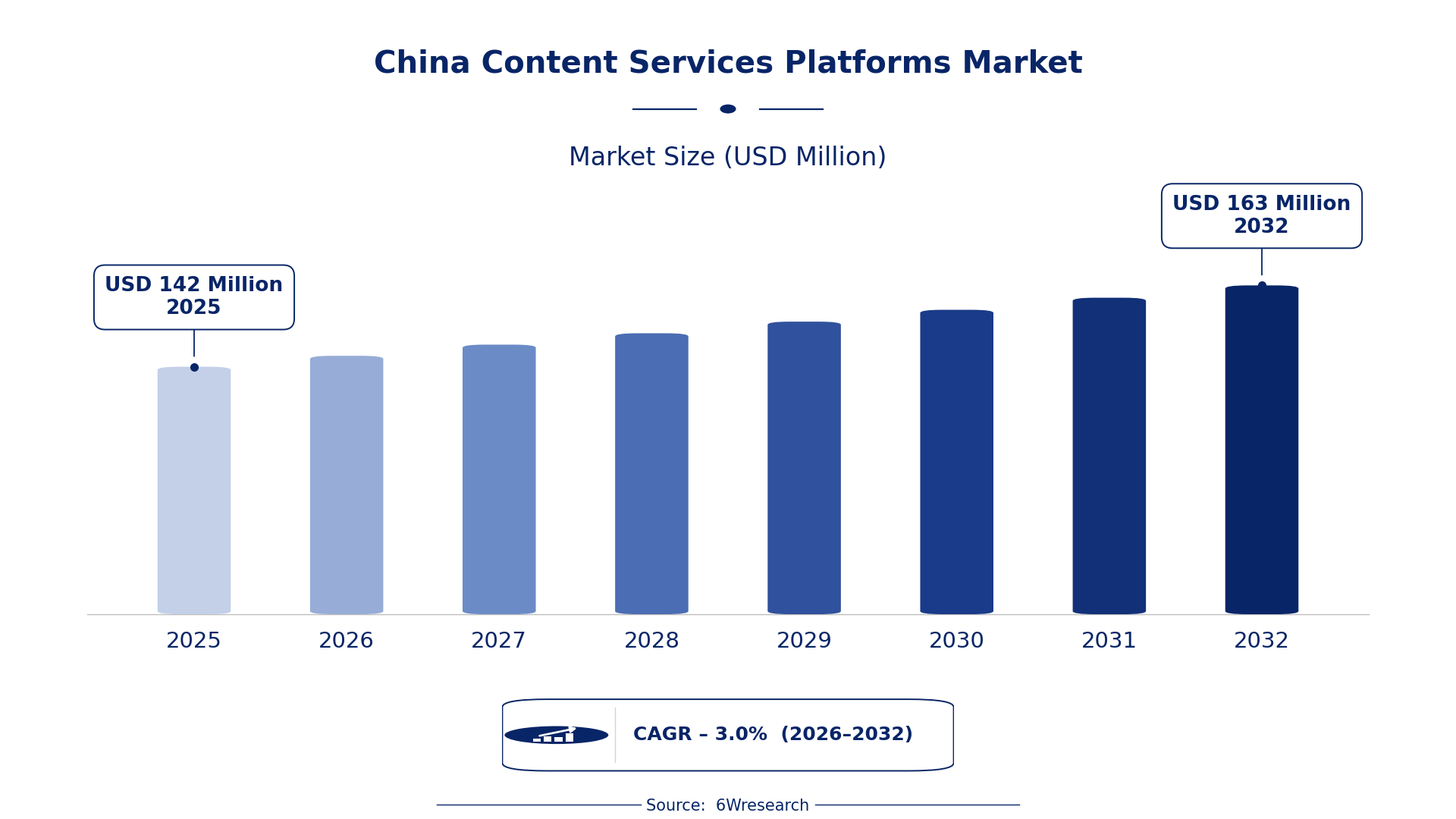
The China Content Services Platforms Market was estimated at USD 142 Million in 2025 and is projected to reach USD 163 Million by 2032, growing at a CAGR of 3.0% from 2026 to 2032.
China Content Services Platforms Market Synopsis
As businesses in China increasingly shift to digital operations, the demand for content services platforms is surging. These platforms not only streamline document management but also foster collaboration, making them essential for organizations grappling with expanding digital content.
The integration of AI and automation into these platforms enhances their capabilities, pushing companies to adopt them more rapidly. Coupled with stringent data protection regulations, organizations are compelled to seek advanced solutions that ensure compliance while boosting productivity.
China Content Services Platforms Market Year-wise Growth Rate and Key Drivers
This graph illustrates the annual growth rates of the China Content Services Platforms Market from 2021 to 2032, highlighting a steady upward trajectory and projected expansion over the forecast period.
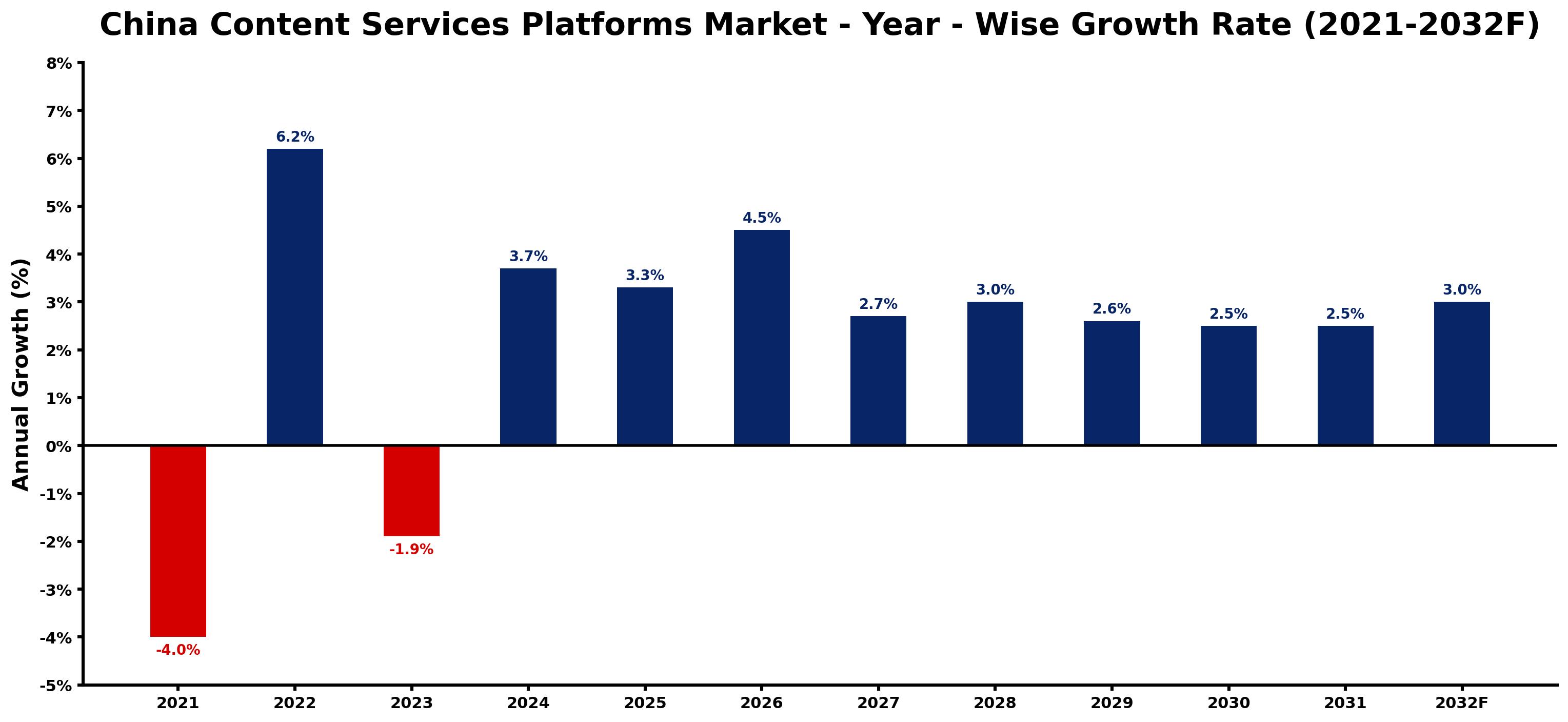
The table below presents the year‑wise growth rates along with the key drivers influencing the market
| Year | Growth Rate | Major Drivers |
| 2021 | -4.0% | Regulatory restrictions imposed by China's National Press and Publication Administration |
| 2022 | 6.2% | Increased smartphone penetration enabling streaming accessibility. |
| 2023 | -1.9% | Consumer privacy concerns over data handling policies in China |
| 2024 | 3.7% | Censorship relaxations encouraging diverse content creation. |
| 2025 | 3.3% | Government support for digital economy initiatives boosting platforms. |
| 2026 | 4.5% | Rise in user-generated content driving platform popularity. |
| 2027 | 2.7% | Youth demographic shift favoring mobile-first content consumption. |
| 2028 | 3.0% | E-sports popularity catalyzing live streaming services growth. |
| 2029 | 2.6% | Regulatory frameworks adapting to encourage multimedia innovation. |
| 2030 | 2.5% | Local partnerships enhancing regional content availability. |
| 2031 | 2.5% | Domestic investment in AI-driven content personalization technologies. |
| 2032 | 3.0% | Local influencers driving niche content engagement growth. |
Note: Market size estimations and growth projections presented in this report are based on 6Wresearch's proprietary forecasting methodology, utilizing the latest available industry data, government publications, and primary research inputs.
China Content Services Platforms Market Key Takeaways
Below are some of the specific key takeaways from the market, including:
- Digital transformation efforts across industries are a key driver for adoption.
- Organizations face challenges in integrating diverse enterprise systems.
- Government regulations emphasize data security and compliance, impacting platform development.
- AI and automation enhancements are critical for differentiating offerings in a competitive market.
- The complexity of managing various content types remains a hurdle for many enterprises.
Evaluation of Restraints in China Content Services Platforms Market
The China Content Services Platforms Market encounters several barriers that can impede growth. One major issue is the integration complexity with existing enterprise systems, which varies greatly among organizations. This challenge often leads to delays in implementation and can deter companies from fully committing to a content services platform. on top of that, stringent local regulations on data security create an additional layer of difficulty, requiring platforms to maintain high compliance standards. The competitive nature of the market adds pressure on vendors to innovate while managing cost efficiencies, complicating their strategies.
China Content Services Platforms Market Trends
Emerging trends within the China Content Services Platforms Market highlight a shift towards cloud-based solutions, driven by the need for remote access and enhanced collaboration. The adoption of AI-driven analytics is becoming more prevalent, allowing organizations to gain insights from their content management processes. Additionally, as compliance requirements tighten, platforms that offer advanced governance features will likely see increased interest.
China Content Services Platforms Market Opportunities
Significant opportunities exist for growth in the China Content Services Platforms Market, particularly in sectors heavily impacted by digital transformation, such as finance, healthcare, and education. Companies that can innovate their offerings to include advanced security features and AI-driven automation will find a receptive market. on top of that, partnerships with local enterprises to enhance platform integration can provide a competitive edge, fostering a more localized approach to content management solutions.
Government Initiatives in the China Content Services Platforms Market
Government policy is playing a crucial role in shaping the China Content Services Platforms Market, particularly through regulations that prioritize data sovereignty and cybersecurity. The support for domestic development in this space is significant, as authorities aim to bolster local technology industries while ensuring compliance with national standards. This regulatory environment is driving innovation but also imposes strict requirements on content service providers.
- A regulatory framework implemented in 2025 mandates enhanced data protection measures for content service providers.
- A national initiative focused on improving digital infrastructure is currently underway, enhancing access to content services.
- New policies are planned for 2026 that will incentivize local firms to adopt advanced content management technologies.
- Government-sponsored workshops are being conducted to educate enterprises on compliance with content governance standards.
Future Insights of the China Content Services Platforms Market
Looking ahead, the China Content Services Platforms Market is set to evolve significantly between 2026 and 2032. Continued digital transformation across sectors will drive demand for more sophisticated content management solutions. As organizations increasingly prioritize collaboration and efficiency, platforms that integrate AI and machine learning will be in high demand. The focus on compliance and data security will further refine product offerings, ensuring that providers stay ahead of regulatory changes while meeting user needs.
China Content Services Platforms Market Latest Developments
In the last 12-14 months, the China Content Services Platforms Market has seen notable activity, with companies rolling out innovations to meet growing demand. The emphasis on compliance and efficiency has led to several strategic partnerships and product launches aimed at enhancing platform capabilities.
- A leading technology vendor launched a new AI-driven content governance feature in early 2025, designed to help organizations meet compliance requirements.
- A regional operator is currently upgrading its infrastructure to enhance the integration of content services platforms, aimed for completion by mid-2026.
- A collaborative project between multiple firms is underway to develop a standardized framework for content management solutions, expected to be completed by late 2025.
- Plans are in motion for a new content services platform that emphasizes data sovereignty, with a rollout expected to begin in Q3 2026.
China Content Services Platforms Market - Key Attractiveness of the Report
- 10 Years of Market Numbers
- Historical Data Starting from 2022 to 2025
- Base Year: 2025
- Forecast Data until 2032
- Key Performance Indicators Impacting the Market
- Major Upcoming Developments and Projects
Key Highlights of the Report:
- China Content Services Platforms Market Outlook
- Market Size of China Content Services Platforms Market, 2025
- Forecast of China Content Services Platforms Market, 2032
- Historical Data and Forecast of China Content Services Platforms Revenues & Volume for the Period 2022-2032F
- China Content Services Platforms Market Trend Evolution
- China Content Services Platforms Market Drivers and Challenges
- China Content Services Platforms Price Trends
- China Content Services Platforms Porter's Five Forces
- China Content Services Platforms Industry Life Cycle
- Historical Data and Forecast of China Content Services Platforms Market Revenues & Volume By Business Function for the Period 2022-2032F
- Historical Data and Forecast of China Content Services Platforms Market Revenues & Volume By Human Resource for the Period 2022-2032F
- Historical Data and Forecast of China Content Services Platforms Market Revenues & Volume By Sales and Marketing for the Period 2022-2032F
- Historical Data and Forecast of China Content Services Platforms Market Revenues & Volume By Accounting and Legal for the Period 2022-2032F
- Historical Data and Forecast of China Content Services Platforms Market Revenues & Volume By Procurement and Supply Chain Management for the Period 2022-2032F
- Historical Data and Forecast of China Content Services Platforms Market Revenues & Volume By Deployment Mode for the Period 2022-2032F
- Historical Data and Forecast of China Content Services Platforms Market Revenues & Volume By Cloud for the Period 2022-2032F
- Historical Data and Forecast of China Content Services Platforms Market Revenues & Volume By On-premises for the Period 2022-2032F
- Historical Data and Forecast of China Content Services Platforms Market Revenues & Volume By Enterprise Size for the Period 2022-2032F
- Historical Data and Forecast of China Content Services Platforms Market Revenues & Volume By Large Enterprises for the Period 2022-2032F
- Historical Data and Forecast of China Content Services Platforms Market Revenues & Volume By SMEs for the Period 2022-2032F
- Historical Data and Forecast of China Content Services Platforms Market Revenues & Volume By Vertical for the Period 2022-2032F
- Historical Data and Forecast of China Content Services Platforms Market Revenues & Volume By Banking, Financial Services, and Insurance for the Period 2022-2032F
- Historical Data and Forecast of China Content Services Platforms Market Revenues & Volume By Retail and Consumer Goods for the Period 2022-2032F
- Historical Data and Forecast of China Content Services Platforms Market Revenues & Volume By Energy and Utilities for the Period 2022-2032F
- Historical Data and Forecast of China Content Services Platforms Market Revenues & Volume By Government and Public Sector for the Period 2022-2032F
- Historical Data and Forecast of China Content Services Platforms Market Revenues & Volume By Healthcare and Life Sciences for the Period 2022-2032F
- Historical Data and Forecast of China Content Services Platforms Market Revenues & Volume By IT and ITeS for the Period 2022-2032F
- Historical Data and Forecast of China Content Services Platforms Market Revenues & Volume By Manufacturing for the Period 2022-2032F
- China Content Services Platforms Import Export Trade Statistics
- Market Opportunity Assessment By Business Function
- Market Opportunity Assessment By Deployment Mode
- Market Opportunity Assessment By Enterprise Size
- Market Opportunity Assessment By Vertical
- China Content Services Platforms Top Companies Market Share
- China Content Services Platforms Competitive Benchmarking By Technical and Operational Parameters
- China Content Services Platforms Company Profiles
- China Content Services Platforms Key Strategic Recommendations






































