China Continuous Delivery Market Size & Growth Rate (2026-2032)
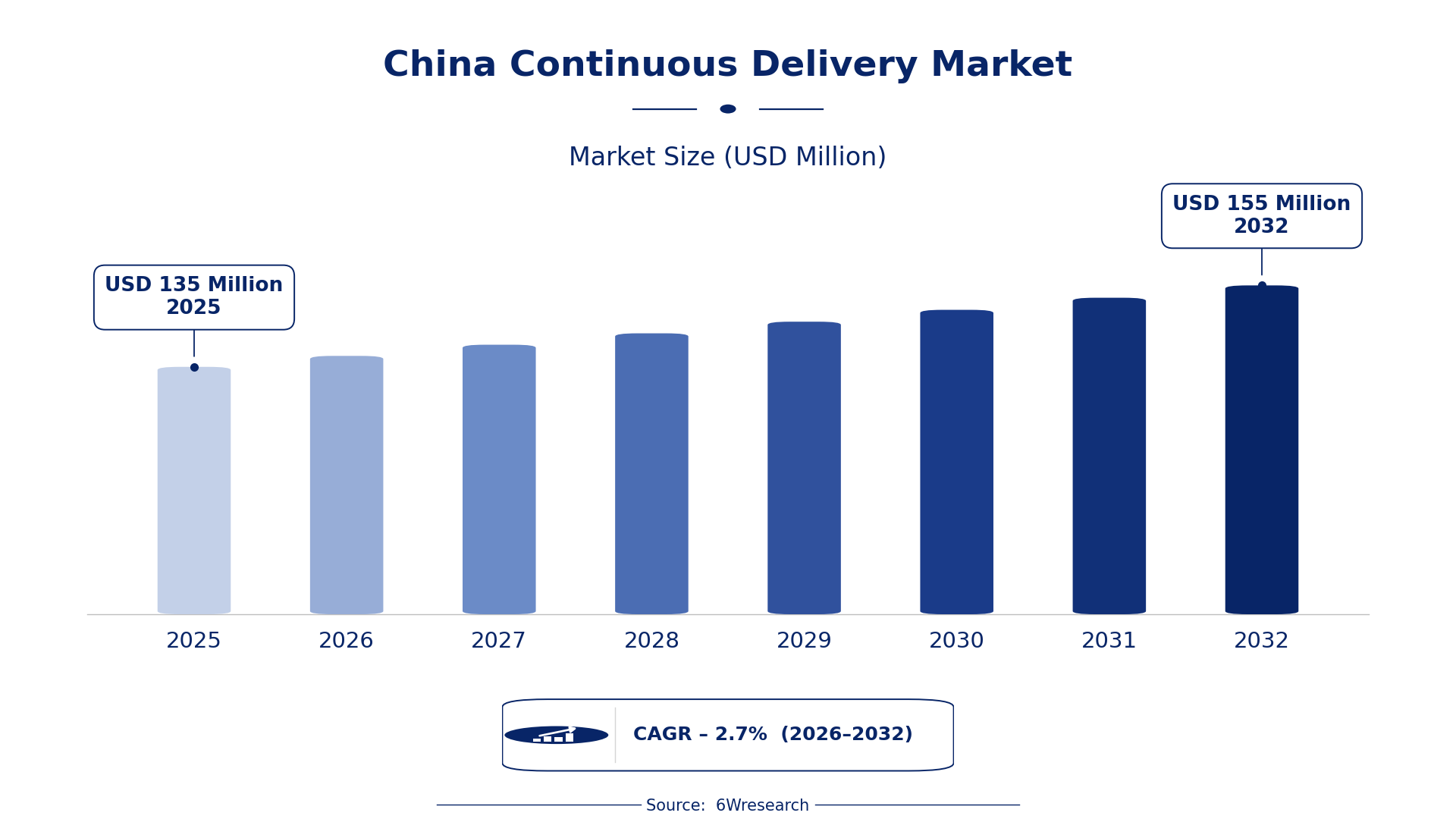
The China Continuous Delivery Market was estimated at USD 135 Million in 2025 and is projected to reach USD 155 Million by 2032, growing at a CAGR of 2.7% from 2026 to 2032.
China Continuous Delivery Market Synopsis
The most compelling force driving the China Continuous Delivery market is the widespread adoption of DevOps practices across various sectors. Companies are increasingly prioritizing speed and quality in their software development processes, pushing for automated delivery solutions that can keep pace with competitive pressures.
As organizations in China strive for digital transformation, the demand for continuous delivery tools and methodologies continues to surge. Cloud-native technologies and advanced CI/CD solutions are becoming essential for businesses looking to optimize their software release cycles and enhance operational efficiency.
China Continuous Delivery Market Year-wise Growth Rate and Key Drivers
This graph illustrates the annual growth rates of the China Continuous Delivery Market from 2021 to 2032, highlighting a steady upward trajectory and projected expansion over the forecast period.
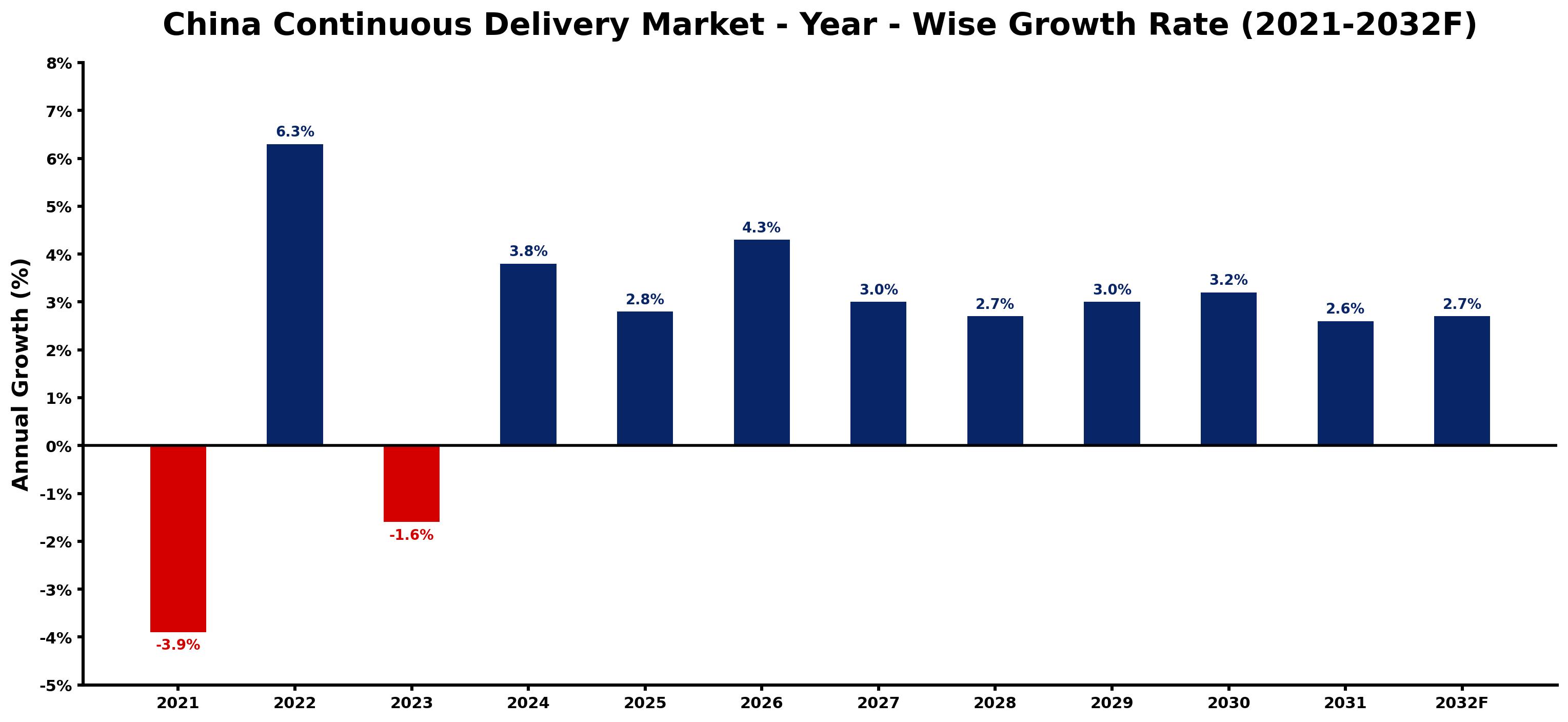
The table below presents the year‑wise growth rates along with the key drivers influencing the market
| Year | Growth Rate | Major Drivers |
| 2021 | -3.9% | China's cybersecurity law delayed software deployment processes. |
| 2022 | 6.3% | Rise of Chinese e-commerce driving continuous delivery adoption. |
| 2023 | -1.6% | Local companies preferred proprietary systems over open-source solutions. |
| 2024 | 3.8% | Growth of AI technologies enhancing software deployment efficiency. |
| 2025 | 2.8% | Investment in smart logistics improving delivery service technologies. |
| 2026 | 4.3% | Local regulations promoting faster software release cycles. |
| 2027 | 3.0% | Surge of fintech applications requiring rapid updates. |
| 2028 | 2.7% | Collaboration with universities fostering software development training. |
| 2029 | 3.0% | Increased cloud adoption accelerating delivery pipeline innovations. |
| 2030 | 3.2% | Focus on improved cybersecurity measures in software updates. |
| 2031 | 2.6% | Expanded use of container orchestration in enterprises. |
| 2032 | 2.7% | Support for small businesses in tech modernization efforts. |
Note: Market size estimations and growth projections presented in this report are based on 6Wresearch's proprietary forecasting methodology, utilizing the latest available industry data, government publications, and primary research inputs.
China Continuous Delivery Market Key Takeaways
Below are some of the specific key takeaways from the market, including:
- DevOps adoption is accelerating, driving demand for continuous delivery solutions.
- Cloud computing and automation are pivotal to enhancing software delivery processes.
- Emerging technologies like AI and machine learning are being integrated into CI/CD pipelines.
- Investment opportunities are abundant in software automation and agile management tools.
- The Chinese government actively supports innovation in the Continuous Delivery sector.
Evaluation of Restraints in China Continuous Delivery Market
The China Continuous Delivery market faces several notable restraints that hinder its full potential. Cultural resistance within organizations often obstructs the implementation of new technologies and methodologies. This reluctance can create bottlenecks in adopting continuous delivery practices, as employees may struggle to adapt to new workflows. on top of that, the lack of standardized processes leads to inconsistencies and inefficiencies, further complicating the software development pipeline. Integrating legacy systems with modern practices presents another significant challenge, as technical complexities can arise, delaying progress. Addressing these issues requires a commitment to education, clear process establishment, and a gradual modernization strategy.
China Continuous Delivery Market Trends
Several trends are shaping the China Continuous Delivery market as organizations strive for efficiency and agility. The shift towards cloud-native technologies is notable, enabling faster and more flexible software deployment. Companies are increasingly investing in CI/CD platforms that automate workflows, reducing manual intervention and minimizing errors. Another emerging trend is the incorporation of AI and machine learning within CI/CD pipelines, which enhances predictive capabilities and optimizes delivery processes. Additionally, a focus on improving collaboration between development and operations teams is becoming essential, driving the need for integrated tools that support agile methodologies.
China Continuous Delivery Market Opportunities
Investment opportunities abound in the China Continuous Delivery market, particularly as organizations seek to enhance their software development capabilities. Areas of growth include automation tools and cloud computing services tailored to local needs. Consulting services that guide companies in implementing continuous delivery practices effectively are also in demand. As digital transformation accelerates across industries, companies providing innovative solutions for continuous delivery are well-positioned to capture market share and drive growth.
Government Initiatives in the China Continuous Delivery Market
The Chinese government plays a significant role in fostering the growth of the Continuous Delivery market. Its initiatives aim to integrate internet technologies with traditional industries, supporting innovation and entrepreneurship. Regulatory measures have been established to ensure data security and intellectual property protection, creating a conducive environment for market players.
- A recently completed initiative promoting the "Internet Plus" action plan aims to enhance digital integration across various sectors.
- A current program is underway, focusing on establishing a national digital infrastructure upgrade to support continuous delivery systems.
- Upcoming policies are expected to enhance funding and resources for startups in the Continuous Delivery sector.
- Current measures are being implemented to provide regulatory frameworks for data security and compliance, fostering trust in the market.
- A planned initiative will facilitate public-private partnerships to drive technology innovation in continuous delivery practices.
Future Insights of the China Continuous Delivery Market
Looking ahead to 2026-2032, the China Continuous Delivery market is set for robust expansion. With enterprises increasingly adopting DevOps to improve their software development processes, the demand for automation and agile methodologies will rise. The growing focus on cloud-based solutions will further support this shift, as companies seek to enhance collaboration and reduce risks associated with traditional methods. As the competitive landscape intensifies, businesses will prioritize innovation, creating numerous opportunities for vendors offering tailored continuous delivery solutions.
China Continuous Delivery Market Latest Developments
Recent activity in the China Continuous Delivery market has been characterized by a wave of innovation and strategic partnerships. Companies are actively seeking to enhance their service offerings and improve operational efficiencies through advanced technologies.
- A major technology vendor launched a new CI/CD platform in Q1 2025 aimed at streamlining software delivery processes for enterprises.
- An ongoing initiative by a leading regional operator focuses on integrating AI capabilities into their continuous delivery tools, enhancing automation and predictive analytics.
- A planned rollout of an advanced cloud computing service is expected to commence in early 2026, designed to support continuous delivery practices.
- A partnership between two technology firms, established in mid-2025, aims to develop solutions that bridge legacy systems with modern continuous delivery frameworks.
- A technology upgrade project is currently underway, expected to improve the scalability of continuous delivery services by late 2025.
China Continuous Delivery Market - Key Attractiveness of the Report
- 10 Years of Market Numbers
- Historical Data Starting from 2022 to 2025
- Base Year: 2025
- Forecast Data until 2032
- Key Performance Indicators Impacting the Market
- Major Upcoming Developments and Projects
Key Highlights of the Report:
- China Continuous Delivery Market Outlook
- Market Size of China Continuous Delivery Market, 2025
- Forecast of China Continuous Delivery Market, 2032
- Historical Data and Forecast of China Continuous Delivery Revenues & Volume for the Period 2022-2032F
- China Continuous Delivery Market Trend Evolution
- China Continuous Delivery Market Drivers and Challenges
- China Continuous Delivery Price Trends
- China Continuous Delivery Porter's Five Forces
- China Continuous Delivery Industry Life Cycle
- Historical Data and Forecast of China Continuous Delivery Market Revenues & Volume By Deployment Mode for the Period 2022-2032F
- Historical Data and Forecast of China Continuous Delivery Market Revenues & Volume By On-premises for the Period 2022-2032F
- Historical Data and Forecast of China Continuous Delivery Market Revenues & Volume By Cloud for the Period 2022-2032F
- Historical Data and Forecast of China Continuous Delivery Market Revenues & Volume By Organization Size for the Period 2022-2032F
- Historical Data and Forecast of China Continuous Delivery Market Revenues & Volume By Small and Medium-sized Enterprises (SMEs) for the Period 2022-2032F
- Historical Data and Forecast of China Continuous Delivery Market Revenues & Volume By Large enterprises for the Period 2022-2032F
- Historical Data and Forecast of China Continuous Delivery Market Revenues & Volume By Vertical for the Period 2022-2032F
- Historical Data and Forecast of China Continuous Delivery Market Revenues & Volume By Banking, Financial Services, and Insurance (BFSI) for the Period 2022-2032F
- Historical Data and Forecast of China Continuous Delivery Market Revenues & Volume By Telecommunications for the Period 2022-2032F
- Historical Data and Forecast of China Continuous Delivery Market Revenues & Volume By Media and entertainment for the Period 2022-2032F
- Historical Data and Forecast of China Continuous Delivery Market Revenues & Volume By Retail and eCommerce for the Period 2022-2032F
- Historical Data and Forecast of China Continuous Delivery Market Revenues & Volume By Healthcare for the Period 2022-2032F
- Historical Data and Forecast of China Continuous Delivery Market Revenues & Volume By Manufacturing for the Period 2022-2032F
- Historical Data and Forecast of China Continuous Delivery Market Revenues & Volume By Education for the Period 2022-2032F
- Historical Data and Forecast of China Continuous Delivery Market Revenues & Volume By Organization Size for the Period 2022-2032F
- Historical Data and Forecast of China Continuous Delivery Market Revenues & Volume By Small and Medium-sized Enterprises (SMEs) for the Period 2022-2032F
- Historical Data and Forecast of China Continuous Delivery Market Revenues & Volume By Large Enterprises for the Period 2022-2032F
- China Continuous Delivery Import Export Trade Statistics
- Market Opportunity Assessment By Deployment Mode
- Market Opportunity Assessment By Organization Size
- Market Opportunity Assessment By Vertical
- Market Opportunity Assessment By Organization Size
- China Continuous Delivery Top Companies Market Share
- China Continuous Delivery Competitive Benchmarking By Technical and Operational Parameters
- China Continuous Delivery Company Profiles
- China Continuous Delivery Key Strategic Recommendations






































