China Conveyors Systems Market Size, Share & Growth Rate
The China Conveyors Systems Market was estimated at USD 249 Million in 2025 and is projected to reach USD 285 Million by 2032, growing at a CAGR of 1.9% from 2026 to 2032. This growth trajectory is largely propelled by the rapid expansion of the manufacturing sector, coupled with substantial investments in infrastructure projects across the nation. Enhanced adoption of automation technologies in industries is further driving the demand for sophisticated conveyor systems, essential for streamlining operational efficiencies and material handling.
China Conveyors Systems Market Year-wise Growth Rate and Key Drivers
This graph highlights how the China Conveyors Systems Market has steadily grown over the years, supported by major growth factors.
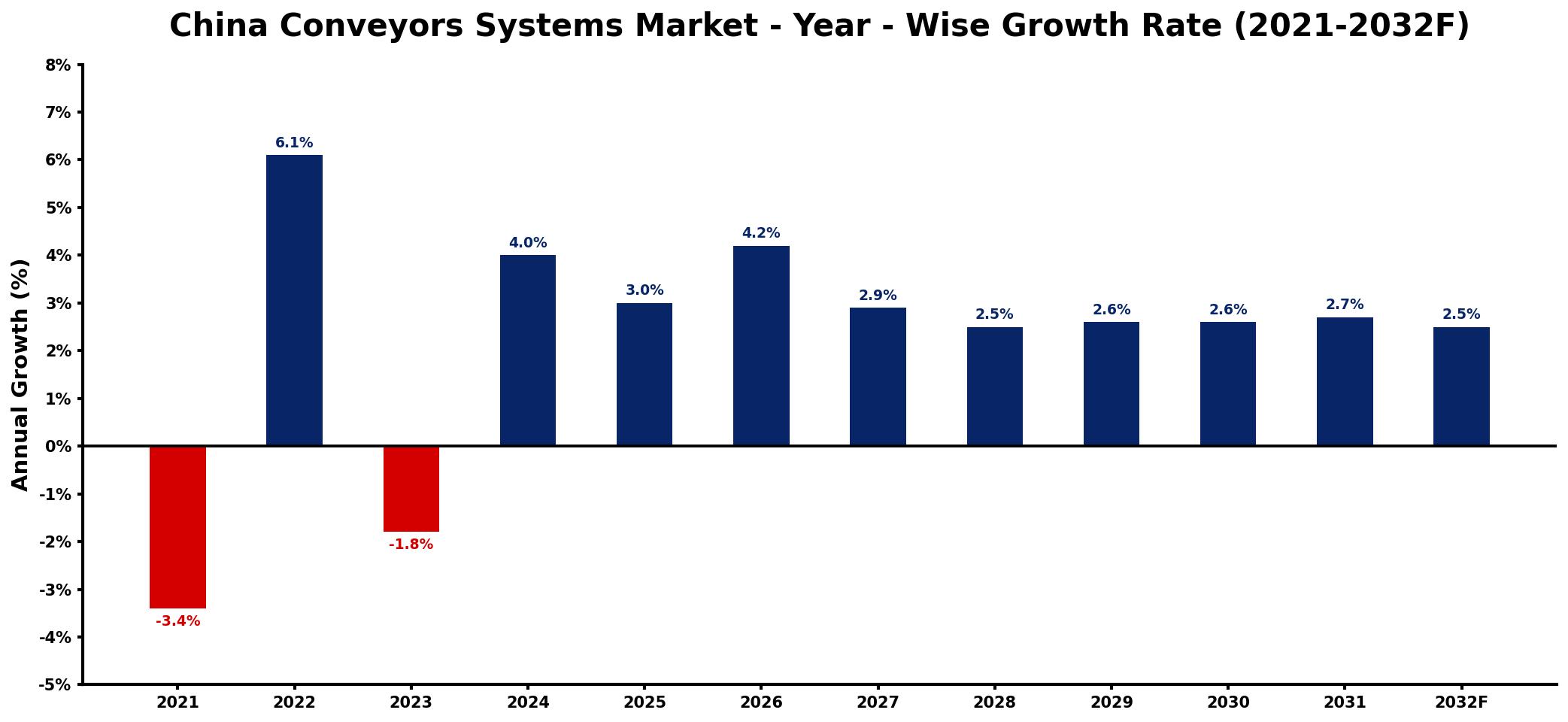
The table below presents the year‑wise growth rates along with the key drivers influencing the market
| Year | Growth Rate | Major Drivers |
| 2021 | -3.4% | decrease in industrial production levels |
| 2022 | 6.1% | growth in e-commerce logistics demand |
| 2023 | -1.8% | reduction in manufacturing output rates |
| 2024 | 4.0% | expansion of warehousing facilities investment |
| 2025 | 3.0% | increase in automated solutions adoption |
| 2026 | 4.2% | rising infrastructure development spending |
| 2027 | 2.9% | rising demand for food processing |
| 2028 | 2.5% | expansion in pharmaceutical manufacturing needs |
| 2029 | 2.6% | improved raw material availability |
| 2030 | 2.6% | growing emerging market penetration |
| 2031 | 2.7% | strengthening international trade flows |
| 2032 | 2.5% | growing regional consumption patterns |
Note: Market size estimations and growth projections presented in this report are based on 6Wresearch's proprietary forecasting methodology, utilizing the latest available industry data, government publications, and primary research inputs.
China Conveyors Systems Market Synopsis
The strongest force shaping the China Conveyors Systems Market today is the increasing integration of automation and robotics in manufacturing facilities. This shift not only amplifies production capacities but also necessitates advanced conveyor solutions designed to enhance productivity and minimize labor costs.
In addition to automation, there is a growing emphasis on sustainability within the industry. Market players are investing in energy-efficient and environmentally friendly conveyor technologies to comply with stringent regulations and meet the rising consumer demand for greener solutions.
China Conveyors Systems Market Key Takeaways
- The market is driven by ongoing industrialization and modernization efforts in China.
- Automation and Industry 4.0 technologies are crucial in shaping demand for conveyor systems.
- There is a notable trend toward sustainable and energy-efficient conveyor solutions.
- Investments in custom conveyor solutions are on the rise, particularly in the e-commerce and food sectors.
- Continuous innovation is essential for companies to maintain competitive advantage in this dynamic market.
Evaluation of Restraints in China Conveyors Systems Market
Despite the promising growth, the China Conveyors Systems Market faces significant challenges. Intense competition among both domestic and international players pressures companies to innovate constantly, which can strain resources. Additionally, fluctuating raw material prices complicate pricing strategies, while regulatory constraints regarding safety and environmental standards impose further operational complexities. Economic uncertainties and geopolitical tensions also pose risks that can deter investment and slow project implementation.
China Conveyors Systems Market Trends
The China Conveyors Systems Market is currently witnessing a transformative trend fueled by technological advancements. The integration of IoT and AI within conveyor systems enhances not just efficiency but also connectivity, enabling smarter operations. Concurrently, the focus on customized solutions continues to grow, especially as industries like automotive and e-commerce seek tailored systems that can meet their unique operational needs. This dual focus on technology and customization is reshaping the competitive landscape.
China Conveyors Systems Market Opportunities
Investment opportunities within the China Conveyors Systems Market are abundant, particularly as infrastructure development accelerates across the country. The rise of advanced manufacturing sectors—such as electronics and automotive—necessitates efficient material handling solutions, presenting a lucrative avenue for investors. Additionally, the emerging trend toward smart, energy-efficient conveyor technologies highlights potential for businesses focusing on innovation. Strategic partnerships with local firms can also unlock market access and foster competitive advantages.
Government Initiatives in the China Conveyors Systems Market
The Chinese government has established various policies that directly impact the conveyor systems market, emphasizing innovation and sustainability. Initiatives such as "Made in China 2025" are designed to foster domestic manufacturing capabilities in high-tech sectors, including conveyor technology. Regulations focused on energy efficiency and emissions control are prompting companies to invest in eco-friendly solutions. Additionally, stringent safety guidelines ensure that companies prioritize worker well-being, further shaping market dynamics.
Future Insights of the China Conveyors Systems Market
Looking ahead to 2026-2032, the China Conveyors Systems Market is set for sustained growth driven by ongoing industrialization and the rise of automation across various sectors. The expansion of e-commerce and logistics will likely increase demand for efficient material handling solutions. Technological advancements, particularly in IoT and AI, will play a crucial role in enhancing operational efficiencies. As businesses increasingly prioritize sustainable practices, the market will witness a shift towards innovative solutions that balance performance with eco-friendliness.
China Conveyors Systems Market Latest Developments (2025 - 2026)
In recent months, the China Conveyors Systems Market has seen a notable emphasis on integrating automation and smart technologies. Companies are focusing on enhancing the efficiency of their conveyor systems through the use of advanced software solutions that enable real-time monitoring and predictive maintenance. Additionally, there is a growing interest in sustainability, with many firms pursuing eco-friendly manufacturing practices and products. This evolving landscape indicates a strong commitment to innovation and adaptability within the market.
China Conveyors Systems Market - Key Attractiveness of the Report
- 10 Years of Market Numbers
- Historical Data Starting from 2022 to 2025
- Base Year: 2025
- Forecast Data until 2032
- Key Performance Indicators Impacting the Market
- Major Upcoming Developments and Projects
Key Highlights of the Report:
- China Conveyors Systems Market Outlook
- Market Size of China Conveyors Systems Market, 2025
- Forecast of China Conveyors Systems Market, 2032
- Historical Data and Forecast of China Conveyors Systems Revenues & Volume for the Period 2022-2032F
- China Conveyors Systems Market Trend Evolution
- China Conveyors Systems Market Drivers and Challenges
- China Conveyors Systems Price Trends
- China Conveyors Systems Porter's Five Forces
- China Conveyors Systems Industry Life Cycle
- Historical Data and Forecast of China Conveyors Systems Market Revenues & Volume By Type for the Period 2022-2032F
- Historical Data and Forecast of China Conveyors Systems Market Revenues & Volume By Roller for the Period 2022-2032F
- Historical Data and Forecast of China Conveyors Systems Market Revenues & Volume By Flat Belt for the Period 2022-2032F
- Historical Data and Forecast of China Conveyors Systems Market Revenues & Volume By Wheel for the Period 2022-2032F
- Historical Data and Forecast of China Conveyors Systems Market Revenues & Volume By Vertical for the Period 2022-2032F
- Historical Data and Forecast of China Conveyors Systems Market Revenues & Volume By Others for the Period 2022-2032F
- Historical Data and Forecast of China Conveyors Systems Market Revenues & Volume By Location for the Period 2022-2032F
- Historical Data and Forecast of China Conveyors Systems Market Revenues & Volume By In-floor for the Period 2022-2032F
- Historical Data and Forecast of China Conveyors Systems Market Revenues & Volume By On-floor for the Period 2022-2032F
- Historical Data and Forecast of China Conveyors Systems Market Revenues & Volume By Overhead for the Period 2022-2032F
- Historical Data and Forecast of China Conveyors Systems Market Revenues & Volume By Load for the Period 2022-2032F
- Historical Data and Forecast of China Conveyors Systems Market Revenues & Volume By Unit Load for the Period 2022-2032F
- Historical Data and Forecast of China Conveyors Systems Market Revenues & Volume By Bulk Load for the Period 2022-2032F
- Historical Data and Forecast of China Conveyors Systems Market Revenues & Volume By Application for the Period 2022-2032F
- Historical Data and Forecast of China Conveyors Systems Market Revenues & Volume By Food & Beverages for the Period 2022-2032F
- Historical Data and Forecast of China Conveyors Systems Market Revenues & Volume By Pharmaceuticals for the Period 2022-2032F
- Historical Data and Forecast of China Conveyors Systems Market Revenues & Volume By Supply chain & Logistics for the Period 2022-2032F
- Historical Data and Forecast of China Conveyors Systems Market Revenues & Volume By Manufacturing for the Period 2022-2032F
- Historical Data and Forecast of China Conveyors Systems Market Revenues & Volume By Mining for the Period 2022-2032F
- Historical Data and Forecast of China Conveyors Systems Market Revenues & Volume By Others for the Period 2022-2032F
- China Conveyors Systems Import Export Trade Statistics
- Market Opportunity Assessment By Type
- Market Opportunity Assessment By Location
- Market Opportunity Assessment By Load
- Market Opportunity Assessment By Application
- China Conveyors Systems Top Companies Market Share
- China Conveyors Systems Competitive Benchmarking By Technical and Operational Parameters
- China Conveyors Systems Company Profiles
- China Conveyors Systems Key Strategic Recommendations






































