China Corn Market Top 5 Importing Countries and Market Competition (HHI) Analysis
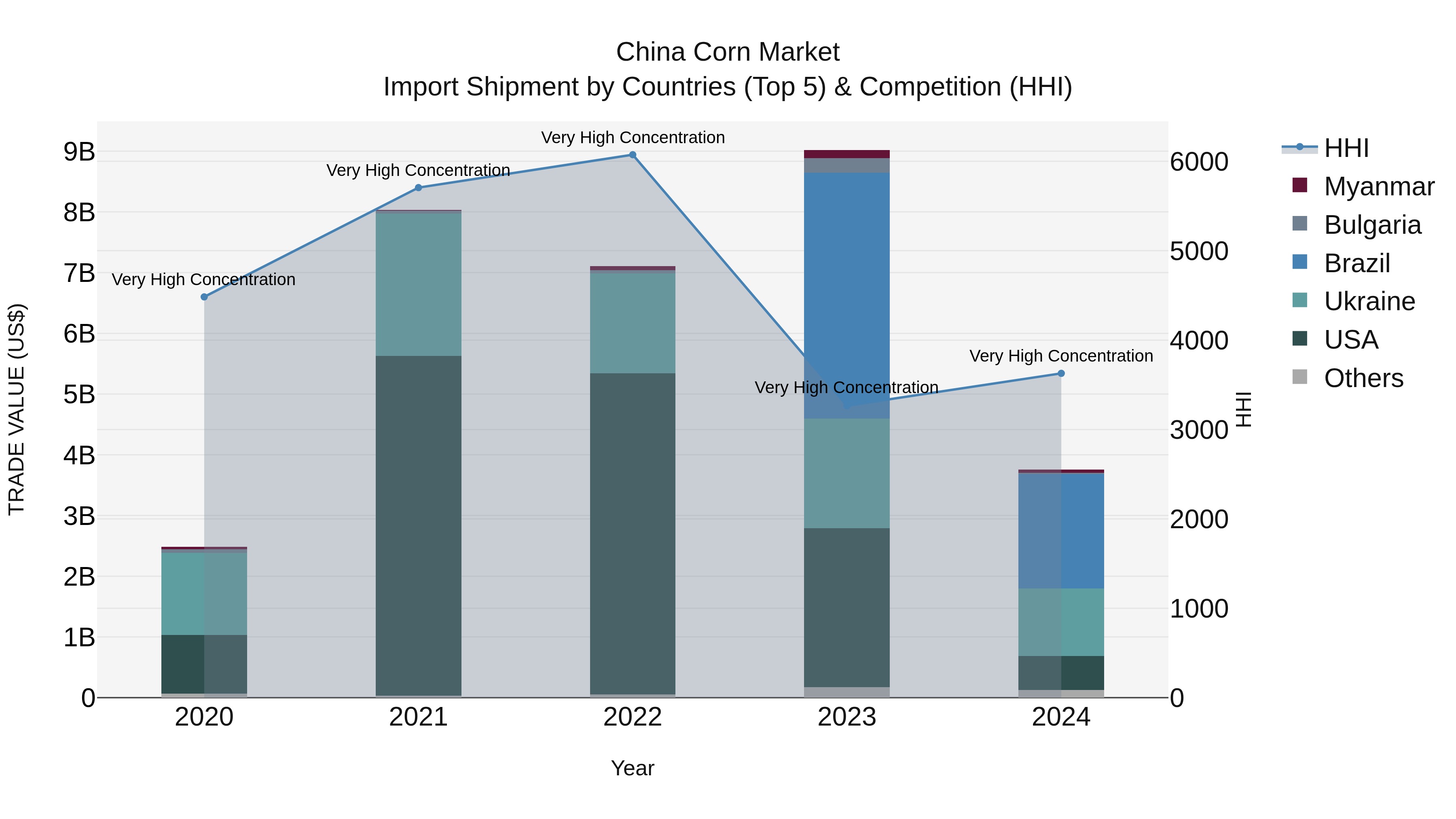
China corn import market in 2024 continued to be dominated by top exporting countries including Brazil, Ukraine, USA, Myanmar, and Russia. Despite a high Herfindahl-Hirschman Index (HHI) indicating market concentration, the industry saw a significant Compound Annual Growth Rate (CAGR) of 10.94% from 2020 to 2024. However, there was a sharp decline in the growth rate from 2023 to 2024 at -58.31%, suggesting potential shifts in market dynamics or external factors impacting corn imports into China.
China Corn Market Growth Rate
According to 6Wresearch internal database and industry insights, the China Corn Market is projected to grow at a compound annual growth rate (CAGR) of 4.7% during the forecast period (2026–2032).
Topics Covered in the China Corn Market Report
The China Corn Market report thoroughly covers the market by nature and end-use. The report provides a detailed analysis of ongoing market trends, opportunities/high-growth areas, and market drivers, helping stakeholders devise and align their market strategies according to current and future market dynamics.
China Corn Market Highlights
| Report Name | China Corn Market |
| Forecast Period | 2026–2032 |
| CAGR | 4.70% |
| Growing Sector | Agriculture |
China Corn Market Synopsis
The China Corn Industry is experiencing steady growth driven by increased demand in feed production, food processing, and industrial uses such as biofuels. The demand for the product is further sustained by the rising requirements for higher corn yield and production efficiency, and this is further supported by the surging shift toward industrial corn products. Along with this, the expansion of animal feed sector and development of biofuel production further increases demand. The technological advancements further support the long-term sustained growth of the market.
Evaluation of Growth Drivers in the China Corn Market
Below are some prominent drivers and their influence on the market dynamics:
| Drivers | Primary Segments Affected | Why It Matters |
| Expansion in Animal Feed Production | By Livestock (Poultry, Swine, Ruminants) | The livestock sector, particularly poultry and swine, is the main consumer of corn for animal feed, fueling consistent demand. |
| Biofuel Production Growth | By End-use (B2B) | Growing demand for biofuels pushes the industrial consumption of corn. |
| Technological Advancements in Agriculture | By Nature (Organic, Conventional) | Innovation in corn cultivation techniques increases yield and efficiency, making corn more accessible. |
| Food Processing Demand | By End-use (B2C) | As consumer demand for processed corn products (e.g., corn starch, corn oil) grows, so does the market for corn. |
| Export Growth | By End-use (B2B) | Demand for Chinese corn exports, especially to Southeast Asia, fuels market growth. |
The China Corn Market Size is projected to grow at a robust pace, with a CAGR of 4.7% during the forecast period of 2026–2032. There are various factors supporting the growth of the market. The demand of corn is rising across multiple sectors such as animal feed, biofuels, and food processing. This demand is further enhanced with the expansion of China’s livestock industry. The surging biofuels consumption is another factor fueling corn demand. In addition, preference for processed corn products such as corn starch, corn syrup, and corn oil also contributes significantly to China Corn Market Growth. Moreover, the government led measures also play an important role in the development and promotion of sustainable practices. Furthermore, the improvements in technology help with corn cultivation and processing, enhancing yields and production efficiency.
Evaluation of Restraints in the China Corn Market
Below are some prominent restraints and their influence on the market dynamics:
| Restraints | Primary Segments Affected | What This Means |
| Climate Variability | By Nature (Organic, Conventional) | Unpredictable weather patterns may affect crop yield and quality, leading to supply chain disruptions. |
| Price Fluctuations in Inputs | By Ingredient (Cereals, Cakes & Meals) | Rising input costs, including fertilizers and labor, affect the profitability of corn producers. |
| Import Dependency | By Source (Plant-Based, Animal-Based) | Dependence on imported seeds and chemicals can cause supply chain risks and increased costs. |
| Regulatory Compliance Pressure | By Products (Supplements) | Increasing regulations around agricultural practices and feed additives can lead to higher compliance costs. |
China Corn Market Challenges
Raw materials price volatility is a major challenge faced by the China Corn Market, especially including seeds and fertilizers, the availability of labor is also volatile further complicating the process. Furthermore, the regulatory pressures concerning environmental sustainability are also increasing. Huge reliance on imported goods is another major constraint the industry encounters. Through farm technology improvements and enhanced supply chain management, these challenges can be surmounted.
China Corn Market Trends
Some major trends contributing to the China Corn Market growth are:
- Rising Use of Corn in Biofuel Production: The rising use of corn for biofuel production leads to market growth as renewable energy demands more corn for ethanol production.
- Shift Toward Organic Corn: The respond of corn producers to the surging requirement for organic products is through increasing their organic corn cultivation.
- Greater Demand for Processed Corn Products: Requirement for processed corn products has increased for items like corn starch, corn oil and other derivatives.
- Increase in Aquaculture Feed: The growth of China's aquaculture industry is driving the demand for specialized corn-based feed ingredients.
Investment Opportunities in the China Corn Market
Some investment opportunities that will shape the dynamics of the China Corn Market include:
- Expansion of Biofuel Production Facilities: The demand for biofuels has grown which creates major investment opportunities for biofuel production facilities to expand their production capabilities.
- Technological Advancements in Corn Yield Optimization: Corn yields will increase through precision agriculture investments which include smart irrigation systems and advanced fertilizers.
- Food Processing Infrastructure: The growing demand for corn-based food products creates business opportunities for investors who improve food processing capabilities.
- Organic Corn Production Facilities: The increasing consumer demand for organic products makes organic corn production systems a profitable investment opportunity.
Top 5 Leading Players in the China Corn Market
Below is the list of prominent companies leading the China Corn Market:
1. China National Chemical Corporation (ChemChina)
| Company Name | China National Chemical Corporation (ChemChina) |
| Established Year | 2004 |
| Headquarters | Beijing, China |
| Official Website | Click Here |
Description: ChemChina is one of the largest state-owned chemical companies in China, involved in the production of various agricultural products, including corn-based products.
2. China National Petroleum Corporation (CNPC)
| Company Name | China National Petroleum Corporation (CNPC) |
| Established Year | 1998 |
| Headquarters | Beijing, China |
| Official Website | Click Here |
Description: CNPC is a major energy and petrochemical company, which also focuses on corn-based biofuel production as part of its green energy initiatives.
3. COFCO Corporation
| Company Name | COFCO Corporation |
| Established Year | 1949 |
| Headquarters | Beijing, China |
| Official Website | Click Here |
Description: COFCO is one of China’s largest food processing and trading companies, significantly involved in the corn trade and processing for food and industrial uses.
4. Sinograin
| Company Name | Sinograin |
| Established Year | 1999 |
| Headquarters | Beijing, China |
| Official Website | Click Here |
Description: Sinograin is a state-owned corporation involved in grain trading and the supply of corn for both food and industrial purposes, as well as for livestock feed.
5. Yunnan Tin Company Limited
| Company Name | Yunnan Tin Company Limited |
| Established Year | 1995 |
| Headquarters | Yunnan, China |
| Official Website | Click Here |
Description: Yunnan Tin is involved in agricultural business diversification, including corn processing for animal feed and biofuel production.
Government Regulations in the China Corn Market
According to Chinese government regulations, the corn industry is governed by stringent regulations emphasizing on food safety, biofuel production, and feed additives. These standards make sure that the corn is used in both food and industrial sectors and comply with high safety requirements. In addition to this, program promote eco-friendly and efficient methods of corn production by encouraging the use of sustainable agricultural practices. Notably, China’s National Biofuel Standards help with the use of corn in bioethanol production, contributing to the nation’s commitment to cleaner energy solutions.
Future Insights of the China Corn Market
The China Corn Market Share is anticipated to rise firmly as demand for corn-based products, especially biofuels and animal feed, continues to rise. Advances in agricultural technologies, increased focus on organic and sustainable farming, and rising demand for processed corn products will contribute to market growth. The increasing preference for corn-based biofuels and processed food products is expected to be a significant driver in the coming years.
Market Segmentation Analysis
The report gives a comprehensive data about the following market segments and their leading categories:
By Nature – Conventional to Lead the Market
According to Rashika, Senior Research Analyst, 6Wresearch, Conventional corn will govern the market due to a wider base of cultivation and application across various sectors such as food and industry. Despite the rise in organic production, conventional corn remains more prevalent due to its cost-effectiveness and availability.
By End-use – B2B to Lead the Market
The B2B segment will lead the market as businesses such as animal feed manufacturers and biofuel producers are the primary consumers of corn in large quantities. The B2B demand for corn is expected to grow due to increasing industrial applications.
Key Attractiveness of the Report
- 10 Years of Market Numbers
- Historical Data Starting from 2022 to 2025
- Base Year: 2025
- Forecast Data until 2032
- Key Performance Indicators Impacting the Market
- Major Upcoming Developments and Projects
Key Highlights of the Report:
- China Corn Market Outlook
- Market Size of China Corn Market, 2025
- Forecast of China Corn Market, 2032
- Historical Data and Forecast of China Corn Revenues & Volume for the Period 2022- 2032F
- China Corn Market Trend Evolution
- China Corn Market Drivers and Challenges
- China Corn Price Trends
- China Corn Porter's Five Forces
- China Corn Industry Life Cycle
- Historical Data and Forecast of China Corn Market Revenues & Volume By Nature for the Period 2022- 2032F
- Historical Data and Forecast of China Corn Market Revenues & Volume By Organic for the Period 2022- 2032F
- Historical Data and Forecast of China Corn Market Revenues & Volume By Conventional for the Period 2022- 2032F
- Historical Data and Forecast of China Corn Market Revenues & Volume By End-use for the Period 2022- 2032F
- Historical Data and Forecast of China Corn Market Revenues & Volume By B2B for the Period 2022- 2032F
- Historical Data and Forecast of China Corn Market Revenues & Volume By B2C for the Period 2022- 2032F
- China Corn Import Export Trade Statistics
- Market Opportunity Assessment By Nature
- Market Opportunity Assessment By End-use
- China Corn Top Companies Market Share
- China Corn Competitive Benchmarking By Technical and Operational Parameters
- China Corn Company Profiles
- China Corn Key Strategic Recommendations
Market Covered
The report provides a detailed analysis of the following market segments and subsegments:
By Nature
- Organic
- Conventional
By End-Use Industry
- B2B (Business to Business)
- B2C (Business to Consumer)






































