China Critical Infrastructure Protection Market Size & Growth Rate (2026-2032)
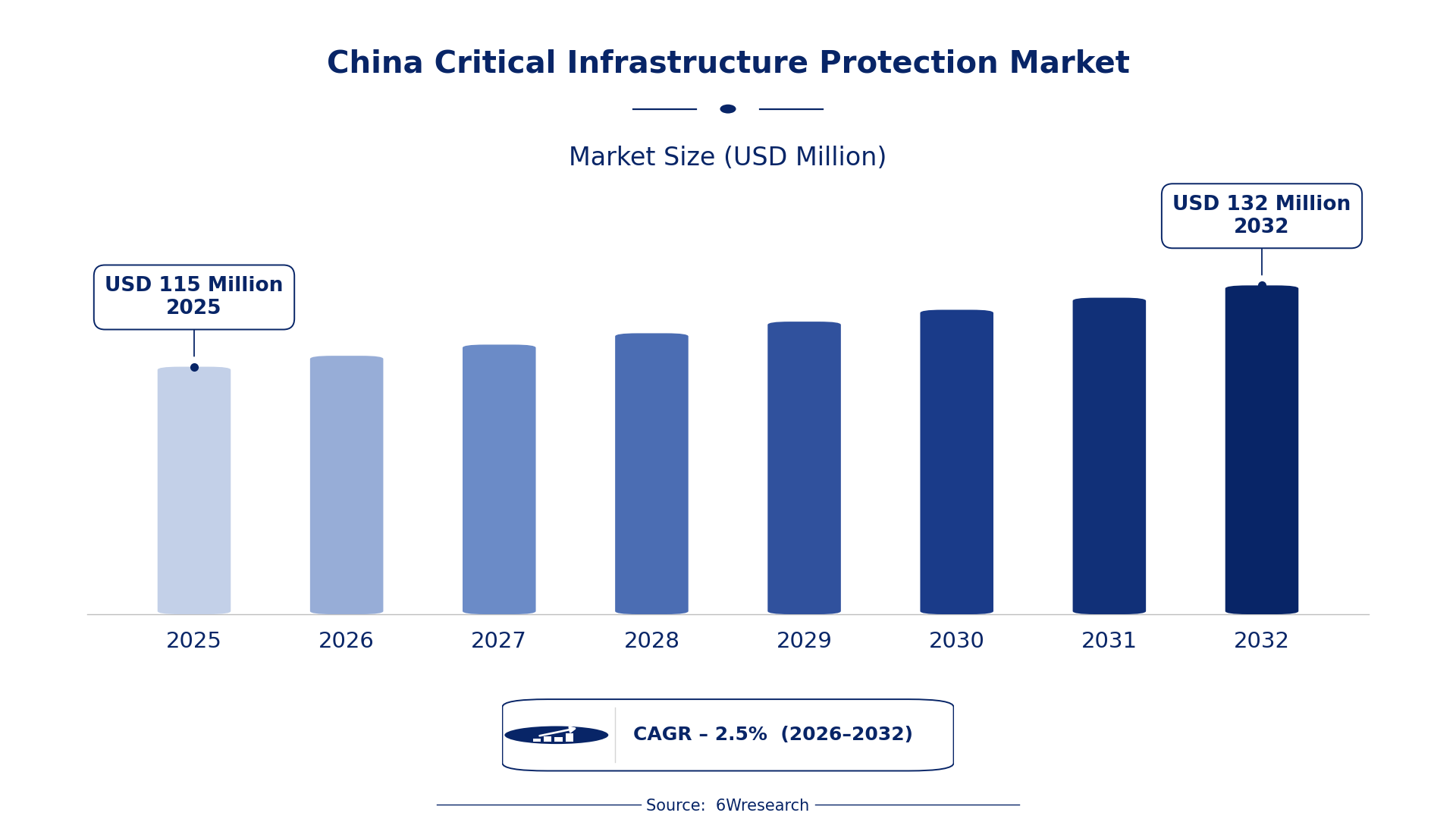
The China Critical Infrastructure Protection Market was estimated at USD 115 Million in 2025 and is projected to reach USD 132 Million by 2032, growing at a CAGR of 2.5% from 2026 to 2032.
China Critical Infrastructure Protection Market Synopsis
The escalating cyber threats targeting critical sectors like energy and transportation are the main forces driving the China Critical Infrastructure Protection Market. Organizations are scrambling to fortify their defenses as vulnerabilities become more apparent amidst increasing digitalization.
Advanced technologies such as artificial intelligence and blockchain are taking center stage in the quest for enhanced resilience. These tools are not only improving response capabilities but are also attracting attention from both domestic and international security providers, eager to meet the rising demand.
China Critical Infrastructure Protection Market Year-wise Growth Rate and Key Drivers
This graph illustrates the annual growth rates of the China Critical Infrastructure Protection Market from 2021 to 2032, highlighting a steady upward trajectory and projected expansion over the forecast period.
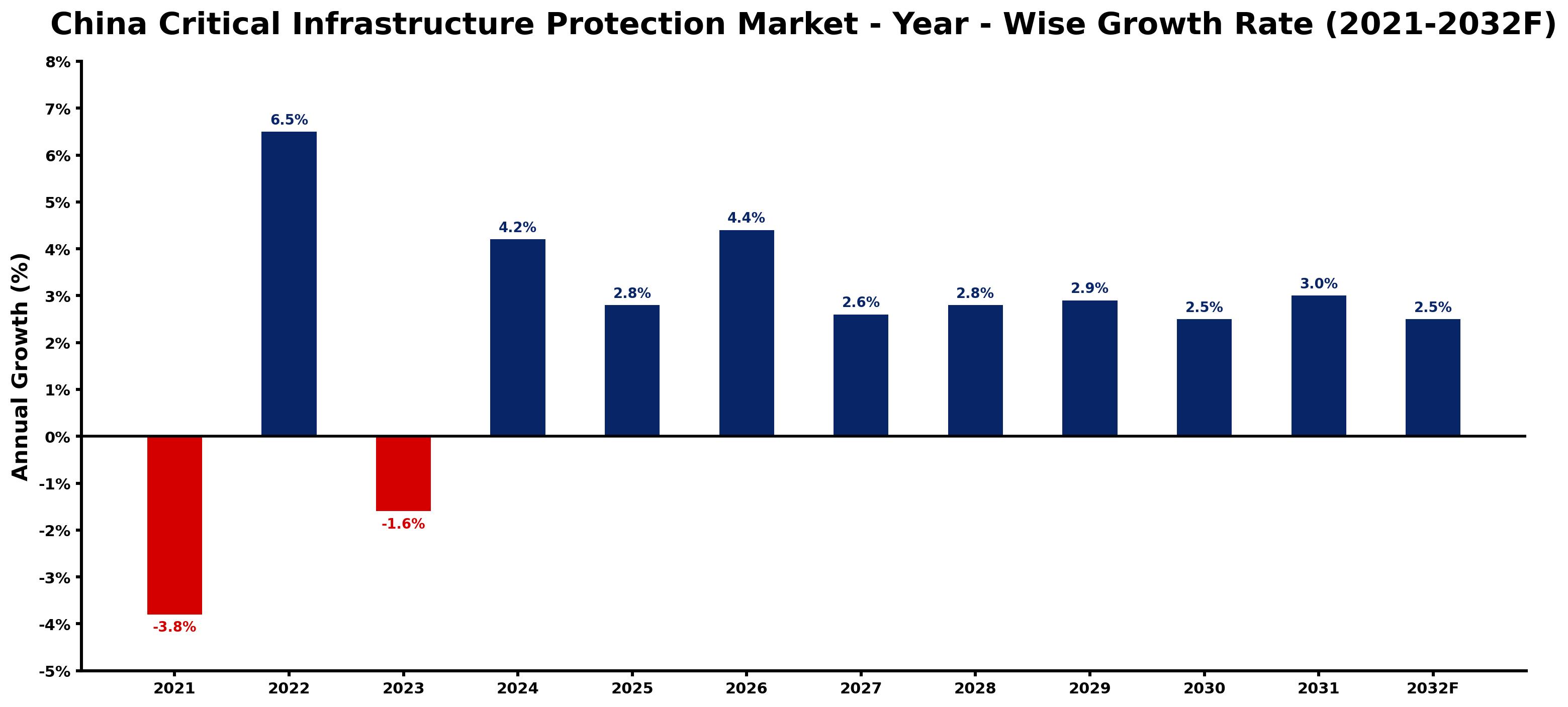
The table below presents the year‑wise growth rates along with the key drivers influencing the market
| Year | Growth Rate | Major Drivers |
| 2021 | -3.8% | Cybersecurity Law enforcement challenges hindered compliance efforts. |
| 2022 | 6.5% | China's 14th Five-Year Plan prioritizes infrastructure security. |
| 2023 | -1.6% | Decreased government funding for public safety initiatives. |
| 2024 | 4.2% | Increased investments in cybersecurity by state-owned enterprises. |
| 2025 | 2.8% | Rising awareness of critical infrastructure vulnerabilities post-pandemic. |
| 2026 | 4.4% | National Security Law mandates stronger infrastructures protection. |
| 2027 | 2.6% | Emerging threats from geopolitical tensions driving protective measures. |
| 2028 | 2.8% | Investment growth in digital surveillance technologies for safety. |
| 2029 | 2.9% | Government funding for resilience against climate-related disruptions. |
| 2030 | 2.5% | Growing public-private partnerships for smart city security initiatives. |
| 2031 | 3.0% | Data protection regulations enhancing infrastructure security protocols. |
| 2032 | 2.5% | Technological advancements in IoT security solutions adoption. |
Note: Market size estimations and growth projections presented in this report are based on 6Wresearch's proprietary forecasting methodology, utilizing the latest available industry data, government publications, and primary research inputs.
China Critical Infrastructure Protection Market Key Takeaways
Below are some of the specific key takeaways from the market, including:
- Cybersecurity threats are becoming more sophisticated, necessitating comprehensive protection strategies.
- AI and machine learning are increasingly being utilized for real-time threat detection and incident response.
- Public-private partnerships are on the rise, fostering collaborative efforts to bolster cybersecurity initiatives.
- Regulatory measures are intensifying, pushing organizations to adopt stringent security protocols.
- Investment in disaster recovery solutions is becoming a priority among critical infrastructure operators.
Evaluation of Restraints in China Critical Infrastructure Protection Market
Despite the growth prospects, the market faces considerable restraints. The rapidly evolving nature of cyber threats creates challenges for organizations trying to keep pace. on top of that, the absence of comprehensive cybersecurity regulations specific to critical infrastructure complicates effective implementation. Companies often grapple with the intricate regulatory environment, leading to confusion regarding best practices and compliance.
China Critical Infrastructure Protection Market Trends
Several key trends are reshaping the China Critical Infrastructure Protection Market. The shift towards proactive cybersecurity measures has gained momentum, with a focus on developing multi-layered defense systems. This includes integration of physical security with cyber measures to create comprehensive security frameworks.
on top of that, the implementation of AI-driven analytics for threat detection is becoming commonplace. Organizations are recognizing the need for agile response mechanisms that can adapt to evolving threat scenarios, leading to the adoption of integrated security solutions across various sectors.
China Critical Infrastructure Protection Market Opportunities
Investors and vendors are presented with multiple growth opportunities in this market. The demand for advanced cybersecurity solutions is soaring, driven by a pressing need for robust systems that protect against both cyber and physical attacks. Services such as intrusion detection systems, video surveillance, and data encryption are particularly sought after.
In addition, the market for training and consultancy services is ripe for development. Companies aiming to enhance their resilience against potential risks will seek expertise to bolster their security posture, creating a lucrative avenue for service providers.
Government Initiatives in the China Critical Infrastructure Protection Market
The Chinese government has adopted a multifaceted approach to strengthen critical infrastructure protection. Emphasizing cybersecurity in national policy, the government is committed to developing a secure environment for vital sectors. Recent regulations and strategic initiatives are driving the urgency for enhanced security measures in critical areas.
- A national cybersecurity enhancement framework launched in late 2022 mandates compliance for key sectors.
- Current initiatives focus on integrating AI technologies within existing security infrastructures, which are now in pilot phases across multiple industries.
- Upcoming regulations expected to roll out by mid-2026 will introduce stricter standards for risk assessment and incident reporting.
- Collaboration programs between government and private sector players are actively promoting knowledge sharing and resource pooling.
- A planned cybersecurity awareness campaign set to launch in Q4 2025 aims to educate critical infrastructure operators about emerging threats.
Future Insights of the China Critical Infrastructure Protection Market
Looking ahead to 2026-2032, the China Critical Infrastructure Protection Market is expected to expand significantly. The increased digitization of infrastructure will amplify the need for sophisticated protection solutions. As cyber threats continue to evolve, organizations will prioritize investments in advanced technologies to safeguard their assets. Regulatory frameworks will also mature, creating a conducive environment for innovation and collaborative efforts across sectors. Security providers are set to benefit from a market hungry for effective protection strategies and solutions.
China Critical Infrastructure Protection Market Latest Developments
In the last 12-14 months, the China Critical Infrastructure Protection Market has witnessed a surge in activity aimed at enhancing security capabilities. Key players are focusing on integrating cutting-edge technologies to stay ahead of evolving threats while the government continues to enforce stricter regulations.
- A major technology vendor launched an innovative AI-powered threat detection system in early 2025, designed to bolster cybersecurity measures.
- In Q3 2025, a collaboration between key stakeholders aimed at enhancing sector-wide cybersecurity standards is currently underway.
- Planning is in progress for a nationwide critical infrastructure audit set to commence by early 2026 to assess vulnerabilities.
- An initiative focused on developing a cybersecurity talent pipeline was completed in late 2025, enhancing workforce preparedness.
- Upcoming regulations to strengthen data protection protocols in critical sectors are expected to be announced in Q2 2026.
China Critical Infrastructure Protection Market - Key Attractiveness of the Report
- 10 Years of Market Numbers
- Historical Data Starting from 2022 to 2025
- Base Year: 2025
- Forecast Data until 2032
- Key Performance Indicators Impacting the Market
- Major Upcoming Developments and Projects
Key Highlights of the Report:
- China Critical Infrastructure Protection Market Outlook
- Market Size of China Critical Infrastructure Protection Market, 2025
- Forecast of China Critical Infrastructure Protection Market, 2032
- Historical Data and Forecast of China Critical Infrastructure Protection Revenues & Volume for the Period 2022-2032F
- China Critical Infrastructure Protection Market Trend Evolution
- China Critical Infrastructure Protection Market Drivers and Challenges
- China Critical Infrastructure Protection Price Trends
- China Critical Infrastructure Protection Porter's Five Forces
- China Critical Infrastructure Protection Industry Life Cycle
- Historical Data and Forecast of China Critical Infrastructure Protection Market Revenues & Volume By Solution for the Period 2022-2032F
- Historical Data and Forecast of China Critical Infrastructure Protection Market Revenues & Volume By Physical Safety for the Period 2022-2032F
- Historical Data and Forecast of China Critical Infrastructure Protection Market Revenues & Volume By Security Video Surveillance Systems for the Period 2022-2032F
- Historical Data and Forecast of China Critical Infrastructure Protection Market Revenues & Volume By Screening for the Period 2022-2032F
- Historical Data and Forecast of China Critical Infrastructure Protection Market Revenues & Volume By Scanning for the Period 2022-2032F
- Historical Data and Forecast of China Critical Infrastructure Protection Market Revenues & Volume By Cybersecurity for the Period 2022-2032F
- Historical Data and Forecast of China Critical Infrastructure Protection Market Revenues & Volume By Encryption for the Period 2022-2032F
- Historical Data and Forecast of China Critical Infrastructure Protection Market Revenues & Volume By Threat Intelligence for the Period 2022-2032F
- Historical Data and Forecast of China Critical Infrastructure Protection Market Revenues & Volume By Component for the Period 2022-2032F
- Historical Data and Forecast of China Critical Infrastructure Protection Market Revenues & Volume By Solution for the Period 2022-2032F
- Historical Data and Forecast of China Critical Infrastructure Protection Market Revenues & Volume By Services for the Period 2022-2032F
- Historical Data and Forecast of China Critical Infrastructure Protection Market Revenues & Volume By Vertical for the Period 2022-2032F
- Historical Data and Forecast of China Critical Infrastructure Protection Market Revenues & Volume By Financial Institutions for the Period 2022-2032F
- Historical Data and Forecast of China Critical Infrastructure Protection Market Revenues & Volume By Government for the Period 2022-2032F
- Historical Data and Forecast of China Critical Infrastructure Protection Market Revenues & Volume By Defense for the Period 2022-2032F
- Historical Data and Forecast of China Critical Infrastructure Protection Market Revenues & Volume By Transport and Logistics for the Period 2022-2032F
- Historical Data and Forecast of China Critical Infrastructure Protection Market Revenues & Volume By Energy and Power for the Period 2022-2032F
- Historical Data and Forecast of China Critical Infrastructure Protection Market Revenues & Volume By Commercial Sector for the Period 2022-2032F
- Historical Data and Forecast of China Critical Infrastructure Protection Market Revenues & Volume By Telecom for the Period 2022-2032F
- Historical Data and Forecast of China Critical Infrastructure Protection Market Revenues & Volume By Chemicals and Manufacturing for the Period 2022-2032F
- China Critical Infrastructure Protection Import Export Trade Statistics
- Market Opportunity Assessment By Solution
- Market Opportunity Assessment By Cybersecurity
- Market Opportunity Assessment By Component
- Market Opportunity Assessment By Vertical
- China Critical Infrastructure Protection Top Companies Market Share
- China Critical Infrastructure Protection Competitive Benchmarking By Technical and Operational Parameters
- China Critical Infrastructure Protection Company Profiles
- China Critical Infrastructure Protection Key Strategic Recommendations






































