China Cryogenic Tanks Market Top 5 Importing Countries and Market Competition (HHI) Analysis
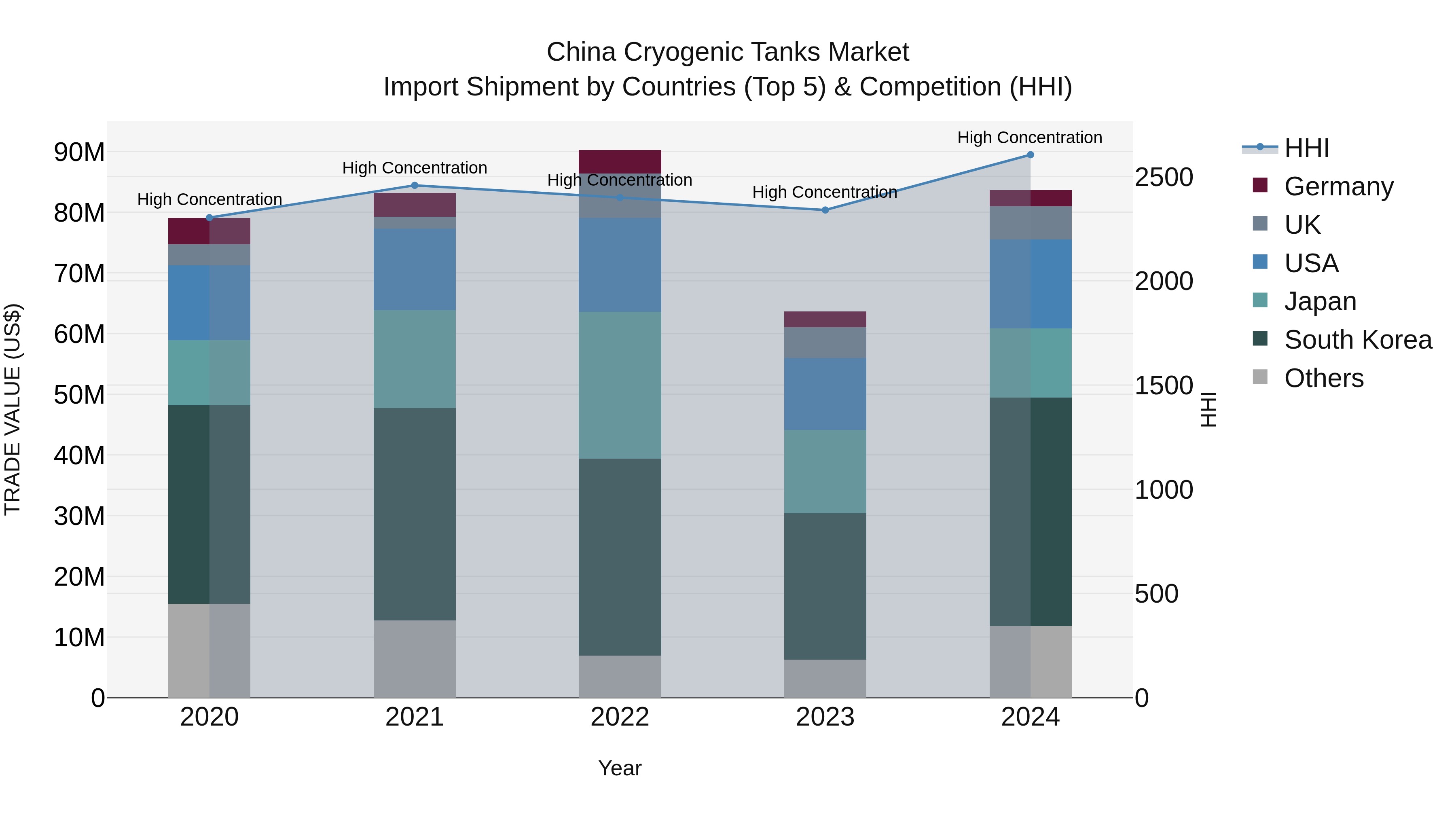
China cryogenic tanks import market continued to see significant growth in 2024, with top exporting countries including South Korea, USA, Japan, UK, and Indonesia. The market exhibited a high Herfindahl-Hirschman Index (HHI) concentration in 2024, indicating a competitive landscape. The compound annual growth rate (CAGR) from 2020 to 2024 stood at 1.42%, with a notable growth rate of 31.31% from 2023 to 2024. These trends suggest a strong demand for cryogenic tanks in China and opportunities for further market expansion in the coming years.
China Cryogenic Tanks Market Overview
China`s Cryogenic Tanks Market is growing in response to increased demand for storing and transporting liquefied gases like LNG and oxygen. These tanks are essential for industries requiring the handling of cryogenic liquids at extremely low temperatures. The market is influenced by the expansion of infrastructure projects and the rise in industrial gas consumption. Technological advancements in tank design and safety features are also driving market developments.
Drivers of the market
The China cryogenic tanks market benefits from the rising demand for LNG as a cleaner energy source. The development of LNG infrastructure and increasing investments in gas processing facilities are major drivers. Additionally, the growth of industrial gases and the need for efficient storage solutions in sectors like healthcare, food processing, and chemicals are contributing to market expansion. Technological innovations in tank design and safety features also play a crucial role in driving market growth.
Challenges of the market
The China cryogenic tanks market encounters challenges related to safety and regulatory compliance. Cryogenic tanks must meet stringent safety standards to handle the extreme temperatures and pressures involved. Ensuring compliance with these regulations requires continuous investment in technology and safety measures. Additionally, the market faces issues with the high costs of tank production and maintenance, which can impact profitability.
Government Policy of the market
Government policies in China encourage the development and use of cryogenic tanks through regulations that ensure safety and efficiency. The "Regulations on the Safety Management of Hazardous Chemicals" mandate stringent safety standards for the storage and handling of cryogenic liquids. Additionally, the government supports infrastructure development and technological advancements in the cryogenic tanks sector through financial incentives and technical standards.
Key Highlights of the Report:
- China Cryogenic Tanks Market Outlook
- Market Size of China Cryogenic Tanks Market, 2024
- Forecast of China Cryogenic Tanks Market, 2031
- Historical Data and Forecast of China Cryogenic Tanks Revenues & Volume for the Period 2021-2031
- China Cryogenic Tanks Market Trend Evolution
- China Cryogenic Tanks Market Drivers and Challenges
- China Cryogenic Tanks Price Trends
- China Cryogenic Tanks Porter's Five Forces
- China Cryogenic Tanks Industry Life Cycle
- Historical Data and Forecast of China Cryogenic Tanks Market Revenues & Volume By Raw Material for the Period 2021-2031
- Historical Data and Forecast of China Cryogenic Tanks Market Revenues & Volume By Steel for the Period 2021-2031
- Historical Data and Forecast of China Cryogenic Tanks Market Revenues & Volume By Nickel Alloy for the Period 2021-2031
- Historical Data and Forecast of China Cryogenic Tanks Market Revenues & Volume By Aluminum Alloy for the Period 2021-2031
- Historical Data and Forecast of China Cryogenic Tanks Market Revenues & Volume By Cryogenic Liquid for the Period 2021-2031
- Historical Data and Forecast of China Cryogenic Tanks Market Revenues & Volume By Liquid Nitrogen for the Period 2021-2031
- Historical Data and Forecast of China Cryogenic Tanks Market Revenues & Volume By Liquefied Natural Gas (LNG) for the Period 2021-2031
- Historical Data and Forecast of China Cryogenic Tanks Market Revenues & Volume By Liquid Hydrogen for the Period 2021-2031
- Historical Data and Forecast of China Cryogenic Tanks Market Revenues & Volume By Liquid Oxygen for the Period 2021-2031
- Historical Data and Forecast of China Cryogenic Tanks Market Revenues & Volume By Application for the Period 2021-2031
- Historical Data and Forecast of China Cryogenic Tanks Market Revenues & Volume By Storage for the Period 2021-2031
- Historical Data and Forecast of China Cryogenic Tanks Market Revenues & Volume By Transportation for the Period 2021-2031
- Historical Data and Forecast of China Cryogenic Tanks Market Revenues & Volume By End Use Industry for the Period 2021-2031
- Historical Data and Forecast of China Cryogenic Tanks Market Revenues & Volume By Metal Processing for the Period 2021-2031
- Historical Data and Forecast of China Cryogenic Tanks Market Revenues & Volume By Energy Generation for the Period 2021-2031
- Historical Data and Forecast of China Cryogenic Tanks Market Revenues & Volume By Electronics for the Period 2021-2031
- Historical Data and Forecast of China Cryogenic Tanks Market Revenues & Volume By Medical Technology for the Period 2021-2031
- Historical Data and Forecast of China Cryogenic Tanks Market Revenues & Volume By Food & Beverage for the Period 2021-2031
- Historical Data and Forecast of China Cryogenic Tanks Market Revenues & Volume By Water Treatment for the Period 2021-2031
- Historical Data and Forecast of China Cryogenic Tanks Market Revenues & Volume By Others for the Period 2021-2031
- China Cryogenic Tanks Import Export Trade Statistics
- Market Opportunity Assessment By Raw Material
- Market Opportunity Assessment By Cryogenic Liquid
- Market Opportunity Assessment By Application
- Market Opportunity Assessment By End Use Industry
- China Cryogenic Tanks Top Companies Market Share
- China Cryogenic Tanks Competitive Benchmarking By Technical and Operational Parameters
- China Cryogenic Tanks Company Profiles
- China Cryogenic Tanks Key Strategic Recommendations






































