China Crystal Lighting Market Summary
The china crystal lighting market was estimated at USD 205 Million in 2025 and is projected to reach USD 238 Million by 2032, growing at a CAGR of 4.1% from 2026 to 2032.
China Crystal Lighting Market Year-wise Growth Rate and Key Drivers
This graph highlights how the China Crystal Lighting Market has steadily grown over the past five years, supported by major growth factors.
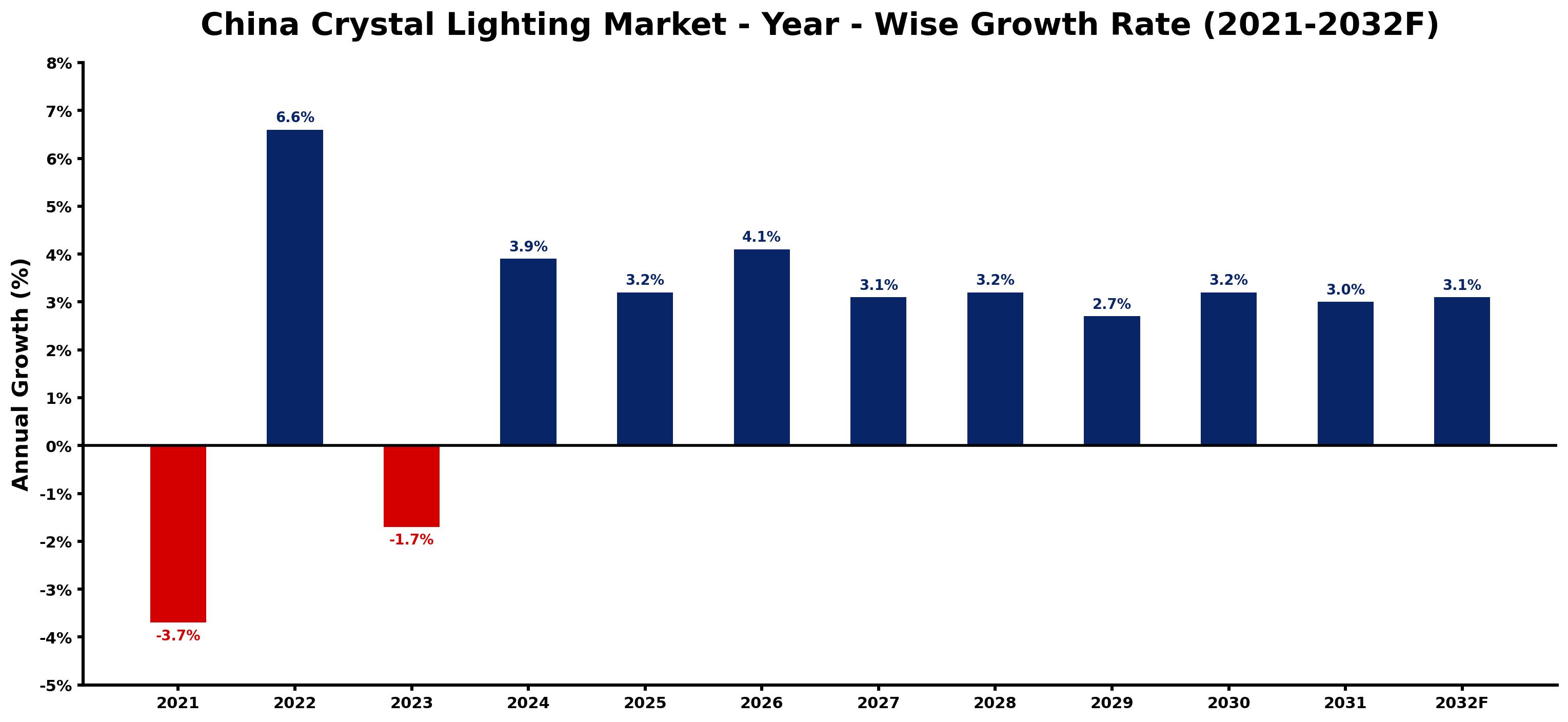
The table below presents the year wise growth rates along with the key drivers influencing the market
| Year | Growth Rate | Major Drivers |
| 2021 | -3.7% | Increased competition from energyefficient alternatives diminished demand for traditional crystal lighting products. |
| 2022 | 6.6% | Urbanization trends push demand for decorative lighting in growing metropolitan areas. |
| 2023 | -1.7% | Supply chain disruptions caused by geopolitical tensions hindered production and diminished market availability. |
| 2024 | 3.9% | E-commerce platforms showcase diverse styles of crystal lighting to wider audiences. |
| 2025 | 3.2% | Trade shows and exhibitions highlight innovative designs attracting industry professionals. |
| 2026 | 4.1% | Sustainability trends influence crystal lighting manufacturers to adopt eco-friendly materials. |
| 2027 | 3.1% | Technological integration in lighting designs introduces smart crystal lighting solutions. |
| 2028 | 3.2% | Architectural firms emphasize elegant lighting in high-end commercial projects across cities. |
| 2029 | 2.7% | Brand collaborations with interior designers create exclusive crystal lighting collections. |
| 2030 | 3.2% | Consumer preferences shift towards customizable lighting solutions for personalized homes. |
| 2031 | 3.0% | Investment in urban infrastructure enhances public spaces with artistic crystal installations. |
| 2032 | 3.1% | The tourism sector flourishes, showcasing luxury hotels featuring extravagant crystal lighting. |
Note - Market size estimations and growth projections presented in this report are based on 6Wresearch's advanced forecasting approach, validated with industry datasets as of June 2026.
Key Highlights of the Report:
- China Crystal Lighting Market Outlook
- Market Size of China Crystal Lighting Market, 2025
- Forecast of China Crystal Lighting Market, 2032F
- Historical Data and Forecast of China Crystal Lighting Revenues & Volume for the Period 2022-2032F
- China Crystal Lighting Market Trend Evolution
- China Crystal Lighting Market Drivers and Challenges
- China Crystal Lighting Price Trends
- China Crystal Lighting Porter's Five Forces
- China Crystal Lighting Industry Life Cycle
- Historical Data and Forecast of China Crystal Lighting Market Revenues & Volume By Product Type for the Period 2022-2032F
- Historical Data and Forecast of China Crystal Lighting Market Revenues & Volume By Ceiling Crystal Lights for the Period 2022-2032F
- Historical Data and Forecast of China Crystal Lighting Market Revenues & Volume By Crystal Chandeliers for the Period 2022-2032F
- Historical Data and Forecast of China Crystal Lighting Market Revenues & Volume By Others for the Period 2022-2032F
- Historical Data and Forecast of China Crystal Lighting Market Revenues & Volume By Applications for the Period 2022-2032F
- Historical Data and Forecast of China Crystal Lighting Market Revenues & Volume By Commercial for the Period 2022-2032F
- Historical Data and Forecast of China Crystal Lighting Market Revenues & Volume By Designer for the Period 2022-2032F
- Historical Data and Forecast of China Crystal Lighting Market Revenues & Volume By Superior Residential for the Period 2022-2032F
- China Crystal Lighting Import Export Trade Statistics
- Market Opportunity Assessment By Product Type
- Market Opportunity Assessment By Applications
- China Crystal Lighting Top Companies Market Share
- China Crystal Lighting Competitive Benchmarking By Technical and Operational Parameters
- China Crystal Lighting Company Profiles
- China Crystal Lighting Key Strategic Recommendations






































