China Cultured Meat Market Size, Share & Growth Rate
The China Cultured Meat Market was estimated at USD 92 Million in 2025 and is projected to reach USD 105 Million by 2032, growing at a CAGR of 1.9% from 2026 to 2032. This growth trajectory is fueled by escalating awareness surrounding environmental sustainability and food security. As consumer preferences shift towards more sustainable protein sources, coupled with significant advancements in cell-culturing technologies, the market is poised for steady expansion.
China Cultured Meat Market Year-wise Growth Rate and Key Drivers
This graph highlights how the China Cultured Meat Market has steadily grown over the years, supported by major growth factors.
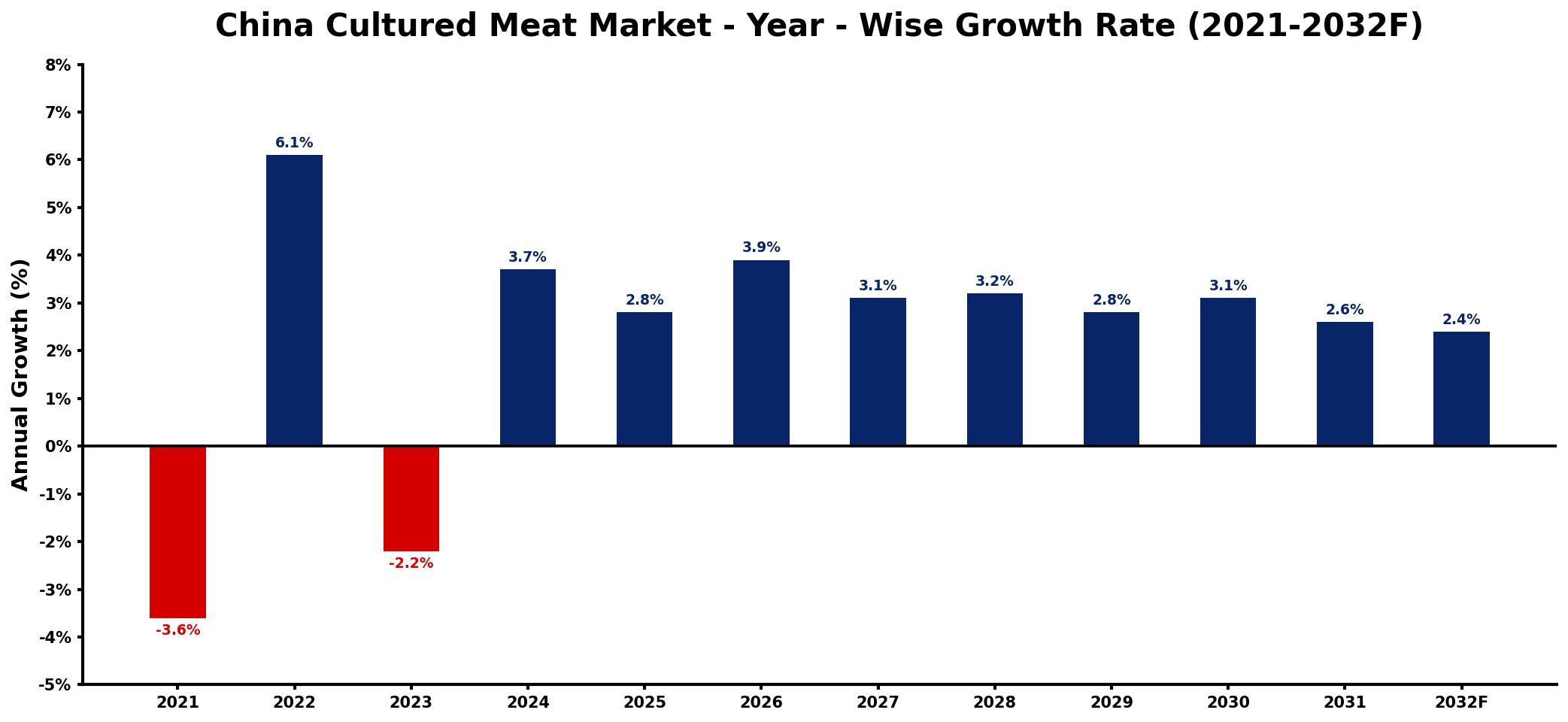
The table below presents the year‑wise growth rates along with the key drivers influencing the market
| Year | Growth Rate | Major Drivers |
| 2021 | -3.6% | Supply chain disruptions affect availability |
| 2022 | 6.1% | Increased consumer interest in alternatives |
| 2023 | -2.2% | Market saturation limits new entrants |
| 2024 | 3.7% | Rising investment in innovative technologies |
| 2025 | 2.8% | Growing partnerships with food brands |
| 2026 | 3.9% | Expansion of distribution networks worldwide |
| 2027 | 3.1% | Emerging trends in sustainable consumption |
| 2028 | 3.2% | Advancements in production efficiency technologies |
| 2029 | 2.8% | Rising awareness of health benefits |
| 2030 | 3.1% | Enhanced regulatory support for alternatives |
| 2031 | 2.6% | Broader acceptance in mainstream markets |
| 2032 | 2.4% | Increased focus on environmental sustainability |
Note: Market size estimations and growth projections presented in this report are based on 6Wresearch's proprietary forecasting methodology, utilizing the latest available industry data, government publications, and primary research inputs.
China Cultured Meat Market Synopsis
The strongest force currently shaping the China cultured meat market is the urgent demand for sustainable food sources. With the Chinese population growing and traditional agriculture facing limitations, cultured meat presents an innovative solution to address these challenges while aligning with global environmental goals.
Moreover, advancements in cell-culturing technologies are amplifying the market's potential. These innovations not only enhance production efficiency but also pave the way for consumer acceptance by improving taste and safety profiles of cultured meat products.
China Cultured Meat Market Key Takeaways
- Emerging market driven by sustainability and food security concerns.
- Technological advancements in cell-culturing are enhancing product appeal.
- Growing investment in research and development supports market growth.
- Government policies favor the expansion of innovative food technologies.
- Consumer acceptance remains a critical factor in market advancement.
Evaluation of Restraints in China Cultured Meat Market
Despite its promising outlook, the China cultured meat market grapples with substantial barriers to its growth. Key among these is the complex regulatory approval process, which remains a significant hurdle for new entrants aiming to meet stringent food safety standards. The novelty of cultured meat technology also poses challenges in consumer acceptance; many potential buyers are still skeptical about the safety, taste, and overall quality of these products, necessitating targeted education and marketing strategies to build trust.
China Cultured Meat Market Trends
Several current and emerging trends are shaping demand within the China cultured meat market. An increasing number of health-conscious consumers are advocating for cleaner, more ethical food sources, further driving interest in alternative proteins. Additionally, collaborations between tech companies and food innovators are fostering rapid advancements in production methods, ensuring that cultured meat can compete effectively against traditional sources. Enhanced branding and marketing efforts are also emerging as crucial strategies to attract a broader customer base.
China Cultured Meat Market Opportunities
The genuine growth and investment opportunities in the China cultured meat market are abundant. There is significant potential for scaling production capabilities to meet increasing consumer demand. Additionally, fostering partnerships with educational institutions for research development can unlock innovative techniques, driving further technological advancements. As the market matures, establishing a robust supply chain for cultured meat production can also lead to efficiencies that enhance profitability.
Government Initiatives in the China Cultured Meat Market
The Chinese government is proactively supporting the development of the cultured meat market as an integral part of its broader food security strategy. Under the "14th Five-Year Plan for Modern Agriculture," initiatives to advance food technologies, including cultured meat, are being prioritized. These policies encompass funding and regulatory backing for research, as well as efforts to scale production while ensuring food safety. Such governmental encouragement is essential for fostering innovation and attracting private investments in this burgeoning sector.
Future Insights of the China Cultured Meat Market
Looking ahead to 2026-2032, the China cultured meat market is likely to witness significant developments as technological innovations continue to emerge. As production techniques become more refined and consumer trust builds, the market could see an expansion of product lines and increased accessibility to various cultured meat options. Moreover, enhanced collaborations across sectors may lead to accelerated growth, positioning cultured meat as a mainstream alternative within China's food ecosystem.
China Cultured Meat Market Latest Developments (2025 - 2026)
In recent months, the cultured meat industry in China has experienced notable momentum as several companies have begun scaling up production capabilities. Innovations in bioreactor technology are streamlining the cell-culturing process, enabling higher yield rates. Additionally, some companies are launching consumer campaigns aimed at educating the public about the benefits of cultured meat, which is essential for building acceptance in a market that is still nascent.
China Cultured Meat Market - Key Attractiveness of the Report
- 10 Years of Market Numbers
- Historical Data Starting from 2022 to 2025
- Base Year: 2025
- Forecast Data until 2032
- Key Performance Indicators Impacting the Market
- Major Upcoming Developments and Projects
Key Highlights of the Report:
- China Cultured Meat Market Outlook
- Market Size of China Cultured Meat Market, 2025
- Forecast of China Cultured Meat Market, 2032
- Historical Data and Forecast of China Cultured Meat Revenues & Volume for the Period 2022-2032F
- China Cultured Meat Market Trend Evolution
- China Cultured Meat Market Drivers and Challenges
- China Cultured Meat Price Trends
- China Cultured Meat Porter's Five Forces
- China Cultured Meat Industry Life Cycle
- Historical Data and Forecast of China Cultured Meat Market Revenues & Volume By Product Type for the Period 2022-2032F
- Historical Data and Forecast of China Cultured Meat Market Revenues & Volume By Poultry for the Period 2022-2032F
- Historical Data and Forecast of China Cultured Meat Market Revenues & Volume By Beef for the Period 2022-2032F
- Historical Data and Forecast of China Cultured Meat Market Revenues & Volume By Seafood for the Period 2022-2032F
- Historical Data and Forecast of China Cultured Meat Market Revenues & Volume By Pork for the Period 2022-2032F
- Historical Data and Forecast of China Cultured Meat Market Revenues & Volume By Duck for the Period 2022-2032F
- Historical Data and Forecast of China Cultured Meat Market Revenues & Volume By End-Use for the Period 2022-2032F
- Historical Data and Forecast of China Cultured Meat Market Revenues & Volume By Nuggets for the Period 2022-2032F
- Historical Data and Forecast of China Cultured Meat Market Revenues & Volume By Burgers for the Period 2022-2032F
- Historical Data and Forecast of China Cultured Meat Market Revenues & Volume By Meatballs for the Period 2022-2032F
- Historical Data and Forecast of China Cultured Meat Market Revenues & Volume By Sausage for the Period 2022-2032F
- Historical Data and Forecast of China Cultured Meat Market Revenues & Volume By Hot dogs for the Period 2022-2032F
- Historical Data and Forecast of China Cultured Meat Market Revenues & Volume By Others for the Period 2022-2032F
- China Cultured Meat Import Export Trade Statistics
- Market Opportunity Assessment By Product Type
- Market Opportunity Assessment By End-Use
- China Cultured Meat Top Companies Market Share
- China Cultured Meat Competitive Benchmarking By Technical and Operational Parameters
- China Cultured Meat Company Profiles
- China Cultured Meat Key Strategic Recommendations






































