China Dark Analytics Market Size & Growth Rate (2026-2032)
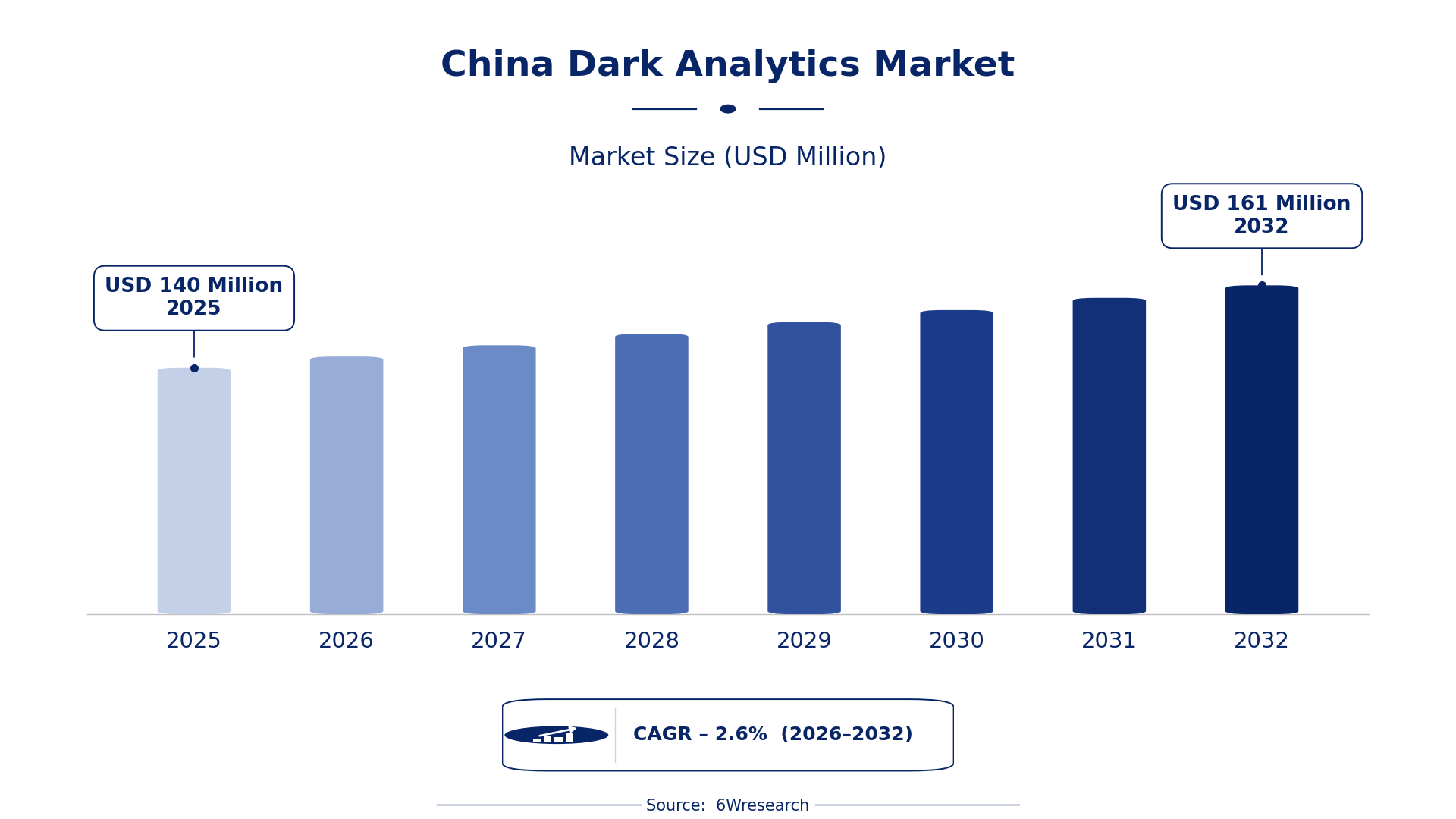
The China Dark Analytics Market was estimated at USD 140 Million in 2025 and is projected to reach USD 161 Million by 2032, growing at a CAGR of 2.6% from 2026 to 2032.
China Dark Analytics Market Synopsis
The China Dark Analytics Market has gained considerable traction recently, fueled by the increasing necessity for businesses to extract insights from unstructured data. As organizations embrace advanced analytics solutions, the focus has shifted toward understanding the underlying patterns that traditional data analysis often overlooks.
Looking ahead, the market is expected to evolve as companies realize the potential hidden within dark data. This shift is propelled by the integration of artificial intelligence and machine learning, which can process vast amounts of unstructured data efficiently, thereby enhancing decision-making capabilities.
China Dark Analytics Market Year-wise Growth Rate and Key Drivers
This graph illustrates the annual growth rates of the China Dark Analytics Market from 2021 to 2032, highlighting a steady upward trajectory and projected expansion over the forecast period.
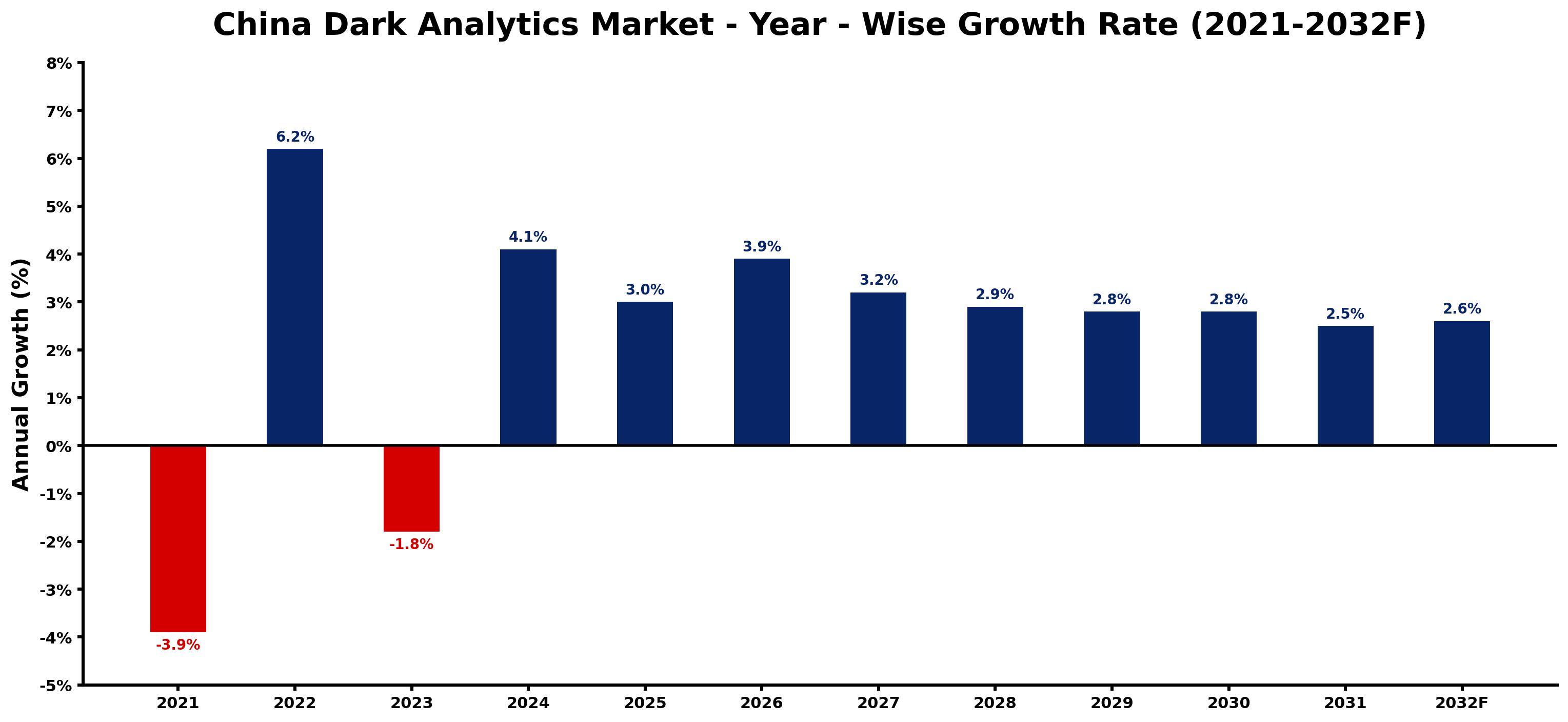
The table below presents the year‑wise growth rates along with the key drivers influencing the market
| Year | Growth Rate | Major Drivers |
| 2021 | -3.9% | Tightened regulations by Cyberspace Administration of China |
| 2022 | 6.2% | Increased regulations on data privacy by Cyberspace Administration |
| 2023 | -1.8% | Increased focus on data security post-Breach of 2022 |
| 2024 | 4.1% | Rise in demand for risk management analytics post-COVID-19 |
| 2025 | 3.0% | Growing national focus on cybersecurity for financial sector |
| 2026 | 3.9% | Investment in AI technologies by local tech companies |
| 2027 | 3.2% | Expanding e-commerce sector driving dark data utilization |
| 2028 | 2.9% | Government push for smart city data integration strategies |
| 2029 | 2.8% | Emergence of advanced machine learning frameworks in analytics |
| 2030 | 2.8% | Heightened focus on consumer data protection laws enforcement |
| 2031 | 2.5% | Development of regional analytics hubs in major cities |
| 2032 | 2.6% | Collaboration between tech firms and universities for innovation |
Note: Market size estimations and growth projections presented in this report are based on 6Wresearch's proprietary forecasting methodology, utilizing the latest available industry data, government publications, and primary research inputs.
China Dark Analytics Market Key Takeaways
Below are some of the specific key takeaways from the market, including:
- The rising adoption of dark analytics tools across various sectors in China.
- Increased focus on compliance with data privacy regulations impacting analytics practices.
- Growing demand for real-time analytics capabilities to stay competitive.
- The integration of advanced AI technologies to drive deeper insights from unstructured data.
- Investment opportunities in cybersecurity solutions that protect sensitive data.
Evaluation of Restraints in China Dark Analytics Market
The growth of the China Dark Analytics Market faces significant challenges primarily due to the opacity surrounding dark data practices. Organizations often grapple with the ethical implications and regulatory requirements of using unstructured data. The absence of clear guidelines can hinder companies from maximizing the potential of dark analytics, as they navigate compliance with laws such as the Cybersecurity Law and the Personal Information Protection Law. These complexities can create hesitancy among potential adopters, stalling the market's growth.
China Dark Analytics Market Trends
Several key trends are emerging within the China Dark Analytics Market. Organizations are increasingly seeking dark data solutions to enhance their decision-making processes. The integration of AI and machine learning algorithms is becoming common, enabling deeper data analysis and uncovering insights that were previously inaccessible. on top of that, there is a heightened emphasis on data privacy and security compliance, driving the development of solutions that respect regulatory frameworks while maximizing analytical capabilities.
China Dark Analytics Market Opportunities
The opportunities in the China Dark Analytics Market are vast. Companies that specialize in data analytics and AI are well-positioned to capitalize on the demand for advanced analytics tools tailored for unstructured data. The surge in unstructured data from various sources such as social media and enterprise documents presents a ripe environment for innovation. Additionally, partnerships with local tech firms and government initiatives focused on data analytics can offer strategic advantages for investors looking to enter this market.
Government Initiatives in the China Dark Analytics Market
The Chinese government is actively shaping the dark analytics market through various initiatives aimed at enhancing data security and encouraging innovation. A stringent regulatory framework is in place to ensure that companies handle dark data responsibly, while also promoting advancements in analytics technologies. These governmental policies are crucial for instilling trust among consumers and businesses alike, thereby facilitating a more robust analytics environment.
- A national digital infrastructure upgrade programme completed in early 2025, enhancing data processing capabilities across sectors.
- An ongoing initiative to enforce compliance with the Personal Information Protection Law, which includes regular audits for companies handling dark data.
- A recently launched public-private partnership aimed at fostering collaboration between tech firms and government entities to drive innovation in data analytics.
- A planned regulatory framework expected to be introduced by mid-2026, mandating transparency in data usage for analytics.
Future Insights of the China Dark Analytics Market
The future for the China Dark Analytics Market is promising, with expectations of sustained growth driven by the increasing need for actionable insights from unstructured data. As organizations continue to recognize the strategic advantage provided by advanced analytics technologies, investments in dark analytics solutions are likely to rise. The focus on regulatory compliance and data security will further push businesses toward adopting these technologies as they strive to harness the full potential of their data.
China Dark Analytics Market Latest Developments
In the past year, the China Dark Analytics Market has seen significant developments that indicate a growing interest and investment in this area. Companies are ramping up efforts to innovate and provide solutions that align with the latest technological advancements and regulatory requirements. This momentum reflects a clear shift towards embracing dark analytics as a critical component of business strategy.
- A major technology vendor launched a new dark analytics platform in Q2 2025, designed to streamline the analysis of unstructured data from multiple sources.
- An initiative that began in early 2025 and remains underway, focuses on integrating AI capabilities into existing analytics tools to enhance data processing efficiency.
- A partnership agreement was signed in late 2025 between a regional analytics provider and a leading cybersecurity firm, aimed at developing secure dark analytics solutions.
- A rollout expected to begin in late 2026 will introduce new compliance tools for businesses to better navigate regulatory challenges associated with dark data.
China Dark Analytics Market - Key Attractiveness of the Report
- 10 Years of Market Numbers
- Historical Data Starting from 2022 to 2025
- Base Year: 2025
- Forecast Data until 2032
- Key Performance Indicators Impacting the Market
- Major Upcoming Developments and Projects
Key Highlights of the Report:
- China Dark Analytics Market Outlook
- Market Size of China Dark Analytics Market, 2025
- Forecast of China Dark Analytics Market, 2032
- Historical Data and Forecast of China Dark Analytics Revenues & Volume for the Period 2022-2032F
- China Dark Analytics Market Trend Evolution
- China Dark Analytics Market Drivers and Challenges
- China Dark Analytics Price Trends
- China Dark Analytics Porter's Five Forces
- China Dark Analytics Industry Life Cycle
- Historical Data and Forecast of China Dark Analytics Market Revenues & Volume By Component for the Period 2022-2032F
- Historical Data and Forecast of China Dark Analytics Market Revenues & Volume By Solutions for the Period 2022-2032F
- Historical Data and Forecast of China Dark Analytics Market Revenues & Volume By Services for the Period 2022-2032F
- Historical Data and Forecast of China Dark Analytics Market Revenues & Volume By Business Application for the Period 2022-2032F
- Historical Data and Forecast of China Dark Analytics Market Revenues & Volume By Marketing for the Period 2022-2032F
- Historical Data and Forecast of China Dark Analytics Market Revenues & Volume By Operations for the Period 2022-2032F
- Historical Data and Forecast of China Dark Analytics Market Revenues & Volume By Finance for the Period 2022-2032F
- Historical Data and Forecast of China Dark Analytics Market Revenues & Volume By Human Resource (HR) for the Period 2022-2032F
- Historical Data and Forecast of China Dark Analytics Market Revenues & Volume By Deployment Mode for the Period 2022-2032F
- Historical Data and Forecast of China Dark Analytics Market Revenues & Volume By Cloud for the Period 2022-2032F
- Historical Data and Forecast of China Dark Analytics Market Revenues & Volume By On-premises for the Period 2022-2032F
- Historical Data and Forecast of China Dark Analytics Market Revenues & Volume By Vertical for the Period 2022-2032F
- Historical Data and Forecast of China Dark Analytics Market Revenues & Volume By Retail & E-commerce for the Period 2022-2032F
- Historical Data and Forecast of China Dark Analytics Market Revenues & Volume By BFSI for the Period 2022-2032F
- Historical Data and Forecast of China Dark Analytics Market Revenues & Volume By Healthcare for the Period 2022-2032F
- Historical Data and Forecast of China Dark Analytics Market Revenues & Volume By Travel & Hospitality for the Period 2022-2032F
- Historical Data and Forecast of China Dark Analytics Market Revenues & Volume By Government for the Period 2022-2032F
- Historical Data and Forecast of China Dark Analytics Market Revenues & Volume By Telecommunication for the Period 2022-2032F
- Historical Data and Forecast of China Dark Analytics Market Revenues & Volume By Others for the Period 2022-2032F
- China Dark Analytics Import Export Trade Statistics
- Market Opportunity Assessment By Component
- Market Opportunity Assessment By Business Application
- Market Opportunity Assessment By Deployment Mode
- Market Opportunity Assessment By Vertical
- China Dark Analytics Top Companies Market Share
- China Dark Analytics Competitive Benchmarking By Technical and Operational Parameters
- China Dark Analytics Company Profiles
- China Dark Analytics Key Strategic Recommendations






































