China Data Catalog Market Size & Growth Rate (2026-2032)
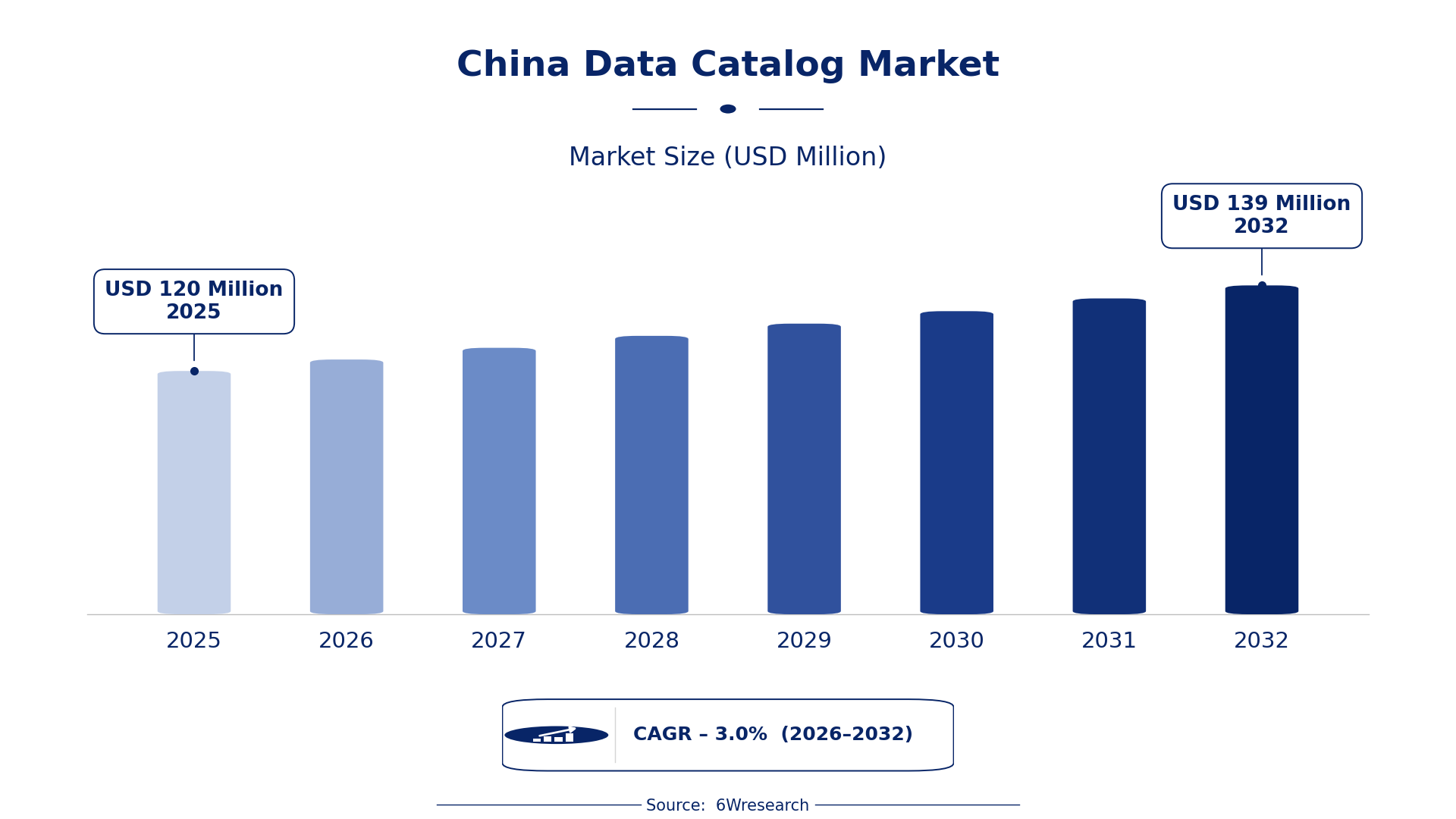
The China Data Catalog Market was estimated at USD 120 Million in 2025 and is projected to reach USD 139 Million by 2032, growing at a CAGR of 3.0% from 2026 to 2032.
China Data Catalog Market Synopsis
The China Data Catalog Market is witnessing substantial growth as organizations increasingly recognize the need for effective data management solutions. The shift towards data-driven decision-making has made data catalogs indispensable, allowing firms to organize, classify, and access data efficiently.
As businesses grapple with escalating data volumes, the demand for data cataloging technologies continues to rise. Innovations in artificial intelligence and machine learning are enhancing the capabilities of data catalogs, providing organizations with tools to improve data discovery and utilization.
China Data Catalog Market Year-wise Growth Rate and Key Drivers
This graph illustrates the annual growth rates of the China Data Catalog Market from 2021 to 2032, highlighting a steady upward trajectory and projected expansion over the forecast period.
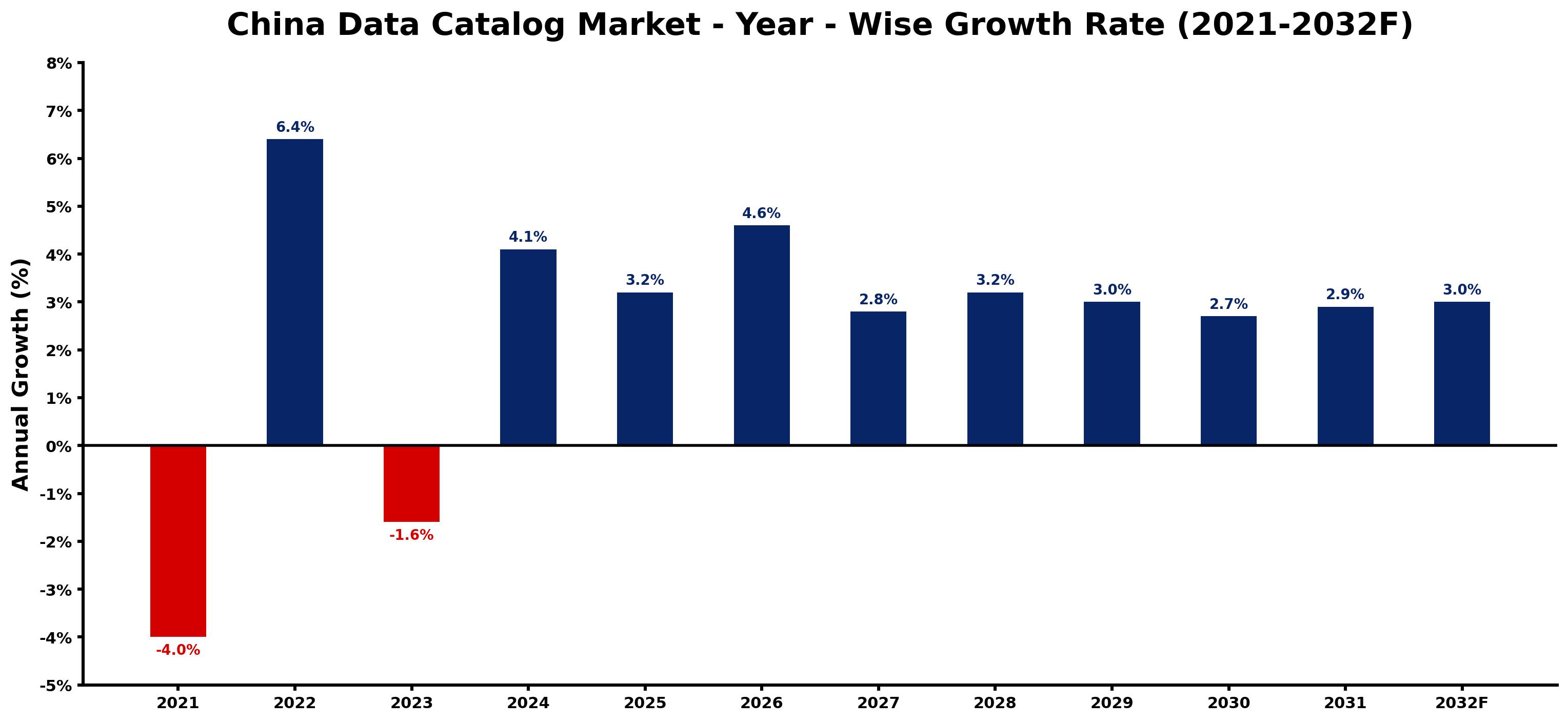
The table below presents the year‑wise growth rates along with the key drivers influencing the market
| Year | Growth Rate | Major Drivers |
| 2021 | -4.0% | Regulatory changes by MIIT limiting data sharing practices |
| 2022 | 6.4% | Implementation of China's data security law enhances cataloging needs. |
| 2023 | -1.6% | Slow adoption of cloud services among local enterprises |
| 2024 | 4.1% | Increased adoption of big data analytics drives catalog usage. |
| 2025 | 3.2% | Rise in cloud computing requires robust data management solutions. |
| 2026 | 4.6% | Growth of AI applications spurs demand for organized datasets. |
| 2027 | 2.8% | Government data sharing initiatives promote public sector transparency. |
| 2028 | 3.2% | Corporate data governance programs necessitate structured catalogs. |
| 2029 | 3.0% | Emergence of smart city projects drives data utilization. |
| 2030 | 2.7% | Strengthening of digital economy strategies boosts data curation. |
| 2031 | 2.9% | Local data residency requirements fuel cataloging innovations. |
| 2032 | 3.0% | Surge in digital transformation initiatives demands advanced data catalogs. |
Note: Market size estimations and growth projections presented in this report are based on 6Wresearch's proprietary forecasting methodology, utilizing the latest available industry data, government publications, and primary research inputs.
China Data Catalog Market Key Takeaways
Below are some of the specific key takeaways from the market, including:
- The growing emphasis on data governance and compliance is driving the adoption of data catalogs across various sectors.
- Organizations are investing in advanced technologies to improve data accuracy and consistency.
- Competition is increasing as new players enter the market with innovative solutions.
- Government regulations are shaping data management practices, influencing market dynamics.
- The need for efficient data management is pushing companies to adopt comprehensive data catalog solutions.
Evaluation of Restraints in China Data Catalog Market
While the China Data Catalog Market is expanding, several constraints hinder its full potential. Organizations struggle to manage vast amounts of data from disparate sources, complicating data organization and retrieval processes. Ensuring data accuracy and consistency across various catalog systems poses additional challenges, particularly as businesses adopt more advanced technologies. on top of that, regulatory compliance and data privacy concerns require firms to navigate strict regulations, which can be resource-intensive and costly. This complexity is compounded by the emergence of alternative data management solutions that compete for market share.
China Data Catalog Market Trends
Current trends indicate a growing integration of AI and machine learning in data catalog technologies, enhancing the capabilities of these tools. Companies are increasingly prioritizing automated data discovery and classification to streamline workflows. on top of that, the shift towards remote work has accelerated the demand for collaborative data management solutions, driving the need for centralized data catalogs that can be accessed from anywhere. As organizations focus on digital transformation, the importance of data catalogs as foundational elements of data strategy continues to rise.
China Data Catalog Market Opportunities
Genuine growth opportunities in the China Data Catalog Market lie in the rising demand for data governance and compliance solutions. As organizations face stricter regulatory requirements, the need for efficient data management practices will expand. Additionally, sectors such as healthcare, finance, and manufacturing are ripe for investment, as they grapple with vast amounts of data requiring effective organization. Companies that focus on developing user-friendly, scalable data catalog solutions will likely capture a significant share of this burgeoning market.
Government Initiatives in the China Data Catalog Market
Government policies are playing a crucial role in shaping the China Data Catalog Market. Emphasizing data management standards, regulatory initiatives are encouraging organizations to adopt effective data governance practices. As the government pushes for improved data security and management, adherence to these regulations is becoming increasingly important for businesses.
- A regulatory framework introduced in 2021 mandates enhanced data management practices across public and private sectors.
- A national data governance initiative currently underway aims to streamline data cataloging processes within government agencies.
- A planned public-private partnership expected to enhance data management capabilities is set to launch in 2026.
- The "Data Security Law" enacted in 2022 emphasizes the necessity of data catalogs for efficient data organization.
- Recent government workshops focused on best practices in data management have spurred interest in adopting data catalog solutions among businesses.
Future Insights of the China Data Catalog Market
Looking ahead to 2026-2032, the China Data Catalog Market is expected to continue its growth trajectory as organizations increasingly prioritize data governance and management. The adoption of cloud-based solutions will likely accelerate, enabling more flexible and scalable data catalog offerings. As regulatory pressures mount, businesses will invest more heavily in compliance-driven data management practices. The integration of emerging technologies will also drive innovation, paving the way for more efficient data catalog solutions that can adapt to the evolving needs of organizations.
China Data Catalog Market Latest Developments
Recent developments in the China Data Catalog Market reflect a dynamic environment as companies seek innovative ways to enhance data management. Over the past year, several initiatives and advancements have emerged, indicating a shift towards more sophisticated data catalog solutions.
- A leading technology vendor launched an advanced data catalog solution in early 2023, integrating AI-driven data discovery features.
- A major regional operator is currently implementing a comprehensive data governance framework, which includes a focus on data catalogs, expected to be completed by Q3 2024.
- An initiative that began in mid-2023 aims to enhance public sector data management practices through the adoption of standardized data catalogs.
- A planned rollout of a nationwide training program for data management professionals is expected to commence in late 2024, focusing on effective use of data catalogs.
- In early 2023, a consortium of major industry players was formed to collaborate on best practices for data cataloging and management.
China Data Catalog Market - Key Attractiveness of the Report
- 10 Years of Market Numbers
- Historical Data Starting from 2022 to 2025
- Base Year: 2025
- Forecast Data until 2032
- Key Performance Indicators Impacting the Market
- Major Upcoming Developments and Projects
Key Highlights of the Report:
- China Data Catalog Market Outlook
- Market Size of China Data Catalog Market, 2025
- Forecast of China Data Catalog Market, 2032
- Historical Data and Forecast of China Data Catalog Revenues & Volume for the Period 2022-2032F
- China Data Catalog Market Trend Evolution
- China Data Catalog Market Drivers and Challenges
- China Data Catalog Price Trends
- China Data Catalog Porter's Five Forces
- China Data Catalog Industry Life Cycle
- Historical Data and Forecast of China Data Catalog Market Revenues & Volume By Component for the Period 2022-2032F
- Historical Data and Forecast of China Data Catalog Market Revenues & Volume By Solutions for the Period 2022-2032F
- Historical Data and Forecast of China Data Catalog Market Revenues & Volume By Services for the Period 2022-2032F
- Historical Data and Forecast of China Data Catalog Market Revenues & Volume By Data Consumer for the Period 2022-2032F
- Historical Data and Forecast of China Data Catalog Market Revenues & Volume By Business Intelligence tools for the Period 2022-2032F
- Historical Data and Forecast of China Data Catalog Market Revenues & Volume By Enterprise Applications for the Period 2022-2032F
- Historical Data and Forecast of China Data Catalog Market Revenues & Volume By Mobile and Web Applications for the Period 2022-2032F
- Historical Data and Forecast of China Data Catalog Market Revenues & Volume By Deployment Mode for the Period 2022-2032F
- Historical Data and Forecast of China Data Catalog Market Revenues & Volume By Cloud for the Period 2022-2032F
- Historical Data and Forecast of China Data Catalog Market Revenues & Volume By On-premises for the Period 2022-2032F
- Historical Data and Forecast of China Data Catalog Market Revenues & Volume By Metadata Type for the Period 2022-2032F
- Historical Data and Forecast of China Data Catalog Market Revenues & Volume By Technical Metadata for the Period 2022-2032F
- Historical Data and Forecast of China Data Catalog Market Revenues & Volume By Business Metadata for the Period 2022-2032F
- Historical Data and Forecast of China Data Catalog Market Revenues & Volume By Organization Size for the Period 2022-2032F
- Historical Data and Forecast of China Data Catalog Market Revenues & Volume By SMEs for the Period 2022-2032F
- Historical Data and Forecast of China Data Catalog Market Revenues & Volume By Large Enterprises for the Period 2022-2032F
- Historical Data and Forecast of China Data Catalog Market Revenues & Volume By Vertical for the Period 2022-2032F
- Historical Data and Forecast of China Data Catalog Market Revenues & Volume By BFSI for the Period 2022-2032F
- Historical Data and Forecast of China Data Catalog Market Revenues & Volume By Retail and eCommerce for the Period 2022-2032F
- Historical Data and Forecast of China Data Catalog Market Revenues & Volume By Manufacturing for the Period 2022-2032F
- Historical Data and Forecast of China Data Catalog Market Revenues & Volume By Government and Defence for the Period 2022-2032F
- Historical Data and Forecast of China Data Catalog Market Revenues & Volume By Healthcare and Life Sciences for the Period 2022-2032F
- Historical Data and Forecast of China Data Catalog Market Revenues & Volume By Telecom for the Period 2022-2032F
- Historical Data and Forecast of China Data Catalog Market Revenues & Volume By Media and Entertainment for the Period 2022-2032F
- Historical Data and Forecast of China Data Catalog Market Revenues & Volume By Transportation and Logistics for the Period 2022-2032F
- China Data Catalog Import Export Trade Statistics
- Market Opportunity Assessment By Component
- Market Opportunity Assessment By Data Consumer
- Market Opportunity Assessment By Deployment Mode
- Market Opportunity Assessment By Metadata Type
- Market Opportunity Assessment By Organization Size
- Market Opportunity Assessment By Vertical
- China Data Catalog Top Companies Market Share
- China Data Catalog Competitive Benchmarking By Technical and Operational Parameters
- China Data Catalog Company Profiles
- China Data Catalog Key Strategic Recommendations






































