China Data Center Colocation Market Size & Growth Rate (2026-2032)
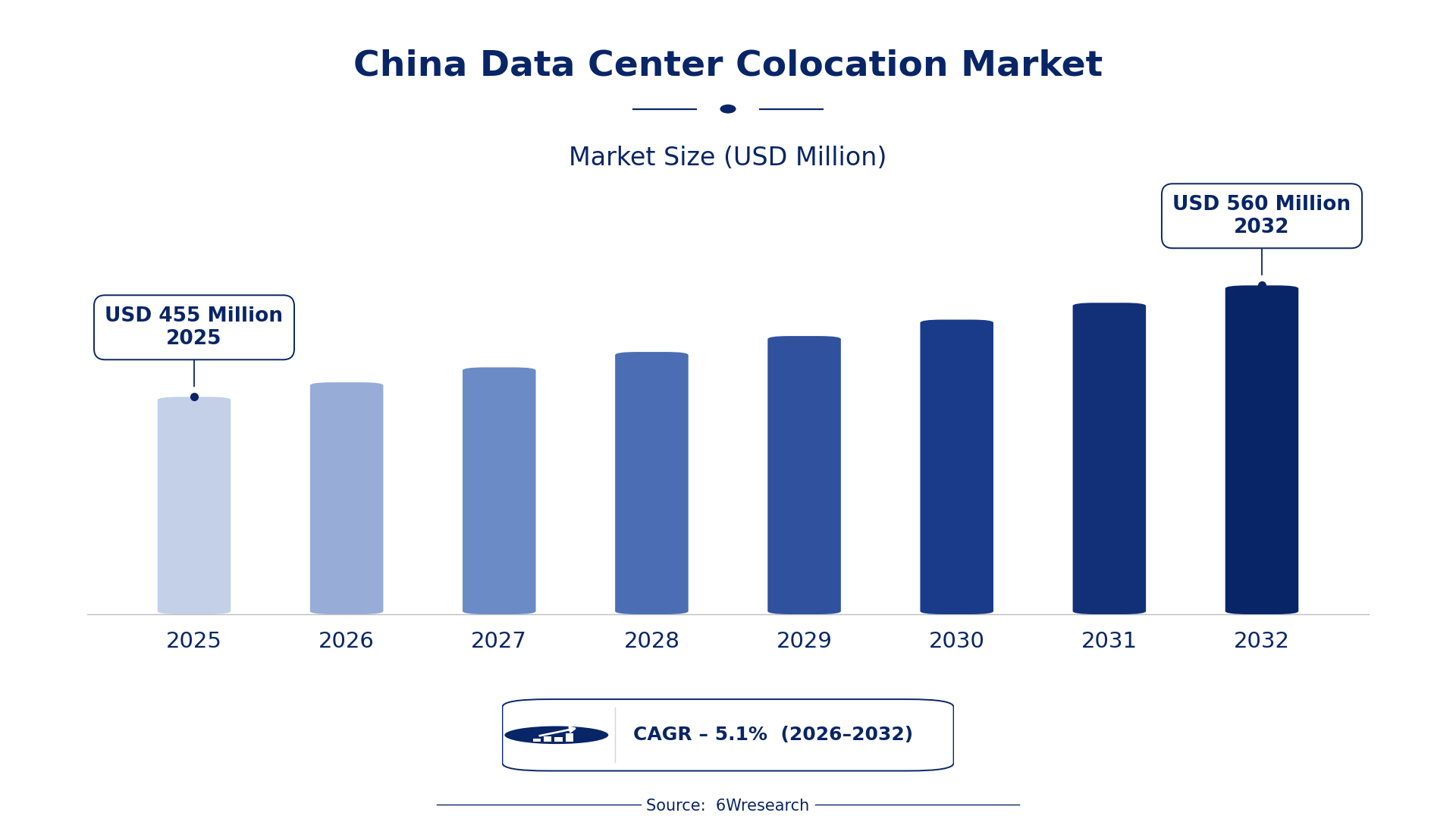
The China Data Center Colocation Market was estimated at USD 455 Million in 2025 and is projected to reach USD 560 Million by 2032, growing at a CAGR of 5.1% from 2026 to 2032.
China Data Center Colocation Market Synopsis
The demand for data center colocation services in China is surging, fueled by the digital transformation initiatives across various industries. Enterprises, ranging from large corporations to small and medium-sized enterprises, are increasingly opting for colocation to enhance their operational efficiency and reduce overhead costs associated with maintaining in-house data centers.
As the proliferation of IoT devices and big data analytics continues, the need for reliable data storage solutions grows. China's tier-1 and tier-2 cities are witnessing significant investments in data center infrastructure, driven by both private enterprises and government policies aimed at supporting the digital economy.
China Data Center Colocation Market Year-wise Growth Rate and Key Drivers
This graph illustrates the annual growth rates of the China Data Center Colocation Market from 2021 to 2032, highlighting a steady upward trajectory and projected expansion over the forecast period.
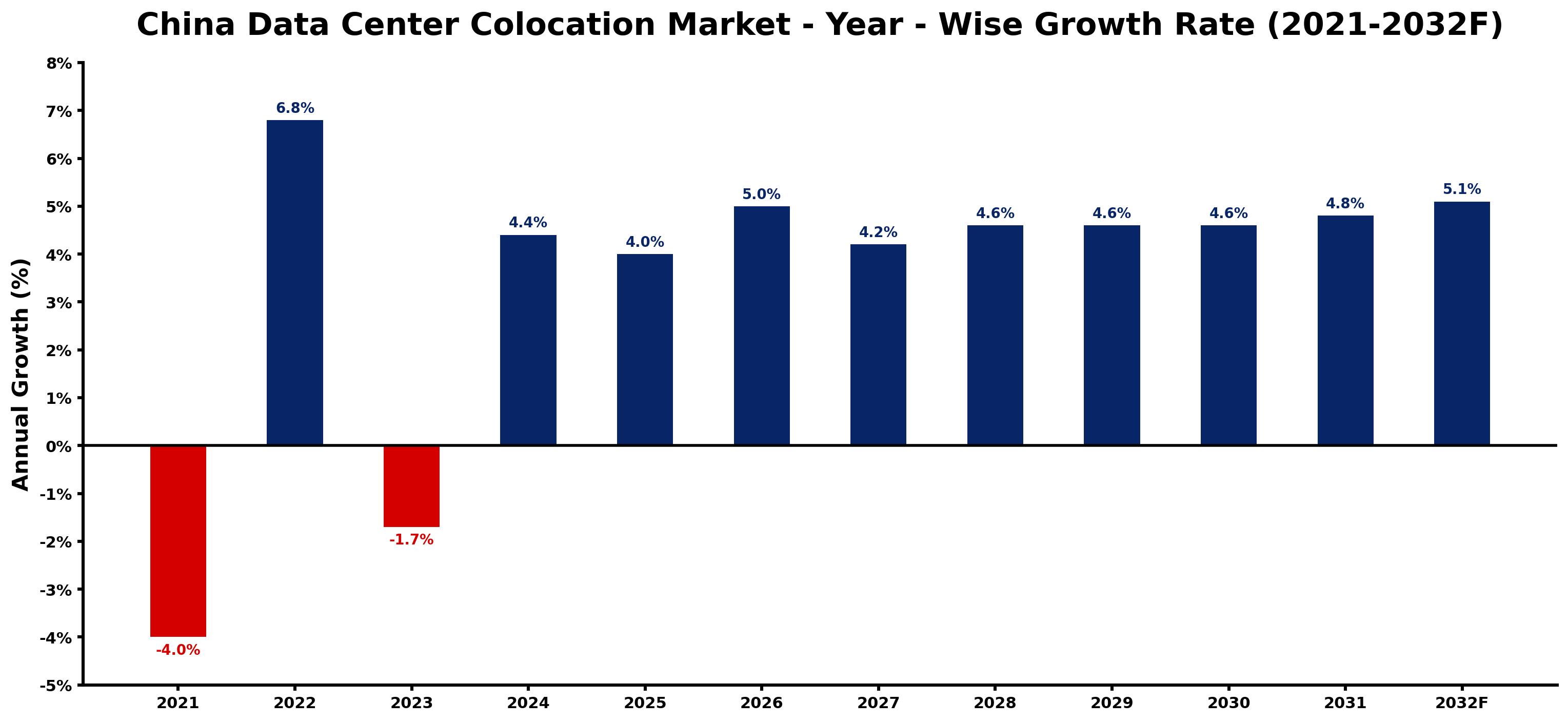
The table below presents the year‑wise growth rates along with the key drivers influencing the market
| Year | Growth Rate | Major Drivers |
| 2021 | -4.0% | Energy consumption regulations tightened by the National Energy Administration |
| 2022 | 6.8% | China's 14th Five-Year Plan supports data center growth. |
| 2023 | -1.7% | Increased electricity costs from local grid infrastructure upgrades |
| 2024 | 4.4% | Increased demand for cloud computing post-COVID-19 recovery. |
| 2025 | 4.0% | Government incentives for green data center development. |
| 2026 | 5.0% | Rise in AI applications driving colocation services demand. |
| 2027 | 4.2% | Local data privacy regulations boost colocation market reliance. |
| 2028 | 4.6% | 5G deployment fosters edge computing and data needs. |
| 2029 | 4.6% | Growing e-commerce demands higher data processing capabilities. |
| 2030 | 4.6% | Digital yuan pilot expands financial transaction data requirements. |
| 2031 | 4.8% | Increased foreign investment following favorable regulatory reforms. |
| 2032 | 5.1% | Emerging technologies drive enhanced data center efficiency. |
Note: Market size estimations and growth projections presented in this report are based on 6Wresearch's proprietary forecasting methodology, utilizing the latest available industry data, government publications, and primary research inputs.
China Data Center Colocation Market Key Takeaways
Below are some of the specific key takeaways from the market, including:
- The market is experiencing robust growth due to rising data storage demands from enterprises.
- Cost efficiency and operational flexibility are major drivers for companies choosing colocation services.
- Intense competition presents challenges for new entrants in the saturated market.
- Government policies are actively promoting the expansion of data center infrastructure.
- Emerging technologies like cloud computing are reshaping the data center colocation landscape.
Evaluation of Restraints in China Data Center Colocation Market
Intense competition is a prominent challenge facing the China Data Center Colocation Market. With numerous providers vying for market share, new entrants struggle to carve out a space. Additionally, the pressure to comply with stringent regulatory requirements is ever-present, demanding resources and focus from operators. The need for high-performance services while managing costs adds further strain, often squeezing profit margins as companies try to meet the increasing expectations of clients.
China Data Center Colocation Market Trends
Several trends are shaping the China Data Center Colocation Market. The increasing adoption of cloud services continues to redefine data storage needs, pushing businesses toward colocation solutions that offer scalability. The rise in IoT applications and the corresponding data explosion require efficient management solutions, propelling demand for colocation services. Additionally, a growing emphasis on energy efficiency and sustainability is prompting providers to innovate in their operations and infrastructure.
China Data Center Colocation Market Opportunities
Growth opportunities in the China Data Center Colocation Market are abundant, particularly in tier-2 cities where infrastructure development is accelerating. Companies are looking for flexible colocation options that can adapt to their changing needs. on top of that, the integration of advanced technologies like AI and machine learning in data management presents avenues for service differentiation. As enterprises continue to embrace digital transformation, the demand for innovative colocation services will only increase.
Government Initiatives in the China Data Center Colocation Market
The Chinese government has taken substantial steps to support the development of the data center colocation market, recognizing its critical role in advancing the digital economy. Policies are geared toward enhancing infrastructure, promoting energy efficiency, and ensuring that data centers are established in regions with advanced telecommunications capabilities. These initiatives are crucial for attracting investment and fostering innovation in the sector.
- A national digital infrastructure upgrade programme was recently completed, enhancing connectivity and reducing latency for data centers.
- Currently ongoing is a regulatory framework that mandates stricter compliance standards for data security and energy efficiency.
- Upcoming initiatives include a public-private partnership aimed at expanding data center capacity in underserved regions.
- In 2025, a policy was introduced to incentivize the use of renewable energy sources in data center operations.
- There is a focus on establishing data centers in special economic zones to stimulate local economies.
Future Insights of the China Data Center Colocation Market
Looking ahead to 2026-2032, the China Data Center Colocation Market is set for a period of steady growth. As digital transformation accelerates across various sectors, the demand for colocation services is likely to rise. Companies will increasingly seek out scalable, energy-efficient solutions to manage their data needs. The government's supportive policies and focus on infrastructure development will further enhance market conditions, making it an attractive space for investment.
China Data Center Colocation Market Latest Developments
In the last year, the China Data Center Colocation Market has witnessed dynamic activity, characterized by significant investments and technological advancements. The competitive landscape is evolving, with providers enhancing their service offerings to capture market share. Innovations in energy efficiency and data security are also gaining traction as operators strive to meet client demands.
- A major technology vendor launched a new energy-efficient cooling solution in mid-2025, aiming to reduce operational costs for data centers.
- A leading regional operator is currently expanding its colocation facilities in tier-2 cities, with construction expected to complete by late 2026.
- An initiative to integrate AI-driven analytics into data center operations began in Q3 2025 and remains underway.
- Plans are in place for a collaborative project between several data center providers to enhance interconnectivity, expected to kick off in early 2026.
- A data center operator announced an upgrade to its security protocols, completed in late 2025, to comply with new regulatory standards.
China Data Center Colocation Market - Key Attractiveness of the Report
- 10 Years of Market Numbers
- Historical Data Starting from 2022 to 2025
- Base Year: 2025
- Forecast Data until 2032
- Key Performance Indicators Impacting the Market
- Major Upcoming Developments and Projects
Key Highlights of the Report:
- China Data Center Colocation Market Outlook
- Market Size of China Data Center Colocation Market, 2025
- Forecast of China Data Center Colocation Market, 2032
- Historical Data and Forecast of China Data Center Colocation Revenues & Volume for the Period 2022-2032F
- China Data Center Colocation Market Trend Evolution
- China Data Center Colocation Market Drivers and Challenges
- China Data Center Colocation Price Trends
- China Data Center Colocation Porter's Five Forces
- China Data Center Colocation Industry Life Cycle
- Historical Data and Forecast of China Data Center Colocation Market Revenues & Volume By Type for the Period 2022-2032F
- Historical Data and Forecast of China Data Center Colocation Market Revenues & Volume By Retail colocation for the Period 2022-2032F
- Historical Data and Forecast of China Data Center Colocation Market Revenues & Volume By Wholesale colocation for the Period 2022-2032F
- Historical Data and Forecast of China Data Center Colocation Market Revenues & Volume By End-User for the Period 2022-2032F
- Historical Data and Forecast of China Data Center Colocation Market Revenues & Volume By Small and Medium-Sized Enterprises (SMEs) for the Period 2022-2032F
- Historical Data and Forecast of China Data Center Colocation Market Revenues & Volume By Large Enterprises for the Period 2022-2032F
- Historical Data and Forecast of China Data Center Colocation Market Revenues & Volume By Industry for the Period 2022-2032F
- Historical Data and Forecast of China Data Center Colocation Market Revenues & Volume By Banking, Financial Services, and Insurance (BFSI) for the Period 2022-2032F
- Historical Data and Forecast of China Data Center Colocation Market Revenues & Volume By IT and telecom for the Period 2022-2032F
- Historical Data and Forecast of China Data Center Colocation Market Revenues & Volume By Government and defense for the Period 2022-2032F
- Historical Data and Forecast of China Data Center Colocation Market Revenues & Volume By Healthcare for the Period 2022-2032F
- Historical Data and Forecast of China Data Center Colocation Market Revenues & Volume By Research and academics for the Period 2022-2032F
- Historical Data and Forecast of China Data Center Colocation Market Revenues & Volume By Retail for the Period 2022-2032F
- Historical Data and Forecast of China Data Center Colocation Market Revenues & Volume By Energy for the Period 2022-2032F
- Historical Data and Forecast of China Data Center Colocation Market Revenues & Volume By Manufacturing for the Period 2022-2032F
- China Data Center Colocation Import Export Trade Statistics
- Market Opportunity Assessment By Type
- Market Opportunity Assessment By End-User
- Market Opportunity Assessment By Industry
- China Data Center Colocation Top Companies Market Share
- China Data Center Colocation Competitive Benchmarking By Technical and Operational Parameters
- China Data Center Colocation Company Profiles
- China Data Center Colocation Key Strategic Recommendations






































