China Data Classification Market Size & Growth Rate (2026-2032)
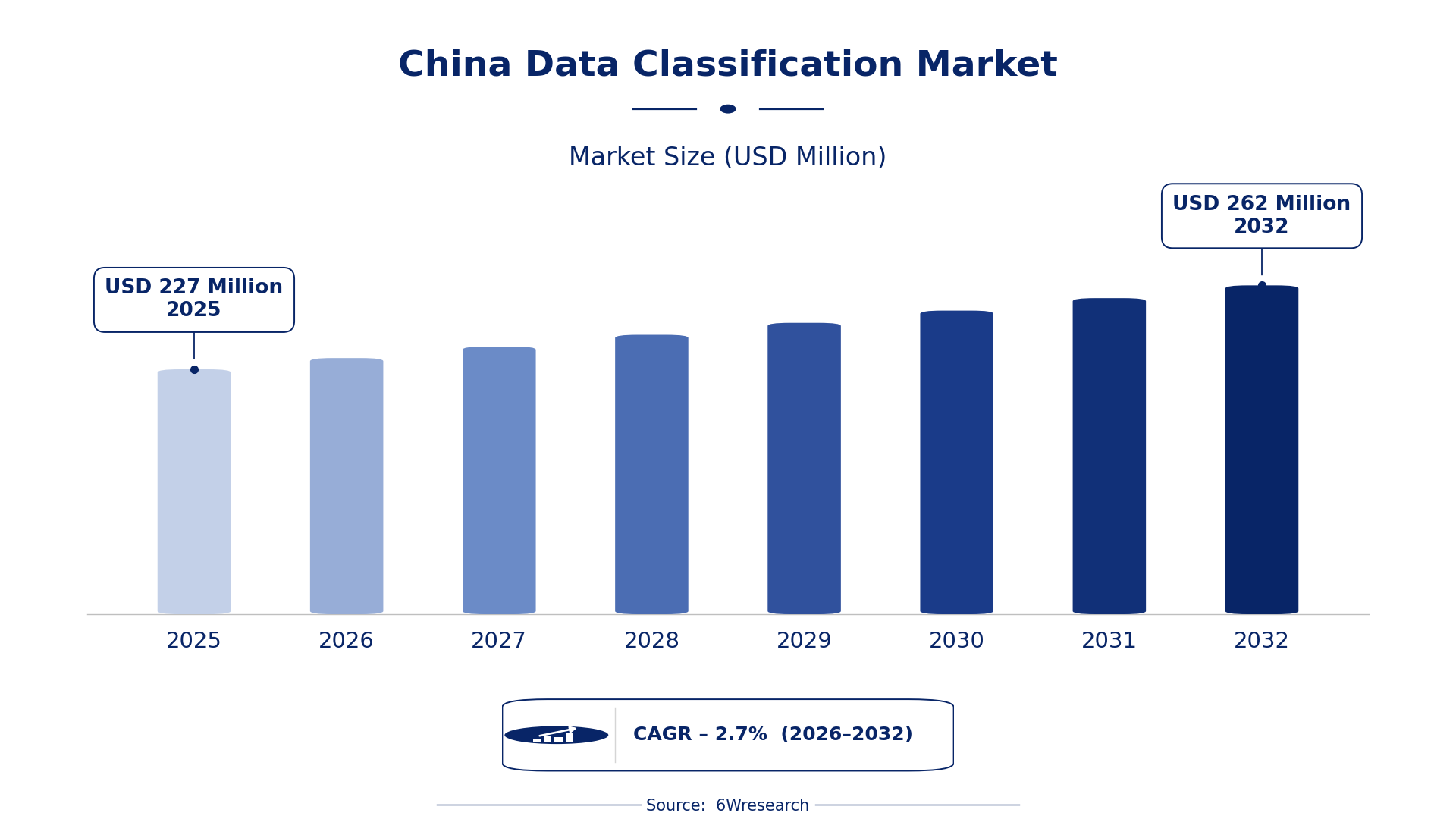
The China Data Classification Market was estimated at USD 227 Million in 2025 and is projected to reach USD 262 Million by 2032, growing at a CAGR of 2.7% from 2026 to 2032.
China Data Classification Market Synopsis
The driving force behind the China Data Classification Market is the urgent need for organizations to secure their data assets. As businesses face increasing scrutiny regarding data management, the focus on proper classification becomes paramount to prevent breaches and ensure compliance.
The market is witnessing a shift towards automation, with companies adopting sophisticated tools that integrate data classification with existing management systems. This trend not only streamlines processes but also enhances the overall efficiency of data governance.
China Data Classification Market Year-wise Growth Rate and Key Drivers
This graph illustrates the annual growth rates of the China Data Classification Market from 2021 to 2032, highlighting a steady upward trajectory and projected expansion over the forecast period.
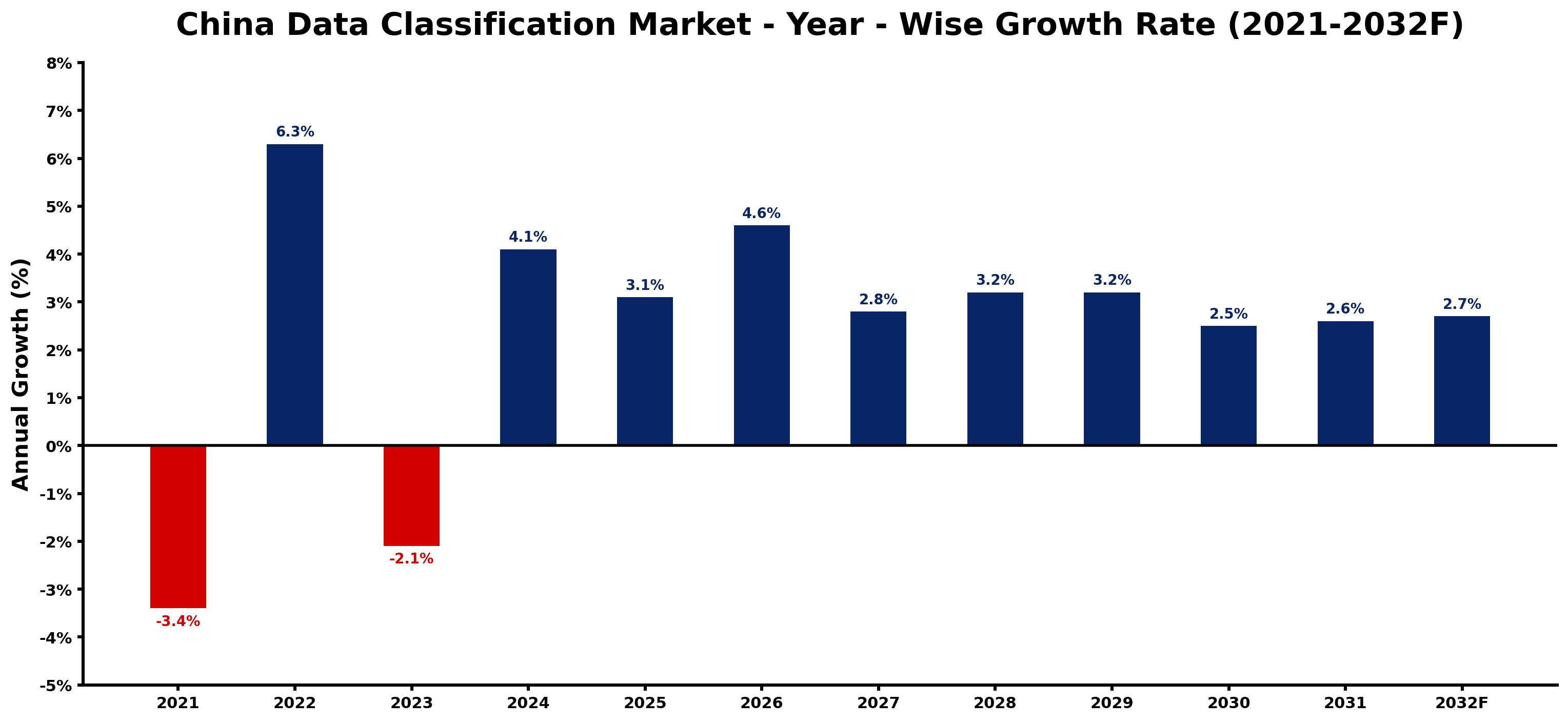
The table below presents the year‑wise growth rates along with the key drivers influencing the market
| Year | Growth Rate | Major Drivers |
| 2021 | -3.4% | Cybersecurity Law compliance challenges for local businesses. |
| 2022 | 6.3% | Implementation of Cybersecurity Law mandates data classification. |
| 2023 | -2.1% | Slowed adoption of cloud services in urban areas. |
| 2024 | 4.1% | Growing cloud adoption drives data privacy regulations adherence. |
| 2025 | 3.1% | Increased enterprise focus on compliance with data protection. |
| 2026 | 4.6% | Evolving digital economy necessitates enhanced data governance policies. |
| 2027 | 2.8% | Rise in data breaches heightens demand for classification services. |
| 2028 | 3.2% | Adoption of AI tools enhances data analysis capabilities. |
| 2029 | 3.2% | Government initiatives promote data sovereignty and local solutions. |
| 2030 | 2.5% | Emerging industries require tailored data classification frameworks. |
| 2031 | 2.6% | Increased emphasis on data privacy fuels regulatory compliance needs. |
| 2032 | 2.7% | Expanded e-commerce platform regulations require categorized data management. |
Note: Market size estimations and growth projections presented in this report are based on 6Wresearch's proprietary forecasting methodology, utilizing the latest available industry data, government publications, and primary research inputs.
China Data Classification Market Key Takeaways
Below are some of the specific key takeaways from the market, including:
- Growing regulatory pressures are pushing organizations to prioritize data classification.
- Automated solutions are becoming essential for effective data management and protection.
- Data breaches are a key motivator, leading to increased investment in classification technologies.
- Integration with data protection tools is a major trend enhancing efficiency.
- Government policies are increasingly shaping compliance requirements within the market.
Evaluation of Restraints in China Data Classification Market
While the China Data Classification Market is on an upward trajectory, several restraints impede its full potential. Organizations often grapple with the complexity of accurately categorizing vast amounts of data, especially given the various regulatory requirements that must be met. Ensuring scalability and compatibility with existing systems poses additional challenges, which can hinder the effective implementation of classification frameworks. The cost associated with deploying sophisticated solutions can also be a deterrent for smaller enterprises.
China Data Classification Market Trends
Several trends are shaping the demand within the China Data Classification Market. There's a noticeable shift towards automated classification tools that utilize machine learning algorithms for enhanced accuracy. The integration of data classification with broader data management strategies is becoming common as organizations seek to improve data governance while remaining compliant with regulations. on top of that, increased awareness around data privacy is driving businesses to invest in advanced classification technologies to mitigate risks associated with data breaches.
China Data Classification Market Opportunities
The evolving landscape presents numerous opportunities for growth in the China Data Classification Market. Enterprises looking to strengthen their data security measures and comply with stricter regulations can benefit from investing in advanced classification solutions. Additionally, there's a rising demand for tailored classification tools that cater to specific industry needs, such as finance or healthcare. Partnerships between technology vendors and organizations can lead to innovative solutions, thereby expanding the market further.
Government Initiatives in the China Data Classification Market
Chinese government policy is increasingly focused on enhancing data security and compliance within the data classification sector. The establishment of clear guidelines regarding data classification is vital for organizations aiming to safeguard sensitive information. As regulatory frameworks tighten, businesses must adapt to evolving standards that mandate rigorous data management practices.
- A regulatory framework established in late 2022 mandates organizations to classify data based on sensitivity to improve protection against breaches.
- Currently ongoing initiatives include the rollout of nationwide training programs aimed at improving data classification practices across various sectors.
- Upcoming regulations expected in 2025 will introduce stricter penalties for non-compliance with data classification requirements.
- The government is also working on a comprehensive data protection strategy to be released in 2024, which will further detail the classification processes for industries handling sensitive data.
Future Insights of the China Data Classification Market
Looking ahead to 2026-2032, the China Data Classification Market is set to evolve as technology and regulatory demands continue to shape its growth. Companies that embrace automation and invest in integrated classification tools are likely to gain a competitive edge. The emphasis on data privacy and security will remain a driving factor, prompting further advancements in classification methodologies to mitigate risks associated with data handling. Organizations that adapt swiftly to these changes will not only improve compliance but also enhance their overall data governance strategies.
China Data Classification Market Latest Developments
Over the past 12-14 months, the China Data Classification Market has experienced several significant developments. Companies are increasingly investing in automated classification technologies, with many seeking integration within their existing frameworks to enhance data security. The push for compliance with government regulations has also fueled innovations in classification methodologies.
- An initiative launched in early 2023 aims to provide tax incentives for businesses investing in advanced data classification solutions, encouraging adoption.
- In Q2 2023, several major organizations announced partnerships to develop cutting-edge classification tools that align with the latest regulatory standards.
- A rollout of new training modules for data classification specialists began in early 2023 and remains ongoing, aiming to address skills gaps in the industry.
- By late 2023, a prominent technology vendor is expected to launch a new classification platform tailored specifically for the healthcare sector.
China Data Classification Market - Key Attractiveness of the Report
- 10 Years of Market Numbers
- Historical Data Starting from 2022 to 2025
- Base Year: 2025
- Forecast Data until 2032
- Key Performance Indicators Impacting the Market
- Major Upcoming Developments and Projects
Key Highlights of the Report:
- China Data Classification Market Outlook
- Market Size of China Data Classification Market, 2025
- Forecast of China Data Classification Market, 2032
- Historical Data and Forecast of China Data Classification Revenues & Volume for the Period 2022-2032F
- China Data Classification Market Trend Evolution
- China Data Classification Market Drivers and Challenges
- China Data Classification Price Trends
- China Data Classification Porter's Five Forces
- China Data Classification Industry Life Cycle
- Historical Data and Forecast of China Data Classification Market Revenues & Volume By Component for the Period 2022-2032F
- Historical Data and Forecast of China Data Classification Market Revenues & Volume By Solutions (Standalone and Integrated) for the Period 2022-2032F
- Historical Data and Forecast of China Data Classification Market Revenues & Volume By Services for the Period 2022-2032F
- Historical Data and Forecast of China Data Classification Market Revenues & Volume By Application for the Period 2022-2032F
- Historical Data and Forecast of China Data Classification Market Revenues & Volume By Access Control for the Period 2022-2032F
- Historical Data and Forecast of China Data Classification Market Revenues & Volume By GRC for the Period 2022-2032F
- Historical Data and Forecast of China Data Classification Market Revenues & Volume By Web for the Period 2022-2032F
- Historical Data and Forecast of China Data Classification Market Revenues & Volume By Mobile & Email Protection for the Period 2022-2032F
- Historical Data and Forecast of China Data Classification Market Revenues & Volume By Centralized Management for the Period 2022-2032F
- Historical Data and Forecast of China Data Classification Market Revenues & Volume By Methodology for the Period 2022-2032F
- Historical Data and Forecast of China Data Classification Market Revenues & Volume By Content-based Classification for the Period 2022-2032F
- Historical Data and Forecast of China Data Classification Market Revenues & Volume By Context-based Classification for the Period 2022-2032F
- Historical Data and Forecast of China Data Classification Market Revenues & Volume By User-based Classification for the Period 2022-2032F
- Historical Data and Forecast of China Data Classification Market Revenues & Volume By Vertical for the Period 2022-2032F
- Historical Data and Forecast of China Data Classification Market Revenues & Volume By BFSI for the Period 2022-2032F
- Historical Data and Forecast of China Data Classification Market Revenues & Volume By Healthcare and Lifesciences for the Period 2022-2032F
- Historical Data and Forecast of China Data Classification Market Revenues & Volume By Government and Defense for the Period 2022-2032F
- Historical Data and Forecast of China Data Classification Market Revenues & Volume By Education for the Period 2022-2032F
- Historical Data and Forecast of China Data Classification Market Revenues & Volume By Telecom for the Period 2022-2032F
- Historical Data and Forecast of China Data Classification Market Revenues & Volume By Media and Entertainment for the Period 2022-2032F
- Historical Data and Forecast of China Data Classification Market Revenues & Volume By Others (Retail and Ecommerce, Manufacturing, and Energy and Utilities) for the Period 2022-2032F
- China Data Classification Import Export Trade Statistics
- Market Opportunity Assessment By Component
- Market Opportunity Assessment By Application
- Market Opportunity Assessment By Methodology
- Market Opportunity Assessment By Vertical
- China Data Classification Top Companies Market Share
- China Data Classification Competitive Benchmarking By Technical and Operational Parameters
- China Data Classification Company Profiles
- China Data Classification Key Strategic Recommendations






































