China Data Governance Market Size & Growth Rate (2026-2032)
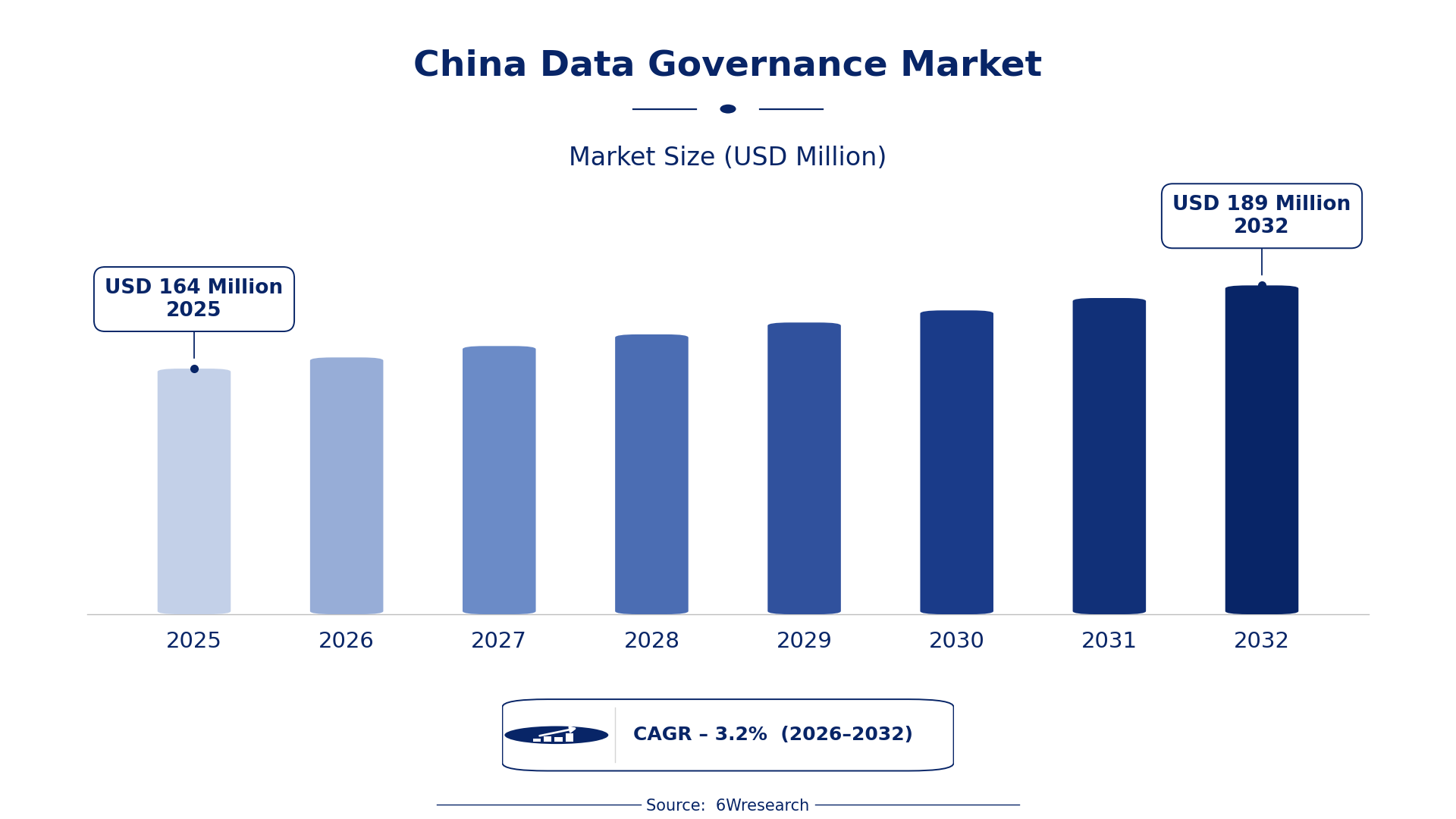
The China Data Governance Market was estimated at USD 164 Million in 2025 and is projected to reach USD 189 Million by 2032, growing at a CAGR of 3.2% from 2026 to 2032.
China Data Governance Market Synopsis
The demand for data governance in China is surging as organizations grapple with the complexities of data management and compliance. With increasing regulatory scrutiny and a focus on data security, businesses across sectors are prioritizing robust governance frameworks. This trend is fueled by a recognition of data as a vital asset that requires meticulous oversight and strategic management.
Organizations are not only investing in technology but are also reshaping their corporate cultures to embrace data stewardship. The convergence of big data analytics and cloud computing solutions is creating a fertile ground for innovative governance approaches, ensuring that data quality and integrity remain at the forefront of business operations.
China Data Governance Market Year-wise Growth Rate and Key Drivers
This graph illustrates the annual growth rates of the China Data Governance Market from 2021 to 2032, highlighting a steady upward trajectory and projected expansion over the forecast period.
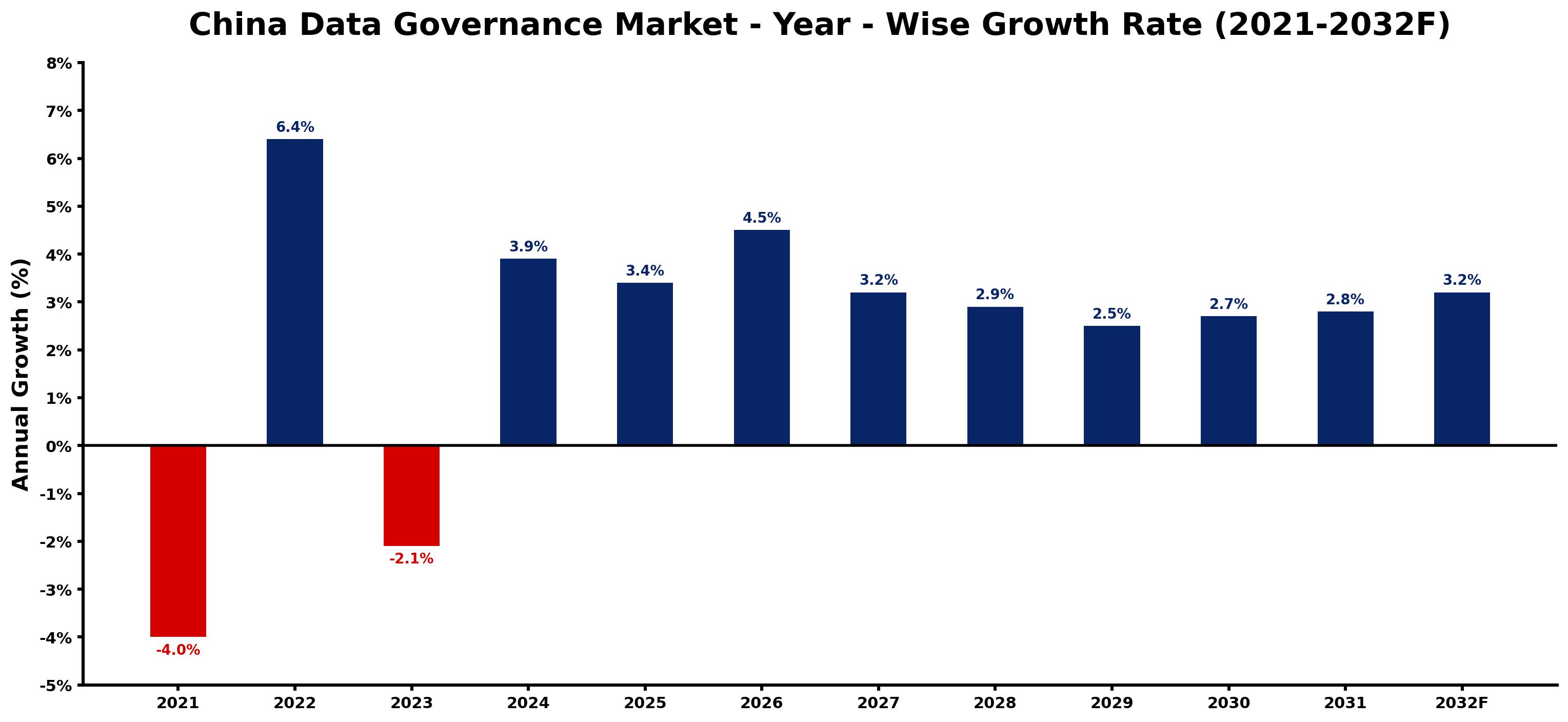
The table below presents the year‑wise growth rates along with the key drivers influencing the market
| Year | Growth Rate | Major Drivers |
| 2021 | -4.0% | National cybersecurity regulations hampered data governance projects. |
| 2022 | 6.4% | Implementation of China’s Data Security Law enforcement |
| 2023 | -2.1% | Increased scrutiny by Cyberspace Administration of China. |
| 2024 | 3.9% | Accelerated adoption of AI increases data governance importance |
| 2025 | 3.4% | Regulatory compliance mandates drive data management investments |
| 2026 | 4.5% | Increasing consumer privacy concerns boost governance frameworks |
| 2027 | 3.2% | Rise of cross-border data flow regulations impacts businesses |
| 2028 | 2.9% | Digital currency initiatives require enhanced data oversight |
| 2029 | 2.5% | Growing focus on cybersecurity amid rising data breaches |
| 2030 | 2.7% | Corporate governance reforms emphasize data accountability standards |
| 2031 | 2.8% | Public sector digitization drives need for data governance |
| 2032 | 3.2% | Emergence of data brokers necessitates stricter governance policies |
Note: Market size estimations and growth projections presented in this report are based on 6Wresearch's proprietary forecasting methodology, utilizing the latest available industry data, government publications, and primary research inputs.
China Data Governance Market Key Takeaways
Below are some of the specific key takeaways from the market, including:
- Data governance frameworks are increasingly crucial for regulatory compliance and data integrity.
- Organizations face rising challenges related to data quality and integration across diverse systems.
- The adoption of advanced data management tools is supporting market growth.
- Government regulations are driving demand for comprehensive governance solutions.
- The recognition of data as a strategic asset is prompting increased investments in governance practices.
Evaluation of Restraints in China Data Governance Market
Regulatory complexities pose a formidable challenge for companies navigating the data governance landscape in China. The evolving landscape of data privacy laws, such as the Data Security Law and the Personal Information Protection Law, necessitates rigorous compliance frameworks. These regulations often lead to heightened operational costs and increased complexity in governance processes. Organizations also struggle with ensuring data consistency and quality across an array of disparate systems, complicating their governance efforts.
China Data Governance Market Trends
Several trends are shaping the China Data Governance Market as organizations look to enhance their data management capabilities. The integration of artificial intelligence in data governance is gaining traction, allowing for improved data quality assessments and anomaly detection. Additionally, there is a shift toward real-time data monitoring, which enables organizations to respond swiftly to compliance demands and emerging threats. Collaboration between data governance teams and IT departments is becoming more common, fostering a unified approach to data management.
China Data Governance Market Opportunities
The future holds substantial opportunities for growth in the China Data Governance Market. Companies are increasingly investing in technologies that support data analytics and governance, creating demand for innovative solutions. on top of that, as organizations recognize the strategic value of data, there is an uptick in funding for initiatives aimed at enhancing data management practices. Public-private partnerships aimed at developing comprehensive governance frameworks also present avenues for expansion and collaboration.
Government Initiatives in the China Data Governance Market
The regulatory framework in China is significantly influencing the Data Governance Market. The government has implemented stringent laws aimed at enhancing data security and privacy, which in turn drives organizations to adopt robust governance practices. Recent initiatives underscore a commitment to improving data management across all sectors, emphasizing compliance and data integrity.
- A national Cybersecurity Law introduced in 2022 mandates strict compliance for data handling processes.
- Current initiatives include government-funded training programs designed to enhance data governance skills among industry professionals.
- A planned public sector data management upgrade, expected to roll out by late 2026, aims to standardize data governance practices across government agencies.
- Ongoing assessments of data protection compliance are being conducted to ensure adherence to the Personal Information Protection Law.
- A regulatory framework designed to promote transparency in data processing practices is currently under development.
Future Insights of the China Data Governance Market
Looking ahead to 2026-2032, the China Data Governance Market is set for steady growth driven by regulatory compliance and data security needs. As organizations increasingly recognize the importance of data as a strategic asset, investment in governance frameworks is likely to rise. The synergy between technological advancements and governance practices will be critical in shaping the future of data management in China. This period will witness greater integration of AI and machine learning in governance solutions, further enhancing data quality and compliance efforts.
China Data Governance Market Latest Developments
In the past year, the China Data Governance Market has seen a flurry of activity as organizations adapt to new regulations and embrace advanced governance solutions. There is a clear trend towards adopting innovative technologies that enhance data management capabilities and streamline compliance efforts.
- A major technology vendor launched a new data governance platform in early 2025, focusing on integration with cloud computing services.
- A collaborative initiative between local governments and tech firms aimed at establishing best practices in data governance is currently underway.
- A new analytics tool designed for real-time data compliance monitoring is expected to hit the market in mid-2026.
- A pilot program for data governance training in educational institutions was completed in late 2025, receiving positive feedback from participants.
- Upcoming legislation focused on enhancing consumer data protection is slated for introduction in 2027.
China Data Governance Market - Key Attractiveness of the Report
- 10 Years of Market Numbers
- Historical Data Starting from 2022 to 2025
- Base Year: 2025
- Forecast Data until 2032
- Key Performance Indicators Impacting the Market
- Major Upcoming Developments and Projects
Key Highlights of the Report:
- China Data Governance Market Outlook
- Market Size of China Data Governance Market, 2025
- Forecast of China Data Governance Market, 2032
- Historical Data and Forecast of China Data Governance Revenues & Volume for the Period 2022-2032F
- China Data Governance Market Trend Evolution
- China Data Governance Market Drivers and Challenges
- China Data Governance Price Trends
- China Data Governance Porter's Five Forces
- China Data Governance Industry Life Cycle
- Historical Data and Forecast of China Data Governance Market Revenues & Volume By Application for the Period 2022-2032F
- Historical Data and Forecast of China Data Governance Market Revenues & Volume By Incident management for the Period 2022-2032F
- Historical Data and Forecast of China Data Governance Market Revenues & Volume By Process management for the Period 2022-2032F
- Historical Data and Forecast of China Data Governance Market Revenues & Volume By Compliance management for the Period 2022-2032F
- Historical Data and Forecast of China Data Governance Market Revenues & Volume By Risk management for the Period 2022-2032F
- Historical Data and Forecast of China Data Governance Market Revenues & Volume By Audit management for the Period 2022-2032F
- Historical Data and Forecast of China Data Governance Market Revenues & Volume By Data quality and security management for the Period 2022-2032F
- Historical Data and Forecast of China Data Governance Market Revenues & Volume By Others for the Period 2022-2032F
- Historical Data and Forecast of China Data Governance Market Revenues & Volume By Vertical for the Period 2022-2032F
- Historical Data and Forecast of China Data Governance Market Revenues & Volume By BFSI for the Period 2022-2032F
- Historical Data and Forecast of China Data Governance Market Revenues & Volume By Retail and Consumer Goods for the Period 2022-2032F
- Historical Data and Forecast of China Data Governance Market Revenues & Volume By Telecom and IT for the Period 2022-2032F
- Historical Data and Forecast of China Data Governance Market Revenues & Volume By Government for the Period 2022-2032F
- Historical Data and Forecast of China Data Governance Market Revenues & Volume By Healthcare for the Period 2022-2032F
- Historical Data and Forecast of China Data Governance Market Revenues & Volume By Manufacturing for the Period 2022-2032F
- Historical Data and Forecast of China Data Governance Market Revenues & Volume By Energy and Utilities for the Period 2022-2032F
- Historical Data and Forecast of China Data Governance Market Revenues & Volume By Transportation and Logistics for the Period 2022-2032F
- Historical Data and Forecast of China Data Governance Market Revenues & Volume By Component for the Period 2022-2032F
- Historical Data and Forecast of China Data Governance Market Revenues & Volume By Solutions for the Period 2022-2032F
- Historical Data and Forecast of China Data Governance Market Revenues & Volume By Services for the Period 2022-2032F
- Historical Data and Forecast of China Data Governance Market Revenues & Volume By Deployment Model for the Period 2022-2032F
- Historical Data and Forecast of China Data Governance Market Revenues & Volume By On-premises for the Period 2022-2032F
- Historical Data and Forecast of China Data Governance Market Revenues & Volume By Cloud for the Period 2022-2032F
- Historical Data and Forecast of China Data Governance Market Revenues & Volume By Organisation Size for the Period 2022-2032F
- Historical Data and Forecast of China Data Governance Market Revenues & Volume By Small and Medium-Sized Enterprises (SMEs) for the Period 2022-2032F
- Historical Data and Forecast of China Data Governance Market Revenues & Volume By Large enterprises for the Period 2022-2032F
- China Data Governance Import Export Trade Statistics
- Market Opportunity Assessment By Application
- Market Opportunity Assessment By Vertical
- Market Opportunity Assessment By Component
- Market Opportunity Assessment By Deployment Model
- Market Opportunity Assessment By Organisation Size
- China Data Governance Top Companies Market Share
- China Data Governance Competitive Benchmarking By Technical and Operational Parameters
- China Data Governance Company Profiles
- China Data Governance Key Strategic Recommendations






































