China Data Protection Market Size & Growth Rate (2026-2032)
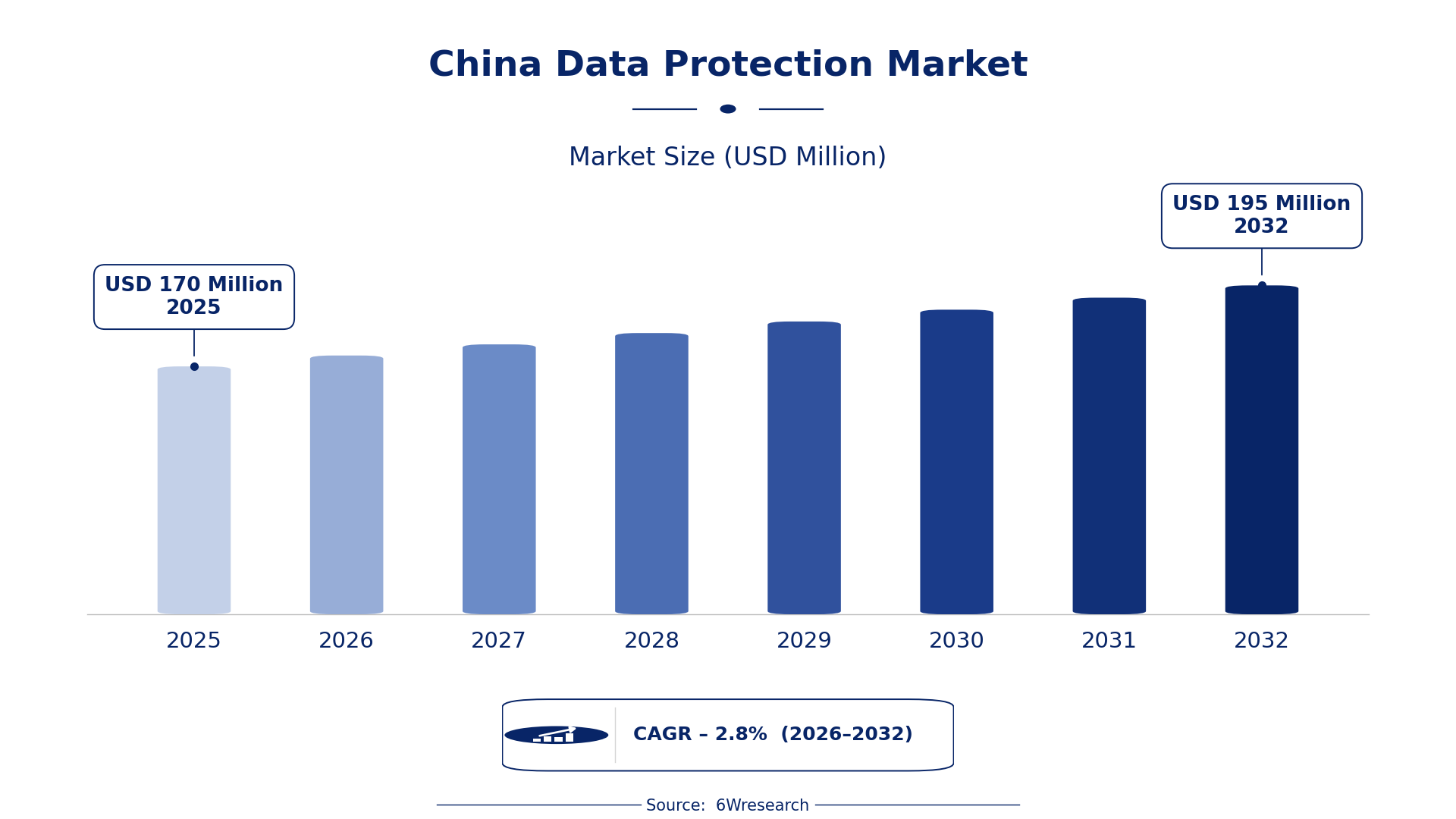
The China Data Protection Market was estimated at USD 170 Million in 2025 and is projected to reach USD 195 Million by 2032, growing at a CAGR of 2.8% from 2026 to 2032.
China Data Protection Market Synopsis
The primary force shaping the China Data Protection Market today is the increasing urgency among organizations to fortify their data security frameworks. As cyber threats multiply and evolve, businesses are compelled to adopt comprehensive data protection measures that ensure compliance and safeguard sensitive information.
In parallel, the stringent regulatory environment driven by government mandates further fuels this market. Laws such as the Cybersecurity Law and the Personal Information Protection Law (PIPL) not only shape operational practices but also stimulate demand for advanced data protection solutions, creating a complex ecosystem of compliance and security needs.
China Data Protection Market Year-wise Growth Rate and Key Drivers
This graph illustrates the annual growth rates of the China Data Protection Market from 2021 to 2032, highlighting a steady upward trajectory and projected expansion over the forecast period.
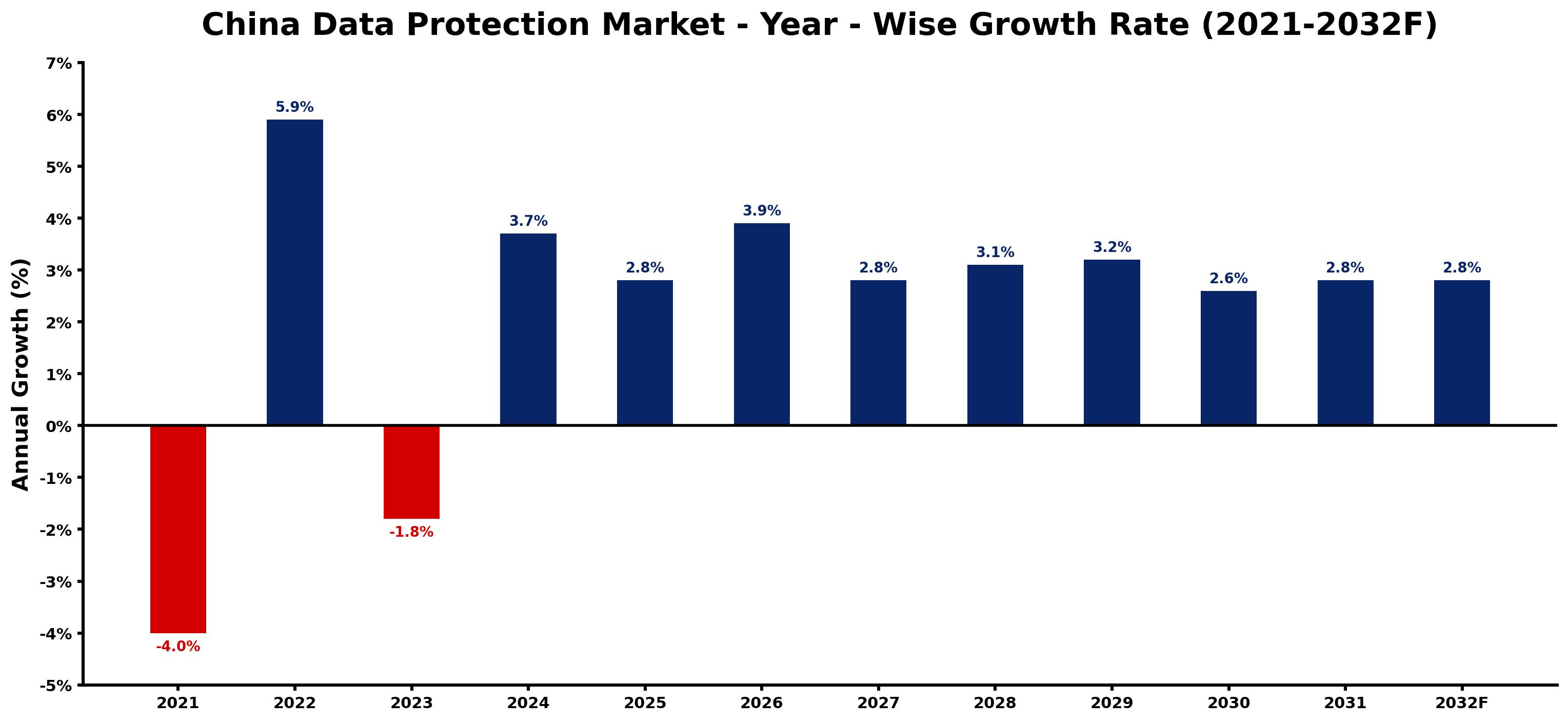
The table below presents the year‑wise growth rates along with the key drivers influencing the market
| Year | Growth Rate | Major Drivers |
| 2021 | -4.0% | Cybersecurity Review Measures hindered new data solutions adoption. |
| 2022 | 5.9% | Implementation of PIPL catalyzing compliance investments. |
| 2023 | -1.8% | Enforcement of Personal Information Protection Law stifled innovation. |
| 2024 | 3.7% | Growing consumer awareness of data privacy issues. |
| 2025 | 2.8% | Increased scrutiny from Cyberspace Administration of China. |
| 2026 | 3.9% | Rise in data breach incidents prompting regulatory responses. |
| 2027 | 2.8% | Escalating digital services requiring enhanced protection measures. |
| 2028 | 3.1% | Regulatory updates enhancing data governance frameworks. |
| 2029 | 3.2% | Growth in cloud services increasing data management demands. |
| 2030 | 2.6% | Emergence of AI technologies necessitating stricter data protocols. |
| 2031 | 2.8% | National privacy campaigns promoting data security awareness. |
| 2032 | 2.8% | Integration of advanced encryption technologies improving safety. |
Note: Market size estimations and growth projections presented in this report are based on 6Wresearch's proprietary forecasting methodology, utilizing the latest available industry data, government publications, and primary research inputs.
China Data Protection Market Key Takeaways
Below are some of the specific key takeaways from the market, including:
- The market is currently valued at USD 170 million and is forecasted to grow steadily through 2032.
- Heightened cyber threats are significantly driving investments in advanced encryption and backup solutions.
- Regulatory compliance is a critical motivator behind the adoption of data protection technologies.
- Organizations are increasingly prioritizing integrated data security strategies covering all data states—at rest, in transit, and in use.
- Technological advancements in data masking and recovery solutions are shaping competitive dynamics in the market.
Evaluation of Restraints in China Data Protection Market
The China Data Protection Market faces real limitations stemming from several factors. A persistent shortage of skilled cybersecurity professionals is making it difficult for organizations to establish robust data protection frameworks. on top of that, the complexity and costs associated with implementing comprehensive solutions often deter smaller businesses from investing adequately. As cyber threats grow more sophisticated, organizations must continually update their systems to fend off attacks, which can be a daunting task amid evolving regulations and resource constraints.
China Data Protection Market Trends
Key trends are emerging in the China Data Protection Market that reflect changing priorities. The integration of Artificial Intelligence (AI) in data security measures is becoming commonplace, enhancing threat detection capabilities. Additionally, there is a notable shift towards cloud-based solutions for data protection, driven by the increasing demand for scalable and efficient storage options. Organizations are also showing a growing interest in multi-layered security approaches that encompass identity management and access controls as part of their data protection strategies.
China Data Protection Market Opportunities
Opportunities abound within the China Data Protection Market as organizations increasingly recognize the need for robust data security measures. With growing awareness of data privacy, there is potential for companies specializing in customized data protection solutions to expand their offerings. The rise of smart technologies and the Internet of Things (IoT) presents further avenues for innovation, particularly in developing solutions that ensure data integrity across interconnected devices. on top of that, increasing public awareness of data breaches can fuel demand for comprehensive protection strategies, making this an opportune time for industry stakeholders to capitalize on market needs.
Government Initiatives in the China Data Protection Market
Government policy is significantly shaping the China Data Protection Market, highlighting the critical need for organizations to enhance their data security protocols. Regulatory frameworks are becoming increasingly rigorous, with a clear emphasis on protecting personal and organizational data. Compliance with these regulations is not just a legal obligation but a competitive necessity in today’s data-driven environment.
- A national Cybersecurity Law enacted in 2017 mandates that organizations must prioritize data protection measures to combat increasing cyber threats.
- Currently underway is the implementation of the Personal Information Protection Law (PIPL), which aims to strengthen data privacy rights for individuals and impose stricter penalties for non-compliance.
- A recently launched initiative encourages public-private partnerships to develop advanced data protection technologies, reflecting the government's commitment to fostering innovation in this sector.
- A planned regulatory update expected in 2026 aims to broaden compliance requirements, emphasizing the need for transparency in data handling practices.
- The establishment of a national data protection awareness campaign is ongoing, designed to educate businesses about compliance and the importance of safeguarding sensitive information.
Future Insights of the China Data Protection Market
Looking towards 2026-2032, the China Data Protection Market is set for steady growth fueled by persistent threats and evolving regulatory requirements. As organizations continue to grapple with sophisticated cyber-attacks, investments in cutting-edge data protection technologies will become imperative. The shift towards cloud solutions and integrated security approaches will likely dominate future strategies, with compliance remaining a primary concern for businesses. In this environment, stakeholders who adapt quickly and embrace innovation are positioned to thrive as the market matures.
China Data Protection Market Latest Developments
In the past year, the China Data Protection Market has experienced significant activity, driven by a heightened focus on cybersecurity and compliance measures. Organizations are increasingly investing in advanced solutions to protect sensitive data, responding to both regulatory pressures and the rising threat landscape.
- A leading technology vendor announced a new data encryption product in Q1 2025, designed to meet the stringent requirements of the PIPL.
- An initiative focused on enhancing cyber threat intelligence capabilities began in early 2025 and remains in active development.
- In early 2026, a major collaboration between several cybersecurity firms is planned to create a new standardized framework for data protection compliance.
- A government-backed project to develop a nationwide data breach response plan is expected to launch in mid-2025, aimed at streamlining how organizations react to security incidents.
- By late 2025, a regional operator will complete its rollout of an upgraded data backup and recovery solution that aligns with new regulatory standards.
China Data Protection Market - Key Attractiveness of the Report
- 10 Years of Market Numbers
- Historical Data Starting from 2022 to 2025
- Base Year: 2025
- Forecast Data until 2032
- Key Performance Indicators Impacting the Market
- Major Upcoming Developments and Projects
Key Highlights of the Report:
- China Data Protection Market Outlook
- Market Size of China Data Protection Market, 2025
- Forecast of China Data Protection Market, 2032
- Historical Data and Forecast of China Data Protection Revenues & Volume for the Period 2022-2032F
- China Data Protection Market Trend Evolution
- China Data Protection Market Drivers and Challenges
- China Data Protection Price Trends
- China Data Protection Porter's Five Forces
- China Data Protection Industry Life Cycle
- Historical Data and Forecast of China Data Protection Market Revenues & Volume By Component for the Period 2022-2032F
- Historical Data and Forecast of China Data Protection Market Revenues & Volume By Solutions for the Period 2022-2032F
- Historical Data and Forecast of China Data Protection Market Revenues & Volume By Services (Professional Services and Managed Services) for the Period 2022-2032F
- Historical Data and Forecast of China Data Protection Market Revenues & Volume By Deployment Mode for the Period 2022-2032F
- Historical Data and Forecast of China Data Protection Market Revenues & Volume By On-premises for the Period 2022-2032F
- Historical Data and Forecast of China Data Protection Market Revenues & Volume By Cloud for the Period 2022-2032F
- Historical Data and Forecast of China Data Protection Market Revenues & Volume By Industry Vertical for the Period 2022-2032F
- Historical Data and Forecast of China Data Protection Market Revenues & Volume By Government and defense for the Period 2022-2032F
- Historical Data and Forecast of China Data Protection Market Revenues & Volume By Banking, Financial Services, and Insurance (BFSI) for the Period 2022-2032F
- Historical Data and Forecast of China Data Protection Market Revenues & Volume By Healthcare for the Period 2022-2032F
- Historical Data and Forecast of China Data Protection Market Revenues & Volume By IT and telecom for the Period 2022-2032F
- Historical Data and Forecast of China Data Protection Market Revenues & Volume By Consumer goods and retail for the Period 2022-2032F
- Historical Data and Forecast of China Data Protection Market Revenues & Volume By Education for the Period 2022-2032F
- Historical Data and Forecast of China Data Protection Market Revenues & Volume By Media and entertainment for the Period 2022-2032F
- Historical Data and Forecast of China Data Protection Market Revenues & Volume By Organization Size Large Enterprises for the Period 2022-2032F
- Historical Data and Forecast of China Data Protection Market Revenues & Volume By SMEs for the Period 2022-2032F
- Historical Data and Forecast of China Data Protection Market Revenues & Volume By Large Enterprises for the Period 2022-2032F
- China Data Protection Import Export Trade Statistics
- Market Opportunity Assessment By Component
- Market Opportunity Assessment By Deployment Mode
- Market Opportunity Assessment By Industry Vertical
- Market Opportunity Assessment By Organization Size Large Enterprises
- China Data Protection Top Companies Market Share
- China Data Protection Competitive Benchmarking By Technical and Operational Parameters
- China Data Protection Company Profiles
- China Data Protection Key Strategic Recommendations






































