China Data Science Platform Market Size & Growth Rate (2026-2032)
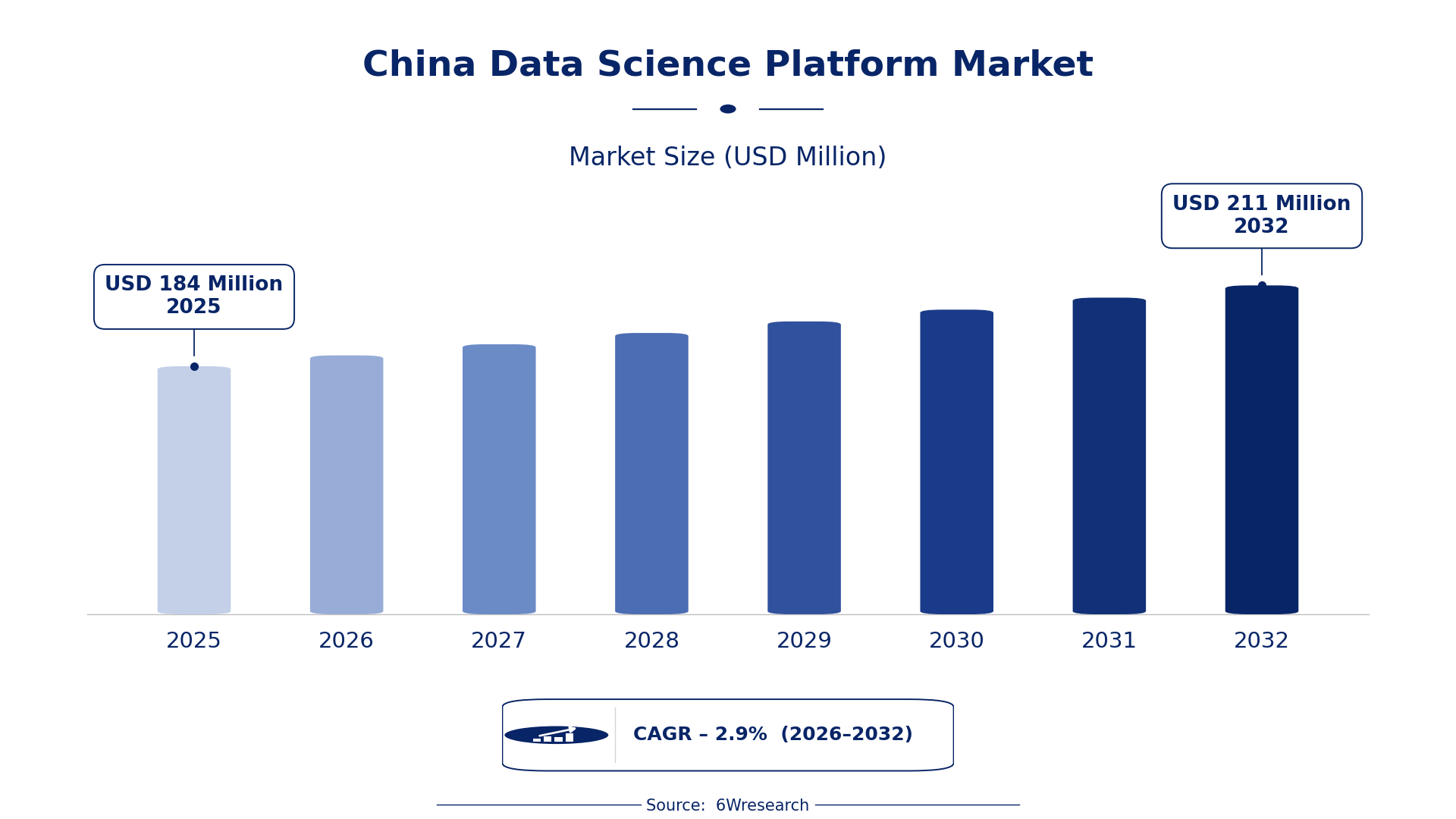
The China Data Science Platform Market was estimated at USD 184 Million in 2025 and is projected to reach USD 211 Million by 2032, growing at a CAGR of 2.9% from 2026 to 2032.
China Data Science Platform Market Synopsis
China's data science platform market is witnessing accelerated growth as companies across various sectors prioritize data-driven methodologies. The proliferation of big data and advancements in artificial intelligence are propelling organizations to seek sophisticated analytics tools that enhance decision-making and operational efficiency.
With a marked increase in data volumes, businesses are not just collecting information but are also focused on extracting actionable insights. This shift is fostering a competitive environment where companies that harness data science effectively are likely to outperform their peers.
China Data Science Platform Market Year-wise Growth Rate and Key Drivers
This graph illustrates the annual growth rates of the China Data Science Platform Market from 2021 to 2032, highlighting a steady upward trajectory and projected expansion over the forecast period.
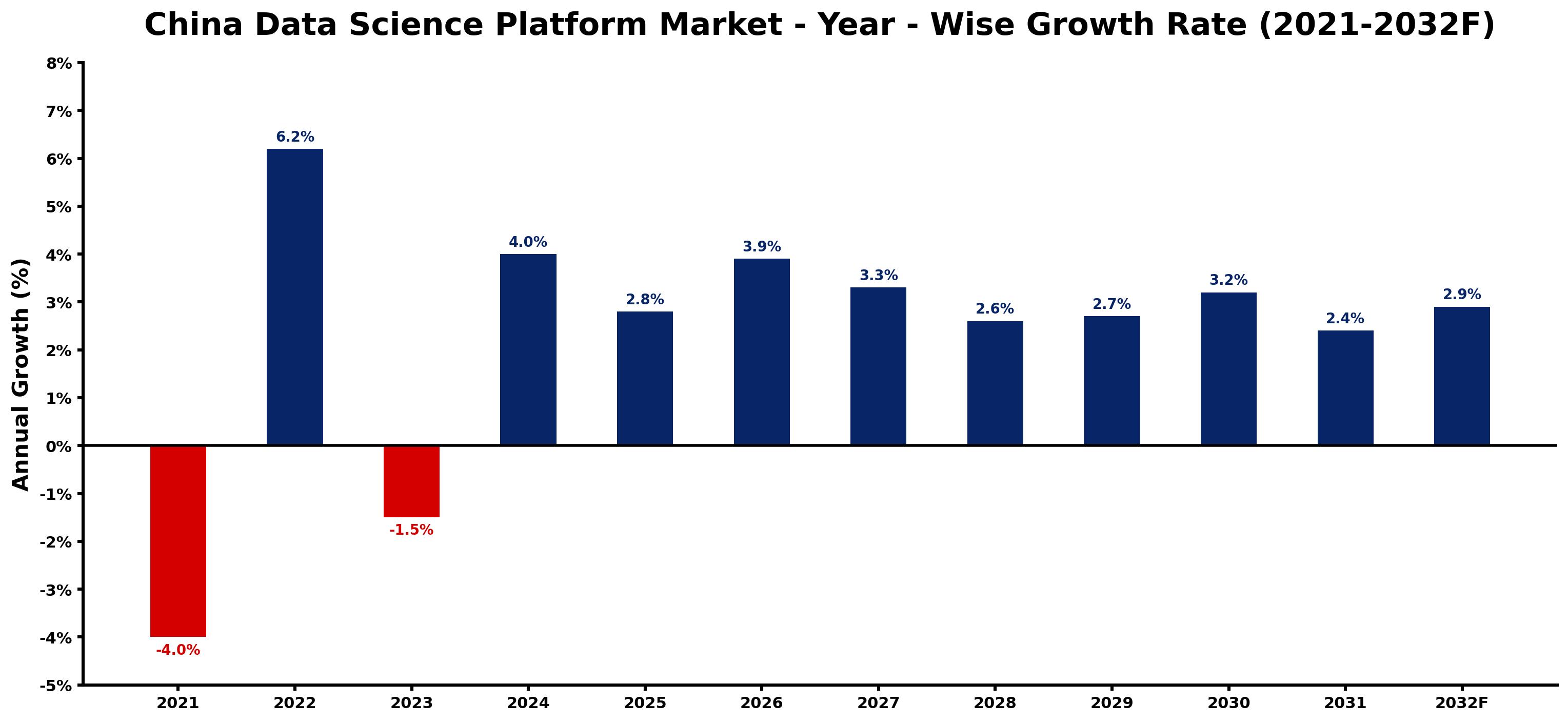
The table below presents the year‑wise growth rates along with the key drivers influencing the market
| Year | Growth Rate | Major Drivers |
| 2021 | -4.0% | Chinese government limits foreign data tools sales. |
| 2022 | 6.2% | National policies promoting AI innovation in industries. |
| 2023 | -1.5% | Data security laws restrict platform operations in China. |
| 2024 | 4.0% | Increased investment in smart city data platforms. |
| 2025 | 2.8% | Growth of e-commerce analytics driving data solutions. |
| 2026 | 3.9% | Government initiatives focusing on digital transformation skills. |
| 2027 | 3.3% | Rise in healthcare data analytics requirements. |
| 2028 | 2.6% | Boost from local tech startups enhancing data services. |
| 2029 | 2.7% | Demand for big data in supply chain management. |
| 2030 | 3.2% | Regulatory frameworks encouraging data sharing among firms. |
| 2031 | 2.4% | Emerging market for smart manufacturing data tools. |
| 2032 | 2.9% | Expanding population demanding enhanced urban data analytics. |
Note: Market size estimations and growth projections presented in this report are based on 6Wresearch's proprietary forecasting methodology, utilizing the latest available industry data, government publications, and primary research inputs.
China Data Science Platform Market Key Takeaways
Below are some of the specific key takeaways from the market, including:
- Strong growth driven by the increasing volume of data and the demand for advanced analytics.
- Innovative tools and technologies are enhancing user experience and analytical capabilities.
- Government initiatives are fostering an environment conducive to data science adoption.
- Challenges remain, particularly the shortage of skilled professionals in the data science field.
- Investment opportunities are emerging in sectors focused on AI and machine learning integration.
Evaluation of Restraints in China Data Science Platform Market
Despite the promising outlook, the China Data Science Platform Market faces notable constraints. A critical challenge is the shortage of qualified data scientists and analysts. This skills gap hinders organizations from fully utilizing the capabilities of data science platforms. on top of that, the rapid pace of technological change demands continuous training and adaptation, which can be resource-intensive for companies. Additionally, many organizations struggle with integrating these platforms into their existing IT ecosystems, raising issues related to compatibility and security.
China Data Science Platform Market Trends
A few trends are distinctly shaping the data science platform market in China. First, the move toward cloud-based solutions is gaining momentum, as organizations seek scalable and flexible platforms for data analytics. Simultaneously, the integration of machine learning and AI capabilities into data science platforms is enhancing predictive analytics, allowing businesses to make informed decisions swiftly. User-friendly interfaces are also becoming increasingly important, as they empower non-technical users to engage with data effectively.
China Data Science Platform Market Opportunities
The market is ripe for investment, particularly in areas where organizations are looking to enhance their data analytics capabilities. Industries such as healthcare, finance, and retail are increasingly adopting data science solutions to improve operational efficiencies and customer experiences. on top of that, the rise of IoT devices is generating massive amounts of data, creating opportunities for platforms that can handle real-time analytics. Startups focusing on niche applications of data science also represent a growing segment worth exploring.
Government Initiatives in the China Data Science Platform Market
Government policy plays a significant role in shaping the China Data Science Platform Market. The Chinese government actively promotes digital transformation and the adoption of advanced technologies across various sectors. This policy support is crucial for fostering innovation and enhancing the capabilities of data science platforms in the country.
- A national digital infrastructure upgrade programme recently launched to enhance connectivity and data handling capabilities across industries.
- Ongoing initiatives to establish research and development centers focused on artificial intelligence and big data analytics.
- A regulatory framework introduced in 2025 to standardize data usage and enhance security measures for data science applications.
- Plans for a public-private partnership initiative expected to launch in 2026, aimed at supporting startups in the data science sector.
- Investment in educational programs to upskill the workforce in data science and analytics, enhancing the talent pool for future growth.
Future Insights of the China Data Science Platform Market
Looking ahead to 2026-2032, the China Data Science Platform Market is set for steady growth. The increasing reliance on data-driven strategies across industries will likely continue to fuel demand for robust data analytics solutions. As companies become more adept at harnessing data insights, platforms that offer advanced capabilities and ease of use will gain traction. on top of that, as government support for innovation persists, the market will attract new players and investments, creating a dynamic environment ripe for further evolution.
China Data Science Platform Market Latest Developments
In the past year, there has been a noticeable uptick in activities within the China Data Science Platform Market. Companies are increasingly prioritizing investments in data analytics technologies, driven by the need for enhanced decision-making and operational efficiency. The focus on integrating AI and machine learning capabilities into platforms is particularly pronounced.
- A leading technology vendor launched a new data science platform in Q1 2025, featuring enhanced machine learning capabilities and user-friendly interfaces.
- An ongoing initiative by a major regional operator aims to develop a comprehensive analytics solution tailored for the retail sector, enhancing customer engagement.
- A partnership formed in mid-2025 between two firms to create a joint data analytics platform designed for real-time processing of big data.
- A rollout expected to begin in late 2026 will introduce government-backed training programs for data scientists in several key cities.
- Plans for a major conference in early 2026 will focus on data science innovation, gathering industry leaders to discuss emerging trends and technologies.
China Data Science Platform Market - Key Attractiveness of the Report
- 10 Years of Market Numbers
- Historical Data Starting from 2022 to 2025
- Base Year: 2025
- Forecast Data until 2032
- Key Performance Indicators Impacting the Market
- Major Upcoming Developments and Projects
Key Highlights of the Report:
- China Data Science Platform Market Outlook
- Market Size of China Data Science Platform Market, 2025
- Forecast of China Data Science Platform Market, 2032
- Historical Data and Forecast of China Data Science Platform Revenues & Volume for the Period 2022-2032F
- China Data Science Platform Market Trend Evolution
- China Data Science Platform Market Drivers and Challenges
- China Data Science Platform Price Trends
- China Data Science Platform Porter's Five Forces
- China Data Science Platform Industry Life Cycle
- Historical Data and Forecast of China Data Science Platform Market Revenues & Volume By Component for the Period 2022-2032F
- Historical Data and Forecast of China Data Science Platform Market Revenues & Volume By Platform for the Period 2022-2032F
- Historical Data and Forecast of China Data Science Platform Market Revenues & Volume By Services for the Period 2022-2032F
- Historical Data and Forecast of China Data Science Platform Market Revenues & Volume By Support and maintenance for the Period 2022-2032F
- Historical Data and Forecast of China Data Science Platform Market Revenues & Volume By Consulting for the Period 2022-2032F
- Historical Data and Forecast of China Data Science Platform Market Revenues & Volume By Deployment and Integration for the Period 2022-2032F
- Historical Data and Forecast of China Data Science Platform Market Revenues & Volume By Business Function for the Period 2022-2032F
- Historical Data and Forecast of China Data Science Platform Market Revenues & Volume By Marketing for the Period 2022-2032F
- Historical Data and Forecast of China Data Science Platform Market Revenues & Volume By Sales for the Period 2022-2032F
- Historical Data and Forecast of China Data Science Platform Market Revenues & Volume By Logistics for the Period 2022-2032F
- Historical Data and Forecast of China Data Science Platform Market Revenues & Volume By Finance and Accounting for the Period 2022-2032F
- Historical Data and Forecast of China Data Science Platform Market Revenues & Volume By Customer Support for the Period 2022-2032F
- Historical Data and Forecast of China Data Science Platform Market Revenues & Volume By Other Business Functions (HR and operations) for the Period 2022-2032F
- Historical Data and Forecast of China Data Science Platform Market Revenues & Volume By Deployment Mode for the Period 2022-2032F
- Historical Data and Forecast of China Data Science Platform Market Revenues & Volume By Cloud for the Period 2022-2032F
- Historical Data and Forecast of China Data Science Platform Market Revenues & Volume By On-premises for the Period 2022-2032F
- Historical Data and Forecast of China Data Science Platform Market Revenues & Volume By Industry Vertical for the Period 2022-2032F
- Historical Data and Forecast of China Data Science Platform Market Revenues & Volume By BFSI for the Period 2022-2032F
- Historical Data and Forecast of China Data Science Platform Market Revenues & Volume By Retail and eCommerce for the Period 2022-2032F
- Historical Data and Forecast of China Data Science Platform Market Revenues & Volume By Telecom and IT for the Period 2022-2032F
- Historical Data and Forecast of China Data Science Platform Market Revenues & Volume By Media and Entertainment for the Period 2022-2032F
- Historical Data and Forecast of China Data Science Platform Market Revenues & Volume By Healthcare and Life Sciences for the Period 2022-2032F
- Historical Data and Forecast of China Data Science Platform Market Revenues & Volume By Government and Defense for the Period 2022-2032F
- Historical Data and Forecast of China Data Science Platform Market Revenues & Volume By Manufacturing for the Period 2022-2032F
- Historical Data and Forecast of China Data Science Platform Market Revenues & Volume By Transportation and Logistics for the Period 2022-2032F
- Historical Data and Forecast of China Data Science Platform Market Revenues & Volume By Organization Size for the Period 2022-2032F
- Historical Data and Forecast of China Data Science Platform Market Revenues & Volume By Small and Medium-Sized Enterprises for the Period 2022-2032F
- Historical Data and Forecast of China Data Science Platform Market Revenues & Volume By Large Enterprises for the Period 2022-2032F
- China Data Science Platform Import Export Trade Statistics
- Market Opportunity Assessment By Component
- Market Opportunity Assessment By Business Function
- Market Opportunity Assessment By Deployment Mode
- Market Opportunity Assessment By Industry Vertical
- Market Opportunity Assessment By Organization Size
- China Data Science Platform Top Companies Market Share
- China Data Science Platform Competitive Benchmarking By Technical and Operational Parameters
- China Data Science Platform Company Profiles
- China Data Science Platform Key Strategic Recommendations






































