China Database Security Market Size & Growth Rate (2026-2032)
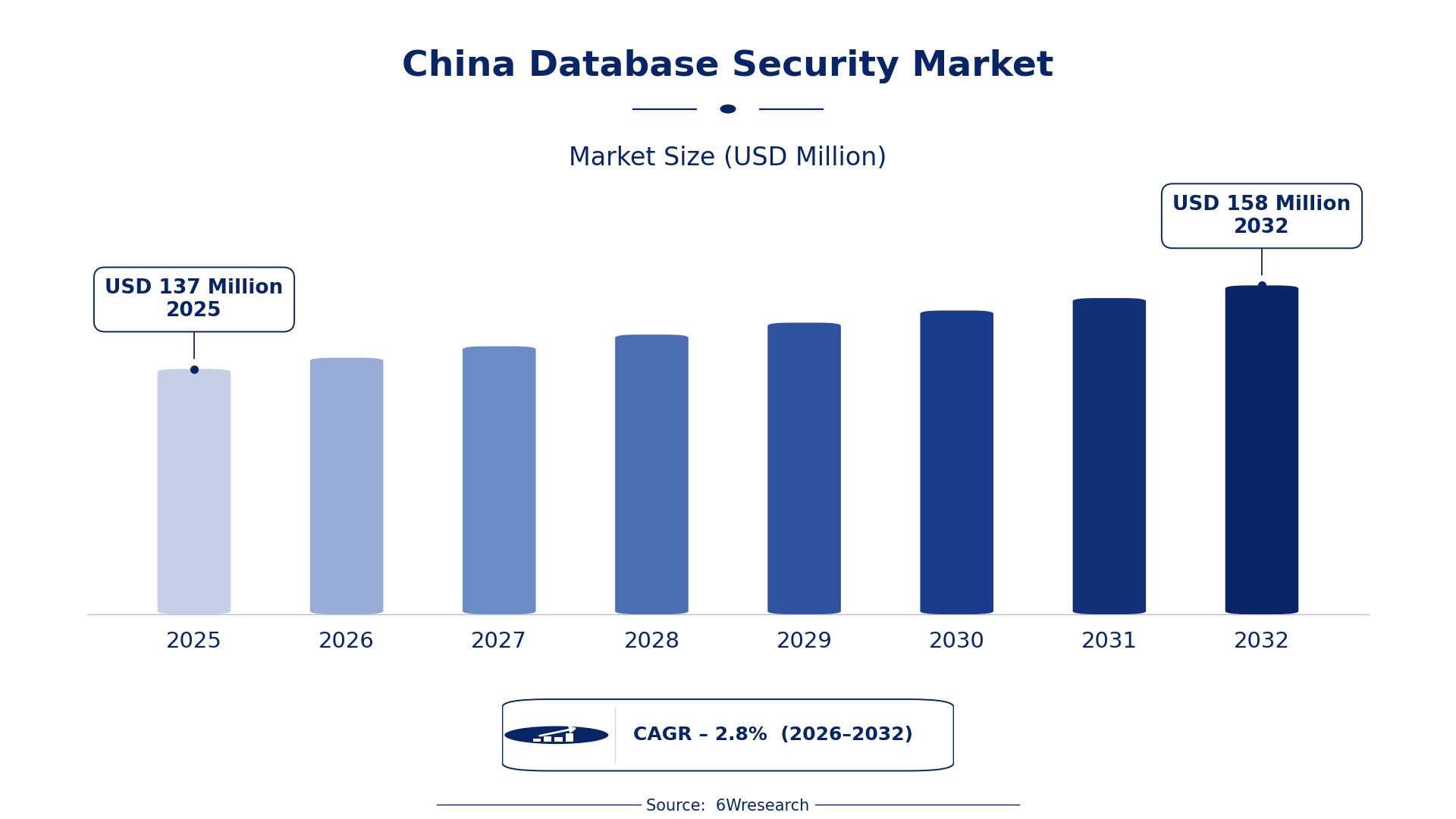
The China Database Security Market was estimated at USD 137 Million in 2025 and is projected to reach USD 158 Million by 2032, growing at a CAGR of 2.8% from 2026 to 2032.
China Database Security Market Synopsis
The urgency for robust database security in China has never been clearer. As organizations generate more data, their exposure to risks from cyber threats escalates. This has pushed companies to invest heavily in security solutions aimed at protecting sensitive information from a variety of malicious actors.
The landscape of database security technologies is marked by innovations such as advanced encryption and vigilant access controls. These measures are essential as firms strive to meet strict regulatory standards and safeguard against increasingly sophisticated cyberattacks.
China Database Security Market Year-wise Growth Rate and Key Drivers
This graph illustrates the annual growth rates of the China Database Security Market from 2021 to 2032, highlighting a steady upward trajectory and projected expansion over the forecast period.
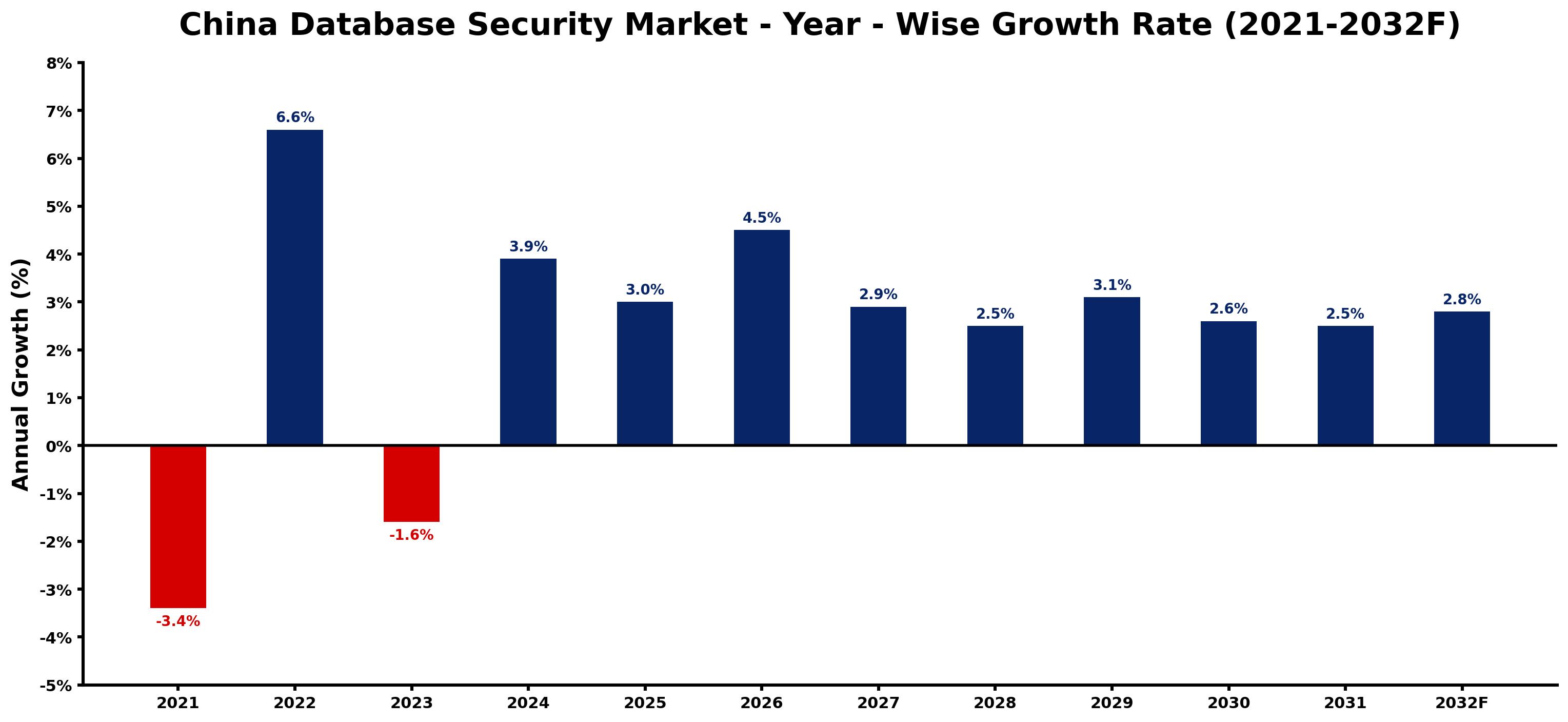
The table below presents the year‑wise growth rates along with the key drivers influencing the market
| Year | Growth Rate | Major Drivers |
| 2021 | -3.4% | Cybersecurity Law compliance costs increased for local firms. |
| 2022 | 6.6% | Implementation of stricter data protection regulations by CAC |
| 2023 | -1.6% | Weak demand from large tech companies like Alibaba. |
| 2024 | 3.9% | Increased investment in AI-driven cybersecurity solutions |
| 2025 | 3.0% | Growing concern over data breaches in financial sector |
| 2026 | 4.5% | Rise of digital healthcare services necessitating database security |
| 2027 | 2.9% | Government push for data localization enhancing security needs |
| 2028 | 2.5% | Emergence of 5G technology increases data vulnerability risks |
| 2029 | 3.1% | Surge in remote working demands secure database access |
| 2030 | 2.6% | Continued growth in online education increasing data sensitivity |
| 2031 | 2.5% | Enhanced cybersecurity training programs promoting database security awareness |
| 2032 | 2.8% | Increasing cross-border data transfer agreements requiring compliance |
Note: Market size estimations and growth projections presented in this report are based on 6Wresearch's proprietary forecasting methodology, utilizing the latest available industry data, government publications, and primary research inputs.
China Database Security Market Key Takeaways
Below are some of the specific key takeaways from the market, including:
- Organizations are prioritizing database security due to the rising frequency of data breaches.
- Compliance with regulations like the Cybersecurity Law is shaping security strategy.
- Innovations in encryption and monitoring technologies are driving market growth.
- Firms face challenges in managing diverse security measures across multiple platforms.
- Regulatory pressures are pushing for more comprehensive security solutions.
Evaluation of Restraints in China Database Security Market
The database security market in China confronts notable obstacles that limit its growth. The rapid sophistication of cyberattacks requires organizations to continuously upgrade their defenses, leading to increased costs and resource allocation. Many companies struggle to keep pace with the evolving threat landscape while also managing security protocols across multiple databases and platforms. This complexity demands a strategic approach, one that encompasses not only technology but also personnel training and awareness.
China Database Security Market Trends
Organizations are increasingly shifting toward integrated security solutions that encompass both physical and digital aspects. The demand for real-time monitoring tools is surging, as businesses recognize the need for immediate threat detection and response. Additionally, the emphasis on data sovereignty and compliance with local regulations is prompting businesses to invest in localized security solutions that address specific market needs.
China Database Security Market Opportunities
As the market continues to grow, several key areas present lucrative opportunities. The rise in cloud adoption creates a demand for security solutions tailored to protect data in cloud environments. on top of that, advancements in artificial intelligence and machine learning are enabling more sophisticated security measures, offering companies the chance to enhance their data protection strategies. As organizations seek ways to innovate while remaining compliant, there will be an increasing need for customized security solutions.
Government Initiatives in the China Database Security Market
The Chinese government's commitment to enhancing cybersecurity is pivotal for shaping the Database Security market. Stringent regulations have been enacted to protect personal information and bolster data security across sectors. This regulatory framework has driven companies to prioritize investment in advanced database security solutions, as compliance becomes a prerequisite for operational viability.
- A regulatory framework introduced in 2021 mandates the adoption of enhanced database security measures in all sectors.
- Current initiatives focus on developing nationwide standards for database encryption and data access controls.
- A planned public-private initiative aimed at improving cybersecurity infrastructure is expected to launch by 2026.
- Recently completed training programs for organizations on compliance with the Personal Information Protection Law (PIPL) have increased awareness.
- Government audits of database security practices are currently underway to ensure adherence to new regulations.
Future Insights of the China Database Security Market
Looking ahead to 2026-2032, the China Database Security market will likely see significant shifts. As data volumes continue to soar, coupled with increasing cyber threats, the demand for advanced security measures will only rise. Companies that embrace emerging technologies such as artificial intelligence for predictive threat modeling will be in a strong position to safeguard their assets. This proactive approach, combined with ongoing regulatory compliance, will define the competitive landscape in the years to come.
China Database Security Market Latest Developments
In the past year, the China Database Security market has experienced substantial activity as companies race to strengthen their data protection protocols. With the government's push for compliance, organizations are ramping up their investments in innovative technologies to enhance their database security postures.
- A major technology vendor launched a new database encryption solution in early 2025, aimed at small to medium enterprises.
- A collaborative project between several tech firms to develop real-time monitoring systems is currently underway, expected to enhance threat detection capabilities.
- An initiative designed to update cybersecurity training standards for professionals was announced in Q3 2025, aimed at improving workforce readiness.
- A planned rollout for a national cybersecurity awareness campaign is set to begin in the second half of 2026.
- New partnerships between database solution providers and cloud service platforms are expected to be finalized by late 2025, enhancing security capabilities.
China Database Security Market - Key Attractiveness of the Report
- 10 Years of Market Numbers
- Historical Data Starting from 2022 to 2025
- Base Year: 2025
- Forecast Data until 2032
- Key Performance Indicators Impacting the Market
- Major Upcoming Developments and Projects
Key Highlights of the Report:
- China Database Security Market Outlook
- Market Size of China Database Security Market, 2025
- Forecast of China Database Security Market, 2032
- Historical Data and Forecast of China Database Security Revenues & Volume for the Period 2022-2032F
- China Database Security Market Trend Evolution
- China Database Security Market Drivers and Challenges
- China Database Security Price Trends
- China Database Security Porter's Five Forces
- China Database Security Industry Life Cycle
- Historical Data and Forecast of China Database Security Market Revenues & Volume By Component for the Period 2022-2032F
- Historical Data and Forecast of China Database Security Market Revenues & Volume By Solution for the Period 2022-2032F
- Historical Data and Forecast of China Database Security Market Revenues & Volume By Services for the Period 2022-2032F
- Historical Data and Forecast of China Database Security Market Revenues & Volume By Business function for the Period 2022-2032F
- Historical Data and Forecast of China Database Security Market Revenues & Volume By Marketing for the Period 2022-2032F
- Historical Data and Forecast of China Database Security Market Revenues & Volume By sales for the Period 2022-2032F
- Historical Data and Forecast of China Database Security Market Revenues & Volume By finance for the Period 2022-2032F
- Historical Data and Forecast of China Database Security Market Revenues & Volume By operations for the Period 2022-2032F
- Historical Data and Forecast of China Database Security Market Revenues & Volume By Organization Size for the Period 2022-2032F
- Historical Data and Forecast of China Database Security Market Revenues & Volume By Large Enterprises for the Period 2022-2032F
- Historical Data and Forecast of China Database Security Market Revenues & Volume By SMEs for the Period 2022-2032F
- Historical Data and Forecast of China Database Security Market Revenues & Volume By Deployment Mode for the Period 2022-2032F
- Historical Data and Forecast of China Database Security Market Revenues & Volume By Cloud for the Period 2022-2032F
- Historical Data and Forecast of China Database Security Market Revenues & Volume By On-premises for the Period 2022-2032F
- Historical Data and Forecast of China Database Security Market Revenues & Volume By Vertical for the Period 2022-2032F
- Historical Data and Forecast of China Database Security Market Revenues & Volume By Banking, Financial Services, And Insurance for the Period 2022-2032F
- Historical Data and Forecast of China Database Security Market Revenues & Volume By Telecommunication and IT for the Period 2022-2032F
- Historical Data and Forecast of China Database Security Market Revenues & Volume By Government and Defense for the Period 2022-2032F
- Historical Data and Forecast of China Database Security Market Revenues & Volume By Manufacturing for the Period 2022-2032F
- Historical Data and Forecast of China Database Security Market Revenues & Volume By Healthcare and life sciences for the Period 2022-2032F
- Historical Data and Forecast of China Database Security Market Revenues & Volume By Retail and Ecommerce for the Period 2022-2032F
- Historical Data and Forecast of China Database Security Market Revenues & Volume By Energy and Utilities for the Period 2022-2032F
- China Database Security Import Export Trade Statistics
- Market Opportunity Assessment By Component
- Market Opportunity Assessment By Business function
- Market Opportunity Assessment By Organization Size
- Market Opportunity Assessment By Deployment Mode
- Market Opportunity Assessment By Vertical
- China Database Security Top Companies Market Share
- China Database Security Competitive Benchmarking By Technical and Operational Parameters
- China Database Security Company Profiles
- China Database Security Key Strategic Recommendations






































