China Deep Transcranial Magnetic Stimulation (DTMS) Device Market (2026-2032) | Forecast, Share, Segmentation, Size & Revenue, Industry, Outlook, Trends, Competitive Landscape, Companies, Growth, Value, Analysis
Market Forecast By Type (Deep Transcranial Magnetic Stimulator (dTMS), Repetitive Transcranial Magnetic Stimulator (rTMS)), By Application (AlzheimersDisease, Depression, ParkinsonsDisease, Epilepsy), By End Use (Research, Diagnostics, Therapeutics) And Competitive Landscape
| Product Code: ETC6741176 | Publication Date: Sep 2024 | Updated Date: Apr 2026 | Product Type: Market Research Report | |
| Publisher: 6Wresearch | Author: Sumit Sagar | No. of Pages: 75 | No. of Figures: 35 | No. of Tables: 20 |
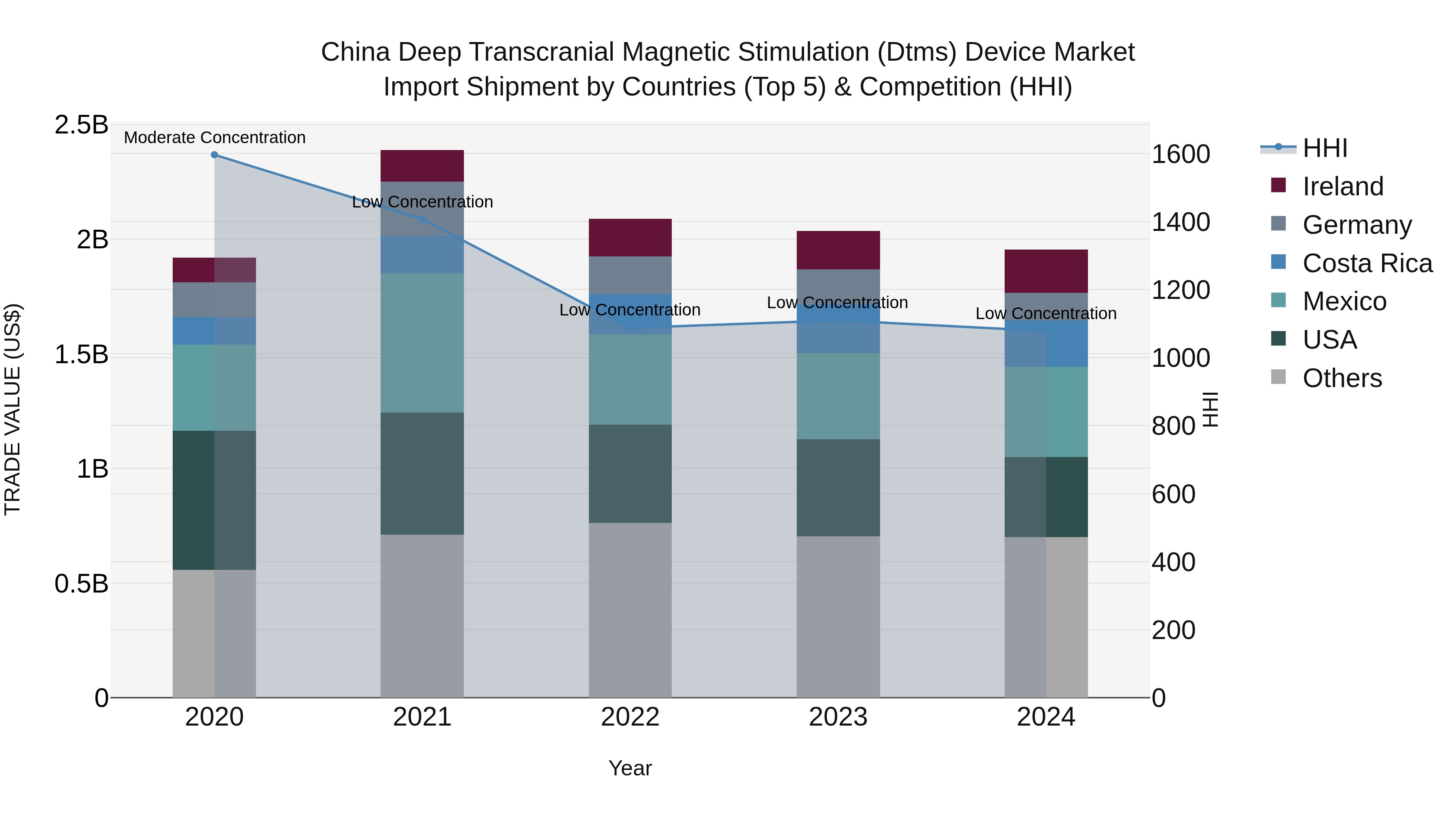
China Deep Transcranial Magnetic Stimulation (Dtms) Device Market Top 5 Importing Countries and Market Competition (HHI) Analysis
In 2024, China saw a steady increase in deep transcranial magnetic stimulation (DTMS) device imports, with top exporting countries being Mexico, USA, Costa Rica, Ireland, and Japan. Despite the slight decline in growth rate from 2023 to 2024, the Herfindahl-Hirschman Index (HHI) remained at low concentration levels, indicating a competitive market landscape. The compound annual growth rate (CAGR) from 2020 to 2024 was 0.45%, reflecting a stable upward trend in import volumes. This data suggests a continued interest and demand for DTMS devices in the Chinese market.
China Deep Transcranial Magnetic Stimulation Device Market Growth Rate
According to 6Wresearch internal database and industry insights, the China Deep Transcranial Magnetic Stimulation Device Market is projected to grow at a compound annual growth rate (CAGR) of 9.4% during the forecast period (2026-2032).
Topics Covered in the China Deep Transcranial Magnetic Stimulation Device Market Report
The China Deep Transcranial Magnetic Stimulation Device Market report thoroughly covers the market by type, application, and end use. The market report provides an unbiased and detailed analysis of ongoing market trends, opportunities/high growth areas, and market drivers, which help stakeholders devise and align their market strategies according to the current and future market dynamics.
China Deep Transcranial Magnetic Stimulation Device Market Highlights
| Report Name | China Deep Transcranial Magnetic Stimulation Device Market |
| Forecast period | 2026-2032 |
| CAGR | 9.4% |
| Growing Sector | Therapeutics |
China Deep Transcranial Magnetic Stimulation Device Market Synopsis
China Deep Transcranial Magnetic Stimulation Device Market is anticipated to record strong growth owing to the increasing prevalence of neurological and psychiatric disorders, rising awareness of non-invasive treatment methods, and rapid expansion of advanced healthcare technologies. The demand for dTMS devices is increasing with growing interest in improving mental health conditions with innovative therapies. Furthermore, healthcare reforms with government support and investments in neurotechnology research are helping to promote dTMS device usage in hospitals and clinics in China.
Evaluation of Growth Drivers in the China Deep Transcranial Magnetic Stimulation Device Market
Below mentioned are some prominent drivers and their influence on the market dynamics:
| Drivers | Primary Segments Affected | Why it Matters (Evidence) |
| Rising Mental Health Awareness | dTMS; Therapeutics | Increasing diagnosis of depression and anxiety boosts demand for advanced therapies. |
| Expansion of Neurology Clinics | rTMS; Diagnostics & Therapeutics | More specialized centers provide more access to neuromodulation therapy. |
| Technological Advancements in Devices | dTMS; Research | Better device efficiency increases the rate of successful clinical trials. |
| Government Healthcare Reforms | All Types; Hospitals | Government support of mental healthcare fuels infrastructure development. |
| Growing Aging Population | dTMS & rTMS; Therapeutics | Higher incidence of neurological disorders increases treatment demand. |
China Deep Transcranial Magnetic Stimulation Device Market is expected to grow at the CAGR of 9.4% during the forecast period of 2026-2032. The market is growing due to the rising burden of neurological disorders, which includes depression, Parkinson’s disease, and Alzheimer’s disease. Furthermore, there is a growing trend towards using non-invasive treatment solutions. The rising healthcare infrastructure and increased investments in neurotechnology research are also contributing to the adoption of neurology devices. The presence of local players and their association with global players also add value to the accessibility of neurology devices. Government initiatives towards mental health also contribute to the rising diagnosis rate, thus driving the market.
Evaluation of Restraints in the China Deep Transcranial Magnetic Stimulation Device Market
Below mentioned are some major restraints and their influence on the market dynamics:
| Restraints | Primary Segments Affected | What This Means (Evidence) |
| High Device Costs | dTMS; Therapeutics | Expensive equipment limits adoption in smaller healthcare facilities. |
| Limited Skilled Professionals | All Types; Hospitals | Lack of trained specialists restricts proper device utilization. |
| Regulatory Approval Delays | rTMS; Research | Lengthy approval processes slow product commercialization. |
| Low Awareness in Rural Areas | All Types; Diagnostics | Limited knowledge reduces early adoption of advanced treatments. |
| Maintenance and Operational Costs | dTMS; Clinics | High upkeep costs impact long-term affordability for clinics. |
China Deep Transcranial Magnetic Stimulation Device Industry Challenges
Irrespective of massive growth and development, the China Deep Transcranial Magnetic Stimulation Device Industry is facing some issues like high investment costs, uneven distribution of advanced healthcare facilities in rural and urban areas, and the lack of trained professionals in hospitals to effectively operate these sophisticated machines. In addition, there are issues related to the regulation and approval processes, which may affect the timely availability of new products in the market. Further, there is a concern related to the cost factor, which may affect small clinics and patients, and awareness related to non-invasive brain treatments, which may affect the growth of the China Deep Transcranial Magnetic Stimulation Device Industry in different regions.
China Deep Transcranial Magnetic Stimulation Device Market Trends
Key trends shaping the China Deep Transcranial Magnetic Stimulation Device Market Growth include:
- Increase in Adoption of Non-Invasive Therapies: Healthcare service providers are increasingly using non-invasive treatment options like dTMS, as it has fewer side effects and provides greater patient comfort.
- Integration of AI in Neurostimulation Devices: The latest neurostimulation devices have started using artificial intelligence technology, which provides more precise treatment and personalization of therapy sessions.
- Hospital-Based Neurology Departments: Large hospitals have started increasing their neurology and psychiatry departments, providing more therapy options to patients. This expansion is driving higher installation rates of dTMS devices across urban healthcare centers.
- Collaborations Between Research Institutes and Manufacturers: Partnerships are increasing between academic institutions and device manufacturers to improve product innovation. Collaborations of this kind accelerate clinical trials and improve the effectiveness of devices.
Investment Opportunities in the China Deep Transcranial Magnetic Stimulation Device Market
Key areas attracting investment in the China Deep Transcranial Magnetic Stimulation Device Market include:
- Expansion of Neurology Treatment Centers – Investors are focusing on establishing specialized neurology and psychiatric centers equipped with advanced dTMS devices. This helps improve access to innovative therapies across major cities.
- Local Manufacturing of Neurostimulation Devices – Setting up domestic manufacturing units can reduce dependency on imports and lower costs. This creates opportunities for both domestic and international players to expand production capabilities.
- Research and Development in Neurotechnology – Increased funding for R&D activities is enabling the development of more efficient and affordable devices. This also enhances China’s position as a hub for neurotechnology innovation.
Top 5 Leading Players in the China Deep Transcranial Magnetic Stimulation Device Market
Some leading players operating in the China Deep Transcranial Magnetic Stimulation Device Market include:
1. BrainsWay Ltd.
| Company Name | BrainsWay Ltd. |
| Established Year | 2003 |
| Headquarters | Jerusalem, Israel |
| Official Website | Click Here |
BrainsWay specializes in deep transcranial magnetic stimulation systems designed for treating depression and neurological disorders. The company focuses on innovative coil designs and clinical research to enhance treatment effectiveness and expand its presence in global healthcare markets including China.
2. MagVenture A/S
| Company Name | MagVenture A/S |
| Established Year | 1992 |
| Headquarters | Farum, Denmark |
| Official Website | Click Here |
MagVenture develops advanced transcranial magnetic stimulation devices used in both research and clinical applications. Its products are widely adopted in psychiatric and neurological treatments, offering precision therapy solutions.
3. Neurosoft Ltd.
| Company Name | Neurosoft Ltd. |
| Established Year | 1992 |
| Headquarters | Ivanovo, Russia |
| Official Website | Click Here |
Neurosoft provides a range of neurodiagnostic and neurostimulation equipment, including TMS systems. The company focuses on affordability and accessibility, making its devices suitable for expanding healthcare infrastructure in emerging markets like China.
4. Nexstim Plc
| Company Name | Nexstim Plc |
| Established Year | 2000 |
| Headquarters | Helsinki, Finland |
| Official Website | Click Here |
Nexstim offers navigated brain stimulation systems that enhance treatment accuracy for neurological conditions. Its advanced technology supports personalized therapy approaches, making it a key player in the growing Chinese neurostimulation market.
5. Yiruide Medical Equipment Co., Ltd.
| Company Name | Yiruide Medical Equipment Co., Ltd. |
| Established Year | 2000 |
| Headquarters | Wuhan, China |
| Official Website | Click Here |
Yiruide is a domestic manufacturer specializing in rehabilitation and neurostimulation devices. The company plays a crucial role in supplying cost-effective TMS solutions within China, supporting broader adoption across hospitals and research institutions.
Government Regulations Introduced in the China Deep Transcranial Magnetic Stimulation Device Market
According to China’s Government Data, multiple initiatives have been introduced to strengthen neurological healthcare and promote the adoption of advanced medical devices. For instance, the Healthy China 2030 plan focuses on mental health awareness and the adoption of innovative medical technologies in the treatment of mental disorders. Secondly, there has been a facilitation of approval processes for advanced medical equipment, thus allowing a quicker market rollout of TMS technology. There is also financial support being offered to public hospitals, which has helped in the upgrade of facilities, thus increasing accessibility in both urban and semi-urban regions.
Future Insights of the China Deep Transcranial Magnetic Stimulation Device Market
The China Deep Transcranial Magnetic Stimulation Device Market is expected to witness sustained growth This is due to increased investments in healthcare infrastructure and constant improvements in neurotechnology. The increase in the occurrence of neurological disorders, as well as the acceptance of non-invasive treatments, will also contribute to the increased adoption of devices in hospitals and clinics. Additionally, the continued support from governments in mental health programs and funding will further increase innovations in the field.
Market Segmentation Analysis
The report offers a comprehensive study of the subsequent market segments and their leading categories.
Deep Transcranial Magnetic Stimulator (dTMS) to Dominate the Market – By Type
According to Rahul, Senior Research Analyst, 6Wresearch, the Deep Transcranial Magnetic Stimulator (dTMS) category captures the highest market share in the China Deep Transcranial Magnetic Stimulation Device Market, primarily due to its effectiveness in treating depression and neurological disorders. The dominance of this segment can be attributed to the superior efficacy of this device in penetrating deeper into the brain, making it highly effective for treating various neurological and psychiatric disorders such as depression and Parkinson’s disease. Furthermore, increasing validation of this treatment method, growing physician affinity towards delivering superior treatment results, and increasing investment in innovative neurostimulation techniques are expected to boost the dominance of dTMS-based medical devices.
Depression to Dominate the Market – By Application
Depression appears to be the leading application segment of the global dTMS device market. This dominance can be attributed to the growing prevalence of mental health disorders, coupled with increasing awareness of superior treatment methods. Healthcare organizations are increasingly opting for dTMS-based medical devices as an alternative treatment method for various neurological disorders, especially treatment-resistant depressions.
Key Attractiveness of the Report
- 10 Years of Market Numbers.
- Historical Data Starting from 2022 to 2025.
- Base Year: 2025.
- Forecast Data until 2032.
- Key Performance Indicators Impacting the Market.
- Major Upcoming Developments and Projects.
Key Highlights of the Report:
- China Deep Transcranial Magnetic Stimulation (DTMS) Device Market Outlook
- Market Size of China Deep Transcranial Magnetic Stimulation (DTMS) Device Market, 2025
- Forecast of China Deep Transcranial Magnetic Stimulation (DTMS) Device Market, 2032
- Historical Data and Forecast of China Deep Transcranial Magnetic Stimulation (DTMS) Device Revenues & Volume for the Period 2022 - 2032
- China Deep Transcranial Magnetic Stimulation (DTMS) Device Market Trend Evolution
- China Deep Transcranial Magnetic Stimulation (DTMS) Device Market Drivers and Challenges
- China Deep Transcranial Magnetic Stimulation (DTMS) Device Price Trends
- China Deep Transcranial Magnetic Stimulation (DTMS) Device Porter's Five Forces
- China Deep Transcranial Magnetic Stimulation (DTMS) Device Industry Life Cycle
- Historical Data and Forecast of China Deep Transcranial Magnetic Stimulation (DTMS) Device Market Revenues & Volume By Type for the Period 2022 - 2032
- Historical Data and Forecast of China Deep Transcranial Magnetic Stimulation (DTMS) Device Market Revenues & Volume By Deep Transcranial Magnetic Stimulator (dTMS) for the Period 2022 - 2032
- Historical Data and Forecast of China Deep Transcranial Magnetic Stimulation (DTMS) Device Market Revenues & Volume By Repetitive Transcranial Magnetic Stimulator (rTMS) for the Period 2022 - 2032
- Historical Data and Forecast of China Deep Transcranial Magnetic Stimulation (DTMS) Device Market Revenues & Volume By Application for the Period 2022 - 2032
- Historical Data and Forecast of China Deep Transcranial Magnetic Stimulation (DTMS) Device Market Revenues & Volume By AlzheimersDisease for the Period 2022 - 2032
- Historical Data and Forecast of China Deep Transcranial Magnetic Stimulation (DTMS) Device Market Revenues & Volume By Depression for the Period 2022 - 2032
- Historical Data and Forecast of China Deep Transcranial Magnetic Stimulation (DTMS) Device Market Revenues & Volume By ParkinsonsDisease for the Period 2022 - 2032
- Historical Data and Forecast of China Deep Transcranial Magnetic Stimulation (DTMS) Device Market Revenues & Volume By Epilepsy for the Period 2022 - 2032
- Historical Data and Forecast of China Deep Transcranial Magnetic Stimulation (DTMS) Device Market Revenues & Volume By End Use for the Period 2022 - 2032
- Historical Data and Forecast of China Deep Transcranial Magnetic Stimulation (DTMS) Device Market Revenues & Volume By Research for the Period 2022 - 2032
- Historical Data and Forecast of China Deep Transcranial Magnetic Stimulation (DTMS) Device Market Revenues & Volume By Diagnostics for the Period 2022 - 2032
- Historical Data and Forecast of China Deep Transcranial Magnetic Stimulation (DTMS) Device Market Revenues & Volume By Therapeutics for the Period 2022 - 2032
- China Deep Transcranial Magnetic Stimulation (DTMS) Device Import Export Trade Statistics
- Market Opportunity Assessment By Type
- Market Opportunity Assessment By Application
- Market Opportunity Assessment By End Use
- China Deep Transcranial Magnetic Stimulation (DTMS) Device Top Companies Market Share
- China Deep Transcranial Magnetic Stimulation (DTMS) Device Competitive Benchmarking By Technical and Operational Parameters
- China Deep Transcranial Magnetic Stimulation (DTMS) Device Company Profiles
- China Deep Transcranial Magnetic Stimulation (DTMS) Device Key Strategic Recommendations
China Deep Transcranial Magnetic Stimulation Device Market (2026-2032): FAQs
The China Deep Transcranial Magnetic Stimulation Device Market is projected to grow at a CAGR of 9.4% during the forecast period 2026-2032.
Growth is fueled by the increase in prevalence of neurological disorders, awareness about mental health, improvement in healthcare infrastructure.
Key challenges include the high cost of the device, lack of skilled professionals, and regulatory hurdles, which may cause a delay in product clearance.
NMPA approval procedures, healthcare reforms under the "Healthy China 2030" initiative, and financial support for research and development of advanced medical device technology.
6Wresearch actively monitors the China Deep Transcranial Magnetic Stimulation (DTMS) Device Market and publishes its comprehensive annual report, highlighting emerging trends, growth drivers, revenue analysis, and forecast outlook. Our insights help businesses to make data-backed strategic decisions with ongoing market dynamics. Our analysts track relevent industries related to the China Deep Transcranial Magnetic Stimulation (DTMS) Device Market, allowing our clients with actionable intelligence and reliable forecasts tailored to emerging regional needs.
Yes, we provide customisation as per your requirements. To learn more, feel free to contact us on sales@6wresearch.com
1 Executive Summary |
2 Introduction |
2.1 Key Highlights of the Report |
2.2 Report Description |
2.3 Market Scope & Segmentation |
2.4 Research Methodology |
2.5 Assumptions |
3 China Deep Transcranial Magnetic Stimulation (DTMS) Device Market Overview |
3.1 China Country Macro Economic Indicators |
3.2 China Deep Transcranial Magnetic Stimulation (DTMS) Device Market Revenues & Volume, 2022 & 2032F |
3.3 China Deep Transcranial Magnetic Stimulation (DTMS) Device Market - Industry Life Cycle |
3.4 China Deep Transcranial Magnetic Stimulation (DTMS) Device Market - Porter's Five Forces |
3.5 China Deep Transcranial Magnetic Stimulation (DTMS) Device Market Revenues & Volume Share, By Type, 2022 & 2032F |
3.6 China Deep Transcranial Magnetic Stimulation (DTMS) Device Market Revenues & Volume Share, By Application, 2022 & 2032F |
3.7 China Deep Transcranial Magnetic Stimulation (DTMS) Device Market Revenues & Volume Share, By End Use, 2022 & 2032F |
4 China Deep Transcranial Magnetic Stimulation (DTMS) Device Market Dynamics |
4.1 Impact Analysis |
4.2 Market Drivers |
4.2.1 Increasing prevalence of neurological disorders in China |
4.2.2 Growing awareness and acceptance of non-invasive treatment options |
4.2.3 Technological advancements in deep transcranial magnetic stimulation (DTMS) devices |
4.3 Market Restraints |
4.3.1 Stringent regulatory requirements for medical devices in China |
4.3.2 Limited reimbursement policies for DTMS therapy |
4.3.3 High initial cost of DTMS devices and treatments |
5 China Deep Transcranial Magnetic Stimulation (DTMS) Device Market Trends |
6 China Deep Transcranial Magnetic Stimulation (DTMS) Device Market, By Types |
6.1 China Deep Transcranial Magnetic Stimulation (DTMS) Device Market, By Type |
6.1.1 Overview and Analysis |
6.1.2 China Deep Transcranial Magnetic Stimulation (DTMS) Device Market Revenues & Volume, By Type, 2022 - 2032F |
6.1.3 China Deep Transcranial Magnetic Stimulation (DTMS) Device Market Revenues & Volume, By Deep Transcranial Magnetic Stimulator (dTMS), 2022 - 2032F |
6.1.4 China Deep Transcranial Magnetic Stimulation (DTMS) Device Market Revenues & Volume, By Repetitive Transcranial Magnetic Stimulator (rTMS), 2022 - 2032F |
6.2 China Deep Transcranial Magnetic Stimulation (DTMS) Device Market, By Application |
6.2.1 Overview and Analysis |
6.2.2 China Deep Transcranial Magnetic Stimulation (DTMS) Device Market Revenues & Volume, By AlzheimersDisease, 2022 - 2032F |
6.2.3 China Deep Transcranial Magnetic Stimulation (DTMS) Device Market Revenues & Volume, By Depression, 2022 - 2032F |
6.2.4 China Deep Transcranial Magnetic Stimulation (DTMS) Device Market Revenues & Volume, By ParkinsonsDisease, 2022 - 2032F |
6.2.5 China Deep Transcranial Magnetic Stimulation (DTMS) Device Market Revenues & Volume, By Epilepsy, 2022 - 2032F |
6.3 China Deep Transcranial Magnetic Stimulation (DTMS) Device Market, By End Use |
6.3.1 Overview and Analysis |
6.3.2 China Deep Transcranial Magnetic Stimulation (DTMS) Device Market Revenues & Volume, By Research, 2022 - 2032F |
6.3.3 China Deep Transcranial Magnetic Stimulation (DTMS) Device Market Revenues & Volume, By Diagnostics, 2022 - 2032F |
6.3.4 China Deep Transcranial Magnetic Stimulation (DTMS) Device Market Revenues & Volume, By Therapeutics, 2022 - 2032F |
7 China Deep Transcranial Magnetic Stimulation (DTMS) Device Market Import-Export Trade Statistics |
7.1 China Deep Transcranial Magnetic Stimulation (DTMS) Device Market Export to Major Countries |
7.2 China Deep Transcranial Magnetic Stimulation (DTMS) Device Market Imports from Major Countries |
8 China Deep Transcranial Magnetic Stimulation (DTMS) Device Market Key Performance Indicators |
8.1 Adoption rate of DTMS therapy in China |
8.2 Number of clinical trials and research studies on DTMS in China |
8.3 Rate of development and commercialization of new DTMS devices in China |
9 China Deep Transcranial Magnetic Stimulation (DTMS) Device Market - Opportunity Assessment |
9.1 China Deep Transcranial Magnetic Stimulation (DTMS) Device Market Opportunity Assessment, By Type, 2022 & 2032F |
9.2 China Deep Transcranial Magnetic Stimulation (DTMS) Device Market Opportunity Assessment, By Application, 2022 & 2032F |
9.3 China Deep Transcranial Magnetic Stimulation (DTMS) Device Market Opportunity Assessment, By End Use, 2022 & 2032F |
10 China Deep Transcranial Magnetic Stimulation (DTMS) Device Market - Competitive Landscape |
10.1 China Deep Transcranial Magnetic Stimulation (DTMS) Device Market Revenue Share, By Companies, 2025 |
10.2 China Deep Transcranial Magnetic Stimulation (DTMS) Device Market Competitive Benchmarking, By Operating and Technical Parameters |
11 Company Profiles |
12 Recommendations |
13 Disclaimer |
Global Go To Market Strategy - 2030
Export potential enables firms to identify high-growth global markets with greater confidence by combining advanced trade intelligence with a structured quantitative methodology. The framework analyzes emerging demand trends and country-level import patterns while integrating macroeconomic and trade datasets such as GDP and population forecasts, bilateral import–export flows, tariff structures, elasticity differentials between developed and developing economies, geographic distance, and import demand projections. Using weighted trade values from 2020–2024 as the base period to project country-to-country export potential for 2030, these inputs are operationalized through calculated drivers such as gravity model parameters, tariff impact factors, and projected GDP per-capita growth. Through an analysis of hidden potentials, demand hotspots, and market conditions that are most favorable to success, this method enables firms to focus on target countries, maximize returns, and global expansion with data, backed by accuracy.
By factoring in the projected importer demand gap that is currently unmet and could be potential opportunity, it identifies the potential for the Exporter (Country) among 190 countries, against the general trade analysis, which identifies the biggest importer or exporter.
To discover high-growth global markets and optimize your business strategy:
Click Here
Pricing
- Single User License$ 1,995
- Department License$ 2,400
- Site License$ 3,120
- Global License$ 3,795

Leadership Perspectives from Industry Events
Search
Thought Leadership and Analyst Meet





Our Clients








6WResearch In News
- Doha a strategic location for EV manufacturing hub: IPA Qatar
- Demand for luxury TVs surging in the GCC, says Samsung
- Empowering Growth: The Thriving Journey of Bangladesh’s Cable Industry
- Demand for luxury TVs surging in the GCC, says Samsung
- Video call with a traditional healer? Once unthinkable, it’s now common in South Africa
- Intelligent Buildings To Smooth GCC’s Path To Net Zero
Latest Reports
- Taiwan Airport Wireless Infrastructure Market (2026-2032)
- Vietnam Airport Wireless Infrastructure Market (2026-2032)
- Thailand Airport Wireless Infrastructure Market (2026-2032)
- South Korea Airport Wireless Infrastructure Market (2026-2032)
- Romania Airport Wireless Infrastructure Market (2026-2032)
- Qatar Airport Wireless Infrastructure Market (2026-2032)
- Philippines Airport Wireless Infrastructure Market (2026-2032)
- Japan Airport Wireless Infrastructure Market (2026-2032)
- Taiwan Airport Winter Services Market (2026-2032)
- Vietnam Airport Winter Services Market (2026-2032)
Industry Events and Analyst Meet

HIMTEX 2026

India Refining Summit 2026

India EV Show 2026

EV tech India Expo 2026

Auto Tech Asia 2026
Whitepaper
- Middle East & Africa Commercial Security Market Click here to view more.
- Middle East & Africa Fire Safety Systems & Equipment Market Click here to view more.
- GCC Drone Market Click here to view more.
- Middle East Lighting Fixture Market Click here to view more.
- GCC Physical & Perimeter Security Market Click here to view more.


