China Digital Insurance Platform Market Size & Growth Rate (2026-2032)
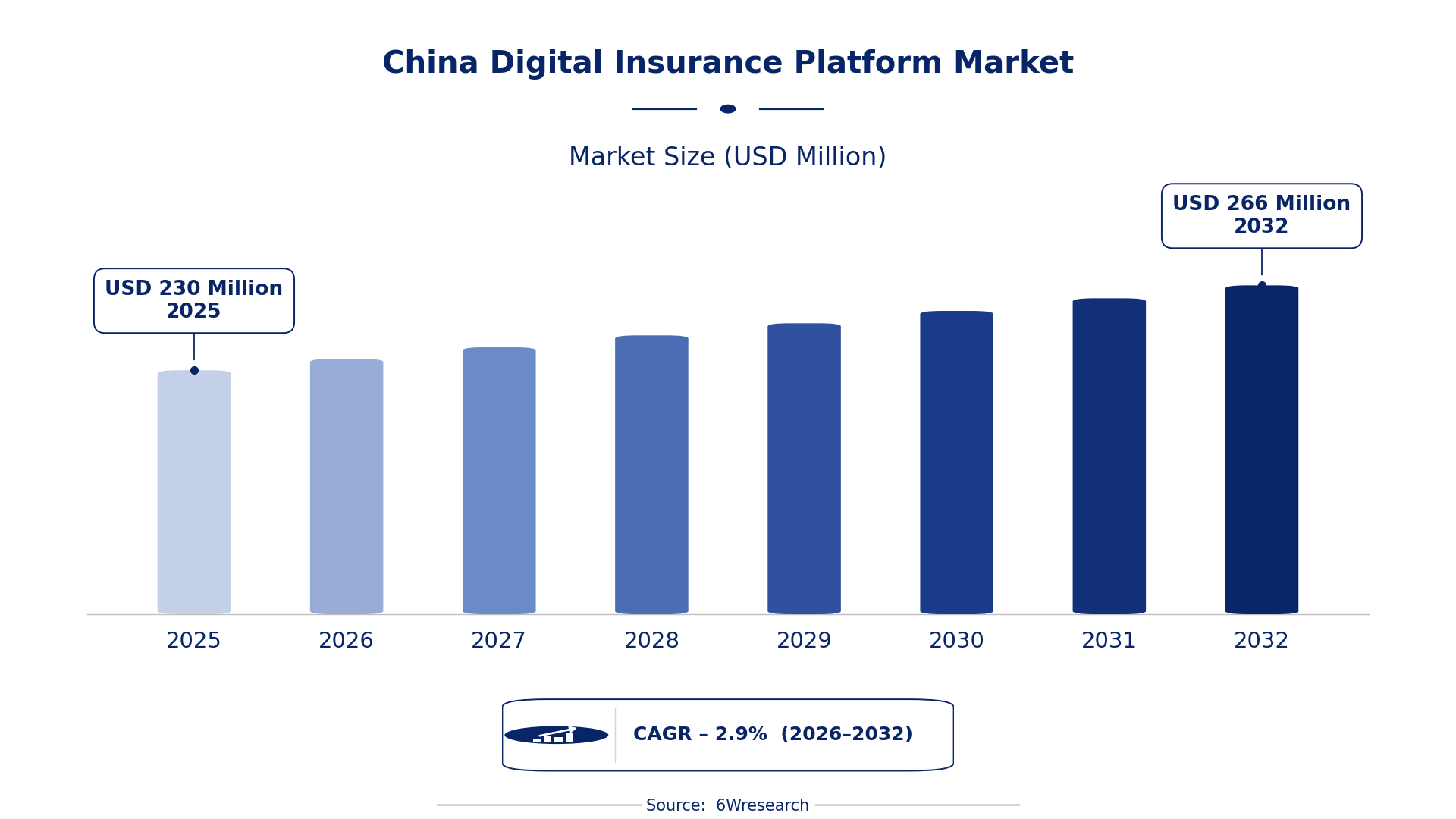
The China Digital Insurance Platform Market was estimated at USD 230 Million in 2025 and is projected to reach USD 266 Million by 2032, growing at a CAGR of 2.9% from 2026 to 2032.
China Digital Insurance Platform Market Synopsis
The China Digital Insurance Platform Market has witnessed a surge in activity as companies adapt to digital-first strategies. This shift has not only modernized operations but also transformed how customers interact with insurers, leading to enhanced engagement and satisfaction.
Looking ahead, the market faces an evolving environment driven by technological advancements and consumer expectations. The focus on personalized insurance products and streamlined services will continue to shape the growth trajectory, as companies strive to remain competitive in a digital economy.
China Digital Insurance Platform Market Year-wise Growth Rate and Key Drivers
This graph illustrates the annual growth rates of the China Digital Insurance Platform Market from 2021 to 2032, highlighting a steady upward trajectory and projected expansion over the forecast period.
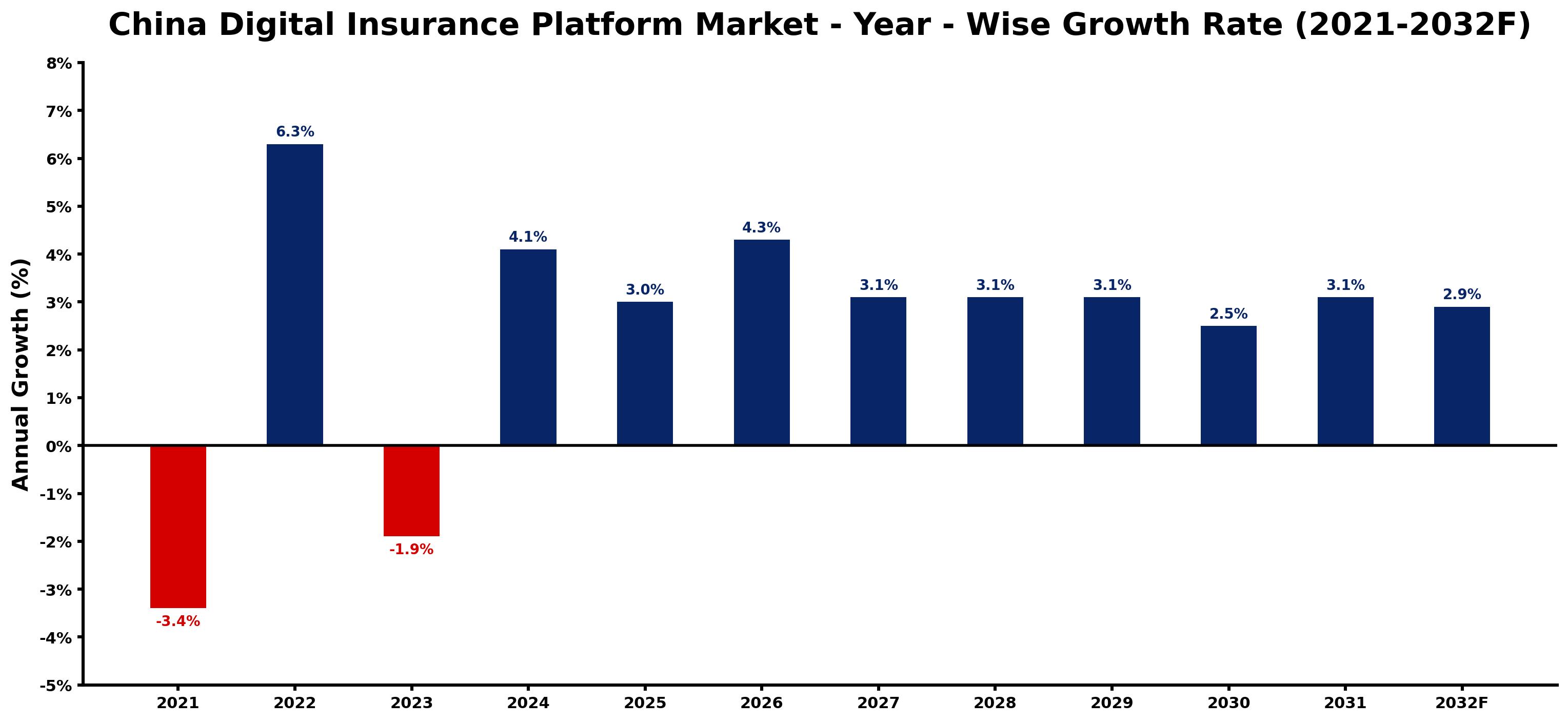
The table below presents the year‑wise growth rates along with the key drivers influencing the market
| Year | Growth Rate | Major Drivers |
| 2021 | -3.4% | Increased compliance costs from CIRC regulations on digital services. |
| 2022 | 6.3% | Accelerated adoption of digital platforms by consumers |
| 2023 | -1.9% | Rising competition from domestic AI-driven insurance platforms. |
| 2024 | 4.1% | Implementation of blockchain for secure insurance transactions |
| 2025 | 3.0% | Rising smartphone penetration enhancing insurance accessibility |
| 2026 | 4.3% | Government incentives promoting fintech integration in insurance |
| 2027 | 3.1% | Increased insurance coverage awareness among urban populations |
| 2028 | 3.1% | Growth in health tech driving digital health insurance solutions |
| 2029 | 3.1% | Lifting of restrictions on cross-border insurance services |
| 2030 | 2.5% | Demand for automated claims processing from consumers |
| 2031 | 3.1% | Emergence of AI-driven risk assessment tools |
| 2032 | 2.9% | Rising collaboration between insurers and tech companies |
Note: Market size estimations and growth projections presented in this report are based on 6Wresearch's proprietary forecasting methodology, utilizing the latest available industry data, government publications, and primary research inputs.
China Digital Insurance Platform Market Key Takeaways
Below are some of the specific key takeaways from the market, including:
- Digital insurance platforms are crucial for improving operational efficiency and customer experience.
- The integration of AI and data analytics is reshaping product offerings and claims processing.
- Regulatory compliance and data privacy remain significant hurdles for market players.
- Innovation in technology is driving the development of more personalized insurance solutions.
- Government policies are increasingly supportive of digital transformation initiatives in the insurance sector.
Evaluation of Restraints in China Digital Insurance Platform Market
Several barriers hinder the growth of the China Digital Insurance Platform Market. Data privacy concerns pose a serious challenge, as consumers become more cautious about sharing personal information. Compliance with evolving regulations complicates matters further, making it essential for companies to invest heavily in legal and IT frameworks. Additionally, traditional insurance agents express resistance to digital platforms, fearing displacement and loss of control over client relationships. Lastly, integrating legacy systems with new digital solutions often leads to technical bottlenecks, delaying implementation and driving up costs.
China Digital Insurance Platform Market Trends
The market is currently experiencing a shift towards automation and artificial intelligence, which are streamlining claims processing and customer interactions. Companies are increasingly adopting cloud-based solutions to enhance flexibility and scalability. on top of that, the demand for personalized insurance products is rising, driven by data analytics that allow insurers to tailor offerings to individual customer needs. Social media and mobile platforms are also becoming critical touchpoints for customer engagement, reflecting a broader trend towards digital-first customer service.
China Digital Insurance Platform Market Opportunities
Opportunities abound in the China Digital Insurance Platform Market, particularly for firms willing to innovate. Investment in technologies such as blockchain can enhance transparency and security in transactions, which is vital for building consumer trust. on top of that, partnerships between insurance companies and fintech firms can lead to the development of comprehensive solutions that cater to underserved demographics. With the government advocating for financial inclusion, there are ample prospects for new products targeting rural and less tech-savvy populations.
Government Initiatives in the China Digital Insurance Platform Market
The regulatory environment in China is actively shaping the Digital Insurance Platform Market, emphasizing the importance of innovation and consumer protection. Government policies are currently focused on enhancing digital financial services, which creates a fertile ground for the growth of digital insurance platforms. As these initiatives unfold, they are expected to drive further adoption and investment within the sector.
- A recently completed initiative focused on implementing stringent data protection regulations to enhance consumer trust in digital transactions.
- Current efforts include a national program aimed at upgrading digital infrastructure, enhancing accessibility for insurance platforms.
- A planned public-private partnership expected to launch by 2027 aims to develop innovative insurance products tailored to the needs of urban and rural populations.
- Initiatives promoting financial literacy among consumers are underway to ensure a better understanding of digital insurance products.
- A proposed framework to facilitate the integration of AI technologies in underwriting processes is expected to be introduced by early 2026.
Future Insights of the China Digital Insurance Platform Market
From 2026 to 2032, the China Digital Insurance Platform Market is set to evolve significantly, with technology at its core. The growing emphasis on customer-centric solutions will drive further investments in artificial intelligence and machine learning, transforming underwriting and claims processes. As companies embrace digital transformation, we can expect a broader range of personalized offerings to emerge, catering to niche markets and specific consumer needs. The integration of innovative technologies will also enhance operational efficiencies, making it easier for insurers to compete in a crowded marketplace.
China Digital Insurance Platform Market Latest Developments
In the past year, the China Digital Insurance Platform Market has seen significant advancements as companies strive to optimize their digital offerings. Several initiatives have been launched to incorporate cutting-edge technologies, aimed at improving customer engagement and operational efficiency.
- A major technology vendor launched an AI-driven claims processing solution in Q1 2025, significantly reducing response times for customers.
- A leading regional operator is currently underway with a pilot program that integrates blockchain technology for improved transparency in policy management.
- By mid-2026, a new platform focused on personalized insurance recommendations based on user data is expected to be rolled out, enhancing customer satisfaction.
- An ongoing collaboration between several insurers aims to develop a standardized digital platform for claims submissions, anticipated to streamline the claims process across the industry.
- A financial technology company is planning to introduce a mobile application designed to simplify policy management and customer interactions by late 2025.
China Digital Insurance Platform Market - Key Attractiveness of the Report
- 10 Years of Market Numbers
- Historical Data Starting from 2022 to 2025
- Base Year: 2025
- Forecast Data until 2032
- Key Performance Indicators Impacting the Market
- Major Upcoming Developments and Projects
Key Highlights of the Report:
- China Digital Insurance Platform Market Outlook
- Market Size of China Digital Insurance Platform Market, 2025
- Forecast of China Digital Insurance Platform Market, 2032
- Historical Data and Forecast of China Digital Insurance Platform Revenues & Volume for the Period 2022-2032F
- China Digital Insurance Platform Market Trend Evolution
- China Digital Insurance Platform Market Drivers and Challenges
- China Digital Insurance Platform Price Trends
- China Digital Insurance Platform Porter's Five Forces
- China Digital Insurance Platform Industry Life Cycle
- Historical Data and Forecast of China Digital Insurance Platform Market Revenues & Volume By Component for the Period 2022-2032F
- Historical Data and Forecast of China Digital Insurance Platform Market Revenues & Volume By Tools for the Period 2022-2032F
- Historical Data and Forecast of China Digital Insurance Platform Market Revenues & Volume By Services for the Period 2022-2032F
- Historical Data and Forecast of China Digital Insurance Platform Market Revenues & Volume By Service for the Period 2022-2032F
- Historical Data and Forecast of China Digital Insurance Platform Market Revenues & Volume By Managed services for the Period 2022-2032F
- Historical Data and Forecast of China Digital Insurance Platform Market Revenues & Volume By Professional services for the Period 2022-2032F
- Historical Data and Forecast of China Digital Insurance Platform Market Revenues & Volume By End-user for the Period 2022-2032F
- Historical Data and Forecast of China Digital Insurance Platform Market Revenues & Volume By Insurance companies for the Period 2022-2032F
- Historical Data and Forecast of China Digital Insurance Platform Market Revenues & Volume By Third-party administrators and brokers for the Period 2022-2032F
- Historical Data and Forecast of China Digital Insurance Platform Market Revenues & Volume By Aggregators for the Period 2022-2032F
- Historical Data and Forecast of China Digital Insurance Platform Market Revenues & Volume By Insurance Application for the Period 2022-2032F
- Historical Data and Forecast of China Digital Insurance Platform Market Revenues & Volume By Automotive and transportation for the Period 2022-2032F
- Historical Data and Forecast of China Digital Insurance Platform Market Revenues & Volume By Home and commercial buildings for the Period 2022-2032F
- Historical Data and Forecast of China Digital Insurance Platform Market Revenues & Volume By Life and health for the Period 2022-2032F
- Historical Data and Forecast of China Digital Insurance Platform Market Revenues & Volume By Business and enterprise for the Period 2022-2032F
- Historical Data and Forecast of China Digital Insurance Platform Market Revenues & Volume By Consumer electronics and industrial machines for the Period 2022-2032F
- Historical Data and Forecast of China Digital Insurance Platform Market Revenues & Volume By Travel for the Period 2022-2032F
- Historical Data and Forecast of China Digital Insurance Platform Market Revenues & Volume By Organization Size for the Period 2022-2032F
- Historical Data and Forecast of China Digital Insurance Platform Market Revenues & Volume By Small and Medium-sized Enterprises (SMEs) for the Period 2022-2032F
- Historical Data and Forecast of China Digital Insurance Platform Market Revenues & Volume By Large enterprises for the Period 2022-2032F
- China Digital Insurance Platform Import Export Trade Statistics
- Market Opportunity Assessment By Component
- Market Opportunity Assessment By Service
- Market Opportunity Assessment By End-user
- Market Opportunity Assessment By Insurance Application
- Market Opportunity Assessment By Organization Size
- China Digital Insurance Platform Top Companies Market Share
- China Digital Insurance Platform Competitive Benchmarking By Technical and Operational Parameters
- China Digital Insurance Platform Company Profiles
- China Digital Insurance Platform Key Strategic Recommendations






































