China Digital Lending Market Size & Growth Rate (2026-2032)
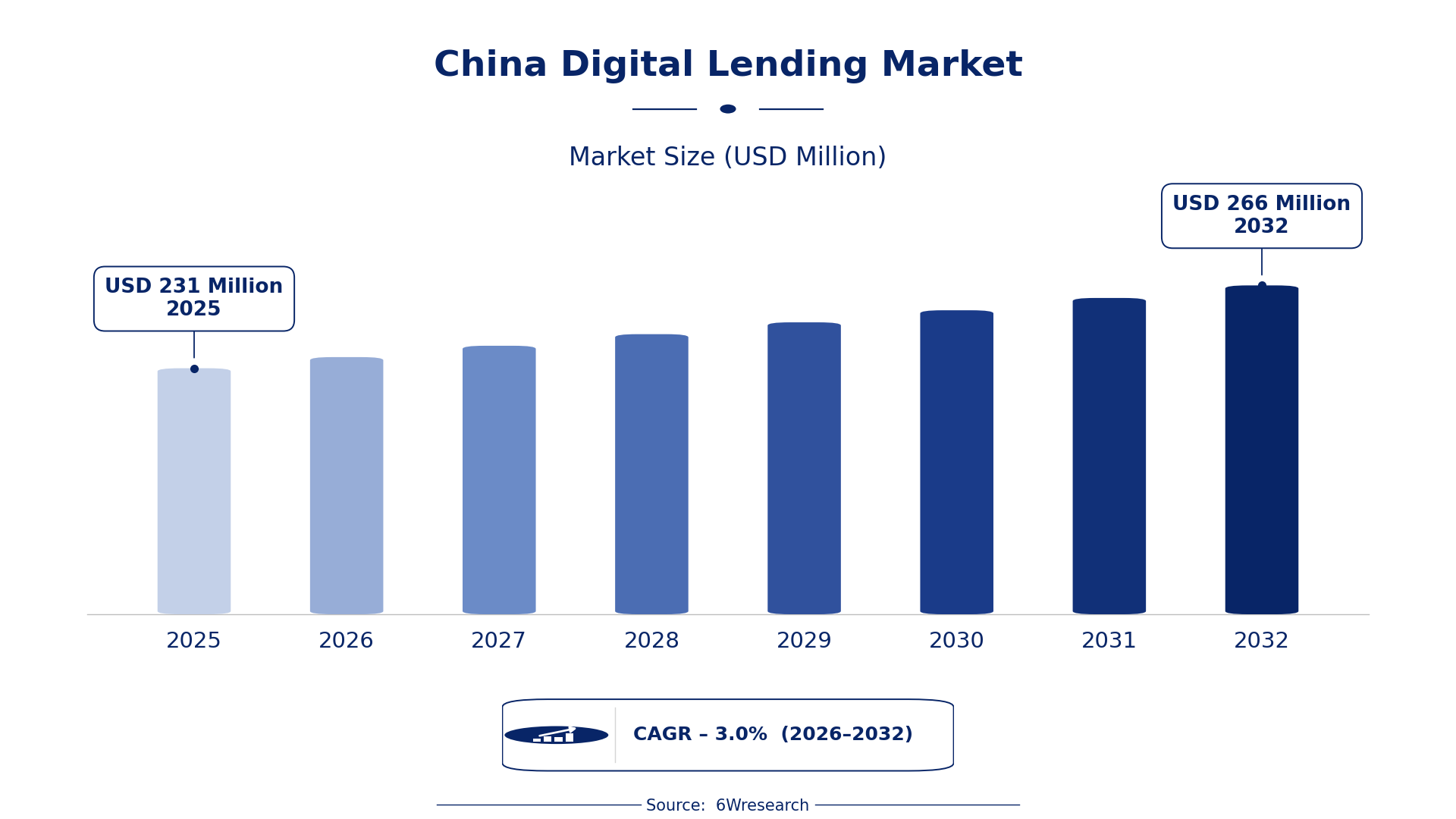
The China Digital Lending Market was estimated at USD 231 Million in 2025 and is projected to reach USD 266 Million by 2032, growing at a CAGR of 3.0% from 2026 to 2032.
China Digital Lending Market Synopsis
The primary force driving the China Digital Lending Market is the increasing demand for convenient and accessible financial services. With a tech-savvy population and high smartphone penetration, consumers are turning to digital platforms for quick loans and financial solutions.
Digital lending platforms are leveraging advanced technologies like big data and artificial intelligence for enhanced risk assessment and credit scoring. This trend is further fueled by the popularity of mobile payment systems such as Alipay and WeChat Pay, which facilitate swift transactions and broaden access to credit.
China Digital Lending Market Year-wise Growth Rate and Key Drivers
This graph illustrates the annual growth rates of the China Digital Lending Market from 2021 to 2032, highlighting a steady upward trajectory and projected expansion over the forecast period.
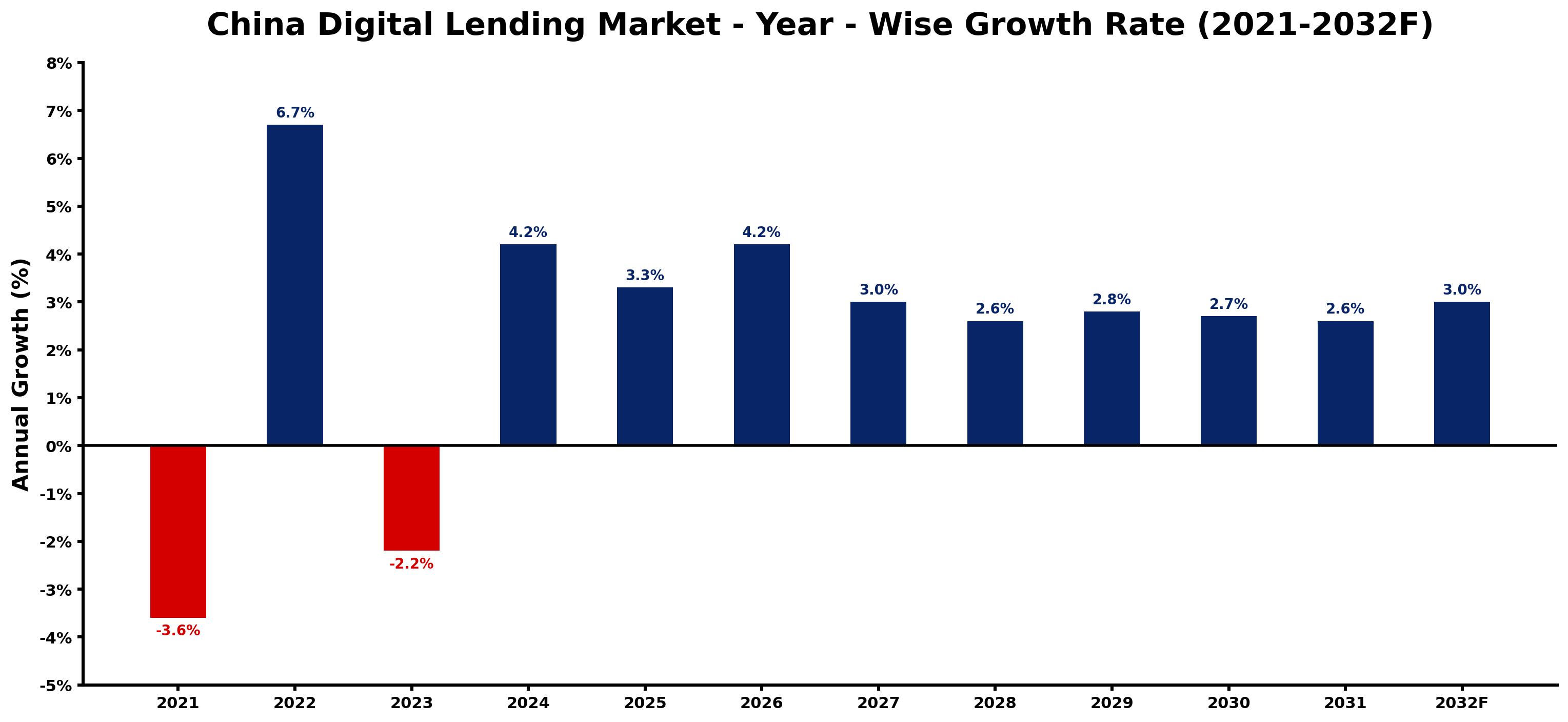
The table below presents the year‑wise growth rates along with the key drivers influencing the market
| Year | Growth Rate | Major Drivers |
| 2021 | -3.6% | PBOC tightening regulations on online lending platforms |
| 2022 | 6.7% | Growing smartphone penetration enhances digital lending access |
| 2023 | -2.2% | Increased defaults due to economic uncertainty post-COVID |
| 2024 | 4.2% | Regulatory support from PBOC for fintech innovations |
| 2025 | 3.3% | Increased consumer acceptance of online financial services |
| 2026 | 4.2% | Young demographic favors digital payment and lending solutions |
| 2027 | 3.0% | Urbanization drives demand for quick access to credit |
| 2028 | 2.6% | Evolving credit scoring models improve loan eligibility assessments |
| 2029 | 2.8% | Emerging partnerships between banks and fintech companies |
| 2030 | 2.7% | Enhanced cybersecurity measures attract more digital borrowers |
| 2031 | 2.6% | Investment in AI technologies streamlines lending processes |
| 2032 | 3.0% | Policy reforms boost trust in digital financial platforms |
Note: Market size estimations and growth projections presented in this report are based on 6Wresearch's proprietary forecasting methodology, utilizing the latest available industry data, government publications, and primary research inputs.
China Digital Lending Market Key Takeaways
Below are some of the specific key takeaways from the market, including:
- The market is experiencing a steady growth trajectory, fueled by increasing internet access and smartphone usage.
- Peer-to-peer lending platforms are gaining traction, offering unique opportunities for both lenders and borrowers.
- Regulatory scrutiny is intensifying, which could reshape operational frameworks and compliance standards.
- Adoption of AI and big data technologies is becoming a standard practice for improved risk assessment.
- Investment opportunities are emerging in underserved segments, particularly among small and medium-sized enterprises.
Evaluation of Restraints in China Digital Lending Market
Despite the promising growth of the China Digital Lending Market, several restraints are evident. Regulatory uncertainty poses a significant challenge, as evolving regulations can disrupt existing business models. Competition is fierce, with numerous platforms vying for market share, which can lead to unsustainable lending practices. on top of that, concerns surrounding data privacy and security are paramount, as the digital nature of these transactions increases exposure to potential breaches. The risk of non-performing loans is also a pressing issue, often stemming from inadequate risk assessment mechanisms. Addressing these challenges will be crucial for sustainable growth.
China Digital Lending Market Trends
Current trends indicate a strong shift towards the integration of technology in lending processes. The rise of peer-to-peer lending platforms is notable, catering to a demographic that values speed and convenience. on top of that, the use of AI and big data for credit scoring is becoming increasingly prevalent, enabling lenders to make more informed decisions. Regulatory developments aimed at enhancing transparency and risk management are also shaping the market, ensuring that consumer protection remains a priority.
China Digital Lending Market Opportunities
Investment opportunities in the China Digital Lending Market are abundant, particularly in technology-driven solutions. The demand for innovative peer-to-peer lending platforms is on the rise, offering avenues for investors to tap into diverse customer segments. Additionally, advancements in digital credit scoring technologies present significant growth potential. With government support for financial technology innovation, the landscape for digital lending is ripe for investment, especially in regions with underserved populations.
Government Initiatives in the China Digital Lending Market
The Chinese government is actively shaping the digital lending market through stringent regulations and initiatives aimed at fostering a stable financial environment. Recent regulatory frameworks have introduced licensing requirements for online lending platforms and established lending limits to curb excessive borrowing. These measures are crucial for protecting consumers and promoting transparency within the sector. As the government continues to monitor market developments, further regulations may emerge to enhance stability and sustainability.
- A regulatory framework introduced in 2020 mandates that online lending platforms obtain licenses and adhere to strict lending limits.
- Ongoing efforts to combat illegal online lending practices include monitoring activities and enforcing penalties for violations.
- A planned initiative expected to enhance consumer education about digital lending services is set to launch in 2026.
- Current regulations focus on improving transparency and risk management within digital lending practices.
Future Insights of the China Digital Lending Market
Looking ahead to 2026-2032, the China Digital Lending Market is likely to witness substantial growth driven by continued technological advancements and a growing consumer base. The increasing preference for online financial services among consumers will further bolster the market. As regulatory frameworks evolve, they will promote responsible lending practices, contributing to a healthier industry. on top of that, the integration of AI and big data analytics is expected to refine lending processes, enhancing operational efficiency and accuracy.
China Digital Lending Market Latest Developments
In the last 12-14 months, the China Digital Lending Market has seen significant activity, with numerous platforms innovating to meet changing consumer needs. The push towards enhanced technological integration has led to several noteworthy developments in the sector.
- A major technology vendor launched a new AI-driven credit scoring system in late 2025, aimed at improving the accuracy of risk assessments.
- An initiative that began in early 2025 to expand digital payment solutions within lending services is currently underway, enhancing consumer access to credit.
- A recent collaboration between multiple fintech platforms was formed to develop a shared data infrastructure to combat fraudulent activities, initiated in Q3 2025.
- Upcoming regulations set to be introduced by the end of 2026 aim to improve transparency in lending practices.
China Digital Lending Market - Key Attractiveness of the Report
- 10 Years of Market Numbers
- Historical Data Starting from 2022 to 2025
- Base Year: 2025
- Forecast Data until 2032
- Key Performance Indicators Impacting the Market
- Major Upcoming Developments and Projects
Key Highlights of the Report:
- China Digital Lending Market Outlook
- Market Size of China Digital Lending Market, 2025
- Forecast of China Digital Lending Market, 2032
- Historical Data and Forecast of China Digital Lending Revenues & Volume for the Period 2022-2032F
- China Digital Lending Market Trend Evolution
- China Digital Lending Market Drivers and Challenges
- China Digital Lending Price Trends
- China Digital Lending Porter's Five Forces
- China Digital Lending Industry Life Cycle
- Historical Data and Forecast of China Digital Lending Market Revenues & Volume By Offering for the Period 2022-2032F
- Historical Data and Forecast of China Digital Lending Market Revenues & Volume By Solutions for the Period 2022-2032F
- Historical Data and Forecast of China Digital Lending Market Revenues & Volume By Services for the Period 2022-2032F
- Historical Data and Forecast of China Digital Lending Market Revenues & Volume By Deployment Mode for the Period 2022-2032F
- Historical Data and Forecast of China Digital Lending Market Revenues & Volume By Cloud for the Period 2022-2032F
- Historical Data and Forecast of China Digital Lending Market Revenues & Volume By On-premises for the Period 2022-2032F
- Historical Data and Forecast of China Digital Lending Market Revenues & Volume By End User for the Period 2022-2032F
- Historical Data and Forecast of China Digital Lending Market Revenues & Volume By Banks for the Period 2022-2032F
- Historical Data and Forecast of China Digital Lending Market Revenues & Volume By Credit Unions for the Period 2022-2032F
- Historical Data and Forecast of China Digital Lending Market Revenues & Volume By NBFCs for the Period 2022-2032F
- China Digital Lending Import Export Trade Statistics
- Market Opportunity Assessment By Offering
- Market Opportunity Assessment By Deployment Mode
- Market Opportunity Assessment By End User
- China Digital Lending Top Companies Market Share
- China Digital Lending Competitive Benchmarking By Technical and Operational Parameters
- China Digital Lending Company Profiles
- China Digital Lending Key Strategic Recommendations






































