China Digital Signature Market Size & Growth Rate (2026-2032)
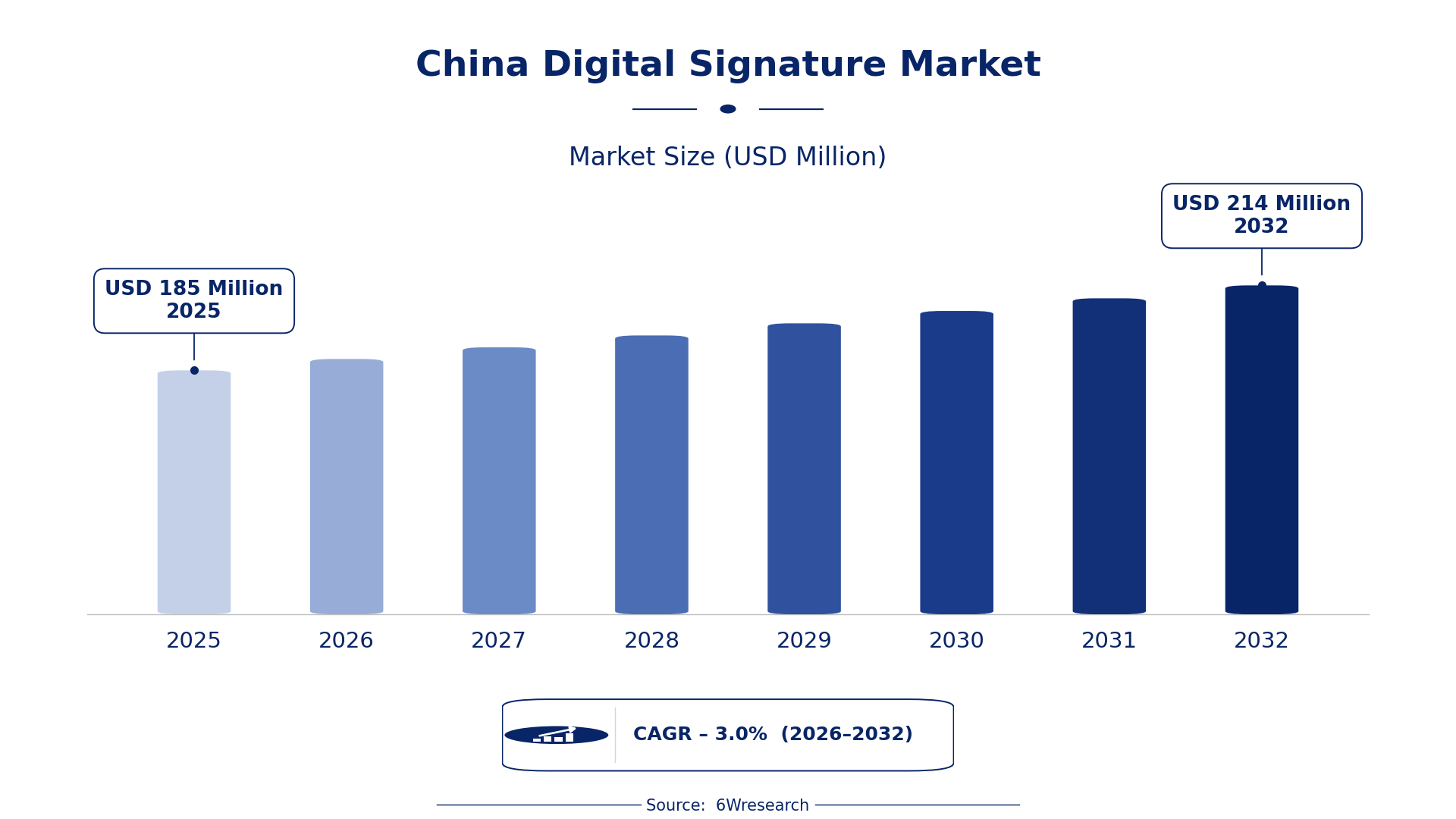
The China Digital Signature Market was estimated at USD 185 Million in 2025 and is projected to reach USD 214 Million by 2032, growing at a CAGR of 3.0% from 2026 to 2032.
China Digital Signature Market Synopsis
The adoption of digital signatures in China is accelerating, driven by the urgency for secure transactions and efficient document management. Organizations and individuals increasingly recognize that digital signatures not only bolster security but also simplify workflows, allowing for quicker processing times.
As e-commerce and digital transactions surge, the demand for legally binding electronic signatures grows. This market's evolution is heavily influenced by technological advancements, such as improved usability features and enhanced integration capabilities, which are critical for businesses looking to modernize their operations.
China Digital Signature Market Year-wise Growth Rate and Key Drivers
This graph illustrates the annual growth rates of the China Digital Signature Market from 2021 to 2032, highlighting a steady upward trajectory and projected expansion over the forecast period.
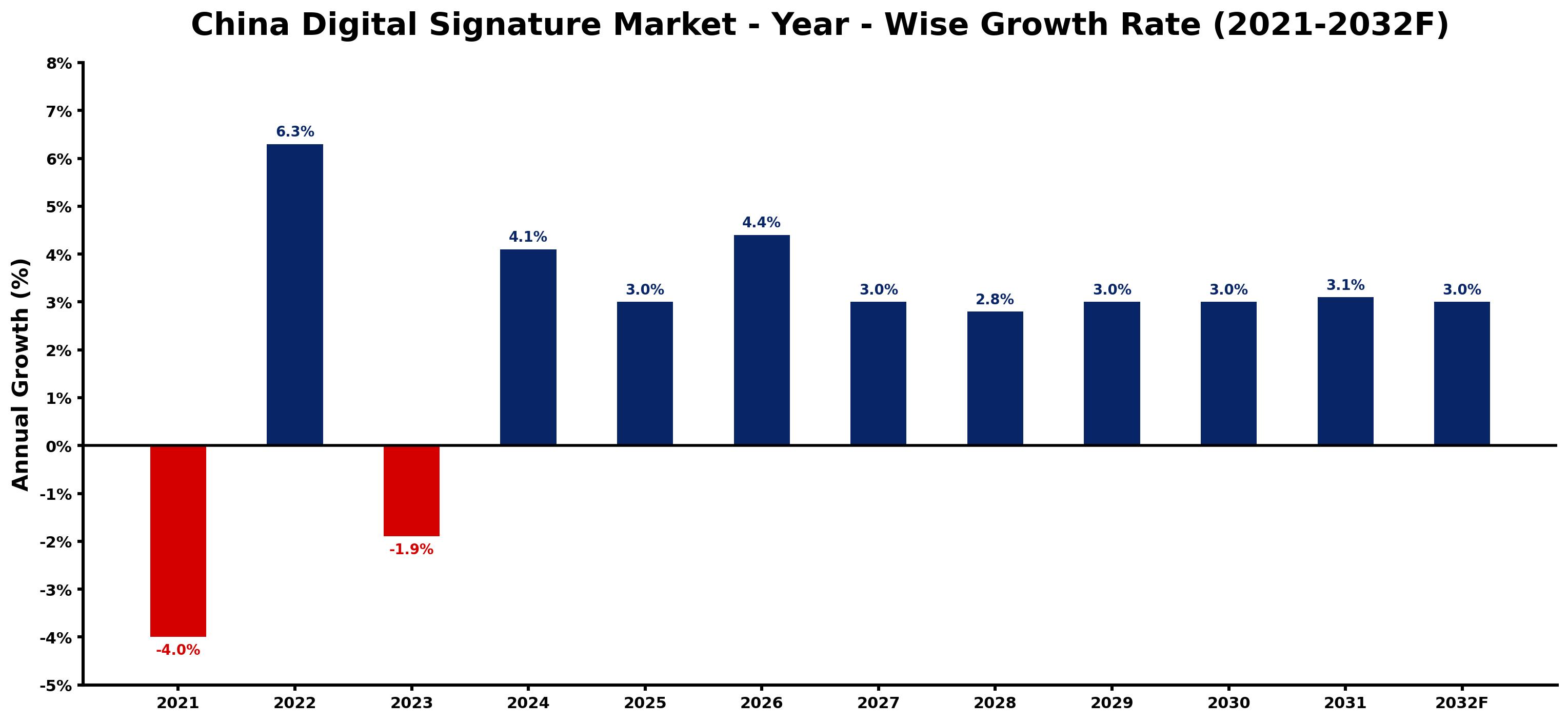
The table below presents the year‑wise growth rates along with the key drivers influencing the market
| Year | Growth Rate | Major Drivers |
| 2021 | -4.0% | National Cyberspace Administration delays digital signature regulations. |
| 2022 | 6.3% | Implementation of China's new electronic signature law. |
| 2023 | -1.9% | Diminished trust in digital signatures after data breaches. |
| 2024 | 4.1% | Increased cybersecurity regulations mandating secure digital transactions. |
| 2025 | 3.0% | Rise of remote work fueling digital document authentication. |
| 2026 | 4.4% | Government support for fintech innovations driving signature adoption. |
| 2027 | 3.0% | Surge in online education requiring verified enrollment processes. |
| 2028 | 2.8% | Growing investments in blockchain technology enhancing signature security. |
| 2029 | 3.0% | Local enterprises digitizing workflows for efficiency gains. |
| 2030 | 3.0% | Increased consumer awareness of digital fraud prevention measures. |
| 2031 | 3.1% | Regulatory push for digital identity verification in commerce. |
| 2032 | 3.0% | Adoption of smart contracts in emerging blockchain applications. |
Note: Market size estimations and growth projections presented in this report are based on 6Wresearch's proprietary forecasting methodology, utilizing the latest available industry data, government publications, and primary research inputs.
China Digital Signature Market Key Takeaways
Below are some of the specific key takeaways from the market, including:
- The increasing number of digital transactions is driving the demand for reliable digital signatures.
- Cybersecurity concerns and data protection are key factors influencing market growth.
- Government initiatives promoting digital infrastructure significantly impact market expansion.
- Innovation in digital signature technologies enhances usability and attracts a broader user base.
- User adoption remains a challenge, requiring strategies for overcoming skepticism towards digital solutions.
Evaluation of Restraints in China Digital Signature Market
Despite the upward trajectory, the China Digital Signature Market faces notable barriers. Many potential users remain hesitant to abandon traditional signing methods, primarily due to unfamiliarity with digital alternatives. Furthermore, the cost of implementing these solutions can be daunting for smaller enterprises. Regulatory compliance also poses challenges, as organizations must navigate a complex legal landscape to ensure their digital signature practices meet governmental standards. Without addressing these factors, the market's growth could stall.
China Digital Signature Market Trends
A few trends are currently shaping the China Digital Signature Market. First, the integration of artificial intelligence and machine learning into digital signature solutions is enhancing authentication processes. Second, an increase in mobile transactions is prompting providers to optimize digital signature technologies for mobile platforms. Finally, there is a growing emphasis on interoperability among different digital systems, as organizations seek solutions that work seamlessly across various platforms and applications.
China Digital Signature Market Opportunities
Investment opportunities within the China Digital Signature Market are expanding. Businesses looking to enhance security protocols can tap into the growing need for digital signature solutions across sectors such as finance and healthcare. Additionally, partnerships between technology vendors and regulatory bodies could pave the way for innovative offerings that align with compliance requirements. Emerging markets, particularly in rural areas, present untapped potential for digital signature adoption.
Government Initiatives in the China Digital Signature Market
Government policies are crucial in shaping the China Digital Signature Market. The focus on enhancing cybersecurity and facilitating digital transformation has led to various initiatives that support the growth of digital signatures. These policies are not only designed to protect data but also to promote efficiency in public and private sectors.
- A national cybersecurity strategy launched recently encourages the adoption of advanced encryption methods, crucial for digital signatures.
- Currently, a digital infrastructure upgrade program is underway, aiming to enhance the security framework for digital transactions.
- A regulatory framework established in early 2026 mandates greater transparency in digital transaction processes.
- A planned public-private initiative is expected to enhance digital signature accessibility in rural communities by 2028.
- Policies promoting the integration of digital signatures in governmental services are currently being rolled out to improve efficiency.
Future Insights of the China Digital Signature Market
Looking ahead to 2026-2032, the China Digital Signature Market is set for steady expansion. As digital transactions become the norm, the significance of secure, efficient signing solutions will only increase. The market will likely benefit from continuous technological advancements and a more favorable regulatory environment. Organizations that proactively adapt to these changes will be best positioned to thrive in this evolving space.
China Digital Signature Market Latest Developments
In the past year, significant developments have taken place within the China Digital Signature Market. Companies are increasingly focusing on enhancing user experiences and integrating new technologies to address market demands. Collaborative efforts between public and private sectors are gaining momentum as they work towards creating a more secure digital environment.
- A technology vendor announced the launch of an innovative digital signature platform in early 2025, aimed at streamlining document management.
- Currently, an initiative that began in mid-2025 focuses on training programs to increase user awareness and adoption of digital signatures.
- A partnership between a major fintech company and a cybersecurity firm was established in late 2025 to enhance digital signature security features.
- A planned rollout of a user-friendly digital signature app is expected to begin in Q3 2026, targeting SMEs.
- Recently, a large-scale public awareness campaign was initiated to educate citizens about the benefits of digital signatures, which remains active into 2026.
China Digital Signature Market - Key Attractiveness of the Report
- 10 Years of Market Numbers
- Historical Data Starting from 2022 to 2025
- Base Year: 2025
- Forecast Data until 2032
- Key Performance Indicators Impacting the Market
- Major Upcoming Developments and Projects
Key Highlights of the Report:
- China Digital Signature Market Outlook
- Market Size of China Digital Signature Market, 2025
- Forecast of China Digital Signature Market, 2032
- Historical Data and Forecast of China Digital Signature Revenues & Volume for the Period 2022-2032F
- China Digital Signature Market Trend Evolution
- China Digital Signature Market Drivers and Challenges
- China Digital Signature Price Trends
- China Digital Signature Porter's Five Forces
- China Digital Signature Industry Life Cycle
- Historical Data and Forecast of China Digital Signature Market Revenues & Volume By Component for the Period 2022-2032F
- Historical Data and Forecast of China Digital Signature Market Revenues & Volume By Solutions for the Period 2022-2032F
- Historical Data and Forecast of China Digital Signature Market Revenues & Volume By Services for the Period 2022-2032F
- Historical Data and Forecast of China Digital Signature Market Revenues & Volume By Solution for the Period 2022-2032F
- Historical Data and Forecast of China Digital Signature Market Revenues & Volume By Software for the Period 2022-2032F
- Historical Data and Forecast of China Digital Signature Market Revenues & Volume By Hardware for the Period 2022-2032F
- Historical Data and Forecast of China Digital Signature Market Revenues & Volume By Vertical for the Period 2022-2032F
- Historical Data and Forecast of China Digital Signature Market Revenues & Volume By BFSI for the Period 2022-2032F
- Historical Data and Forecast of China Digital Signature Market Revenues & Volume By Government for the Period 2022-2032F
- Historical Data and Forecast of China Digital Signature Market Revenues & Volume By Defense for the Period 2022-2032F
- Historical Data and Forecast of China Digital Signature Market Revenues & Volume By Legal for the Period 2022-2032F
- Historical Data and Forecast of China Digital Signature Market Revenues & Volume By Real Estate for the Period 2022-2032F
- Historical Data and Forecast of China Digital Signature Market Revenues & Volume By Organization Size for the Period 2022-2032F
- Historical Data and Forecast of China Digital Signature Market Revenues & Volume By Large Enterprises for the Period 2022-2032F
- Historical Data and Forecast of China Digital Signature Market Revenues & Volume By Small and Medium-Sized Enterprises (SMEs) for the Period 2022-2032F
- Historical Data and Forecast of China Digital Signature Market Revenues & Volume By Deployment Mode for the Period 2022-2032F
- Historical Data and Forecast of China Digital Signature Market Revenues & Volume By Cloud for the Period 2022-2032F
- Historical Data and Forecast of China Digital Signature Market Revenues & Volume By On-Premises for the Period 2022-2032F
- China Digital Signature Import Export Trade Statistics
- Market Opportunity Assessment By Component
- Market Opportunity Assessment By Solution
- Market Opportunity Assessment By Vertical
- Market Opportunity Assessment By Organization Size
- Market Opportunity Assessment By Deployment Mode
- China Digital Signature Top Companies Market Share
- China Digital Signature Competitive Benchmarking By Technical and Operational Parameters
- China Digital Signature Company Profiles
- China Digital Signature Key Strategic Recommendations






































